This week the Network resumes its monthly meeting schedule in Columbia, Charleston and Greenville after taking a summer break in July and August. The Charleston group merged their meeting with CAFE, which was meeting at the same time at the ILA Hall on Monday. (The Network meets there every second Monday of the month.)
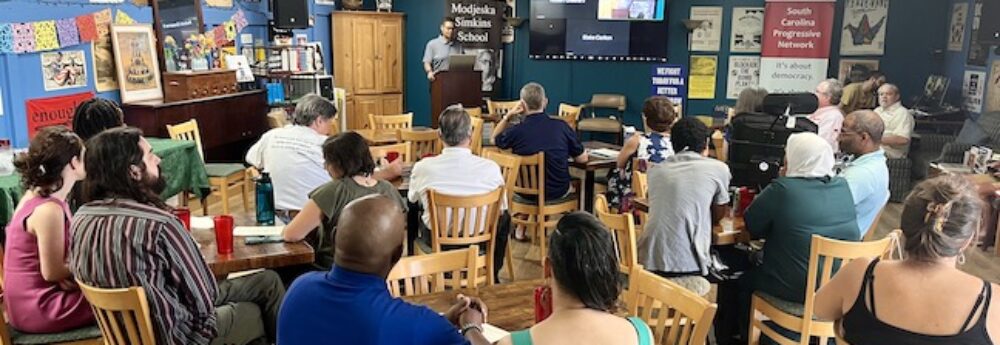
Last night, the Columbia group met in a new location, the historic Modjeska Simkins house on Marion Street. I think she would have been pleased to see us gathered under her roof – black, brown and white, gay and straight, believers and humanists – talking about movement building. Being in that space was a privilege, and we thank the Columbia Historic Foundation for allowing us to meet there.
We had a good turnout, with several new folks. Our guest speaker was Martin Chernoff, who talked about the genocide in Darfur and a rally he’s helping organize that will be held Oct. 6 at 2pm at the State House. He sees South Carolina, an early primary state, being the perfect place to stage a big rally and invite the presidential candidates to participate. The event will include local and nationally known entertainers.
The Darfur Action Group has launched a savvy campaign and promises to stay engaged after the rally is over. For details, click here.
Frank Knapp and Dr. Sam Baker, who led the discussion after the Network’s screening of Michael Moore’s documentary Sicko earlier this month, talked about health care reform initiatives in South Carolina and where the presidential candidates are on the issue. Framing the debate is a priority, as the language is new enough to confuse voters. That’s just how the candidates – who have raked in megabucks from the insurance and pharmaceutical companies that stand to lose huge if this country goes for “socialized medicine” – want it. They want to appear to have a plan to fix the health care problem when, in fact, all but the good congressman from Ohio are reaching for Band-Aids when a tourniquet is in order.
If you want to join the new group South Carolinians for Universal Health Care, e-mail us at network@scpronet.com.
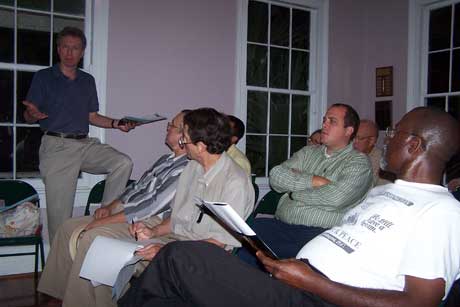
Frank Knapp talks about health care reform efforts in South Carolina.
We talked about the Pride March, which will be held in Columbia Sept. 22. For a full schedule of Pride activities, which kick off Sept. 15, see SC GLPM’s Web site. If your organization wants to distribute literature, feel free to drop it off at the Network’s table.
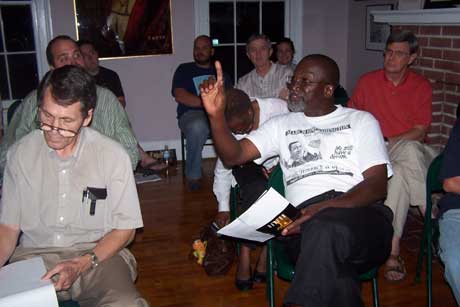
Network Co-Chair Rev. Bennie Colclough talks about the upcoming Pride March Sept. 22, where he’ll be a featured speaker.
Finally, we heard from Rehan Khan, who asked to speak on behalf of USC’s Student Muslim Association about a fundraiser (being held tonight on campus) for an injured Iraqi girl. Salee, who is 10, lost both of her legs during a U.S. led missile strike while playing near her house. She was recently brought to South Carolina to receive medical attention and prosthetic limbs by the No More Victims foundation.
Rehan also invited the Network to join them for a Fast-A-Thon on Oct. 4 and to break bread at a community meal on campus that evening. The South Carolina Fast-a-Thon was organized to raise money and awareness for impoverished people around the world. By pledging to fast on the 4th from sunrise to sunset, the group hopes to raise money and awareness for Iraqi war victims who need food and medical attention. All of the raised proceeds will go towards providing relief to victims of collateral damage. Find out more and make your pledge by clicking here.
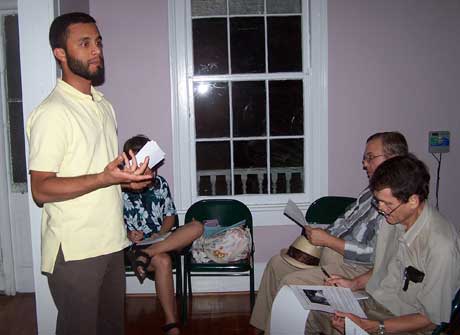
Medical student Rehan Khan invites the Network to join USC’s Muslim Students Association in a Fast-a-Thon Oct. 4 to raise money and awareness about poverty.
Our next Columbia meeting will be held on Oct. 9 (the second Tuesday of every month) at 7pm at the Simkins House, 2025 Marion St. We’ll hear from Conchita Cruz, newly hired to head up the Coalition for New South Carolinians. We hope you’ll join us. Free drinks and snacks. Good people. Big ideas. What more could you want?
If you’re in the Upstate, join us tomorrow night in Greenville at 7pm at Open Book, 110 S. Pleasantburg Dr. Meetings are informal and open to anyone interested in knowing more about the Network and getting involved to make change in South Carolina.