Piñata Politics Just Tempest in a Tea Party Pot

By Becci Robbins

Talk about falling down the rabbit hole. At this time last week I was making a gift for my friend Donna Dewitt to celebrate her retirement from the SC AFL-CIO. And what says party like a piñata?

Yes, the piñata was my idea. I made it. I filled it with candy and Bobby Bucks. I videotaped its predictable demise. I sent the clip to friends to amuse them in these most un-amusing times. Who knew it would go viral?

The breathless response has been over the top, a sad commentary on the echo chamber that is the Internet.

Was the piñata in poor taste? Yes. Was it malicious? No. Am I sorry it caused some people to lose their minds? That’s their problem.

My only regret is having put a dear friend in the position of having to defend a piñata she did not know about or ask for. Donna works harder at a thankless job than anyone I know. She doesn’t deserve the heat she’s taken, including death threats and a promise from Gov. Nikki Haley on national TV to “continue beating up on unions.”

To fixate on unions instead of dealing with the critical problems we’re facing is to use the tired politics of distraction. I should have expected it from the governor, whose favorite posture is that of victim – first of racism, then sexism, now union thugs.

While Haley has made an odd habit of union-bashing, for me she crossed the line when she used her last State of the State address to proclaim: “Unions are not needed, wanted or welcome in South Carolina.” Instead of a message to unite all of us who call the Palmetto State home, she served up a campaign speech of red meat. It was inappropriate. And insulting.

When the governor bashes unions, she’s bashing my colleagues. She’s bashing my friends. She’s bashing my family. She’s bashing me. So forgive me for taking it personally, but I’ve had enough.

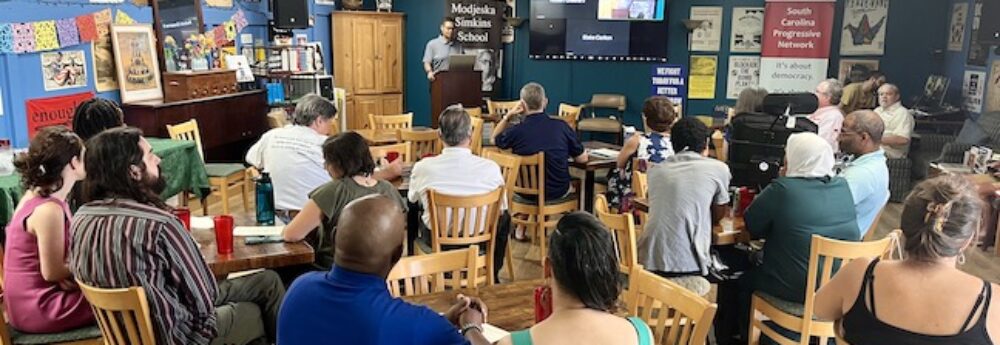
The piñata was intended as comic relief among friends after a long day of talking about the state budget, our election system and workers’ rights at the SC Progressive Network‘s annual spring conference. The party was a chance to unwind and honor Donna, our longtime co-chair. For the governor to use the incident for political gain is predictable but unfair, and more than a little ironic.

After all, Donna didn’t do anything as shameful as cut funding for education and mental health services. She didn’t gut environmental regulations or stack boards with corporate cronies. She didn’t show contempt to the Supreme Court. She didn’t campaign on a promise of transparency and then routinely sanitize her paper trail. She didn’t lobby for a corporation while being on their payroll. She didn’t use her power like a bludgeon.

Donna smacked a piñata. Which is, good people, what happens to piñatas. I made one of a Corporate Fat Cat for John Spratt’s retirement party, and it, too, got smashed. Why didn’t it go viral? Because nobody could make political hay out of it.

And that’s exactly what the governor is doing. Yesterday I got an email solicitation from her office inviting me to watch the video and contribute $250 to fight “Big Labor.” The email mentions President Obama twice. Talk about tasteless.

The governor will get no apology from me. But I offer one to Donna for putting her in an awful position. She could have risked hurting my feelings by refusing to play along at the party. Or she could have thrown me under the bus when she started catching heat. She did neither. As a labor leader, she knows something the governor doesn’t: solidarity matters most when it’s inconvenient.

Sorry if this flap has embarrassed any of our members. Please know that Donna and Network Director Brett Bursey have made the best of the rare media attention. (Watch Brett on Fox and Donna on CNN, for starters.)

It may not be pretty, but at least people are talking about organized labor in South Carolina. It’s a conversation that’s long overdue, and it’s up to us to keep it honest.

Becci Robbins is SC Progressive Network Communications Director. Reach her at becci@scpronet.com.
Calling all SC political junkies and social activists

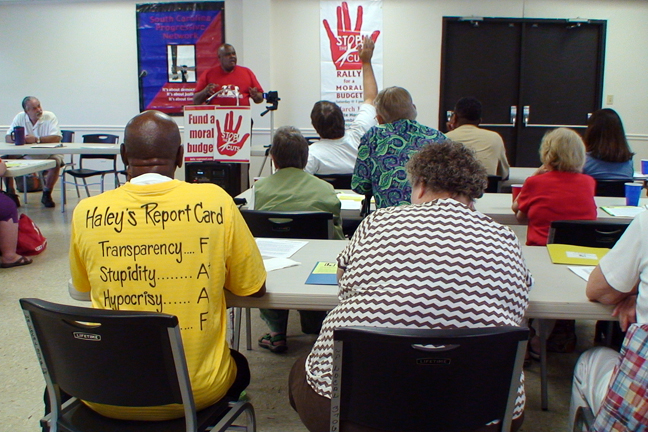
SC Progressive Network Spring Gathering

May 19, 10:30am – 5:30pm
CWA Hall, 566 Chris Dr., West Columbia

Network Co-chair Rep. Joe Neal answers questions at the 2011 Spring Gathering.

PROGRAM

10am: Registration, coffee and doughnuts

10:30 – Welcome and introductions

11 – Missing Voter Project Workshop: Finding, registering and engaging the 50 percent of South Carolinians who don’t vote

11:30 – Racial Profiling Workshop: Are your local cops following the law the Network helped pass? What you can do about it.

Noon – lunch and Social Media Workshop (optional): Everything you wanted to know about social networking but were afraid to ask

1pm – Sorry State of the State: A reality check and a call to organize!

  • Update on Network’s recent and future fight for a moral budget, and planning next steps
  • Protecting voting rights in South Carolina – what we did last year, and a look at what’s ahead
  • Defending the working class and collective bargaining in a fiercely right-to-work state

4 – Network business and political endorsement process

5 – Reception to honor the retiring Donna Dewitt for her years of service to SC’s labor community. She will be the first to take a whack at a Haley pinata.

$10 registration includes conference materials and lunch by Tio’s
RSVP at 803-808-3384 or network@scpronet.com

More about the Network at scpronet.com

We’re all better off when we’re all better off

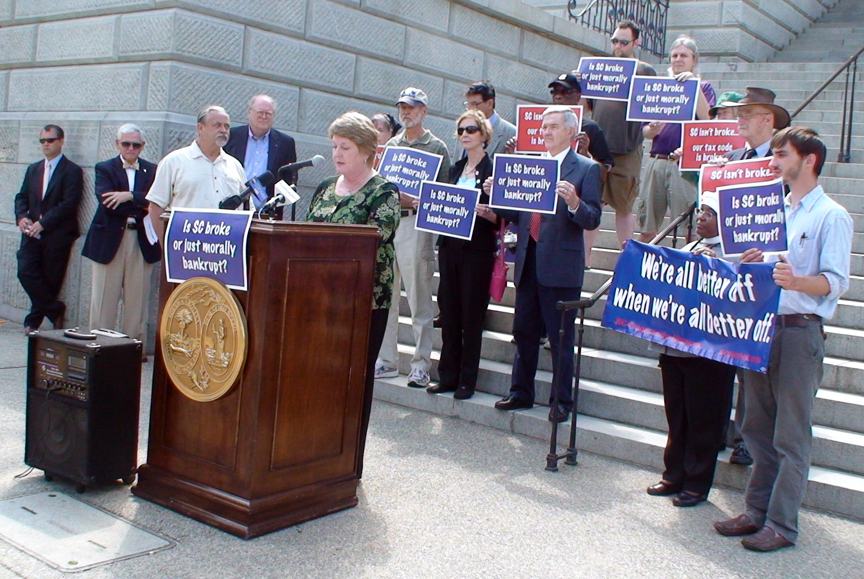
Sen. Phil Leventis has introduced the “TRAC Recommendation Act” (S 1454) that eliminates or reduces many sales tax exemptions, a move supported by the SC Progressive Network, which has been working to promote fair taxation and sustainable budgets. “Our state’s not broke,” Leventis said at a May 1 press conference, “but we are teetering on the verge of moral bankruptcy in our failure to meet the needs of our citizens.”

Unlike the recommendation by the Republican-sponsored Tax Realignment Commission (TRAC) that called for using new revenue to further lower taxes, Leventis’ bill requires new revenue to be used to fund statutory obligations for education and local governments. The legislation would increase the state’s budget by nearly $1 billion next year.

Leventis noted that during his 32 years as a state senator, “I have been guided by the principle that government should invest in meeting the needs and aspirations of its citizens. This principle has been undermined by an ideology claiming that government is the cause of our problems, and accordingly, must be starved. A government unwilling to invest tax dollars in itself and its citizens is the real source of our problems. When businesses strive to be competitive, they do so by investing in their future. That is what we have to do today in South Carolina to insure a more prosperous future.”

We’re not broke; narrow political ideology has trumped statesmanship. The lack of political will to fairly reform our tax codes to meet our basic civic contracts for education and infrastructure leads our citizens to believe that “minimally adequate” is the best we can hope for.

Leventis was joined by representatives from the SC Progressive Network, a coalition of organizations that represents the interests of a majority of the state’s families who make less than $42,000 a year.

“We don’t expect the legislature to pass the bill this year, but it’s critical for the public to understand that a lot of money is being left on the table,” said Network director Brett Bursey. “It should be up to the taxpayers to decide if their money is best spent on education or on further reducing taxes to compete with Mexico.“

Of all the industrialized nations, only Chile and Mexico have a lower individual tax burden than the United States, according to the Organization for Economic Cooperation and Development. Among the 50 states, South Carolina is ranked 43rd in the nation in taxes as a percentage of income, and dead last in per-capita state taxes (National Tax Foundation).

“We’re all better off, when we’re all better off,” said Network Co-chair Virginia Sanders, citing a recent International Monetary Fund report on the correlation between income inequality and general prosperity.

Our state’s business-friendly climate is reflected in the Forbes ranking that puts South Carolina 5th in its “business friendly regulatory environment” but 44th in quality of life. Forbes ranks the quality of our labor supply at 22nd, far behind North Carolina (third) and Georgia (fourth). “The message this sends is that South Carolina, with its lax regulations and unskilled labor force, is a cheap place to do business — but you might not want to live here,” Bursey said.

The House budget cuts mandatory funding for education by $665 million and local government funds by $71 million. These spending levels are set by law, but EFA and local government funding obligations are ignored by budget provisos due to a presumed lack of revenue and lack of political will. These cuts means larger classes, fewer teachers, police and fire fighters, as well as deteriorating infrastructure, all of which combine to make our state less competitive.


SC Education Association Jackie Hicks addresses the shortfall in education funds that could be helped by Leventis’ bill. See more photos from the press conference here.

The TRAC recommendations on sales taxes would raise nearly $1 billion next year and more in coming years. This is close to what we need to meet these mandatory spending levels, and more comprehensive tax reforms would meet and exceed them for years to come.

“The critical debate I hope to spark,” Leventis said, “is whether the role of our government is shaped by the special-interest groups who make the majority of campaign contributions, or by the citizens who pay the taxes. I believe that citizens are willing to pay fair and equitable taxes when they get their money’s worth. It’s called democracy.”

In this year’s House budget:
• The statutory funding level for the Education Finance Act was cut by $665 million, keeping our per-pupil funding at 1998 levels.
• The statutory funding for local governments’ support of police, fire and public services was cut $71 million.
• The revenue from the extra penny of sales tax for Act 388 was $129.5 million short of what was needed for education funding through sales tax, rather than property tax, requiring another raid on the General Fund.

The House budget shorted mandatory funding of these core public services by nearly $736 million. If you add the $129.5 million shifted from the General Fund, you come up with just about what the TRAC recommendations could recover through broad and fair sales tax reforms.

The TRAC Recommendations Act (S 1454) would:
• Raise the $300 “max tax” on cars, boats and planes and raise $61-$143 million annually as increased caps kick in.
• Tax food (not purchased with food stamps) at an effective rate of 2.41%, raising $251 million next year. 18.2% of the state’s population is receiving SNAP benefits and will pay no tax on food.
• Tax non Medicaid/Medicare medicine (with a $100 cap) and home utilities at an effective rate of 1.25%, raising $124 million next year. Those on Medicare or Medicaid (44% of the state’s children) will pay no tax on medicine.