Category Archives: National News/Commentary
Nullifying the nullifiers; a political primer
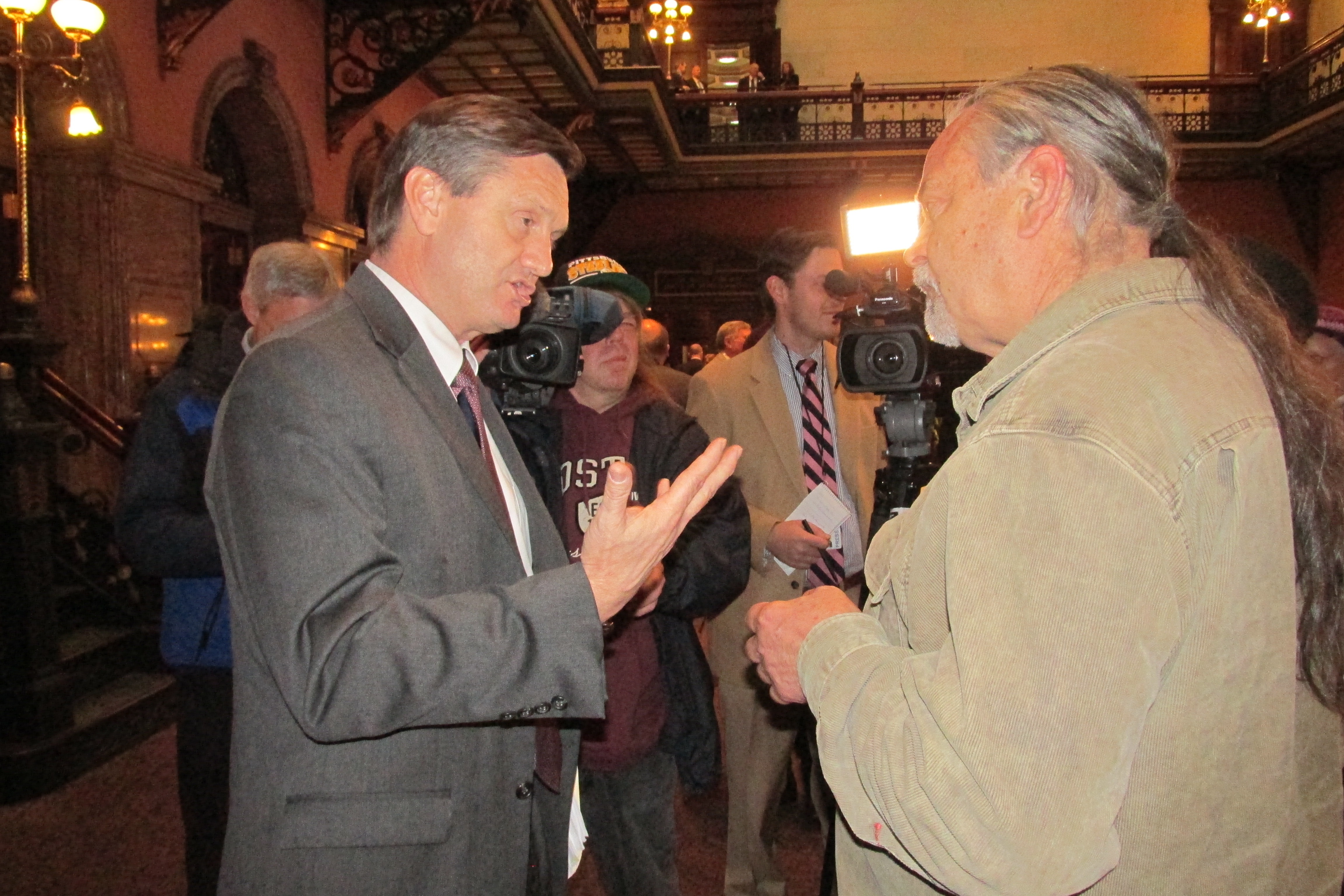
SC Progressive Network Director Brett Bursey challenges Sen. Tom Davis outside Senate chambers before senators take up the “Nullify Obamacare” bill. Truthful Tuesday activists have been lobbying lawmakers since the legislature reconvened on Jan. 14.
The “Nullify Obamacare” bill was voted down in the SC Senate late Wednesday night, with a vote of 33 opposed to nine in favor of the House-passed version. It’s complicated, but here’s a breakdown.
Sen. Tom Davis (R-Beaufort) completely rewrote H- 3101, which expressly rejected Medicaid expansion and regulated federal ACA Navigators. (The Network was among the groups in South Carolina awarded a grant to help people navigate the insurance marketplace to be in compliance with the new health care law.)
The amended bill died after Lt. Gov. Glenn McConnell ruled that Davis’ amendment was not germane to the House version. McConnell, who serves as president of the Senate, said of the House version, “I was having trouble understanding what that bill really did.”
Sen. Brad Hutto (D-Orangeburg) raised a point of order that the regulations placed on Navigators had nothing to do with the original bill. McConnell agreed, and ruled Davis’ entire amendment out of order.
In a move seen as disrespectful in the body that prides itself on being deliberative and cordial, Davis appealed McConnell’s ruling to the Senate floor. Twenty-eight senators, 14 from each party, upheld the decision to kill Davis’ amended bill.
With Davis’ version of H-3101 dead, the vote then was called on the original House version that even Davis had declared unconstitutional. Only nine Republicans voted to adopt the “Nullify Obamacare” version of the bill. In the end, 19 Republicans joined 14 Democrats to reject the bill on a 33 – 9 vote.
That only nine of 28 Republican senators took the rigid Tea Party stance against “Obamacare” is seen by SC Progressive Network Director Brett Bursey as “a rare victory for rational thought in the legislature.”
That said, Bursey cautioned that the damage has already been done, calling the time-sapping legislative posturing “bad political theater.” South Carolinians are already suffering from the state’s refusal to participate in the Affordable Care Act, with more than 1,000 deaths predicted here this year because lawmakers refused to accept Medicaid expansion money (which, we remind you, is OUR tax dollars.)
The death of H-3101 doesn’t mean that South Carolina lawmakers will stop obstructing the ACA. South Carolina is still refusing money for a state insurance marketplace and Medicaid expansion. The Davis bill would have added regulating state Navigators and blocking public bodies from helping people get insurance to the state’s anti-Obamacare campaign.
“A goal of our Truthful Tuesday protests,” Bursey said, “was to get people talking, change the dialogue, and reduce the Tea Party influence on Republicans. That is happening.”
Another Truthful Tuesday; 17 more arrested
Rev. Tom Summers leads a prayer with healthcare advocates, ACA navigators and concerned citizens kneeling in the road outside the SC State House March 18, the third week in a row of civil disobedience led by the SC Progressive Network.
Photos on Flickr.
Why did I get arrested?
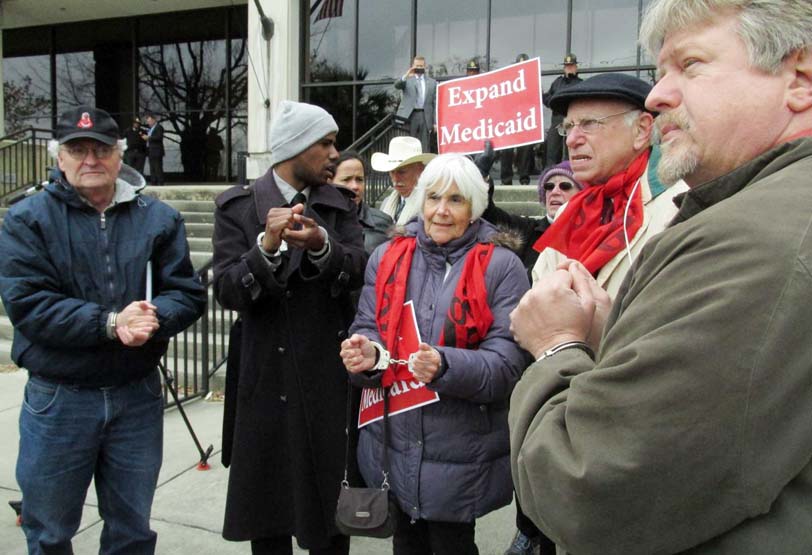
Pat Jobe (left) was one of 11 protesters arrested March 4 for blocking the road to the entrance of the SC State House on the day the Senate took up the “Nullify Obamacare” bill. With him are (from left) Wayne Borders, Kitt Grach, Jim Childress and Shawn Crowe. They are part of the Truthful Tuesday movement, which aims to educate the public about the Affordable Care Act and to pressure state lawmakers to expand Medicaid.
By Rev. Pat Jobe, Greenville Unitarian Universalist Fellowship
The young, Latino police chief, Ruben Santiago, could not have been more polite, more professional, more thorough. “I’m giving you one more chance to get out of the road and back on the sidewalk. You understand you are breaking the law and are about to be arrested?”
I will not soon forget the anger and frustration on the faces of the Capitol police, the black Smokey The Bear hats whose job it is to protect and assure smooth operations to the members of the General Assembly as they photographed us and ignored me when I said, “Thank you for being here. Thank you for your service.”
Had we chosen to disrupt the immoral actions of the General Assembly on its property, on the jurisdiction of the men in the black hats, we would have faced a possible $5,000 fine and three years in prison. By blocking the driveway on a Columbia city street, we faced a traffic ticket, handcuffs, a ride in a police car and about an hour of processing in police headquarters. We also have a court date of March 28.
There are so many vignettes, so many questions, so many stories to tell but I think I’m out of bed at five in the morning because of the questions. Why did we do it? The refusal of the legislature and the governor to take billions in new Medicaid money is dooming tens of thousands of poor people to less than the best medical care available to their wealthier neighbors. We have medicine that saves lives. In many cases, an estimated 1,300 this year in South Carolina, the result will be death.
People are going to die.
In addition to cancer survivor Jim Childress (and would he have survived had he been poor? Another question) a third Greenville UU made the trip to Columbia. She hopes to remain anonymous because she’s looking for work right now. But as we rode to Columbia she told of a friend who had stomach pain, was bent double with pain, was urged by his coworkers at Walmart to go the emergency room. He didn’t go. He failed to show for work for a few days and was found dead in his apartment. He had made it clear that he didn’t seek medical care because of the cost. He had made an earlier trip to the hospital and had received a bill for $30,000.
Did we do any good? If my Facebook page is any indicator, we got the attention of lots of folks who liked what we did. If the questions confronting Sen. Tom Davis as he walked into the Senate lobby Tuesday are any indication, yes, we did some good. Davis is seeking to amend the anti-Affordable Care Act law to prohibit any “public body” like the city of Greenville, or our libraries from helping anybody sign up for the Affordable Care Act. He would also like to make it a difficult, to impossible, for any private organization, like the SC Progressive Network, to sign people up for the Affordable Care Act.
Our immediate past president at the Fellowship, Richard Kelly, has encouraged me to consider a sermon on our becoming a police state. I wonder if I could be arrested for that?
But being an insufferable zealot, I also wonder why it took me 60 years to get arrested, to commit an act of civil disobedience. Why not in the 60’s and 70’s to support civil rights, voting rights, women’s rights, gay rights, the environment, the poor, good nutrition, to oppose every corporate and government madness that seeks to disempower anybody and place the good of one group above the good of another? Why have I not grabbed every bullhorn, stood on every stump, and in the words of John Prine, “screamed and hollered and cried?”
The story is probably legend, but when Thoreau was jailed for refusing to pay a tax to support the Mexican War, Emerson is said to have passed the jail and seen Thoreau inside.
“Henry, what are you doing in there?” Emerson asked.
“Ralph, what are you doing out there?” Thoreau asked.
I don’t know when I will be back in police custody, and I fear it will cost more next time. But I know civil disobedience is an effective tool in the struggle for The More Beautiful World Our Hearts Know Is Possible. I capitalize that phrase because it is the title of a good book by Charles Eisenstein that is challenging me to do all I can to get food to the hungry, healing to the sick, and peace to a world tortured by all kinds of silly wars.
Thank you for the huge wave of encouragement I have received for my time in handcuffs and my ride in the back of a police cruiser.
•••
Pat Jobe likes Mark Twain’s tease of Lord Byron, “On with the dance. Let joy be unconfined is my motto. Whether there is any dance to dance or any joy to unconfine.”
Family doctor can “no longer stand idly by”
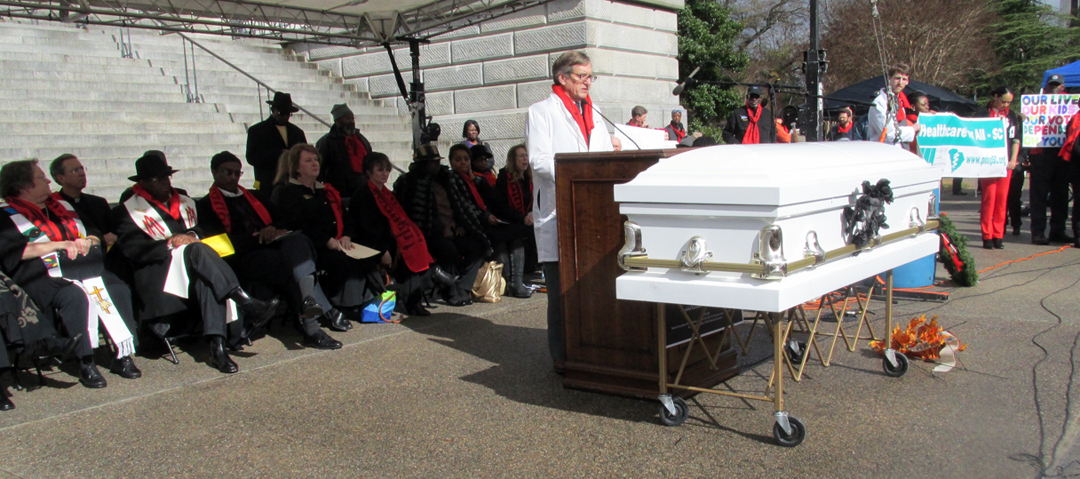
David F. Keely, M.D.
Family Medicine and Public Health, Rock Hill, SC
Remarks made at the Truthful Tuesday Coalition’s Enough is Enough rally Jan. 14.
On behalf of Healthcare For All – South Carolina, our state’s chapter of Physicians for a National Health Program, it gives me great pleasure to welcome everyone today for this important message about health care, present and future, in our state.
As a family physician with additional training and experience in public health, I have come to the point in my career of 35+ years in South Carolina where I can no longer stand idly by.
The term “health justice” is not heard often enough or loudly enough nowadays. Today we have already heard the disturbing information about the number of individuals who die unnecessarily every year in our state because they lack access to affordable, basic health care services – where is the justice in that?
Affordable and accessible quality health care for all should be the end goal in our country – and the Affordable Care Act [ACA] is a step in that direction.
In our current U.S. healthcare “system”, over 1,000 insurance companies offer a complex array of coverage plans; disgruntled physicians struggle daily with all the different private insurance “rules”; and, the administrative overhead of it all costs us as citizens about $400 BILLION each year! That’s enough “wasted money” to provide ongoing, accessible, affordable, quality healthcare (both preventive and sick care) for ALL 48 million Americans who are currently uninsured.
Over the past year, HFA-SC has reached out to community organizations, the faith-based community, and young physicians – newly-trained nurse practitioners. The ongoing debate in South Carolina about ACA-related Medicaid expansion has helped energize HFA-SC’s grassroots advocacy efforts. Yes, clearly the “new Medicaid” in South Carolina under the ACA brings essential health benefits that are not part of “existing SC Medicaid” – and what is at stake? — the current health and future welfare, educability, and productivity of South Carolina’s people all over the state! And I am here to say that our state’s physicians really need to speak out on this.
Officially, the South Carolina Medical Association’s Board of Trustees is staying neutral, despite our important grassroots voices gaining steam on the “new Medicaid” expansion issue in our state. From the SCMA website last legislative session, where it addressed the Affordable Care Act’s “new Medicaid” expansion, I quote: The SCMA’s Position The SCMA agrees with finding solutions to provide health care to all South Carolinians. However, we are concerned that the Medicaid expansion is a temporary and unsustainable fix that is not the solution for the long term health issues facing South Carolina.
This statement came across to me as the SCMA backing Governor Haley — I have to wonder though that that is not the true voice of physicians practicing in this state – and so I am glad that we are having this rally today to shed further light on that.
As a family physician (and small businessman), sure, I see existing South Carolina Medicaid insurance as needing to be more efficient — but HHS Director Tony Keck is already making good progress on this front, so existing SC Medicaid inefficiency is NOT a reason for refusing the “new Medicaid” expansion opportunity. Saving the lives of needy and deserving South Carolinians is what this debate needs to be about, first & foremost! That indeed is a smart investment!
As a family physician (who is active in the faith-based community in Rock Hill), I shudder and bleed compassion when I have to look into the face of medical bankruptcy and then also the ravages of totally preventable, advanced chronic disease in both rural and urban areas of our state.
Stories abound, as my colleagues gathered here today can well attest – economically-struggling, hard-working South Carolina adults with a poverty-level income, without dependent children, and thus no access to affordable health care due to the refusal of our state to extend the “new Medicaid” under the ACA to them.
In his guest op-ed in The State last year, Dr. Jeb Hallett (a seasoned surgeon practicing in Charleston), put into words very well what I believe so many physicians can no longer tolerate… I quote: “It is helpful to have an image of what rejecting Medicaid expansion will really look like. Forget the green Medicaid dollars that are the focus of too many lawmakers’ conversations; for them, this is all about a news conference where they politicize their loyalty to fiscal restraint.
As a health-care provider, I imagine the limbs of diabetics that will be amputated; I envision the twisted faces of those who forever will be changed by disabling strokes. Yes, leaving the most vulnerable citizens in our state uncovered results in greater expense for us all – as the uninsured often go without preventive care and proper ongoing treatment, that leads to emergency situations where much higher costs to treat are passed on to insurance companies – and then ultimately to policy holders as higher premiums. We all lose.
You should know that current South Carolina Medical Association President, Dr. Bruce Snyder, a vascular surgeon in Greenville, issued a call for “community action” to all SC physicians in April 2013 – it is published on the SCMA website.
I quote: “I challenge the physicians in South Carolina to be the leaders in their communities and in the state that I know they can be… Every physician in South Carolina knows an issue that is important to them which would have a positive impact on our state. Individually and collectively we should make sure our voices are heard on every subject, yes, every subject that has an impact on the health of South Carolinians.”
As concerned citizens, we need to echo this call loudly in our local communities. Yes, all of you, talk to your primary care and specialty physicians – now is the time!
So, in closing, please join HFA-SC and help us get the “silent” physicians around our state to speak up! Thank you!


Navigators latest target in Right’s war on “Obamacare”
The SC Progressive Network‘s Charleston Navigators are featured briefly in this MSNBC piece on the right wing’s latest war on “Obamacare.”
We anticipate legislation in January that will require Navigators to be licensed by the state Dept. of Insurance. ALEC-crafted bills requiring licensing requirements to make it almost impossible for anyone other than an insurance agent or broker to serve have passed in a number of “refusnick” states, and are expected here soon.
A bill to make it illegal for the City of Charleston (local governments) to offer space to Navigators, or help in anyway to implement the ACA, passed the SC House last session. The “Nullify Obamacare” bill is number two on the Senate’s agenda when it reconvenes Jan. 14.
Progressive Network helps South Carolinians navigate new healthcare insurance marketplace

The SC Progressive Network is among the nonprofit organizations in South Carolina to receive a grant from the US Dept. of Health and Human Services to train and manage insurance marketplace navigators.
The Network’s navigators are helping people understand their health insurance options, and purchase an individual, family, or small business plan as required by the Affordable Care Act (ACA). The Network is providing this service because the SC legislature refused to set up a state-run exchange.
People who make between $11,500 and $46,000 are eligible for reduced price policies. But 280,000 South Carolinians who make less than $11,500 will have to pay full price for insurance. The ACA was designed to expand Medicaid to provide free health care to those in poverty.
South Carolina’s Republican leadership refused to take the $1.4 billion federal grant to expand Medicaid and provide healthcare for the poor. Gov. Nikki Haley led opposition to “Obamacare,” claiming that South Carolina couldn’t afford the 10% matching funds ($140 million) it would have to pay beginning in 2020.
We’d remind folks that eliminating just one of the state’s 80 sales tax exemptions could cover the cost of expanding Medicaid. Raising the $300 sales tax cap on luxury cars, yachts and private planes to the regional average would raise $160 million next year. That’s just one of the exemptions that leaves more than $2.4 billion in revenue out of our budget.
For information or help in applying for insurance through the federal health exchange, call the Network Navigators at 803-445-1921 or email navigator@scpronet.com.
Teaching the real history of the 1963 March on Washington
By Bill Fletcher, Jr.
August 28 marked the 50th anniversary of the historic March on Washington for Jobs and Freedom. Publicly associated with Dr. King’s famous “I Have a Dream” speech, this march brought more than 250,000 people to the nation’s capital. The day went down in history as a powerful show of force against Jim Crow segregation. Over time this great event has risen to levels of near mythology. The powerful speech by Dr. King, replayed, in part, for us every January on Martin Luther King Day, has eclipsed all else—so much so that too many people believe that the March on Washington was entirely the work of Dr. King.
It is also barely remembered that the March on Washington was for freedom and jobs. In fact, The Americans, a high school history text by publishing giant Houghton Mifflin Harcourt, tells students that the march was called simply “to persuade Congress to pass the [1963 civil rights] bill.” In reality, the demand for jobs was not a throwaway line designed to get trade union support. Instead it reflected the growing economic crisis affecting black workers.
Indeed, while Dr. King was a major player, the March on Washington did not begin as a classic civil rights march and was not initiated by him. There is one constituency that can legitimately claim the legacy of the march—one that has been eclipsed in both history as well as in much of the lead-up to the August 2013 commemorations: black labor.
Initiated by A. Philip Randolph, president of the Brotherhood of Sleeping Car Porters, the march became a joint project with the Southern Christian Leadership Conference. Randolph and other black labor leaders, particularly those grouped around the Negro American Labor Council, were responding to the fact that the black worker was largely being ignored in the discussions about civil rights. In addition, the economic situation was becoming complicated terrain for black workers.
As historian Nancy MacLean has pointed out, the elements of what came to be known as deindustrialization—which was really part of a reorganization of global capitalism—were beginning to have an effect in the United States, even in 1963. As with most other disasters, it started with a particular and stark impact on black America.
It is also barely remembered that the Student Nonviolent Coordinating Committee played a key role in the event. The civil rights leadership insisted that the militant rhetoric of the original speech by SNCC’s then-chairman John Lewis—now Congressman John Lewis—be toned down. Reading U.S. history textbooks, students are seldom even introduced to the words of Lewis or other speakers. Here is Pearson’s U.S. history textbook coverage:
“Many people, including Christian and Jewish religious leaders, gave speeches that day, but none moved the crowd as did King. His voice rang as he proclaimed, ‘l have a dream that my four little children will one day live in a nation where they will not be judged by the color of their skins but the content of their character.’”
Teaching about the March on Washington presents a series of challenges precisely because it involves counteracting sanitized textbooks and demythologizing not only the march, but also the Black Freedom Struggle—the Civil Rights Movement, as it became known. As such, there are a few points that cannot be overlooked if we want to honor the march’s true story:
1. The context.?The idea for the march in 1963 did not appear out of nowhere, and the fact that A. Philip Randolph originated it was no accident. The notion of the March on Washington in 1963 was, in certain respects, the revival of an idea from 1941 when Randolph convened a group to plan a march on Washington, D.C. to protest the segregation of the growing war industry. That march, which was planned as a black march on Washington, never happened because the mere threat of 100,000 African Americans marching forced President Franklin Roosevelt to give in to the demand for an executive order bringing about formal desegregation of the war industry.
2. The actual march was the result of work that began in the 1950s.?Although conceptualized by Randolph, the march was actually the result of the increasing tempo of a social movement. It could not have been organized in a little more than six months—as it was—if it had not been connected to local organizing that had gone on for decades in NAACP youth councils, churches, unions, women’s groups, and more. It was not individuals who chartered buses from all over the country—it was organizations.
3. The march’s principal organizer was Bayard Rustin.?This year President Obama will posthumously award Bayard Rustin the Medal of Freedom, however teaching about Rustin complicates the simplistic Civil Rights narrative offered to students by corporate history textbooks. Rustin was a gay pacifist with a long history of organizing, but despite his record of achievements, homophobia led to him being denied the title of national director of the march—technically, he served under Randolph.
Rustin closed the march with a list of demands and had everyone pledge “that I will not relax until victory is won.” He was a complicated character who remained in organized labor and became a mentor to many, especially to younger activists in the burgeoning gay rights movement. At the same time, he refused to later condemn the Vietnam War and was critical of the Black Power Movement.
4. The march was controversial on many levels within the Black Freedom Movement.?Individuals, such as Malcolm X, were critical of it, albeit in a contradictory manner, claiming that it would not amount to anything. And there were those within the march who, like then-SNCC chairman John Lewis, wanted a more militant posture.
5. The economic situation for African Americans was not addressed in any fundamental manner in the aftermath of the march.?There were periodic improvements, but the crisis that Randolph and the NALC saw brewing in the early 1960s took on the features of a catastrophe by the mid to late 1970s, a fact that we have been living with ever since. Divorcing “civil rights” from economic justice is a feature common to mainstream approaches to history, including those found in school curricula.
6. The entirety of Dr. King’s August 28, 1963 address should be read.?What comes across is something very different from the morally righteous and tame “I Have a Dream!” clips and textbook soundbites usually offered around the time of Dr. King’s birthday. In fact, the speech is a militant and audacious indictment of Jim Crow segregation and the situation facing African Americans.
To truly honor the legacy of this anniversary, teachers should have students compare the King of the actual speech with the King from the clips. It would also be useful to have students read and discuss some of the day’s other speeches. For example, in Randolph’s opening speech he proclaimed that those gathered before him represented “the advance guard of a massive moral revolution” aimed at creating a society where “the sanctity of private property takes second place to the sanctity of the human personality.” This is a sentiment that we never hear about that day.
This 50th anniversary of the March on Washington also offers an opportunity to connect the issues and experiences of 1963 with current realities. In 2013, black workers have been largely abandoned in most discussions about race and civil rights. As National Black Worker Center Project founder Steven Pitts has repeatedly pointed out, with the economic restructuring that has destroyed key centers of the black working class, such as Detroit and St. Louis, much of the economic development that has emerged has either avoided the black worker altogether or limited the role of black workers to the most menial positions. Thus, unemployment for blacks remains more than double that of whites and hovers around Depression levels in many communities.
We can all do justice to this anniversary by asking the right questions and providing the actual historical context in which the 1963 March unfolded. More so, we can also offer, as Rustin asked the marchers in 1963, our “personal commitment to the struggle for jobs and freedom for Americans. . .and the achievement of social peace through social justice. How do you pledge?”
Bill Fletcher Jr. is a longtime labor, racial justice and international activist. He is an editorial board member and columnist for BlackCommentator.com and a senior scholar for the Institute for Policy Studies in Washington, D.C. Fletcher is the co-author (with Fernando Gapasin) of Solidarity Divided: The Crisis in Organized Labor and A New Path Toward Social Justice (University of California Press) and ‘They’re Bankrupting Us!’ And 20 Other Myths about Unions (Beacon Press).
Federal court judge throws out Republican lawsuit to close South Carolina primaries

Federal Judge Mary Lewis dismissed the Greenville County Republican Party lawsuit against the State Election Commission Wednesday, ruling that the party did not have standing to bring the case to court. The state and Greenville County Republican parties filed the complaint in 2010, seeking to require primary voters to register as Republicans to cast a vote in that party’s primary.
The state party withdrew from the suit before the case was heard, contributing to the judge’s determination that the Greenville County party did not have standing to change statewide election laws. Voters in South Carolina do not have to register by party.
The SC Progressive Network – along with 13 members of the SC Black Legislative Caucus, the SC Independence Party, the Constitution Party and the Columbia Tea Party – were defendant/intervenors in the case.
“For years now, we have successfully fought Republican-sponsored legislation to close the primaries,” said Network Director Brett Bursey. “They sued the Election Commission to get the courts to do what they couldn’t accomplish in the legislature their own party controls. The state party pulled out of this suit because it didn’t want to argue the merits of a rigged election system.”
Bursey argued against such legislation before the House Judiciary Committee in March 2012. “We presented the committee a list showing that 20 of its 25 members won their elections in the primary, didn’t have general election opposition, and won with around 99 percent of the vote. I think they tabled the bill because they couldn’t defend the current system, much less one that restricted participation in the primaries.”
South Carolina has the least-competitive legislative elections in the nation, with nearly 80 percent of 2012 elections for the State House having only one major party candidate. “This is not what democracy should look like,” said Network Chair Emeritus Joe Neal, an intervenor in the suit. “Today the South Carolina federal court has upheld the rights of voters in South Carolina, especially the minority community, to free and unfettered access to the polls.”
“What passes for representative democracy in South Carolina is a farce,” Bursey said. “It will take at least a decade to fix the mess created by our legislature, which has spent 20 years making ‘safe’ districts that discourage competition.”
The Network is doing its best to educate the public about the serious need to create competitive political districts that encourage politicians to represent everyone in their district, not just the partisan 10 percent that turn out in the primaries. We are working to broaden electoral participation, not narrow it.
Vote suppression is the real voting fraud
By Brett Bursey
Director, SC Progressive Network
When I saw Rep. Alan Clemmons’ guest column in The State, “Voting problems continue to haunt us” (July 21), I was hoping he’d explain his part in peddling the myth of dead people voting in South Carolina, and apologize to the people he misled. He did neither.
Instead, he again claimed an “undeniable presence of election fraud in South Carolina,” and took a cheap shot at the S.C. Progressive Network to make his point. He referenced an instance years ago when bogus forms were turned in by someone the network hired to do voter registration in Florence County. I caught the fraud myself and called SLED and the County Election Board the day the forms were submitted.
No fraudulent votes were cast. I testified against the perpetrator, and he went to jail. The system worked.
Clemmons’ column goes on to call the photo ID law he championed “a good first step” and said, “Now, to cast a ballot, you are required to prove who your are and that you are eligible to vote in that election.”
The truth is that Clemmons’ bill was interpreted — essentially rewritten — by the federal appeals court, which ruled that “South Carolina’s new law … does not require a photo ID to vote.” The state spent $3.5 million on private attorneys to defend a law against a problem that doesn’t exist — and lost.
While unable to cite a single case of in-person voter impersonation, Clemmons told the U.S. Department of Justice that “voter fraud in South Carolina is an unspoken truth.” Still today, he conflates absentee ballot and voter registration fraud, neither of which requires a photo ID, with in-person fraud at the polls, of which there is no evidence.
In the nine years Clemmons has chaired the House’s Election Laws Subcommittee, he has killed every bill the network’s legislative members have sponsored to broaden voter participation. He nixed our proposals to establish early voting centers and high school voter registration programs, to reduce the influence of money in elections, to re-enfranchise felons and to adopt voter-verified paper ballots.
Rather than working to make voting more accessible and inclusive, Clemmons has said voting should not be easy.
We do agree on one thing: South Carolina’s election system is dysfunctional. It was established by the 1895 state constitution, which reversed the democratic aspects of the 1868 constitution that empowered black citizens. It delegated authority to 46 county election boards, appointed by local legislators, with no centralized control.
County election boards interpret and enforce election laws differently, and are not accountable to the State Election Commission.
Clemmons proposes to fix the problem by putting the State Election Commission under the partisan office of secretary of state. But in Florida and Ohio, where they run elections, secretaries of state have been accused of disenfranchising thousands of voters.
More partisan control in a state already crippled by it would be a mistake. A better answer would be to empower our independent, nonpartisan State Election Commission to run elections.
The truth is, our democracy is not threatened by voter fraud but by legislators who have rigged the system. Around 10 percent of eligible voters are choosing our Legislature.
If Clemmons was truly concerned about the “sanctity” of our electoral system, he would address the fact that the S.C. Legislature has the least-competitive elections in the nation, with 80 percent of lawmakers elected with no general-election opposition.
Clemmons, for example, got 99.12 percent of the vote in 2012, when he was the only candidate on the ballot. He was swept into office by 6.1 percent of voters in his district.
The Network believes we can do better. We will continue to fight to make our democracy more representative, and invite anyone who shares our goal to join us. Call us at 803-808-3384, email us at network@scpronet.com, or find us Facebook or Twitter.