
Mars Vanquishing Ignorance
Daniel Deweese
New Legacy Project
In today’s liberal-permissive (western) societies, we are relatively free, (formal freedom-to use the old Marxist jargon) you can buy this or that ,if you have money. You can travel here or there (again if you have money), you are (after the Supreme Court’s recent decision) free to marry whom ever you want. You are relatively free from danger, if you are white. You are relatively free to say what you want as long as you are not a whistle blower.
During the week of liberal victories (which should be celebrated); the Supreme Court’s ruling on the constitutionality of the subsidies provided by the ACA and marriage equality, one must not forget a more ominous victory was won for global capital; the TPP. The Trans-Pacific Partnership, which will not only displace thousands of workers but will also subvert the sovereignty of the nation-state. That is to say, multinational corporations will be able to hold tribunals in order sue a nation-state if a law (in the form of environmental regulations, worker’s rights, and so on) obstructs the objective, that is the profits of the aforementioned corporations. It should also be noted that the entire process has been shrouded in secrecy, those governing the process refusing to release the specifics of the deal.
The irony of this situation is that the same “liberal” administration pushing for certain freedoms (LGBT rights, access to health care and what appears to be anti-racists policies) also served as the impetus for secret trade agreements such as the TPP and the mega-secret TISA (Trade In Services Agreement). Again, we can do what we want to a certain extent but we are prohibited from deciding the very economic coordinates that determine the framework of our network of choices. Freedom must be more.
One must examine how ideology dissimulates antagonisms. For instance with Dylann Roof, we are not simply dealing with the distorted psychology of an individual, we are contending with ideology. In his manifesto, he claimed; “They are ruining our country and raping our women.” Of course, there are antagonisms in our society (poverty, violence etc.), however, it is through ideology that the antagonisms produced by the system itself are displaced onto a race of people (a’la the Jews in Hitler’s Germany and blacks in the white supremacist south). This ideological frame work accounts for the asymmetry and antagonisms experienced in a society and thus providing a precarious consistency in the symbolic order.
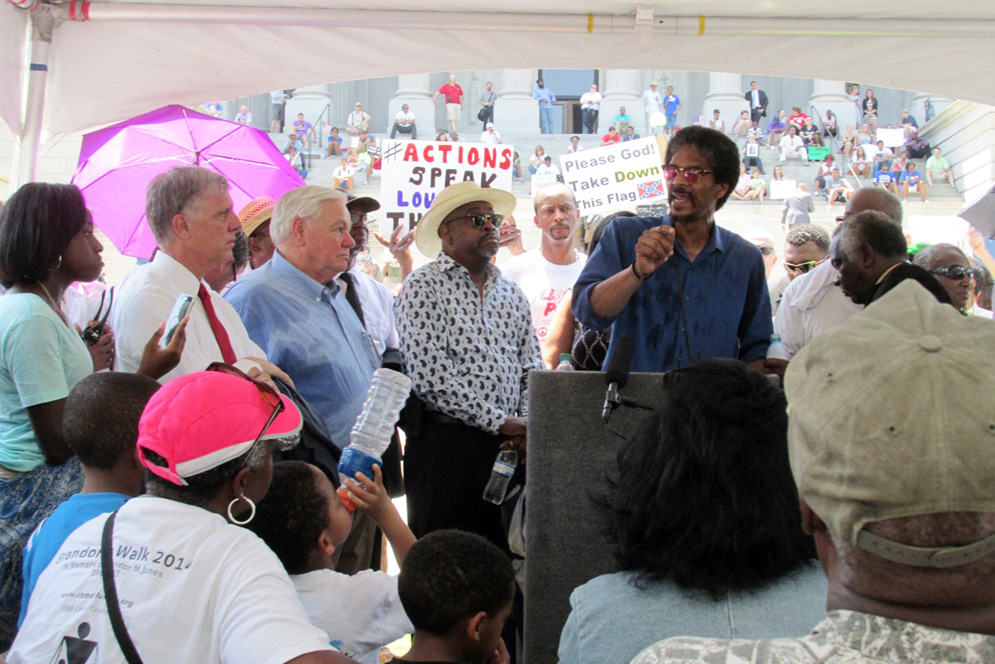
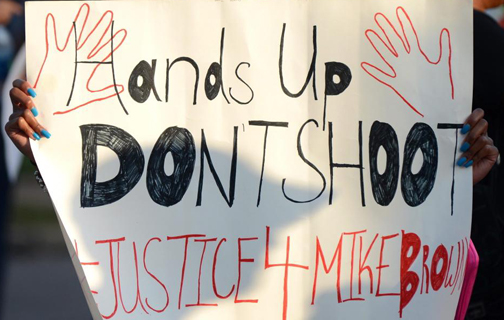
We should not miss the crucial point here; Zizek’s (2008) notions of subjective and objective violence can lend some elucidation here, the subjective (singular) violence of a distorted individual should not dissimulate the objective violence of the state, as it so often does. Haley’s call for the confederate flag to come down (only after being pressured by the people), and her cries for unity must not conceal the violence of the state directed towards minorities and the poor; in the form of the refusal of the Medicaid expansion, the death of Walter Scott and an entire history of lynching and police killings (Denmark Vesey, Orangeburg Massacre, etc.)
The dominant hegemonic ideology often utilizes individual acts of subjective violence to distort, conceal and disguise its own violence. It is appropriate to recall here Orwell’s; “Ignorance is Strength.” The psychoanalytic concept of displacement is useful in clarifying this statement. One’s own aggressive tendencies are projected onto an other thereby maintaining a psychical homeostasis (strength) while at the same time repressing, that is, keeping the subject ignorant of the source of this conflict, which always returns in the guise of different symptoms.
Furthermore, one must be careful with the calls for “unity” and “coming together” after the Charleston massacre, for many conservative commentators (and liberals) this “coming together” is another way of stating; “Lets not talk about systemic racism.” I.e: police brutality, the overwhelming incarceration of black males, voter suppression and poverty in the black community.
Of course the flag should come down, but as many have observed; will this serve as an impetus for any type of sustainable movement that addresses the aforementioned acts of objective violence that constitute the very ground of existence for so many people? Irrespective of the liberal-optimism and conservative reactionary responses, no one can say for sure. One of the first steps towards liberation is to question the dominant ideology presented to us. It is the only way that we can clear the obfuscation and monopolization of reality. In order to combat the strength of those in power, we must first defeat ignorance.