Network members make news

The SC Progressive Network is always proud of its members, but this week several of them got the media attention they so deserve. Read about what they’re up to, and be inspired by their dedication to work and community.

South Carolina Coalition for Healthy Families helped successfully defeat a bill that would have required women view an ultrasound before obtaining an abortion. A compromise was reached that changed the language to “allow” rather than “require” a woman view an ultrasound image. You can link to the bill here. Read more in The State, the Greenville News, and WIS News 10.

Conchita Cruz, an organizer for Coalition for New South Carolinians, was featured on the cover and lead story in Free Times.

Ed Madden, a longtime Network activist who has served on our executive committee and on the boards of SC GLPM and SC Equality Coalition, was featured in the arts section of Free Times for his debut poetry book, Signals. Join him for his launch party on April 20 at the Hunter Gatherer Pub, 900 Main St., in Columbia and on April 23, 7-9pm, at if Art Gallery, 1223 Lincoln St. Madden describes the book as “meditations on personal and cultural memory, race, and sexuality in the New South.” It includes several poems on the politics of race and sexuality in Southern culture, and at least two poems written at and about SC Progressive Network events.

And the Unitarian Universalist Fellowship in Columbia’s effort to “go green” was featured in The State.

Great work, comrades!

Men explain things; facts don’t get in their way

By Rebecca Solnit
TomDispatch.com

I still don’t know why Sallie and I bothered to go to that party in the forest slope above Aspen. The people were all older than us and dull in a distinguished way, old enough that we, at forty-ish, passed as the occasion’s young ladies. The house was great – if you like Ralph Lauren-style chalets – a rugged luxury cabin at 9,000 feet complete with elk antlers, lots of kilims, and a wood-burning stove. We were preparing to leave, when our host said, “No, stay a little longer so I can talk to you.” He was an imposing man who’d made a lot of money.

He kept us waiting while the other guests drifted out into the summer night, and then sat us down at his authentically grainy wood table and said to me, “So? I hear you’ve written a couple of books.”

I replied, “Several, actually.”

He said, in the way you encourage your friend’s seven-year-old to describe flute practice, “And what are they about?”

They were actually about quite a few different things, the six or seven out by then, but I began to speak only of the most recent on that summer day in 2003, River of Shadows: Eadweard Muybridge and the Technological Wild West, my book on the annihilation of time and space and the industrialization of everyday life.

He cut me off soon after I mentioned Muybridge. “And have you heard about the very important Muybridge book that came out this year?”

So caught up was I in my assigned role as ingénue that I was perfectly willing to entertain the possibility that another book on the same subject had come out simultaneously and I’d somehow missed it. He was already telling me about the very important book – with that smug look I know so well in a man holding forth, eyes fixed on the fuzzy far horizon of his own authority.

Continue reading

Lethal injection gets the OK from Supreme Court

Diann Rust-Tierney
Executive Director

National Coalition to Abolish the Death Penalty

As I write this today, the cherry blossoms are fading, but the machinery of death is lumbering along with renewed authority and conviction.

This morning, the Supreme Court ruled in Baze v. Rees that lethal injection posed no risk of unnecessary pain and suffering for the more than 3,200 who still face execution. It is ironic that while this decision was being announced, just a few blocks away people of faith in Washington, DC welcomed Pope Benedict XVI, who shares our belief that capital punishment is an affront to humanity and has no place in modern society.

At the same time that the Baze decision was being announced, the Supreme Court heard arguments on a second death penalty case, Kennedy v. Louisiana, which challenges that state’s law that expands the death penalty to crimes other than murder.

Today we are reminded just how far we have to go in our fight to achieve abolition.

Those of us in the anti-death penalty movement know we have a tough, but lifesaving, task ahead. To end the death penalty we have to overturn capital punishment state by state.  I’d like to tell you what NCADP is doing to get us closer to abolition and why.

A new Harris poll confirms what we’ve all believed to be true – support for the death penalty in the United States is weakening. Fifty-two percent of Americans say the death penalty is no deterrent to murder. An astonishing 95% of those polled are convinced innocent people have already been convicted of murder. These figures are supported by earlier polls that indicate that three-quarters of Americans believe that an innocent person has already been executed in this country. Fifty-eight percent of recent respondents said they would oppose the death penalty based upon the knowledge that innocent people are sometimes convicted of murder.  

While the poll numbers are encouraging, we must do more to build the constituency for death penalty abolition across the nation. The stronger our movement is in America’s towns, cities and states, the more we can shape the public opinion that influences state legislators. Ultimately, they will respond if the voters say enough costly, state-sponsored killing is enough. And then we can rightly declare, “Mission accomplished.”

Most NCADP affiliates are small, headed by a few highly committed activists leading anywhere from a dozen to several thousand members. NCADP provides training, materials and advice that helps them build their membership, educate state legislators and encourage local citizens to shout out, “No!” to the death penalty.

Our immediate goal is to reduce the number of states with the death penalty from today’s 36. NCADP is uniquely experienced in waging these state battles – our staff includes veterans of the historic death penalty abolition victory in New Jersey as well as individuals who fought successfully to prevent capital punishment from being reintroduced in Wisconsin.

In med schools, the abortion curriculum has left the classroom

By Louisa Pyle
RH Reality Check

As recently as six or seven years ago, abortion was included in my medical school’s curriculum, but no longer. The comprehensive curriculum I naively expected that would provide medical students with the knowledge to meet the common needs of their female patients simply does not exist. At a party last weekend I asked a few second years, four twenty-three-year-old men, to report back to me if they hear the “A” word at any time this semester. They gleefully dubbed themselves the “Medical Student Moles for Choice.” Abortion is a shadow that wisps in and out of medicine, much like the quiet shadow of abortion in many women’s lives, not addressed directly, not discussed in coffee shops or over family dinner.

Medical school is, in many ways, a language school. Someone told me once that a medical student learns over 20,000 new words in their first two years of school, and in addition to the new vocabulary, I soon became capable of saying things over dinner that one should never say. “Rectum” no longer induces giggles and “vagina” is boring, not sexy or empowering. And yet, the word “abortion” is still said with a pause, a nod, a little quieter than the rest of the sentence. I’m happy when we talk about it at all: for me, the problem is the deafening silence. That a procedure more common than an appendectomy would never be named: In the halls of science and healthcare, that to me is an abomination.

At one time at my medical school, a state institution of strong reputation in the Deep South, the physician responsible for the classroom teaching in women’s reproductive health, “Dr. L,” included a full hour lecture on the medicine and science of abortion care in the OB/Gyn curriculum. She included her own stories of patients, the hooks on which we medical students hang all this physiology and chemistry in our overtaxed memories.

Even so, the students of this relatively conservative locale responded with powerfully reproachful marks on the course feedback forms. As student feedback influences not only the next year’s teaching of any course but also the tenure and performance assessment of the teachers, physicians, themselves, Dr. L. was forced to remove the lecture. During the following few years, including my turn with her, she managed to sneak in ten minutes on abortion safety when discussing contraception. “Abortion is safe,” was the message I heard, “but if you have a problem with it, you better be sure you know how to offer your patients appropriate birth control.”

Continue reading

Sean’s last wish

Elke Kennedy sent this piece around to friends today. After her son’s death, she founded Sean’s Last Wish (a Network member) to work for passage of hate crimes legislation in South Carolina. The editorial was published in Washington Blade.

Gay man’s killer should be the last homophobe to get away with murder.

By Jeff Marootian

SEAN WILLIAM KENNEDY would have turned 21 on April 8, but his life was taken from him last May when he was beaten to death while walking home from a bar in Greenville, S.C.

After an evening of fun with friends, you’re happy as you walk toward the comforts of home. A car speeds up beside you. An unfamiliar man jumps out. He calls you a faggot and punches you in the face knocking you out. As you fall, unconscious, your head cracks on the curb.

Stephen Moller, who issued that blow to Sean’s head, later left this voicemail for a friend of Sean’s: “You tell your faggot friend that when he wakes up he owes me $500 for my broken hand.”

As punishment, Moller will likely serve less than a year in jail for an act of violence motivated by hate and fear. Less than a year for ending the promising life of a mother’s son, brother to loving siblings and a friend to many.

In Sean’s case, the prosecutors claim they cannot prove “malicious intent” — that Moller intended to kill Kennedy.

So, they have formally charged him with involuntary manslaughter. While this carries a maximum sentence of five years, Moller will likely be set free with little to no time actually served.

A JURY SHOULD have the option to decide if this is a hate crime and prosecutors should have the option to ask for such a verdict. Sadly, hate crimes laws do not exist in South Carolina and the federal statute for hate crimes does not include sexual orientation and gender identity. The major force of hate crimes laws lies in the generally included “penalty enhancement” clause that empowers the court to increase the penalty for someone convicted of such a crime. Sean’s killer should spend more than one year in jail.

Having spent five years working as a civilian in a law enforcement agency, I have heard most of the arguments from all sides of the hate crimes issue.

There has been a great deal of meaningful debate about their effectiveness and concern over their justification. Proving that hatred is a motivation can be both costly and untenable, but this cost pales in comparison to the cost of letting offenders slip through a faulty system.

SINCE SEAN KENNEDY’S death, there have been several other high profile incidents that involved killing motivated by hate and fear. No single law will end the cycle of ignorance that leads people to this type of violence.

Our energies must be focused on changing the root causes of this kind of violence, and the criminal justice system must be united and unwavering in handling these types of crimes. Sean is sadly not the last LGBT youth to be killed because of who he was, nor was he the first.

We should work to honor Sean’s last wish that his killer must be among the last to be prosecuted under a sieve-like system that lets Moller slip through.

For more information about the passage of hate crimes laws, visit www.seanslastwish.com.
Mind the pay gap

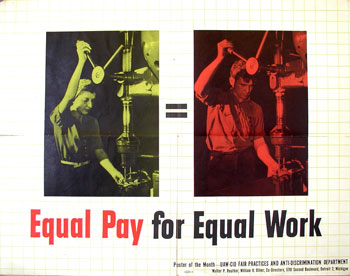
equal_pay.jpg
UAW-CIO Fair Practices and Anti-discrimination Department poster c.1950

By Mary Beth Maxwell

Recent headlines reveal what many of us already know — Americans are witnessing the highest inflation rates seen in over 20 years. According to the U.S. Department of Agriculture, food prices climbed nearly five percent in 2007, and as housing and energy costs skyrocket out of control, working families are getting squeezed. In these difficult times, we should also be reminded that women face even greater financial struggles when weathering this economic storm.

With the observance of Equal Pay Day on April 24, we mark how far into each year a woman must work to earn as much as a man did in the previous year. Recent wage data from the Bureau of Labor Statistics does not give cause for celebration. In 2007, women earned only 80 cents for every dollar a man earned. This pay gap was substantially greater for minorities, with African-American women making only 70 cents and Hispanic women making only 62 cents for every dollar earned by their male counterparts. While women are more reluctant to negotiate salaries and are often employed in underpaid professions, one grim reality remains — gender-based discrimination still inherent in our society has largely caused the pay gap that persists today.

Continue reading

Lobbyists rake in record $2.8 billion in 2007

Corporations, industries, labor unions, governments and other interests spent a record $2.79 billion in 2007 to lobby for favorable policies in Washington, the nonpartisan Center for Responsive Politics has calculated. This represents an increase of 7.7 percent, or $200 million, over spending in 2006.

And for every day that Congress was in session, industries and interests spent an average of $17 million to lobby lawmakers and the federal government at large. The drug industry spent more than any other, increasing its lobbying 25 percent last year.

Read the full news release here.

See OpenSecrets.org’s Lobbying Database here.

John Yoo’s tortured explanations

By Michael Winship
t r u t h o u t | Perspective

“John Adams,” that entertaining and instructive TV mini-series based on David McCullough’s biography, is a reminder that, in some respects, nations are created as much from rancor and ego as they are from hope and goodwill.

In the television version of the irascible Mr. Adams’s saga, democracy triumphs. Still, while watching it, I can’t help but be a little depressed by the thought that while the Founding Fathers sought to build a government of laws rather than men and were crafting such worthy documents as the Declaration of Independence and the Constitution, the current administration’s legacy to history will be a series of documents that chose to subvert the very Constitution that Adams, Jefferson, and the others battled so hard to create.

These documents reveal themselves slowly and reluctantly, as if to acknowledge that those who wrote them know deep in their souls what they have done is wrong and antithetical to the ways of a republic.

The latest to ooze its way to the surface, thanks to a Freedom of Information Act suit by the ACLU, is the March 14, 2003, memo written by John Yoo, former deputy in the Justice Department’s Office of Legal Counsel (OLC), an acolyte of David Addington, Vice President Cheney’s chief of staff and former Cheney legal counsel.

Contrary to claims the abuses at Abu Ghraib and other prisons were contrived by subordinates on the ground – i.e., “hicks with sticks” – Yoo’s 81-page memo rationalizes motive and establishes the bar for virtually every human rights violation that has taken place in the name of fighting the global war on terrorism.

Continue reading

Upstate progressive throws hat into ring

Ted Christian has announced he is running against US Rep. Bob Inglis, the congressman who is so low-profile it’s easy to forget he’s even in DC. Christian is one of three candidates vying for the Democratic congressional nomination, along with Paul Corden, a former marketing executive and retired community college teacher from Spartanburg, and Bryan McCanless of Greenville. Inglis faces a primary challenge from Charles Jeter, an environmental engineer and Reagan administration official from Greer.

Here is a clip from Christian’s kick-off press conference on March 31.

Here is a bit about the candidate, taken from his Web site.

Bio:

I grew up in Florida, received a degree in aerospace engineering from the University of Florida in 1983, and then worked in Houston on the space shuttle and space station programs until basically retiring on stock market investments in 1991. I moved to Greenville in 1999, and bought a house off North Main.

Why am I running?

As much as anything, I’d like to raise the bar a bit.

The democratic process in our country has become a money driven circus, with politicians marketed substantially like cereal, in many cases qualified for office by not much more than money and packaging, while the principal fixed goal of either main party has become greater market share and the power it brings.

The consequences of this political retailing are increasingly dire. Our country now as a matter of stated policy wages aggressive war, the greatest of crimes, invading other nations without legitimate cause. The US is increasingly under what amounts to martial law, with American citizens subject to imprisonment without charge and search without warrant. The US now tortures people, sometimes to death, and laws against torture are brushed aside by a President who essentially proclaims himself above the law. A potentially ruinous public debt continues to mount, the current administration having amassed nearly as much debt as all the previous administrations combined. The US military budget is by any rational standard morbidly obese, greater than all the military budgets for the rest of the world combined, fueling a spiraling arms race which threatens to eventually destroy humanity. The US operates a de facto concentration camp in Cuba, to the detriment of our global standing. The US is effectively a client state of Israel, degrading the quality of American political leadership and compromising prospects for peace in the Middle East. Election turnouts are at historic lows, and with the increasing use of unverified computer voting many have lost confidence their votes are even counted. The Constitution has substantially in principle, and in no small measure in fact, passed into history.

These are grave matters, yet it is unlikely most will be discussed in any substantive fashion, if they are broached at all, by most politicians in the coming election. The American political process is plainly dysfunctional, and we need to talk about it.