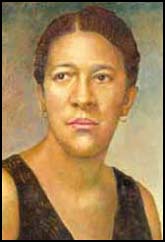
Remembering the legendary Modjeska Simkins

usasimkins.jpg

If you’re in Columbia Tuesday night, join us for a special screening of ETV’s documentary about Modjeska Simkins, “Making a Way Out of No Way.” The 50-minute film celebrates this icon of South Carolina’s civil rights movement.

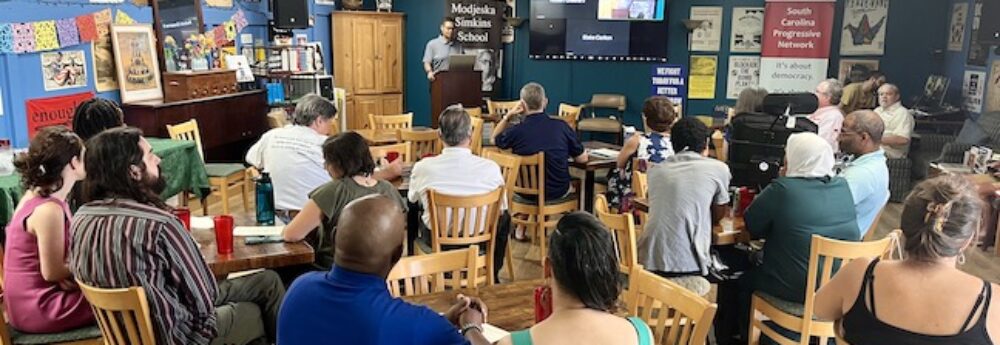
The 7pm screening will be followed by a discussion with some of Modjeska’s comrades about her teachings and legacy. We will meet at Modjeska’s house (now a historical site) at 2025 Marion St. in downtown Columbia. Modjeska’s favorite libation, port, will be served, along with other beverages and popcorn. The event is free and open to the public.

Come out for an evening of remembrance and celebration of a life well lived. You will be inspired – maybe enough to get involved yourself in the fight for human rights.

For information, call the SC Progressive Network at 803-808-3384.

10 things you should know about John McCain

(but probably don’t):

1. John McCain voted against establishing a national holiday in honor of Dr. Martin Luther King, Jr. Now he says his position has “evolved,” yet he’s continued to oppose key civil rights laws.1

2. According to Bloomberg News, McCain is more hawkish than Bush on Iraq, Russia and China. Conservative columnist Pat Buchanan says McCain “will make Cheney look like Gandhi.”2

3. His reputation is built on his opposition to torture, but McCain voted against a bill to ban waterboarding, and then applauded President Bush for vetoing that ban.3

4. McCain opposes a woman’s right to choose. He said, “I do not support Roe versus Wade. It should be overturned.”4

5. The Children’s Defense Fund rated McCain as the worst senator in Congress for children. He voted against the children’s health care bill last year, then defended Bush’s veto of the bill.5

6. He’s one of the richest people in a Senate filled with millionaires. The Associated Press reports he and his wife own at least eight homes! Yet McCain says the solution to the housing crisis is for people facing foreclosure to get a “second job” and skip their vacations.6

7. Many of McCain’s fellow Republican senators say he’s too reckless to be commander in chief. One Republican senator said: “The thought of his being president sends a cold chill down my spine. He’s erratic. He’s hotheaded. He loses his temper and he worries me.”7

8. McCain talks a lot about taking on special interests, but his campaign manager and top advisers are actually lobbyists. The government watchdog group Public Citizen says McCain has 59 lobbyists raising money for his campaign, more than any of the other presidential candidates.8

9. McCain has sought closer ties to the extreme religious right in recent years. The pastor McCain calls his “spiritual guide,” Rod Parsley, believes America’s founding mission is to destroy Islam, which he calls a “false religion.” McCain sought the political support of right-wing preacher John Hagee, who believes Hurricane Katrina was God’s punishment for gay rights and called the Catholic Church “the Antichrist” and a “false cult.”9

10. He positions himself as pro-environment, but he scored a 0—yes, zero—from the League of Conservation Voters last year.10
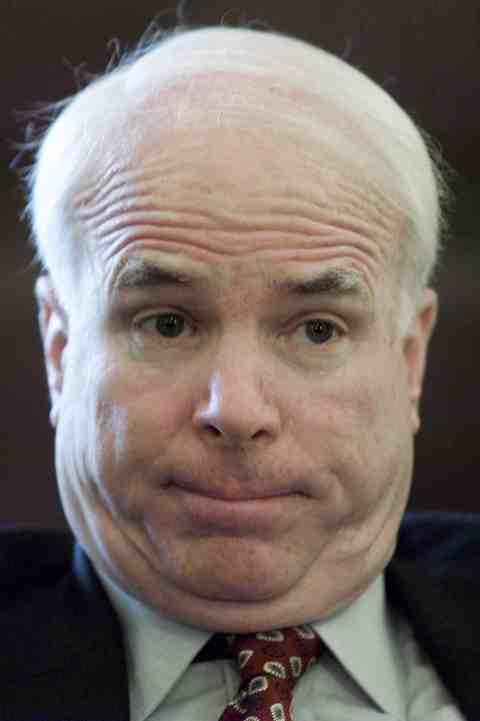
mccain.jpg

Sources:
1. “The Complicated History of John McCain and MLK Day,” ABC News, April 3, 2008

“McCain Facts,” ColorOfChange.org, April 4, 2008

2. “McCain More Hawkish Than Bush on Russia, China, Iraq,” Bloomberg News, March 12, 2008

“Buchanan: John McCain ‘Will Make Cheney Look Like Gandhi,'” ThinkProgress, February 6, 2008

3. “McCain Sides With Bush On Torture Again, Supports Veto Of Anti-Waterboarding Bill,” ThinkProgress, February 20, 2008

4. “McCain says Roe v. Wade should be overturned,” MSNBC, February 18, 2007

5. “2007 Children’s Defense Fund Action Council® Nonpartisan Congressional Scorecard,” February 2008

“McCain: Bush right to veto kids health insurance expansion,” CNN, October 3, 2007

6. “Beer Executive Could Be Next First Lady,” Associated Press, April 3, 2008

“McCain Says Bank Bailout Should End `Systemic Risk,'” Bloomberg News, March 25, 2008

7. “Will McCain’s Temper Be a Liability?,” Associated Press, February 16, 2008

“Famed McCain temper is tamed,” Boston Globe, January 27, 2008

8. “Black Claims McCain’s Campaign Is Above Lobbyist Influence: ‘I Don’t Know What The Criticism Is,'” ThinkProgress, April 2, 2008

“McCain’s Lobbyist Friends Rally ‘Round Their Man,” ABC News, January 29, 2008

9. “McCain’s Spiritual Guide: Destroy Islam,” Mother Jones Magazine, March 12, 2008

“Will McCain Specifically ‘Repudiate’ Hagee’s Anti-Gay Comments?,” ThinkProgress, March 12, 2008

“McCain ‘Very Honored’ By Support Of Pastor Preaching ‘End-Time Confrontation With Iran,'” ThinkProgress, February 28, 2008

10. “John McCain Gets a Zero Rating for His Environmental Record,” Sierra Club, February 28, 2008

List compiled by MoveOn.org.
Gas gouging and green jackets

By Martha Burk

Paid at the pump lately? Who hasn’t, and we’re paying more with each tank. Gas is up a quarter a gallon in the last two weeks alone, but don’t expect big oil to feel your pain. The moguls at ExxonMobil, the fattest of the petroleum cartel cats, will squander several millions of your fuel dollars sponsoring the Masters golf tournament and entertaining their buddies during the April 8 to 12 festivities.

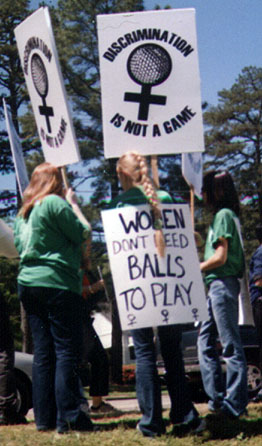
The Augusta National Golf Club, home of the Masters, is famous for its top notch course, beautiful azaleas, members in green jackets — and sex discrimination. A female may be good enough to take the Oval Office, but no woman is good enough make it through the front gates of Augusta National as an equal. Even after a national argument five years ago that played out from network TV to kitchen tables, the boys in green refused to allow women members into their exclusive club. They’re still standing firm.

augusta.jpg

Augusta National lost its TV sponsors for two years over their refusal to admit women, but ExxonMobil came to the rescue, stepping up to the sex-segregation plate with a new multi-year contract to underwrite the Masters broadcast. Female shareowners are outraged, and have filed stockholder resolutions demanding that the company account for the number of dollars spent at Augusta and other venues that discriminate on the basis of gender. The resolutions state the obvious — the company wouldn’t do it if the subject was race. But apparently the boys in the boardroom (there are only two women out of 13) don’t think sex discrimination is such a big deal. Management sent out a letter last month urging stockholders to vote against this simple demand for disclosure.

But don’t think the company isn’t trying to woo women’s dollars while thumbing its nose at the principles of fairness and equality. In a breathtaking act of corporate hypocrisy, last month ExxonMobil also ran a nationwide full page color ad in the New York Times touting its celebration of International Women’s Day, and its support for women rising in the ranks of business — in Africa. The ad cost only a few hundred thousand — several million less than the Augusta sponsorship. Guess they think female newspaper readers are a cheap date.

Women at ExxonMobil are not buying the stonewalling by company management on the Augusta National issue, and women at other firms involved with the club continue to complain of sex discrimination to national women’s rights groups. Attitudes that begin on the golf course naturally spill over to the office, where women say they are passed over for promotion, paid less, and even sexually harassed at many of the companies these guys head. The National Council of Women’s Organizations has been making sure women at the green-jacketed CEO companies get a little payback. The group helped women employees at Morgan Stanley sue that company two years ago for discriminatory employment practices. They recently got a settlement for $46 million. And importantly, they got a change in company policy that expenses and entertainment at discriminatory clubs will no longer be underwritten with company dollars.

Exxon ought to listen to this canary in the coal mine. Women — no doubt including some of its own employees — are fed up. The company’s record-breaking bottom line has been fattened by their work. That bottom line has also been pumped up by female customers who must drive to get to work, school, church, and the grocery store. So whether you’re a woman behind the wheel or a man who cares about the women in your life, the next time you need a fill-up, consider what you’re really paying for when you choose one brand over another.

While ordinary people struggling to balance their checkbooks, the corporate guests of ExxonMobil are struggling to get another drink at the company-sponsored open bars in Augusta, Georgia. And oh yeah, the corporation gets to deduct every penny. Hold that thought. It just might cause you to drive to the next pump a little further down the block.

Burk is author of “Your Money and Your Life: The High Stakes for Women Voters in ‘08 and Beyond”

Mad science

Deconstructing Bunk Reporting in Five Easy Steps
By Beth Skwarecki

Bitch Magazine

British scientists have uncovered the truth behind one of modern culture’s greatest mysteries: why little girls play with pink toys. Is it because toy companies flood whole store aisles with the color? Or because well-meaning relatives shower girl babies with pink blankets and clothing? Nope. According to the men in lab coats, it’s purely biological.

Apparently, women are hardwired to like pink because our cavewoman foremothers spent their days gathering red leaves and berries amongst the trees while their husbands were out hunting. Later, women needed to notice red-faced babies and blushing boyfriends. And why do men like blue? Because it’s the color of the sky.

This evolutionary just-so story takes up three pages of a 2007 issue of Current Biology. To back up the assertion that pink is a universal girly preference worth examining, the authors refer to a 1985 study finding that little girls use more pink and red crayons in their drawings than little boys do.

Dig further, however, and the story completely falls apart. British women do prefer pink, but the author’s claim of a “robust, cross-cultural sex difference” turns out to be neither. The scientists compared British natives with Chinese immigrants to Britain, and glossed over the differences. For example: The girliest color in the British results, a purplish-pink, was in fact the Chinese men’s favorite.

Nowhere do scientific findings get more mangled than when they’re about the differences between men and women. According to the science pages, women aren’t just biologically hardwired to prefer pink to blue. We’re also predisposed to backstab one another in the workplace, cry in the boardroom, and have both lower iqs and less of a sense of humor than men.

Some misleading stories come from bad science, where the study authors’ conclusions aren’t supported by their own data. Others are well-conducted studies whose conclusions mutate upon contact with the mainstream media. Newspapers and websites are prone to playing fast and loose with their reports on studies, often neglecting to reveal salient facts about a study’s sample group or methodology.

The fact is that science articles aren’t designed to be read by non-scientists. College and grad students in the sciences are trained in how to do it: They review papers and discuss them in journal clubs; learn how to question methodologies (Is that sample really big enough? Was that the right test to use?); and learn how to be critical of authors’ interpretations (Do the results really mean what they say they mean?). Students also know to look at context for each study, looking up previous papers on the subject, reviewing the authors’ previous work, and searching out any evidence of bias that might color a study’s findings.

Journalists looking for a quick story, however, do little such research. And in an age where news sites, wire services, and blogs pick up stories with lightning-fast speed, bad research gets around. When London’s Sunday Times reported on a 2007 study claiming that men get dumber in the presence of blond women, the paper got the name of the journal wrong, citing the Journal of Experimental Psychology rather than the Journal of Experimental Social Psychology. Nearly every subsequent news article repeated the error because they were content to simply reword the Times’ version of the story rather than finding and discussing the study itself.

Continue reading