Monthly Archives: May 2008
Remembering Sean Kennedy
Family and friends gathered in a downtown Greenville park on May 16 to honor the memory of Sean Kennedy on the first anniversary of his murder. His mother, Elke Kennedy, has campaigned tirelessly in the past year to educate the public and to promote passage of hate crimes legislation in South Carolina. She established Sean’s Last Wish Foundation to further that work.
After an emotional ceremony, the crowd filed down to the Falls Park bridge and dropped daisies into the Reedy River.
Read an earlier blog post about Sean here.
Elected women make a difference
by NOW President Kim Gandy
Okay, take a guess. What do the G.I. Bill, the School Lunch Program, and the Fair Labor Standards Act have in common? How about federal aid to education, the nationwide network of veterans’ hospitals, and the tax deduction for child care expenses?
If you’re really stumped, how about Title IX, the equal educational opportunity law? The Equal Pay Act and the Family and Medical Leave Act? The Freedom of Choice Act? The Paycheck Fairness Act and the Fair Pay Act? Okay, maybe now you’re getting the idea.
Yes, despite their paltry representation, women in Congress introduced them all, along with countless other reforms that affect our lives to this day. It might sound clichéd, but women leaders do make a difference. Women began serving in Congress less than 100 years ago, and throughout that brief history they have made a great impact – a truly progressive, society-transforming impact.
Organizations like NOW, and feminists in general, often state that we need more women in government, from local school boards all the way to the highest levels of office. Increasing the number of women in power is a good thing — that’s just common sense, right? But taking a closer look at why it’s so important has been on my mind as the November elections approach.
First, there’s simple parity. Currently, women hold a paltry 16 percent of the seats in the United States Congress and they make up 24 percent of the state legislatures. Only eight states have women governors, and we all know that the U.S. has yet to have a woman president or even a female nominee from a major political party. And as recently as 1992, women were only 2% of the U.S. Senate.
With women vastly under-represented in this arena, and glass ceilings still to be smashed, women’s rights advocates would be negligent not to try to correct such an imbalance.
But there’s so much more to the argument than fairness.
It might seem obvious, but it’s worth noting that most women legislators can be counted on to fight for the “bread and butter” women’s issues that a legislature exclusively occupied by men might not bother to tackle. Access to reproductive health services and child care, the right to equal pay and education opportunities, ending sexual harassment and all forms of violence against women – without a doubt, these issues advance when women with firsthand experience secure the authority to do something about them.
It was a woman, in fact, the very first woman ever to serve in Congress, Jeannette Rankin, who introduced the very first piece of federal social welfare legislation — a bill to reduce maternal and infant mortality.
Moms rising
Bush operative pushes voter-ID law
By Jason Leopold
Consortium News
A senior legal adviser to the Bush-Cheney 2004 reelection campaign is working behind the scenes to help enact a Missouri state constitutional amendment that critics say would suppress the vote in the key battleground state this November by requiring voters to show proof of citizenship.
Mark “Thor” Hearne, Bush-Cheney’s national counsel in 2004 and now a partner in the St. Louis, Missouri, firm of Lathrop & Gage, has been collaborating with Missouri’s Republican state Rep. Stanley Cox, the sponsor of the constitutional amendment, Cox’s office confirmed this week.
For years, Hearne has been a leading Republican figure demanding stricter voter-identification laws and popularizing claims about widespread voter fraud, although many election experts dismiss such alarms as hyperbole.
During the 2004 campaign, Hearne reportedly worked with White House political adviser Karl Rove on “voter fraud” issues and spearheaded GOP efforts to challenge voter-registration drives by pro-Democratic groups.
According to a posting at his law firm’s Web site, “Hearne traveled to every battleground state and oversaw more than 65 different lawsuits that concerned the conduct of the election.”
Hearne also has shown up as a background figure in the Bush administration’s scandal that erupted over the firing of nine federal prosecutors, some of whom came under White House criticism for not seeking pre-election voter fraud indictments in 2006.
More recently, Hearne has been instrumental in pushing state lawmakers to pass strict voter identification laws in Missouri, New Mexico, Indiana and other states. The Indiana voter-ID law recently was upheld by the conservative majority on the U.S. Supreme Court.
Hearne conducted much of this work through his now defunct organization, the American Center for Voting Rights (ACVR), which called itself a non-partisan group defending voter rights and seeking to enhance public confidence in the fairness and outcome of elections.
However, an investigation into ACVR by blogger Brad Friedman reported that it concentrated on stricter voter-ID laws. “Thor Hearne helped to write that Indiana law, then Thor Hearne submitted an amicus brief to the Supreme Court on behalf of Republican U.S. Congress members in support of it.”
GOP Strategy
Rather than an epidemic of illegal voters casting ballots, some election experts point to a nationwide Republican strategy of exploiting those concerns to depress the voting of low-income and minority citizens and thus boost the chances of GOP candidates.
Joseph Rich, formerly chief of the voting section in the Justice Department’s Civil Rights Division, said that under the Bush administration the department “shirked its legal responsibility to protect voting rights.”
“Over the last six years, this Justice Department has ignored the advice of its staff and skewed aspects of law enforcement in ways that clearly were intended to influence the outcome of elections,” Rich wrote in a March 29, 2007, op-ed in The Los Angeles Times.
“From 2001 to 2006, no voting discrimination cases were brought on behalf of African American or Native American voters. U.S. attorneys were told instead to give priority to voter fraud cases, which, when coupled with the strong support for voter ID laws, indicated an intent to depress voter turnout in minority and poor communities.”
The truth about veteran suicides
By Aaron Glantz
Foreign Policy in Focus
Eighteen American war veterans kill themselves every day. One thousand former soldiers receiving care from the Department of Veterans Affairs attempt suicide every month. More veterans are committing suicide than are dying in combat overseas.
These are statistics that most Americans dont know, because the Bush administration has refused to tell them. Since the start of the Iraq War, the government has tried to present it as a war without casualties.
In fact, they never would have come to light were it not for a class action lawsuit brought by Veterans for Common Sense and Veterans United for Truth on behalf of the 1.7 million Americans who have served in Iraq and Afghanistan. The two groups allege the Department of Veterans Affairs has systematically denied mental health care and disability benefits to veterans returning from the conflict zones.
The case, officially known as Veterans for Common Sense vs. Peake, went to trial last month at a Federal Courthouse in San Francisco. The two sides are still filing briefs until May 19 and waiting for a ruling from Judge Samuel Conti, but the case is already having an impact.
“Shh!”
That’s because over the course of the two week trial, the VA was compelled to produce a series of documents that show the extent of the crisis effecting wounded soldiers.
“Shh!” begins one e-mail from Dr. Ira Katz, the head of the VAs Mental Health Division, advising a media spokesperson not to tell CBS News that 1,000 veterans receiving care at the VA try to kill themselves every month.
“Our suicide prevention coordinators are identifying about 1,000 suicide attempts per month among the veterans we see in our medical facilities. Is this something we should (carefully) address ourselves in some sort of release before someone stumbles on it?” the e-mail concludes.
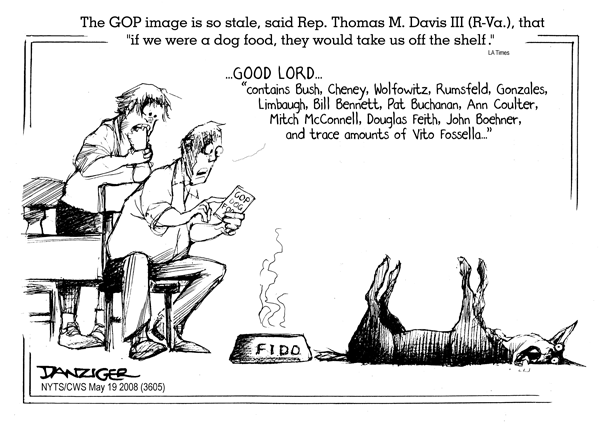
GOP getting crushed in polls, key races
By Jim VandeHei and David Paul Kuhn
The Politico
John McCain is planning to run as a different kind of Republican. But being any kind of Republican seems like some sort of death sentence these days.
In case you’ve been too consumed by the Democratic race to notice, Republicans are getting crushed in historic ways both at the polls and in the polls.
At the polls, it has been a massacre. In recent weeks, Republicans have lost a Louisiana House seat they had held for more than two decades and an Illinois House seat they had held for more than three. Internal polls show that next week they could lose a Mississippi House seat that they have held for 13 years.
In the polls, they are setting records (and not the good kind). The most recent Gallup Poll has 67 percent of voters disapproving of President Bush; those numbers are worse than Richard Nixon’s on the eve of his resignation. A CBS News poll taken at the end of April found only 33 percent of Americans have a favorable view of the GOP – the lowest since CBS started asking the question more than two decades ago. By comparison, 52 percent of the public has a favorable view of the Democratic Party.
Things are so bad that many people don’t even want to call themselves Republicans. The Pew Research Center for the People & the Press has found the lowest percentage of self-described Republicans in 16 years of polling.
“The anti-Republican mood is fairly big, and it has been overwhelming,” said Michigan Republican Party Chairman Saul Anuzis.
With an environment so toxic, does McCain have even a chance of winning in November?
Democrats’ bumper crop
Last week’s Indiana primary put an exclamation point on one of the big civic-political trends of the year: Democratic turnout is surging.
Of all adult Hoosiers who could vote, 27.6 percent went to the polls to choose between Hillary Rodham Clinton and Barack Obama, the fourth-strongest turnout this year — and more than 20 percentage points higher than in either of the state’s previous two presidential primaries. And something similar has happened across the country:
State by State: Click Here to View Chart
In Washington, D.C., and the 26 states that have had contested Democratic primaries all three times, turnout of the voting-age, citizen population in those contests has averaged 19 percent in 2008 — 9 points higher than in 2004 (when John Kerry wrapped up the nomination by early March) and 10 points higher than in 2000 (when Al Gore did likewise, and the GOP nominating contest was harder-fought.) More than one-quarter of adults showed up to vote Democratic in D.C., Vermont, New Hampshire, Indiana, Massachusetts, Wisconsin and Ohio.
And 17 places recorded percentage-point turnout gains in double digits since 2000. The Republicans have not seen the same phenomenon; the turnout of adults for GOP primaries topped 20 percent only in New Hampshire this year, and in 15 states turnout was a smaller percentage this year than in 2000.
Pro-choice candidates fight for Senate seats
By Dana Goldstein
RH Reality Check
Exhausted and stultified by the endless Democratic primary? Gagging a little bit every time you hear that John McCain is a “maverick?” With all the attention paid to the presidential slugfest, it’s easy to forget that this November, over a third of the United States Senate will also be up for grabs. While supporters of reproductive rights fervently hope to see the White House back in pro-choice hands, the Senate would act as the crucial check on presidential power should that effort be thwarted. That’s because with veto power over federal judicial appointments, only Senators have the ability to stymie a conservative president’s attempts to place another anti-Roe justice on the Supreme Court.
Today’s Senate Democrats enjoy only a razor-thin 51-49 majority, meaning they can’t prevent conservative filibusters or override a presidential veto. And according to NARAL Pro-Choice America classifications, there are currently just 35 strongly “pro-choice” senators and 17 “mixed choice” senators (including majority leader Harry Reid), but a full 48 “anti-choice” senators. That means when it comes to protecting reproductive health and rights, every open seat can make a difference, whether Republican or Democratic. Here are some of the key races to look out for:
Maine
One might think that two-term Republican Senator Susan Collins would be facing a tougher than usual reelection battle this year because of her constituents’ frustrations with the conservative excesses of the Bush years. Still, polls show Collins leading her Democratic competitor, Rep. Tom Allen, by over 20 points. “Independent Democrat” Sen. Joe Lieberman has said he will campaign for her.
Family planning: an historic right
By Donna P. Hall
American women, like those in other industrialized countries, take our family planning for granted. But we shouldn’t. It’s only been 40 years since family planning was recognized as an international human right.
It was May 13, 1968, that the International Conference on Human Rights, held in Tehran, declared that “Parents have a basic human right to determine freely and responsibly the number and the spacing of their children.”
It is an understatement to say that for women worldwide, this was a revolutionary declaration. For millennia, women were valued almost exclusively as mothers — while family planning was illegal. But women have sought means of limiting their mothering at least since Cleopatra tried using gold pellets. Women have always known that family planning gives them options — time to mature, to get an education or hold a job, or to recover from previous pregnancies.
Women also know that motherhood, though beautiful, is dangerous. More than 40 percent of all pregnancies suffer complications, and in 15 percent of pregnancies the complications are life-threatening. Infection, hemorrhage, high blood pressure (eclampsia), and obstructed labor, were routine killers of women worldwide, rich and poor alike, until the western medical advances of the 20th century. The Taj Mahal is a bereaved emperor’s monument to the wife who died at the age of 39 giving birth to his 14th child. In 1900, death in childbirth was still common, but women around the world bore an average of six children each.
The arrival of the intra-uterine device and the birth control pill in 1960 began the era of safe, affordable and effective contraceptives, and pressure from the post World War II generation of educated women gradually led to its legalization around the world.