Voting reform update

By Brett Bursey
Director, SC Progressive Network

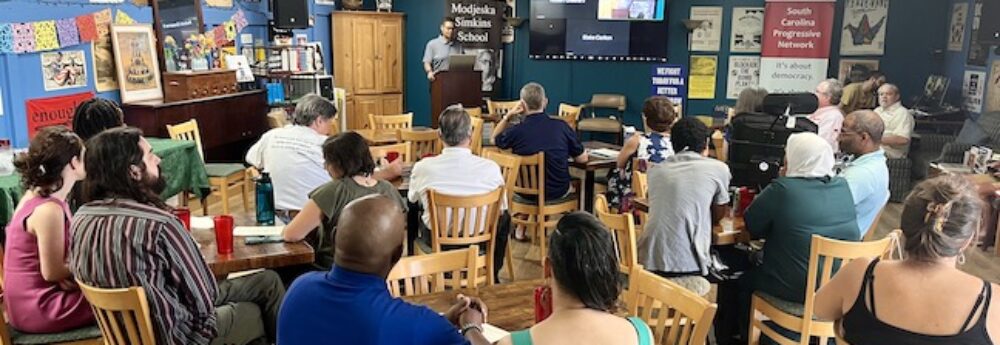
The last couple of weeks of hearings in the House and Senate on voting reform legislation have gone a little better than expected. Not to say we are winning, but we have mixed results. We can anticipate that there will be an early voting bill passed out this session. The best version (the one we sponsored), H-3608 (Mack-D Charleston) was the only one of six early voting bills to come out of subcommittee. We had to give up the Same Day Registration aspect of the bill that allowed citizens to register to vote between 15 and three days before the election to get it out of subcommittee. Rep. Bakari Sellers (D-Orangeburg), who is on the House Judiciary Election Laws subcommittee, did a magnificent job moving the bill to the full committee.

Our sponsor of the Early Voting bill in the Senate, S-369 (Leventis, D-Sumter) testified at a Senate Judiciary subcommitee April 2 about the practicality and benefits of registering voters during the early voting period. We presented Michael Dickerson, the Ex. Director of the Mecklenburg Co. Board of Elections, to testify about how that county, with 600,000 voters, runs its early voting system. Dickerson told the subcommittee (Senators Campsen, Cleary, and Scott) that the county that includes Charlotte uses the exact same machines to vote as we do in SC. Dickerson said that the system has bipartisan support, the citizens and the election workers love it, and it saves money.

Sen. Campsen (R-Charleston) has a voting reform bill that calls for early voting as we experienced it in 2008, but without having to have an excuse. Campsen’s bill calls for early voting only at the county election office — no satellite facilities — and includes photo ID’, doing away with fusion voting, and increasing the penalties for fraud. It is the worst bill we can come out of this session with, but will still be better than what we have by allowing “no excuse early voting.” The election workers testified that Campsen’s bill would overwhelm the county offices and make the elderly and infirm wait in line with thousands of other voters.

Hearings in the Senate will continue, probably on April 16, and we will continue to argue for our early voting bill that calls for satellite facilities, and same-day registration. We are considering offering as a compromise applying photo ID requirements to those who register at the early voting centers. This would impact only a small percentage of voters (in Mecklenburg, only 2,000 out of 120,000 were Same Day Registrants), not impact the elderly, rural and minority voters who may not have photo IDs, and give the Republicans who demand photo IDs a face-saving victory. Accepting any form of photo ID is controversial among our allies, and we need to reach a consensus on this.

The bill to restrict petition candidates (S-590 & H-3208) will probably pass the House and is in the Senate subcommittee. The Senate sponsor of the bill, Brad Hutto (D-Orangeburg) assures us that he will narrow it to only apply to citizens not being able to sign a petition for a candidate for an office they voted for in a primary. The bill would currently prohibit a voter from signing a petition for a candidate for ANY office if they voted in a primary, even if there were no candidate for the office they wanted to sign a petition for.

The bill calls for petition candidates to have to file notice of their intention to run by March 30, prior to the general election. This deadline has been held unconstitutional by the courts, and Sen. Hutto is willing to consider moving the filing date for petition candidates back to the Aug 15 deadline for third-party candidates.

It’s all about Mark Sanford — again

By Joseph Neal
(Rev. Neal served as Co-chair of the SC Progressive Network for a decade)
Guest Columnist, The State

Author and pastor Rick Warren begins his transformative book, The Purpose Driven Life, with a simple statement: “It’s not about you.”

As Gov. Mark Sanford engages the General Assembly in political gamesmanship over accepting federal stimulus dollars, his actions should prove to South Carolinians that despite his words to the contrary, it’s not about you.

Don’t be confused. Whether or not the governor accepts the money has nothing to do with the potential impact on you, your family or your quality of life.

So, to the more than 4 million residents of our state, it’s not about you.

To the 1,000 to 6,000 public school teachers facing layoffs if the money is rejected, it’s not about you.

To the hundreds of thousands of school children facing larger class sizes, fewer gifted and talented course offerings and fewer textbooks and supplies, it’s not about you.

To the business owners who rely on state government or the workers it employs to survive, it’s not about you.

To the 241,000 residents currently unemployed, it’s not about you.

Even to the 601,868 of you who voted for Sanford in the 2006 general election, it’s not about you.

And especially to the 170 members of the General Assembly, it’s not about you.

If nothing else, this continuing controversy should confirm once and for all that the governor does not have — and has not had — the best interest of South Carolinians at heart. For six years, the governor has used his bully pulpit to mislead and misinform residents, resulting in alternating tides of fear and anger.

He has manufactured controversies and exaggerated differences with the General Assembly for the sole purpose of either garnering more power for himself or defunding and destabilizing state government. Those are the only two end products of his political agenda.

The debate over school vouchers is nothing more than a vehicle to limit funding to public education by diverting it elsewhere. The governor’s persistent calls for eliminating the personal income tax is merely a means to take away the most stabile revenue source — even in a downturn — for state government.

With the controversy surrounding the stimulus money, the governor gets to accomplish both goals. The stimulus bill affords the governor new-found power to shape the budget debate. And he has used his position to catapult himself into the national spotlight. At the same time, he has more authority than ever to severely limit or destabilize state government. For Sanford, the stimulus debate, as the political pundits say, is a perfect storm.

Sanford does not believe in the power of government to better the lives of citizens. The governor does not believe in the responsibility of government to be a safety net for those who are less fortunate or cannot help themselves.

His attacks on state government will have the net effect of shrinking our state’s middle class. This is particularly troubling for African-American residents, who hold a greater share of managerial positions in state government than in the private sector.

The governor’s attacks on public education threaten to exacerbate economic and racial disparities in our state. Education is our society’s greatest equalizer. Keeping our residents poor and ignorant makes the state attractive only to those types of businesses that will keep them in subjugation.

Rev. Warren’s words were intended to remind us to move beyond being self-absorbed and find God’s purpose for our lives by helping one another. This is particularly true for anyone desiring to be a public servant. So, Mark Sanford, enough. It’s not about you.

Rev. Neal represents Richland and Sumter counties in the S.C. House.

The Re-Blease-ing of South Carolina

By Charlie Smith, Charleston, SC

A distant relative of mine on both my mother’s and father’s sides of the family (yes, I am a native South Carolinian) was once elected to the office now held by Governor Mark Sanford. One of the sayings that got him elected and kept him in office as a noted 20th century…yes 20th Century…Governor and later U.S. Senator was his declaration that “To educate a nigger is to ruin a good field hand.” Sayings like this and equally offensive daily rants during his tenure as Governor and later as US Senator were designed to pit poor white upstate millworkers and sharecroppers against African Americans and against the evil politically dominant Charleston “aristocrats” and “dandies”; the kind of man he described as “…some fellow who does nothing, lives on his daddy’s name and doesn’t pay his debts.”; and more colorfully as those who “fiddled away their nights watching decadent theater shows, yelling with delight at a foul mouth Yankee woman and a man dressed as “The Pink Lady.”

As governor, Coleman Livingston Blease fought with all his might against a law that would require all children under the age of fourteen in South Carolina to attend school. He preached against this legislation to poor whites ranting that “The Bible says a great deal about obedience to parents and reverence for parents and believing in the Book and its teachings, as I do. I say to the parents, and for the sake of their children, our country and for their future, keep within your own control the rearing and education of your own children.”

Continue reading

A parable for our times

Speech delivered by the Rev. Dr. Neal R. JonesUnitarian Universalist Fellowship, (a member of the SC Progressive Network) at the April 1 People’s Stimulus Rally

A great teacher once told a story that went something like this: Once upon a time, a man was traveling down a winding, dangerous road, and he was set upon by thieves, who beat him and robbed him and left him half dead. By chance, a priest was traveling down that same road, and when he saw the man, he passed by on the other side. Later, a Levite came down the road, and when he saw the man, he too passed by on the other side. Then a Samaritan came upon the man, and when he saw him, he had compassion, and he went to him, bound up his wounds, and took him to an inn where he could be cared for. Jesus concluded his Parable of the Good Samaritan by telling his listeners, “Go and do likewise.”

This story was told long ago, but it is as current as today’s news. For the people of South Carolina have been left lying in the ditch, beaten down by the second highest unemployment rate in the country. We have been robbed of our health insurance. Over 300 persons per day are losing their health insurance in South Carolina, so that 16 percent of us are uninsured, one of the highest rates in the country. We have been wounded by a ìcorridor of shameî that runs through the heart of our state, where our neediest children have been consigned to a ìminimally adequateî education, as if that were morally adequate. We have suffered from a minimum wage that is not a livable wage and does not reward the hard work or respect the dignity of working people.  In the worst economic crisis since the Great Depression, all Americans are hurting, and South Carolinians are hurting the most.

Continue reading