SC Retirees Must Keep Sharp Eye on New Spending Panel

A new federal commission is meeting for the first time today in Washington, and Julie Harbin, president of the South Carolina Alliance for Retired Americans (the newest member of the SC Progressive Network), is encouraging retirees in the Palmetto State to pay close attention in the coming months.

The panel, the National Commission on Fiscal Responsibility and Reform, is a bi-partisan group charged with recommending ways to lower the federal debt. US Congressman John Spratt serves on the Commission, which will offer its recommendations in December.

Harbin fully supports the goals of the Commission, but is deeply concerned that some are urging the panel to recommend changes in Social Security as a way to reduce the federal deficit. “If the commission takes a thorough and honest look at Social Security, it will see one of our nation’s greatest success stories. Social Security has helped generations of retirees stay out of poverty. South Carolina’s retirees want to make sure that Social Security remains strong for our children and grandchildren,” Harbin said. She noted that for over 25 percent of retirees, Social Security is their only source of income. With an average monthly benefit of only $1,164, she said that Social Security is, “a tenuous lifeline for many seniors.”

Harbin said that Social Security did not cause our large deficits. Since 1983, American workers have paid enough Social Security payroll taxes to accumulate a $2.5 trillion surplus in the Social Security Trust Fund. But between 2001 and 2006, Washington gave away $2.48 trillion in tax cuts.

To help retirees better follow the panel’s work, the Alliance for Retired Americans has written the Commission to urge that its work be conducted in open, televised sessions and that it hold field hearings across the country to listen to public testimony.

SC Alliance for Retired Americans President Julie Harbin.

Calling all SC political junkies

Tired of politics as usual?


Don’t miss the SC Progressive Network’s Conference April 10!

Booker T. Washington Cultural Arts Center
2611 Grant St., Columbia SC

FREE and open to the public!

Join us for the SC Progressive Network’s 14th annual spring conference, beginning with non-partisan policy work and ending with political action. This year, we have candidates from our own ranks running for office. Given these politically charged and challenging times, this promises to be a lively day of talking politics. We need YOU at the table!

AGENDA

11 am: Registration and light lunch (RSVP for lunch required by4/8/10. Pay $10 on site. Please let us know of any dietary restrictions.)

Noon-2:30pm: Progressive Network Education Fund meeting. If your organization is part of the Network’s nonpartisan coalition, your organization has a seat on the board and should be represented. Remember: this is YOUR organization. It is only as strong as you make it.

  • Network Co-chairs Rep. Joe Neal and Donna Dewitt will review our policy struggles and lead a discussion on sharpening our strategy and tactics.
  • Network Director Brett Bursey will lead a workshop on “Corporations and Democracy.”
  • “Jobs With Rights” organizer Ken Riley, President of the Charleston longshoreman’s union will present the campaign’s plan to fight SC’s anti-worker laws.

3-5pm: Progressive Voter Coalition meeting. SC ProVote is a political action committee of individual Network members and allies. ProVote supports candidates, regardless of party, that support our values of a just and inclusive democracy.

  • We’ll hear from candidates seeking our endorsement, target races and refine strategies and tactics.
  • We’ll discuss Progressive Caucus plans for the state Democratic Convention April 24.
  • Political consultants Carey Crantford and Wil Brown will lead a session on effective messaging of campaigns.

For more information or to RSVP for lunch, call 803-808-3384 or email network@scpronet.com.

Racial profiling topic of TV program

SC Progressive Network Director Brett Bursey recently appeared on WIS-TV’s Awareness show to talk about the racial profiling study the Network completed in January, as well as the legislation we’ve been advocating for several years. He was joined on the program by Sheriff Leon Lott.

Click below to view.

Part one

Part two

Part three

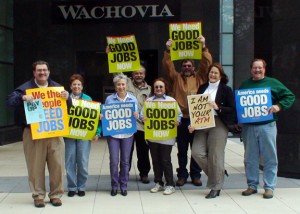
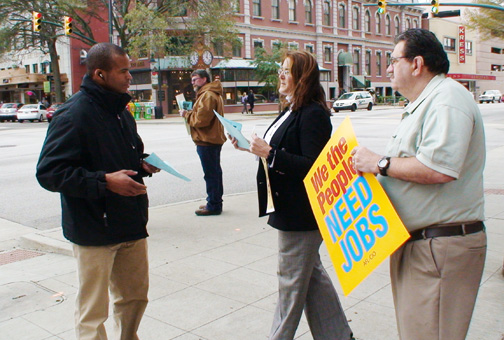
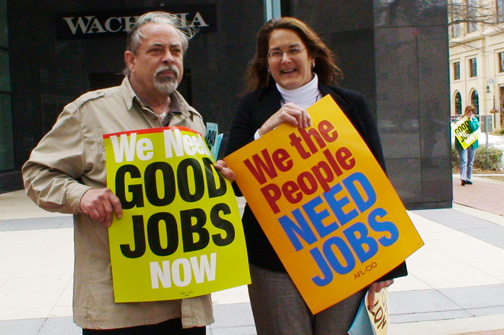
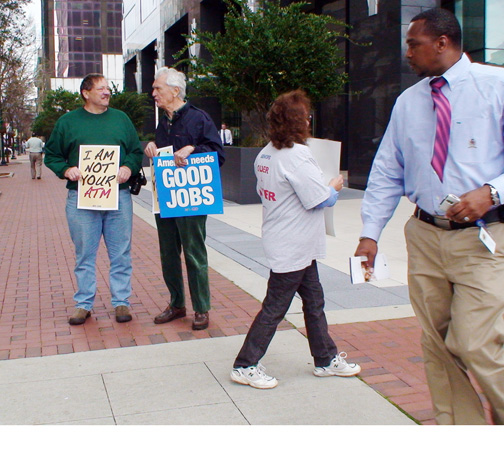
Labor activists picket Wachovia in Columbia


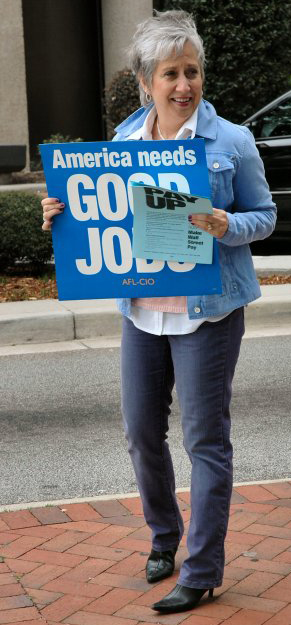
As part of a national effort led by the AFL-CIO, labor supporters held a lunch-time informational picket in front of Wells Fargo/Wachovia’s Columbia headquarters. Members of the SC Progressive Network joined the SC AFL-CIO, SC Alliance for Retired Americans (our newest Network member) and the Central Labor Council in passing out fliers and talking to passersby about the bank’s practices.

“America needs 11 million jobs, and big Wall Street banks should pay to rebuild jobs and the economy they helped destroy,” said Jenny Patterson, President of the Columbia Central Labor Council.

Since the recession began, America has lost nearly nine million jobs when we needed to create more than 2 million just to stay even. While Americans have lost jobs, homes, retirement savings and hope, Wall Street banks took billions in taxpayer bailouts and gave executives some $145 billion in 2009 pay and bonuses. Now they’re spending millions lobbying to kill financial reform.

The AFL-CIO is calling for a major jobs plan to extend unemployment
insurance benefits, food assistance and health benefits; rebuild our crumbling infrastructure; increase aid to state and local governments to save critical services and jobs; increase funding for neglected communities to match people who need jobs with work that needs to be done; and use TARP money to get credit flowing to small businesses for job creation.

What you should know:

* Wells Fargo/Wachovia got a $25 billion taxpayer bailout.

* Wells Fargo/Wachovia paid CEO John Stumpf $21.3 million last year.

* Wells Fargo/Wachovia spent $2.9 million on lobbying last year to kill financial reforms.

SOURCES: Company SEC filings, The New York Times, Center for Responsive Politics

View more photos by clicking here.

Family planning services are wise investment

By Beth Richardson

Columbia attorney with Tell Them, an e-advocacy network supported by the New Morning Foundation, a member of the SC Progressive Network

The Legislature faces the unenviable task of finding ways to reconcile the state’s budget while continuing to provide meaningful services to its citizens. What many lawmakers do not see, however, is the great opportunity to achieve a documented 17:1 return on investment simply by restoring funding for family planning services.

Births to teen mothers in South Carolina cost taxpayers upwards of $156 million annually. (In Richland and Lexington counties alone, that number reaches $15 million.) We have the eighth-highest rate of pregnancies among 15- to 19-year-olds in the nation, and our state’s teen pregnancy rates are on the rise. In some rural counties, the rates can be as high as 200 pregnancies per 1,000 young women ages 18 to 19. Why? They have received virtually no family planning education in school, and due to a series of state budget cuts, they have no access to contraceptive counseling and clinical services in their isolated rural communities.

A state’s money invested in family planning services offers a strong return on investment and represents sound fiscal policy. A cost-benefit analysis conducted by researchers at the University of Iowa and the University of Northern Iowa found that in as little as five years, a state can save $17 for every tax dollar invested in programs and clinics that help prevent unintended pregnancies among 14- to 19-year-olds.

Of course economics are only one part of the equation. Restoring state funding for family planning services will mean fewer unintended pregnancies, so fewer children will be born into situations where they will be at greater risk of child abuse or neglect.

Here is what we know: Children born to mothers age 15 and younger are twice as likely to be abused or neglected in the first five years of their lives than are the children born to mothers ages 20 to 21. They are more likely to grow up in a poor and mother-only family, to live in an impoverished or underprivileged neighborhood and to suffer high risks to both their health status and potential school achievement. Poverty, inadequate social support, mothers’ lack of education, mothers’ cognitive immaturity and greater maternal stress all have been suggested as possible factors contributing to unsatisfactory social and educational outcomes for the children of teen mothers, many of whom never were intended.

One in four children and nearly half of single-mother families are expected to be poor in 2011. Making further progress in reducing teen pregnancy will benefit the national and state economies as well as improve the educational, health and social prospects for this generation of young people and the next.

On March 23, thousands of South Carolinians are taking part in our state’s first-ever virtual march on the State House. They believe, as we do, that one of the most fiscally responsible actions our Legislature can take is to properly fund age-appropriate reproductive health education and access to services for all South Carolinians. By protecting all children and young adults now, we can save millions of dollars in public health care and welfare services in the future.

It’s our responsibility to stand together on behalf of all these young people, so that each of them can have the opportunity for a future that is bright and healthy. We must take a long view, and invest in programs that will make South Carolina a healthier state.

Making the case for urban agriculture

By K. Rashid Nuri
Director, Truly Living Well Center for Natural Urban Agriculture

In his State of the Union address, President Obama enumerated ongoing problems requiring his attention: health care, the economy, job creation, environmental issues and lack of renewable fuels. In doing so, he suggested that increasing agricultural exports would help solve some of these problems.

While export agriculture might indeed help some corporations, it is unlikely to resolve issues directly affecting the public. One thing that would, however, is urban agriculture. While not a panacea, urban agriculture can allay many of the concerns mentioned by the president, and it can do so in several critical ways.

Our country is now undeniably urban. According to recent demographics, 81 percent of us now live in cities or suburbs. And with so few of us living on farms or in rural areas, our familiarity with the production and source of our food is limited. As an urban organic farmer, I find it amazing that so many chefs, produce managers, restaurateurs and Americans in general remain blithely unaware of the sources of their food. Many have no idea what food looks like coming out of the soil, let alone have an awareness of seasonal fluctuations in fruit and vegetable production.

Implications of this lack of knowledge and involvement in our own food production are immense, affecting all aspects of our life.

Since the dust bowl era of the 1930s and the end of World War II, there has been an effort by government and corporate America to industrialize American agriculture. There has been an emphasis on efficiency and quantity rather than on growing quality food and protecting natural resources. Agriculture is estimated to represent approximately 20 percent to 25 percent of the U.S. annual energy budget, and as much as 40 percent of that energy goes towards production of artificial fertilizers and pesticides. Chemical-based growth stimulants produce large quantities of food at the expense of the minerals, vitamins and trace elements that create flavor and nutrition. Evidence of the poor quality of our food can be seen in rising rates of obesity, vitamin deficiencies and food-borne illnesses.

Sadly, the major victim of industrial agriculture is the American public. We are subjected to more chemicals in food, more additives in food products and massive advertising campaigns for these products, and until recently were offered few healthy alternatives.

We Americans are in the early stages of reclaiming our food sovereignty. This is evidenced by the fast-growing organic sector in agriculture, the advent of urban agriculture initiatives and the increased numbers of farmers markets found in urban areas everywhere.

All across the nation, urban farmers are growing crops on vacant lots, in abandoned fields, in greenhouses, on balconies, by schools, in prison yards, in nursing homes and in countless other creative and engaging places. These urban growing fields can be privately owned, formed as cooperatives, as neighborhood organizations, in collaboration with universities or as partners with city and county governments. Options are endless. Urban America is beginning to wake up and feed itself.

Urban agriculture can play a critical role in reversing many negative aspects of industrial agriculture. Urban farming enhances the health of metropolitan residents, creates “green” jobs, produces affordable locally grown organic fruits and vegetables; teaches people to grow their own foods; reconnects people to their food and the land; and strengthens the environment through reduced fossil fuel dependence and carbon sequestration.

The source of our food is an abstract concept for most of us. But this is changing. More and more people are exploring the supply chain that connects the production of their food to its final consumption. People are returning to the earth as they learn that urban gardens provide benefits beyond good food. This includes economic savings, environmental improvement, lifestyle enhancement, increased exercise and family and community bonding.

President Obama mentioned increasing agricultural exports, but also said that First Lady Michelle Obama would continue her work on problems associated with child obesity. Ironically, the industrial agriculture the president supports is directly connected to child obesity. Industrial agriculture and the lack of personal involvement in food production are leading factors causing our people to become obese and less healthy.

The time has come for we Americans to reclaim our agricultural heritage. Participating in urban agriculture would be a major step in that direction.

This was provided by the American Forum, a nonprofit, nonpartisan, educational organization that provides the media with the views of state experts on major public concerns in order to stimulate informed discussion.
Federal lobbying climbs in 2009 as lawmakers execute aggressive congressional agenda

Center for Responsive Politics

The economy stunk. Corporations slashed jobs. And some firms, once juggernauts of American industry, simply ceased to exist. But for federal lobbyists, 2009 proved to be a year of riches unlike any other, a Center for Responsive Politics analysis indicates.

In all, federal lobbyists’ clients spent more than $3.47 billion last year, often driven to Washington, D.C.ís power centers and halls of influence by political issues central to the age: health care reform, financial reform, energy policy.

That figure represents a more than 5 percent increase over $3.3 billion worth of federal lobbying recorded in 2008, the previous all-time annual high for lobbying expenditures. And it comes in a year when a recession persisted, the dollar’s value against major foreign currencies declined and joblessness rates increased.

In 2009’s 4th quarter, lobbying expenditures increased nearly 16 percent over 4th quarter levels from 2008, whereas spending only increased about 3 percent from the 3rd quarter of 2008 to the same period in 2009.

Last year’s 4th quarter also marked the first quarter in U.S. history that federal lobbying expenditures cracked the $900 million mark — which they did with ample room to space, hitting a record $955.1 million for the quarter, the Center’s research shows.

“Lobbying appears recession proof,” said Sheila Krumholz, the Center’s executive director. “Even when companies are scaling back other operations, many view lobbying as a critical tool in protecting their future interests, particularly when Congress is preparing to take action on issues that could seriously affect their bottom lines.”

At nearly $266.8 million, the pharmaceutical and health products industryís federal lobbying expenditures not only outpaced all other business industries and special interest areas in 2009, but stand as the greatest amount ever spent on lobbying efforts by a single industry for one year.

The pharmaceutical and health products industry was followed last year in overall lobbying expenditures by business associations ($183 million), oil and gas ($168.4 million) and insurance ($164.2 million). In each case, the 2009 totals are greater than that of 2008. Electric utilities, at $144.4 million, placed fifth, although this industry’s 2009 lobbying total is slightly off its 2008 pace.

Continue reading

Global speak out targets human population crisis

The Center for Biological Diversity announced today its participation in the second annual Global Population Speak Out, a month-long effort to publicize the crisis of unsustainable human population growth. The Center is speaking out as part of its overpopulation campaign, which addresses the devastating impacts of overpopulation on endangered species.

“The Center for Biological Diversity joins this year’s Global Population Speak Out to help raise awareness about this critical environmental issue and the endangered species and habitats threatened by human overpopulation,” said Randy Serraglio, a conservation advocate leading the Center’s campaign. “Unsustainable human population growth is the primary underlying factor driving the current decline and mass extinction of other life on Earth.”

The Center’s campaign, launched in February 2009, is a major educational initiative drawing attention to the close connection between the massive increase in human numbers and the rapid decrease in the planet’s biological diversity. “It is rare that an environmental group is willing to address the deep-seated problem of overpopulation,” said Serraglio, “but with more species going extinct today than ever before in our lifetime, we can no longer ignore our impact on the planet. We hope that many more conservation groups will join the conversation about population growth because it affects every environmental issue.”

As part of the ongoing campaign, the Center has created a Web site that illuminates the connection between burgeoning human population and accelerating biodiversity loss. “Most biologists agree that we have begun the sixth mass extinction event in the Earth’s history,” said Serraglio. “What separates this one from earlier events is that it is being driven by a single species – humans. All the direct threats to the earth’s biodiversity – land-use changes due to urban sprawl and commercial development, environmental contamination, competition for water and other resources, climate change, and so on – are driven by human overpopulation.”

The 2010 Speak Out promises to be larger than last year’s, as hundreds of individuals and groups have pledged to participate. This year’s sponsors include prominent conservation voices from outside the United States, where the subject of human overpopulation is less taboo, including the president of the European Section of the Society for Conservation Biology and the director of conservation at the African Conservation Foundation.

“As part of the GPSO this month and the Center’s overpopulation campaign, we’re planning to launch creative, multimedia education projects focused on protecting endangered species and our environment,” said Serraglio. “Our goal is to reach out to the public in new ways and help people understand how they can be part of the solution to curb runaway human population growth.”

Support reproductive rights in SC

On March 23, join South Carolina’s first Virtual March in support of responsible reproductive health policies. Advocates are organizing the march through Tell Them‘s Web site. Thousands of men and women from across the state are joining together to let their legislators know they support access to medically accurate sexual health information and access to counseling and clinical services. Together, through responsible reproductive health policies, we can reduce the number of unintended pregnancies in South Carolina. Join today by registering here. The march is an easy way people can let legislators know they support this issue and expect representatives to support responsible public health policies.