No Kings in South Carolina

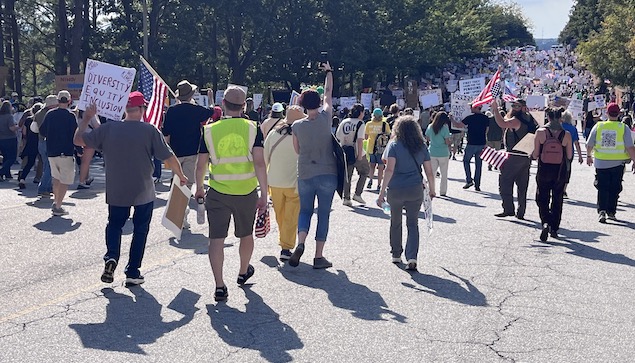
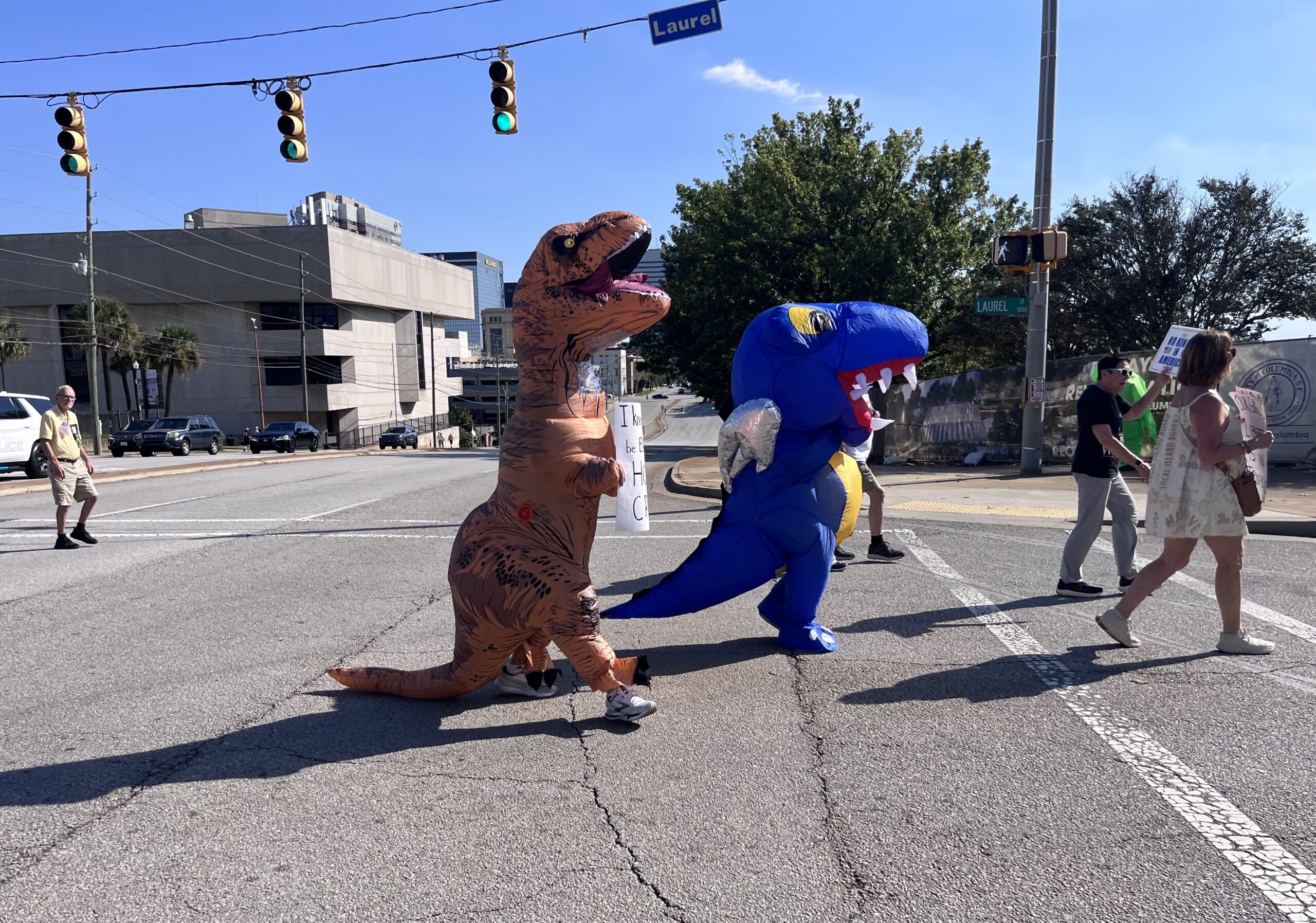
Protesters march down Laurel Street Oct. 18 in downtown Columbia on their way from the SC State House to the Governor’s Mansion.

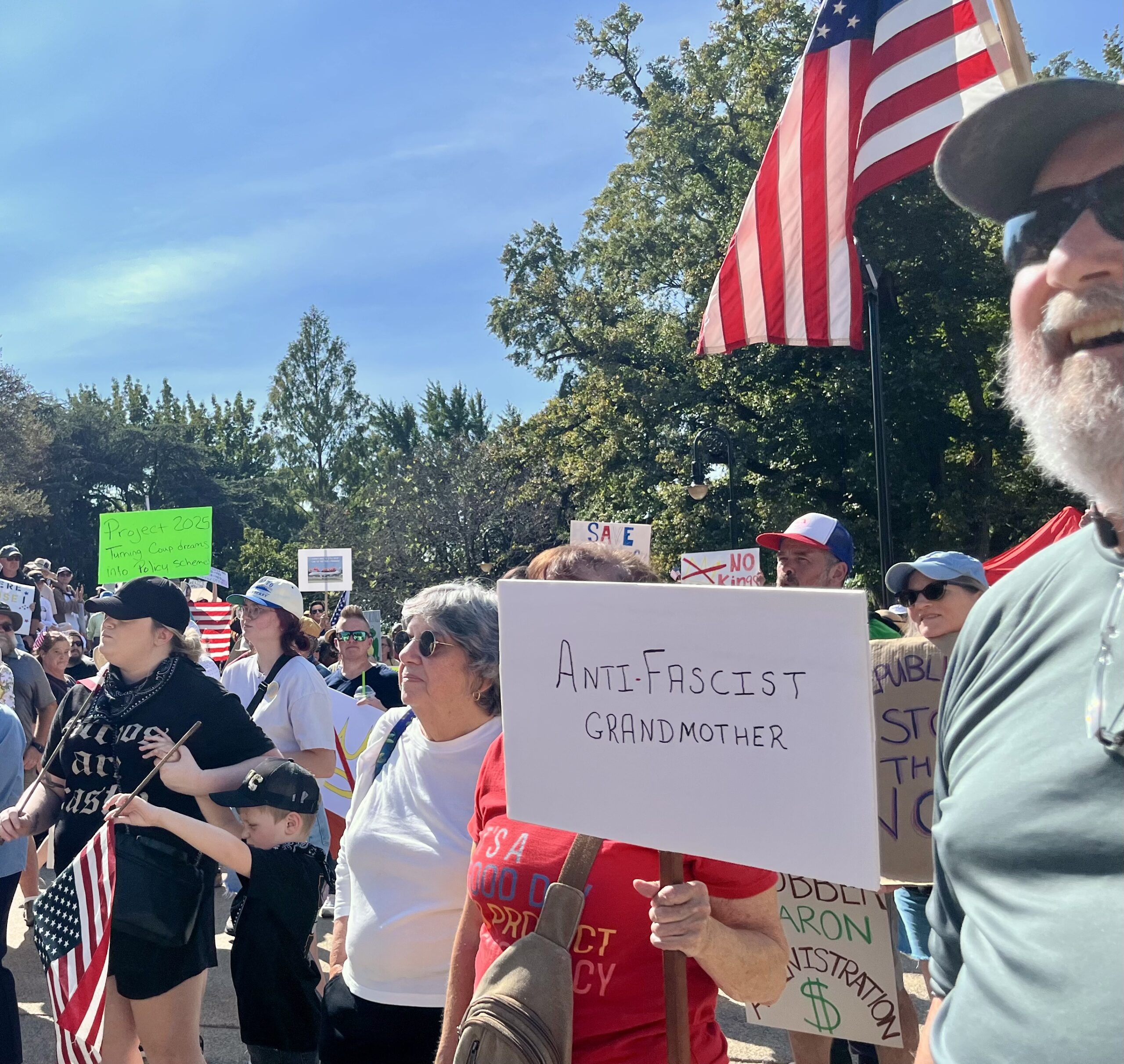
According to organizers of the No Kings rallies, some 7 million people turned out at large and small events across the country. Even with numbers still coming in, Oct. 18, 2025, marks one of the largest single-day nationwide demonstrations in our history.

There were more than 2,700 protests across all 50 states. South Carolina did its part, with events from the Lowcountry to the Upstate. It was a joyful and peaceful day. The only arrest took place in Myrtle Beach, where a woman brandished a firearm to threaten the crowd.

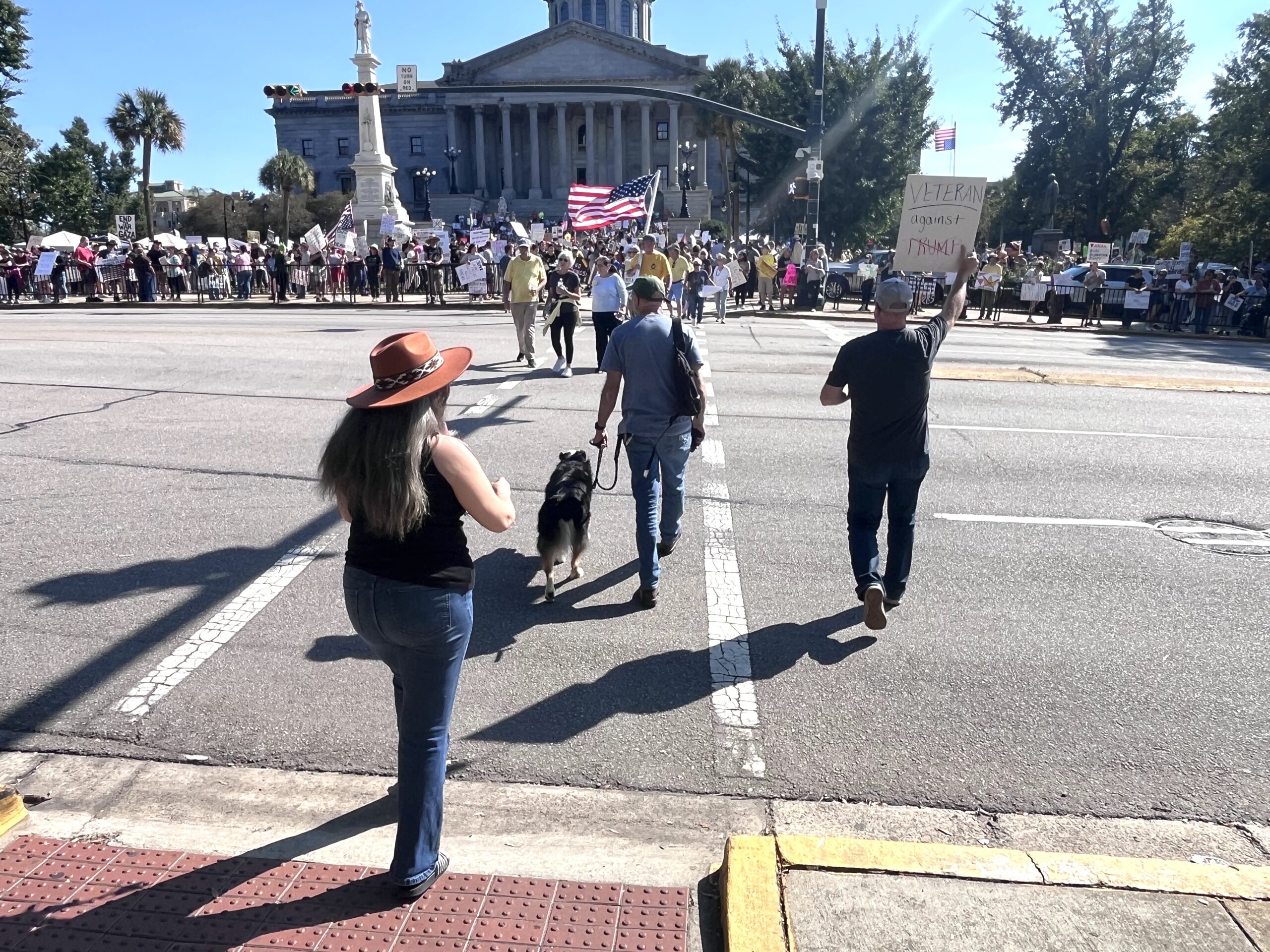
Columbia turned out in a big way, gathering at the SC State House for a rally, followed by a march to the Governor’s Mansion. Congratulations to everyone who spent their Saturday defending democracy. You looked amazing.

GROW adds Creole spice to the menu

Need relief from all the crazy? Put on your party dress, lace up your dancing shoes, and join us Thursday night at 8 for GROW’s first Blues Workshop Jam.

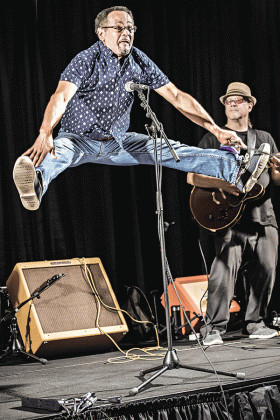
It promises to be a lively gathering, headlined by Donald Cesar, who has become a crowd favorite at GROW’s jazz shows.

A Louisiana native who now lives in Orangeburg, Cesar was born into a family whose musical heritage spans generations. His grandfather Alphonse “Bois Sec” Ardoin, was a pioneer of the gumbo that is zydeco, and was so accomplished that he earned a NEA Heritage Fellowship.

Small wonder that Ceasar would become a musician himself, learning to play the drums, keyboard, and harmonica. He has shared the stage with legendary artists, including John Delafose, Fats Domino, The Nevilles, B.B. King , Ruth Brown, Gatemouth Brown, Allen Toussaint, James Brown, The Platters, The Drifters, The Clovers, The Temptations, Tyrone Davis, Prince, and Dion Warwick, among many others. Cesar has performed at Spoleto, at various music festivals, and in venues across the South.

“He’s played with everybody,” said vocalist Sara Williams, a fixture in the local music scene and the original force behind GROW’s jazz workshops. “He brings such joy to his music that you can’t help but dance when he’s on stage. He’s also just a really good guy. I met up with him in DC when he drove Drink Small up there to receive a national award.”

Ceser has deep roots in the Creole tradition, and he plans to weave music history into the shows, making them true workshops.

“Cesar is a natural entertainer,” said Brett Bursey, executive director of the SC Progressive Network, the nonprofit overseeing GROW’s operations. “We are thrilled for the chance to showcase his extraordinary talent and help grow the blues community in Columbia.”

Blues workshops will be held 8–10pm every 2nd and 4th Thursday, will follow the style and spirit of the jazz workshops, which feature a core band, Justus, who are joined by musicians of various backgrounds and abilities each night. Some are regulars; some stop in every now and again. Every night is as different as the players on the stage, which keeps it interesting and fresh. The only constant is the warmth and camaraderie in the room.

“There is a generosity of spirit during these jam sessions that is a balm in these tough times,” said Becci Robbins, the Network’s communications director and GROW’s building manager. “Now I’ve got two more Thursdays each month to help me adjust my attitude. I swear it is the best therapy.”

As Ceasar himself commands, “Come get you some!”

GROW is located at 1340 Elmwood Ave. in the heart of Columbia. Easy parking. Doors open at 7:30. Music begins at 8. No cover, but we rely on donations to help support the artists and keep the lights on at GROW.

Questions? Call 803-808-3384 or email network@scpronet.com.

Check out one of Cesar’s first performances at GROW, a rendition of Kansas City punctuated with white-hot harmonica.

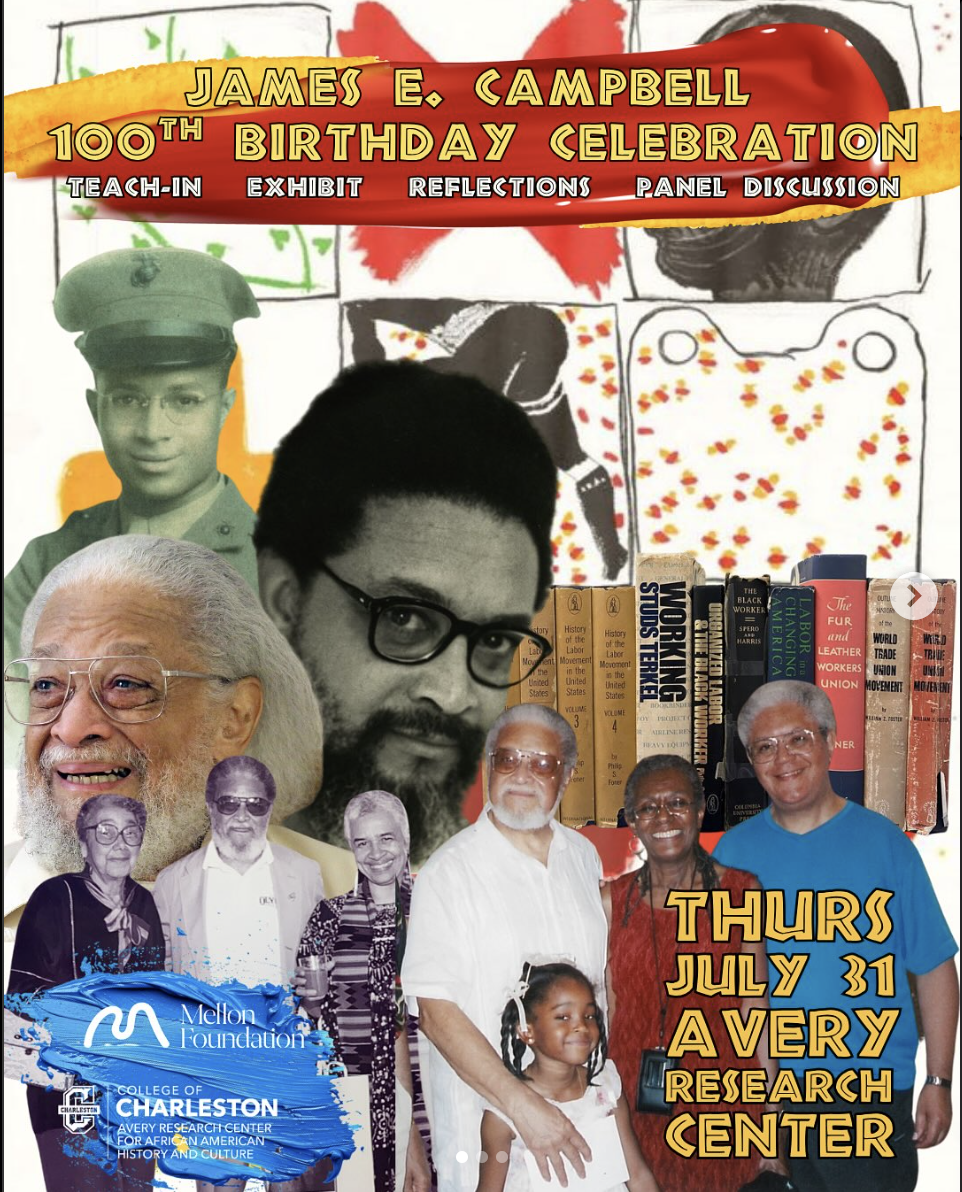
The spirit of James Campbell is alive and well!

On what would have been his 100th birthday, friends and family of James E. Campbell gathered at the Avery Research Center in Charleston on July 31 to mark his extraordinary life with a day of teachings, discussions, and remembrances. Surely, he would have approved.

Campbell was a longtime member of the SC Progressive Network, and was among the first to receive the organization’s Thunder and Lightning Award, in 1998. He served as a mentor to many and an inspiration to all who had the pleasure to work with him.

For more, including links to his papers archived at Avery, see our write-up posted after he transitioned in 2021.

Modjeska Simkins School wraps spring session

On Saturday, students from across the state gathered at GROW in Columbia to celebrate their graduation from the Modjeska Simkins School. It was a joyous occasion. After four months of intensive study together, it was clear that they had bonded and felt a sense of collective power.

A third of the 63 graduates this session attended the Monday night classes in-person at GROW. Another third joined the class on Zoom. And, for the first time, some of the students participated from our satellite sites in Sumter and at Penn Center.

The hybrid class model was so successful that the school is already working to replicate it in additional cities next session. SC Progressive Network Director Brett Bursey said, “Bringing activists together to participate as a group strengthens the local communities that are the heart of movement building. Those connections will last beyond the school, and beyond election cycles.”

The School’s lead instructor, Dr. Robert Greene II, reminded students that, “The state of South Carolina is about much more than John C. Calhoun, Ben Tillman, James Byrnes, and Lindsey Graham. This state is also about Robert Smalls and Modjeska Simpkins, Septima Clark and Robert Elliott, men and women who have fought tirelessly for civil and human rights since the founding of this state as a colony in the late 17th century. In a sense, by completing this class you are also a part of that long struggle for human rights in the Palmetto State.”

Penn Center Executive Director Dr. Robert Adams gave the commencement address. He opened his remarks by saying, “First and foremost, I understand from the time we spent together that we are the ones that we’ve been waiting for, that Modjeska Simpkins was not a solitary or singular eruption of the search for black freedom. She was a link in a long chain of freedom seekers.

“We have to make sure that we don’t allow that chain to be broken, that we continue the tradition…we are central to moving this battle forward. And so I really appreciate and honor each and every one of you, for all the brilliance, wonderful spirit, and sense of vision that you all have brought to this course.”

James L. Felder, a lifelong civil rights activist and one of the first three Black men elected to the SC House in 1970, facilitated the Sumter satellite site. He said, “We have a generation that do not know their history. We’ve lit a fire in Sumter. We really got folks excited over there.”

Student Candace Dore helped facilitate Penn Center’s satellite site. “I’ve learned so much throughout the course, and I definitely feel better equipped to be an agent of change for South Carolina,” she said. “Knowledge really is power, and it’s something that people can’t take away from you.”

Rhonda Grego said she attended an historically Black high school and taught history Benedict College. “I’ve had many opportunities to learn African American history. So what was it about the Modjeska School? It was bringing together all at one time this timeline and being confronted with it in a short, compressed amount of time. It’s a lot to process, indeed. But, boy, am I glad that I did it.”

Students are already busy working on projects together, and the school is preparing short courses and organizer trainings ahead of the Network’s fall conference at Penn Center Oct. 31 – Nov. 2. Stay tuned for details.

These are difficult times in America, but we are rising to meet the challenge in South Carolina. We need your help and involvement. You can support the school by making a donation HERE. We appreciate contributions of any amount, and promise to use those dollars to continue teaching truth and growing people power in the Palmetto State.

• • •

See our graduation photo album  and graduation video

Briggs Before and Beyond Brown

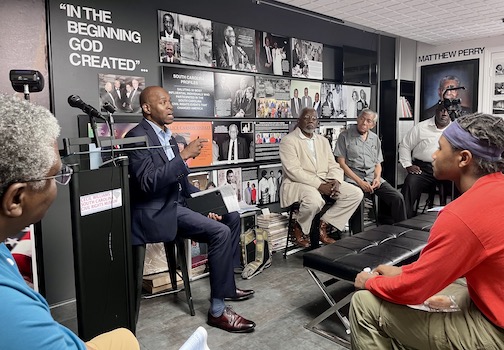
On May 17, the SC Civil Rights Museum in Orangeburg hosted a program to explore Briggs v Elliott‘s role — and historical snub — in the landmark Brown v Board case.

USC’s Dr. Bobby Donaldson moderated the panel: Cecil Williams, noted photographer and force behind the museum, and civil rights activist Nathaniel Briggs, a descendant of Harry Briggs Sr.

After the program, attendees loaded a bus for a tour of the museum’s new building now under construction. It is ideally located next to two HBCUs, Claflin and SC State.

Dr. Bobby Donaldson (left) Nathaniel Briggs (center) and Cecil Williams
SC Progressive Network Director Brett Bursey

A timely discussion about the courts with Armand Derfner

The Modjeska Simkins School will hold a Deep Dive Sunday at 4pm with nationally renowned civil rights attorney Armand Derfner, who will talk about the US Supreme Court’s sytemic betrayal of civil rights and how that history informs this moment. 

Derfner helped shape the Voting Rights Act in numerous Supreme Court arguments, and worked on desegregating state university systems and state legislatures across the South. He co-authored the new book Justice Deferred: Race and the Supreme Court with distinguished historian Dr. Vernon Burton

Derfner’s personal story is extraordinary. His Jewish parents fled Poland to Paris, where Armand was born in 1938. He was just two years old when the Nazis marched into Paris, forcing the family to flee again. They managed to get to New York, where Derfner spent most of his youth. He graduated from Princeton and Yale, and went to work for a big law firm. 

In the summer of 1965, Derfner took time off to volunteer in Mississippi during a time of extreme racial violence — and ended up staying in the South. He moved to Charleston in 1969, and has now been practicing civil rights law for nearly 60 years.

For more about Derfner and his legal work, check out these links:

The Post and Courier May 30, 2024: Good Faith? Not in the SC Legislature and not on the US Supreme Court

Champions of SC Civil and Human Rights, oral history, July 2, 2007: Voting Rights Before the United States Supreme Court

Our Deep Dive series is part of the Modjeska Simkins School’s spring program. The School was launched in 2015 as a project of the SC Progressive Network. To support the school, you can donate HERE. Contributions help provide stipends for guest speakers and scholarships for students across the state.

Klan War author Fergus Bordewich to speak at Modjeska Simkins School March 30

Did you know that 153 years before our current president was indicted for inciting an insurrection, another US president used the Insurrection Clause to track and arrest hundreds of white terrorists in South Carolina? It was news to us, too.

Historian Fergus Bordewich will talk about that and other material in his latest book, Klan War, at a program on Sunday, March 30, at 4pm on Zoom and in-person at  GROW, 1340 Elmwood Ave. in Columbia.

The program is part of the spring session of the Modjeska Simkins School, a project the SC Progressive Network launched in 2015. The school’s Deep Dive series is free and open to the public. Online participants must register HERE.

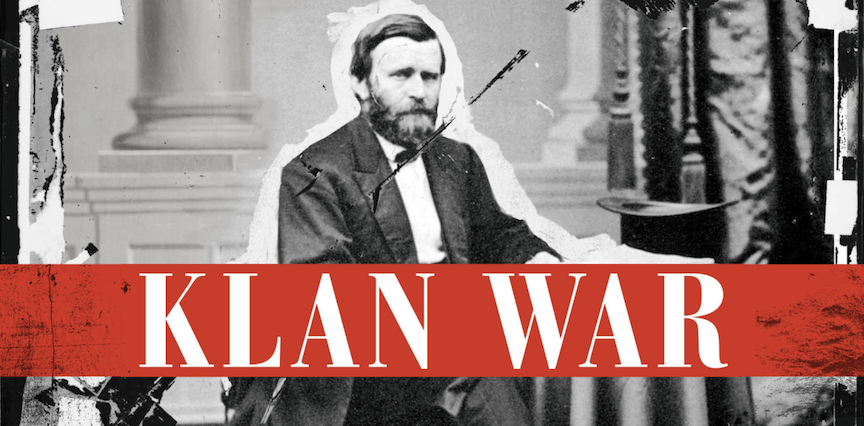
Klan War: Ulysses S. Grant and the Battle to Save Reconstruction is touted by Knopf as “a stunning history of the first national anti-terrorist campaign waged on American soil.”

Jennifer Szalai of The New York Times called the book a “cautionary tale,” warning that, “a premature push for conciliation and compromise can leave the roots of some very old pathologies untouched, ready to grow again when the conditions are right.”

After the Civil War ended, the 14th Amendment was passed to grant and defend equal rights to formerly enslaved people. As soon as the war ended, the Ku Klux Klan organized to terrorize them — depriving them of the rights afforded to all citizens through the 14th Amendment.

Nowhere in the country was the mayhem and murder more widespread than in South Carolina, the “cradle of secession.” In 1870, President Ulysses S. Grant declared martial law in nine South Carolina counties, and hundreds of KKK members were arrested.  The trials were held in Columbia and Charleston.

“My book is one of history, not present-day politics,” Borderwich said, “but a few conclusions are inescapable. The United States is not so exceptional that it is somehow absolved from the potential for organized terrorist violence of the type we have seen in other countries. 

“The story of Reconstruction and the Klan war further demonstrates that rights that we take for granted — as freedmen did in the 1870s — can be taken away again. There are forces in today’s America that have the potential to undermine our most basic democratic processes and institutions, as we saw on January 6, 2021. We must remain vigilant if we are not to let our democracy slip through our fingers.”

Bordewich will appear in-person at GROW. His books will be available for purchase.

Connecting the dots between slavery and capitalism: a conversation with Dr. Justene Hill Edwards

On Sunday, March 23, the Modjeska Simkins School will host a program to explore the intersection of Black history, slavery, and American capitalism with national expert University of Virginia professor Dr. Justene Hill Edwards.

The program is free and open to the public. Participants may join on Zoom or in-person at GROW in Columbia.

Dr. Hill Edwards’ latest book, Savings and Trust: The Rise and Betrayal of the Freedman’s Bank, examines the relationship between democracy and capitalism during the Reconstruction era. The Freedman’s Bank served tens of thousands of recently emancipated African Americans, many of them making deposits in the Freedman’s banks in Charleston and Beaufort.

Why and how did it fail, and what are the lessons it can teach us today?

Recent research on racial and economic inequality in the United States has led to policy discussions that have placed blame on issues such as access to affordable credit and redlining. Hill Edwards argues that we cannot fully understand why economic inequality persists by looking to modern American history for answers. 

Hill Edwards’ books — Unfree Markets: The Slaves’ Economy and the Rise of Capitalism in South Carolina (2021) and Savings and Trust (2024) consider the role of the federal government and America’s banking industry in furthering economic inequality at the end of slavery in 1865. The books show that the vestiges of race-based economic inequality are not in the late-nineteenth or twentieth centuries, but in the period of legal slavery.

Sunday’s program is part of the Modjeska School’s Deeper Dive series, which is a supplement for the students, who are currently studying the antebellum era, Civil War, and Reconstruction.

“We are pleased to be able to bring Dr. Hill Edwards back to the school this session,” said Network Executive Director Brett Bursey. “Her research helps reveal how our state’s minimally adequate education — and the escalating legislative assault on teaching truth — continue to serve the interest of the monied gentry.”

The program will be held 4-6pm on Zoom and in-person at the SC Progressive’s HQ at 1340 Elmwood Ave. in Columbia. To join online, register HERE.

SC Native food program cut by new administration

Cecil Rigby, 2023 Modjeska Simkins School graduate

Just as Modjeska Simkins School students learn about South Carolina’s indigenous peoples’ struggles for just treatment, we see them take yet another hit courtesy of the Trump Administration.

In 2022, the Biden Administration started the “Local Food Purchase Assistance” program, a cooperative agreement between the US Department of Agriculture’s (USDA) Agricultural Marketing Service and the South Carolina Department of Agriculture (SCDA) that resulted in the Catawba Nation receiving $6.1 million in LFPA funds. SCDA was responsible for administering $4.7 million of that total.  

Using these federal funds, SCDA contracted with aggregators to buy food from local, socially disadvantaged producers to distribute free to underserved populations in the state.

Under new orders, that program is now terminated.

USDA states “The intent of the program is to target Socially Disadvantaged. For the purpose of this program, “socially disadvantaged” is a farmer or rancher who is a member of a Socially Disadvantaged Group. A Socially Disadvantaged Group is a group whose members have been subject to discrimination on the basis of race, color, national origin, age, disability, and, where applicable, sex, marital status, familial status, parental status, religion, sexual orientation, genetic information, political beliefs, reprisal, or because all or a part of an individual’s income is derived from any public assistance program. While purchasing from socially disadvantaged farmers and ranchers is not a requirement, it is a target. Proposals should include the steps the applicant will take to target this population.”

USDA notified states on Friday that it was unfreezing funds for existing LFPA agreements but did not plan to carry out a second round of funding for fiscal year 2025.

Until now, LFPA food was distributed in 24 South Carolina underserved counties — more than half. Those counties were identified based on their unemployment, poverty rates, rural classification, remote classification, and current distribution of food. They include: Abbeville, Aiken, Allendale, Bamberg, Barnwell, Cherokee, Clarendon, Colleton, Dillon, Edgefield, Georgetown, Greenwood, Hampton, Horry, Jasper, Lee, Marion, Marlboro, McCormick, Oconee, Orangeburg, Pickens, Union, and Williamsburg counties. 

All 24 counties have expansive food deserts. Unfortunately, things are about to be worse for people in these areas.

The Catawba Nation’s efforts to provide healthy food to its citizens include Black Snake Farm, a 22-acre farm made possible through the LFPA’s “Plus” program during the pandemic. The grant from USDA was to provide enough funding to purchase food for the market until December 2026. 

The farm works to grow healthy and fresh food that can go into tribal households throughout the year. They “hope that in the future this farm can feed Catawba families and serve as a source for easily accessible food.”

Statewide, SCDA agreements under this and similar programs were expected “to impact over 800,000 students at 124 School Food Authorities. Of this total, SCDA estimated that at least 213 thousand students in underserved areas” would receive increased access to local foods.

Why would anyone expect any attempts to receive reparations for past injustices have any chance to succeed when such a wealthy nation as ours withdraws basic assistance like this from its most deserving citizens?  

Attempts and hopes to build community economics that are decoupled from exploitative systems of production and trade are being smothered in the crib yet again.