Dear Senator Graham:

Today I received a letter from you in response to a letter I wrote you regarding the Employee Free Choice Act. To say I was disheartened at your response was the understatement of the year.

You stated that you believe that employees and employers are entitled to fair, confidential, and democratic elections when it comes to the decision of unionization. You further stated that you wanted to guarantee employees free choice by secret ballot without intimidation or pressure presumably by union organizers. What you fail to realize is the pressures Corporations put on their employees when it comes to the “so called elections”.

In the current corporate-controlled process, it’s not free choice when management can bombard employees with anti-union messages anywhere, anytime in the workplace while workers can talk about the union only on break time and only in the break area, and union organizers have no right to set foot in the workplace. Further, I take you to the case of Gary E. McClain, a constituent of yours, who worked for Pactiv Corporation. Mr. McClain was picked up by the local sheriff, committed, and drugged against his will for daring to suggest that the union be allowed to speak.

You talk very highly of protecting one’s right to vote in your letter, but you fail to acknowledge that a majority of people wanting to unionize is a democratic process. You ignore current companies such as AT&T, Kaiser Permanente, and Harley Davidson, who accept a majority sign-up as the employee’s voice. Finally, how is a majority of working men and women who choose to act as a bargaining unit anything but a democratic process?

You also argue in your response to my letter that by requiring management to go to mediation or binding arbitration if the first contract is not agreed to within 120 days put an unfair burden on management. Again, you are lacking in your facts. Management typically will drag its feet when it comes to a first contract with the hopes of breaking apart the union and reversing the vote by false promises. Additionally, here in South Carolina, the Department of Labor has a full-time mediator on staff whose job it is to mediate between employee, employer, and even the union. Mediation services are not binding arbitration or a cost of thousands of dollars. Mediation is where an independent person goes back and forth to discuss the issue and help establish an agreement.

Finally, you fail to mention in your letter just what companies are sponsoring and giving money to the anti-employee free choice act; companies such as Bank of America, who if memory serves me correctly, got $45 billion of my tax money in a bail-out. Companies such as Citigroup who received $50 billion hard-earned middle class tax dollars. Finally, let’s examine how Chairman and CEO Frank Blake advocated for the bailout of Fannie Mae and Freddie Mac, and is now leading the charge against the Employee Free Choice Act.

Let me ask you the following: were you influenced by the fact that the Home Depot PAC gave you $6000 between 2002 and this year? Or how about the $4,650 you received in 2008 from Citigroup? Or even the $3000 you received in 2008 from Bank of America. Please, let us South Carolinians know just how much your vote for our rights costs – we would be real interested to know.

Best regards,

Nancy Seufert

Proud Member of the AFGE Local 1869

North Charleston, SC

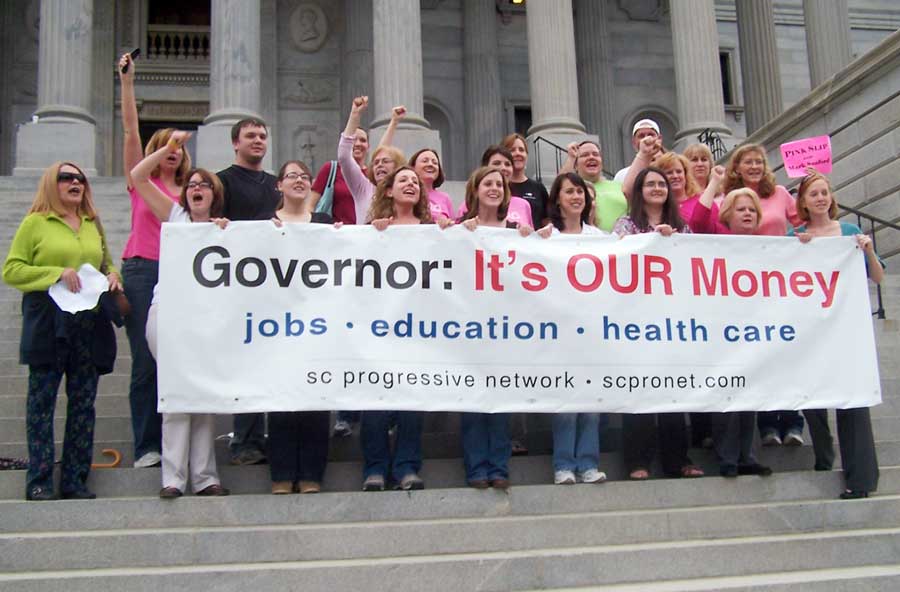
People’s $timulu$ Rally

April 1, 5:30 – 6:30pm • State House, Columbia

Gov. Mark Sanford is refusing to take $700 million in stimulus money that South Carolinians will have to pay for even if we don’t use.

Tell the governor to quit grandstanding at our expense!

If the governor does not sign the stimulus agreement by April 3, thousands of South Carolina’s teachers and public safety employees risk losing their jobs, and student will face increased tuition costs at our colleges and universities.

Join teachers, public workers and students who are facing cutbacks, layoffs and increasing debts to tell the governor it’s OUR money!

Instead of pouring our money into bailing out wealthy bankers, we need government investments that create new jobs, provide health care and quality education for all, end the foreclosure epidemic and support sustainable, clean energy.

If you cannot attend the rally but want to make your voice heard, please contact the governor by calling 803-734-2100, faxing 803-734-5167 or by emailing from the governor’s web site.

The rally is sponsored by the SC Progressive Network. For details, call 803-808-3384.

More anti-choice BS

By Becci Robbins
SC Progressive Network

Debate continued today on the 24-hour mandate bill that would require a woman have a “period of reflection” after obtaining an ultrasound before terminating a pregnancy. The Senate session was held in a room too small to accommodate the crowd, so many of us stood in the hallway craning to hear, just one more indication that this body has no real interest in including the public in its deliberations.

The discussion centered on the question of whether the bill caused an undue burden for women, especially in rural areas, who would have to take off two days of work or classes, or provide child care so they could make two trips to one of the three clinics in SC that provide abortion services.

To help minimize that burden, Kevin Bryant (the same Senator who got into trouble because he had a “funny” post on his blog saying the only difference between Obama and Osama was just a little BS) offered a compromise that would allow women to get their ultrasound at a “crisis pregnancy center,” of which there are many in South Carolina. The argument is that a woman could get an ultrasound at any number of facilities, making it easy to fulfill the requirement.

At least three problems, as I see it. One: the people providing ultrasounds at these CPCs, as they are referred to by folks in the field, are not licensed. Two: going to one of these facilities would still require at least another half-day off, and the expense of a second ultrasound. Three: the people at these facilities are in the business of steering women, with sometimes unsound and unsavory practices, into carrying pregnancies to term. 

I know this because as a reporter a decade ago I went undercover into Birthright of Columbia, one of many of such facilities in South Carolina, posing as a woman with an unwanted pregnancy. I wrote a story about my experience, and it was unsettling. The “counselor” was coercive and heavy handed, trying his best to convince me to carry the pregnancy to term and that “we” would put the baby up for adoption.

Funneling women into these CPCs is the last thing we need to be doing. As benign as it may look on the surface, don’t be deceived. This is yet one more attempt to dissuade women from making decisions for themselves and giving power to people in the business of manipulating and frightening women with sometimes flat-out false information (such as the abortion/breast cancer link).

The full committee will meet next week to take up the bill. Please contact the Medical Affairs Committee and tell them to vote NO on H-3245. Email your senator: by clicking here.

Petition candidate curbs sought

Critics say it will force voters to go with political parties
By Jim Davenport

The Associated Press

South Carolina’s Democrats and Republicans are working together to limit petition candidate challenges to their nominees, raising the concerns of a voting rights advocate Monday about whether the party efforts will hurt voters’ ability to put candidates of their choosing on the ballot.

Senate Majority Leader Harvey Peeler, R-Gaffney, introduced a bill last week that would force petition candidates to file at the same time party hopefuls do. The measure also would bar those who vote in primaries from signing petitions to get independent candidates on the ballot.

“From our perspective, that voter has already participated in that nominating process,” said Jay W. Ragley, the South Carolina Republican Party’s executive director. “A voter who votes in a primary and then signs a petition is essentially given two bites at the apple to nominate someone for office.”

In a state with an open primary system, the move will force voters more than ever to go along with political parties, observers said.

“I just think it’s an unnecessary impediment to an open democratic system and it’s clearly designed to protect the two dominant parties. The notion that if you vote in a primary, you can’t sign a petition for anybody is overly broad,” said [SC Progressive Network Director] Brett Bursey, a voting rights advocate, on Monday. “There’s something about democracy that they’re not quite getting.”

Both major parties are unabashed about the desire to cut post-primary challenges to their nominees. That’s been a problem for both parties in the past. For instance, state Sen. Mike Rose of Summerville knocked off an incumbent in last year’s GOP primary and then faced a petition candidate in the general election backed by a mix of Republicans and Democrats.

Continue reading

Stop the violence against women

The “alleged” beating of pop star Rihanna has inspired an new public service announcement about the dangers of dating violence.

The PSA was put together by teen interest organization DoSomething.org, it features actors re-enacting the “Umbrella” singer’s brutal confrontation with R&B hitmaker Chris Brown pieced together by statements made in the LAPD’s affidavit of the Feb. 8 incident, in which Chris reportedly punched, bit, and choked Rihanna.

Dating abuse is a serious issue. 1 in 3 teens is abused in a relationship. Let’s fight to stop youth dating abuse. Join DoSomething.org’s 1 in 3 Campaign to make a statement, stop the abuse and keep teenagers safe.

Losing the oxygen of journalism

Gray Brechin

Editor’s Note: As more and more daily newspapers fall by the wayside – victims of a terrible economy and the Internet – many critics of the mainstream media say the MSM is getting what it deserves, for having failed in so many of its responsibilities to a democratic society.
But there is a danger as fewer reporters are left to chronicle events, even imperfectly, as author and historian Gray Brechin notes in this guest essay.

We seldom think of oxygen unless it’s absent. You’d think about it a lot if it suddenly exited this room; you’d start gasping and writhing, your eardrums would burst, you and your neighbors would do a lot of bleeding on each other, then you’d die.

But if we gradually replaced oxygen with nitrous oxide mixed with just a soupcon of cyanide gas, you might not notice that anything was missing at all; you might feel very content as your brain and body gradually turned off and you lapsed into a sleep without end.

I’ve frequently criticized the San Francisco Chronicle for just that — for its lack of the kind of mental oxygen that makes for a healthy democratic polity. In my book Imperial San Francisco: Urban Power, Earthly Ruin, I showed how it and two other leading San Francisco newspapers a century ago served the interests of their owning families — the deYoung, Hearst, and Spreckels clans.

All three detested each other to the point of murder, although they could all agree — as do all major newspaper-owning families and corporations to this day — that capitalism is the only acceptable means of arranging human affairs and that the value of land and the structures built upon it must continue to rise.

They also agreed that an expanding U.S. empire in the Pacific Basin suited their own interests just fine. As the young William Randolph Hearst advised his father in an 1885 letter, “Every atom of humanity added to the struggling mass means another figure to the landlord’s bank account.”

All three media dynasties had very large real estate holdings and bank accounts that were replenished and enlarged by every atom added to the struggling mass far below those families.

Continue reading

Subcommittee delays vote on anti-choice bill

Yesterday, the SC Senate Medical Affairs Subcommittee met to hear testimony on H.3245, a bill that the House passed last month that would require a woman to wait 24 hours after receiving an ultrasound in order to have an abortion. The hearing room was packed, with opponents of the bill greatly outnumbering those in support. The subcommittee took no vote, and likely will meet again within the next two weeks to do so.  

I was among those who spoke against the bill. Here is a transcript of my testimony.

*********

I am Becci Robbins, and I am the communications director for the SC Progressive Network, a job I have held since the Network was created in 1995. We are a diverse coalition of 61 organizations and hundreds of individual members from across the state.

Our organization works to promote and defend policies of tolerance and inclusiveness that protect individuals against discrimination based on race, gender, sexual orientation, economic status, disability, age or other categorizations used to diminish one group for the benefit of others.

Our coalition includes a broad range of people working on a variety of issues. Our members don’t always agree on everything, but we respect each other’s differences and know that our diversity is our strength. This perspective has enriched our organization and has helped us reach beyond our differences to work together for the common good.

That ability to work cooperatively and constructively — respecting the broad range of human experience and values — is what I would wish for the South Carolina legislature. Yours is an exclusive club made up primarily of men, most of them white, most of them well-educated and well-off. That narrow perspective does not always serve the citizens of South Carolina, especially those who do not enjoy the same privilege as the legislators who represent them.

That lack of perspective has been evident over the years as the legislature has worked to chip away at reproductive rights. The members of this nearly all-male body has no idea what it feels like to deal with an unwanted pregnancy. For many, the issue of abortion is a theoretical construct, an idea to be debated and used as a political tool.

In January, I watched the House debate this bill. As a grown woman, I was insulted that lawmakers felt entitled to making decisions about the most intimate details of my health and welfare. The insinuation at the core of the 24-hour waiting period is that women are not to be trusted, are not capable of making responsible choices for themselves and their families. 

To those lawmakers who oppose abortion on religious grounds, I would not try to change their minds or challenge their sincerity. It is not my place. Neither is it their place to impose their religious and moral values on me and other women.

This bill is an attempt to do just that. While it is ostensibly about making a woman wait 24 hours before terminating her pregnancy, the truth is that this bill is one more step in a well-orchestrated and incremental approach to limiting women’s access to the full range of reproductive services. 

The 24-hour mandate has serious implications. For some women, especially for working women and those living in rural areas, this bill poses an undue burden. For women with children, it means finding child care for two days instead of one. For women in college, it means missing two days of classes, instead of one. For women who don’t live in one of the three cities with clinics that provide pregnancy terminations, it means two days of driving long distances, not just one. Please don’t make what is already a difficult process even more difficult for these women.

I am here today to speak for the women who have no power, no voice, women who more often than not find themselves on the losing end of political gamesmanship. I am here because I know of no woman who has ever taken the decision to end her pregancy lightly. I am here because I know of no woman who has not thought long and hard before making this most difficult choice for herself and her family.

Finally, I would urge you and your colleagues to spend your time addressing the critical issues facing the citizens of this state: poor education, lack of health care, disappearing jobs and a failing economy. Surely those issues should take precedence over this bill and others seeking to control the lives of women in South Carolina.

Thank you for your time.

Erin Go Gay!


SC Pride won “BEST GREEN FLOAT” in the 5 Points’ St. Patty’s Day parade in Columbia on March 14. Organizers of the parade contacted SC Pride Sunday to announce their winning entry and congratulate them. Winning prize is a $50 gift certificate to 5 Points businesses.

The float was made from recycled materials including donated soda cans to form a rainbow and cardboard boxes making a pot of gold with the “My Pride Color is GREEN” logo painted on the front. Marchers with SC Pride handed out leftover “SC is SO GAY” bracelets and “My Pride Color is GREEN” cups left over from SC Pride 2008 to crowds of on-lookers who braved the weather.

Much thanks to everyone who turned out to help despite the rain and cold weather!

SC Pride has much to be proud of; in NYC they won’t let gay groups march in the parade but in South Carolina the GLBT group won an award!

Ryan C. Wilson

President, SC Pride Movement


What does one TRILLION dollars look like?

All this talk about “stimulus packages” and “bailouts”…

A billion dollars…

A hundred billion dollars…

Eight hundred billion dollars…

One TRILLION dollars…

What does that look like? I mean, these various numbers are tossed around like so many doggie treats, so I thought I’d take Google Sketchup out for a test drive and try to get a sense of what exactly a trillion dollars looks like.

We’ll start with a $100 dollar bill. Currently the largest U.S. denomination in general circulation. Most everyone has seen them, slighty fewer have owned them. Guaranteed to make friends wherever they go.

A packet of one hundred $100 bills is less than 1/2″ thick and contains $10,000. Fits in your pocket easily and is more than enough for week or two of shamefully decadent fun.

Believe it or not, this next little pile is $1 million dollars (100 packets of $10,000). You could stuff that into a grocery bag and walk around with it.


While a measly $1 million looked a little unimpressive, $100 million is a little more respectable. It fits neatly on a standard pallet…

And $1 BILLION dollars… now we’re really getting somewhere…

Next we’ll look at ONE TRILLION dollars. This is that number we’ve been hearing so much about. What is a trillion dollars? Well, it’s a million million. It’s a thousand billion. It’s a one followed by 12 zeros.

You ready for this?

It’s pretty surprising.

Go ahead…

Scroll down…

Ladies and gentlemen… I give you $1 trillion dollars…


(And notice those pallets are double stacked.)

So the next time you hear someone toss around the phrase “trillion dollars”… that’s what they’re talking about.