

A HISTORY OF AFRIKAN PEOPLE
A Community Course Syllabus
This seven-part series is a Modjeska Simkins School special presentation by Dr. Burnett Gallman, who serves on the National Board of the Association for the Study of Classical African Civilizations and who has been teaching for 40 years.
The 2026 session will be held on Sunday afternoons July 12–Aug. 23 on Zoom 4:30–6pm.
To register, click HERE.
While we are offering this course free, please remember that operating the school takes money. If you are able, consider making a donation HERE.
Questions? Email info@modjeksaschool.com or call 803-808-3384.
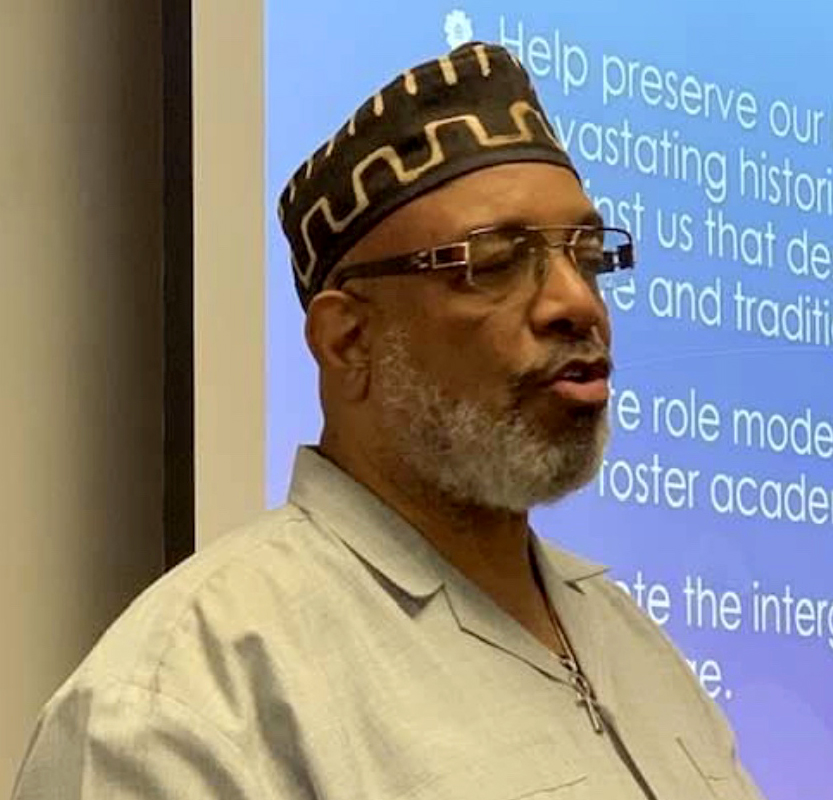
Dr. Burnett Gallman
Introduction: It has been repeatedly proven that the history of Black people in the world has been ignored, altered, denied, lied about and even claimed by other people. A caveat to this truth is that the behavior of non-Black people towards people of Afrikan origin has also been hidden and distorted. This course aims to reveal who Afrikan people were, who Afrikan people are and what Afrikan people have had to deal with, still deal with and still thrive.
NOTE: Primary references are indicated with an asterisk.
July 12
Lecture 1: Historiography: The History of History: Why is History important to AUSA?
In this lecture, examples of the altered, ignored and altered history are presented while offering probable causes for such behavior. Without understanding and including the truthful and accurate history of the Afrikan people who were kidnapped and enslaved in the so-called “New World”, any history would be built on the lies of omission and commission, miseducation, and racism of the kidnappers and enslavers. This lecture is designed to set the stage for the lecture series.
Objectives
• To introduce and highlight the manner in which the writing of history has been manipulated in the service of white narcissistic pseudo-supremacy.
• To stimulate a re-thinking of the way that events, heroes. and sheroes have been painted and presented to us.
• To understand that not only historiography is to blame but the entire entertainment industry (including all forms of journalism, film, television and sports).
• To stimulate further research.
References and Suggested Reading
Browder, Anthony T. Exploding the Myths, Volume I: Nile Valley Contributions to Civilization. Washington: The Institute of Karmic Guidance, 1992.
*Burrell, Tom. Brainwashed: Challenging the Myth of Black inferiority. NY: Smileybooks, 2010
*Carruthers, Jacob H. Intellectual Warfare. Chicago: Third World Press,1999
*Harriot, Michael. Black AF History: The Un-Whitewashed Story of America. New York: Dey Street Books, 2023
Diop, Cheikh Anta. The African Origin of Civilization: Myth or Reality.
Westport: Lawrence Hill and Company, 1974.
Diop, Cheikh Anta. Origin of the Ancient Egyptians. In: General History of Africa, Volume II: Ancient Civilizations of Africa. United Nations Educational, Scientific and Cultural Organization (Editor: G. Mokhtar) Berkley: University of California Press, 1990, pp. 15-61
also found in Van Sertima, Ivan (Editor): Great African Thinkers: Cheikh Anta Diop, Volume I, New Brunswick: Transaction Books, 1986, pp. 35-63
Donaldson, Bobby. Address at the Southern Region Conference of the Association for the Study of Classical African Civilizations. Claflin University, Orangeburg, SC, November 23, 2019
Freire, Paulo. Pedagogy of the Oppressed. NY: Continuum, 1992
Frazier, T. Zachary. Agnotology and Information. Proceedings of the Association for information science and technology. Vol. 52, Issue 1, pp.1-2
Gallman, Burnett Kwadwo. Sankofa University: Studying African- Centered History and Culture. Columbia, SC: Imhotep-The Drum, 2020
Hurston, Zora Neale. Barracoon: The Story of the Last “Black” Cargo. NY: Amistad, 2020
James, George G. M. Stolen Legacy. San Francisco: Julian Richardson Associates Publishers, 1976.
*Khamit-Kush, Indus. What They Never Told You in History Class, Volume One. Buffalo: Eworld, Inc., 1999
*Loewen, James W. Lies My Teacher Told Me: Everything Your American History Textbook Got Wrong. NY: The New Press, 2018
Loewen, James W. Sundown Towns: A Hidden Dimension of American Racism. NY: The New Press, 2018
Mills, Charles W. The Racial Contract. Ithica: Cornell University Press, 1997
Obenga, Theophile. Ancient Egypt and Black Africa: A Student’s Handbook
for the Study of Ancient Egypt In Philosophy, Linguistics, & Gender Relations. Chicago: Karnak House, 1992.
Proctor, Bradley. D. White Supremacy in the Academy: The 1913. Meeting of the American Historical. Association. The Activist History Review. November, 2019
Rhoden, William C. $40 Million Slaves: The Rise, Fall and Redemption of the Black Athlete. NY: Three Rivers Press, 2006
Rutherford, Mildred Lewis. A Measuring Rod to Test Text Books and Reference Books In Schools, Colleges and Libraries. Athens, GA: United Confederate Veterans, 1919
Sellers, Cleveland. Interview May, June, August 2020
Sokoya, Kinaya C. A Push from Below How the Black Power Movement Changed Higher Education. Bloomington, IN: Authorhouse, 2018
Thompson, Anderson. The Decade of Truth. The Compass: Journal of the Association for the Study of Classical African Civilizations. Volume 2, Number 1, pp. 8-61, 2017
Troullot, Michel-Rolph. Silencing the Past: Power and the Production of History. Boston: Beacvon Press, 1995
T’Shaka, Oba. The Political Legacy of Malcolm X. Richmond, California: Pan Afrikan Publications, 1983
Van Sertima, Ivan. They Came Before Columbus: The African Presence in Ancient America. NY: Random House, 2003
Van Sertima, Ivan (Editor). Nile Valley Civilizations. New Brunswick: Transaction Books, 1984.
Van Sertima, Ivan (Editor). Egypt Revisited. New Brunswick: Transaction Books, 1989.
Watkins, William H. The White Architects of Black Education: Ideology and Power in America, 1865-1954. NY: Teachers College Press, 2001
Williams, Chancellor. The Destruction of Black Civilization: Great Issues of a Race from 4500 B.C to 2000 A.D. Chicago: Third World Press, 1976, pp. 17-61
July 19
Lecture 2: Kemet: Afrika’s Classical Civilization: Who were they and why is this important?
Despite the many movies featuring non-Black actors such as Elizabeth Taylor, Charlton Heston, and Yul Brynner portraying ancient Egyptians, it has been repeatedly proven that the ancient Egyptians were Black. That is, until they were invaded by the Persian, Assyrians, Greeks, Romans and especially the Arabs and the blood lines were mixed. Although there are still scattered scholarly attempts to resist this truth, most serious scholars have reluctantly accepted this reality. In this lecture, expert references are used to discuss the history and achievements of ancient Egypt (or Kemet, as they called their country) dynasty by dynasty.
References and Suggested Reading
Akbar, Na’im. Light from Ancient Afrika. Tallahassee: Mind Productions & Associates, Inc., 1994.
Ashby, Solange. Calling Out to Isis: The Enduring Nubian Presence at Philae. Piscataway: Gorgias Press, 2020
*Anthony Browder, Anthony T. Exploding the Myths, Volume I: Nile Valley Contributions to Civilization. Washington: The Institute of Karmic Guidance, 1992.
*Badawi, Zeinab. An African History of Africa: From the Dawn of Humanity to Independence. London: WH Allen, 2024, pp. 31-63
*Carruthers, Jacob H. Essays in Ancient Egyptian Studies. Los Angeles: University of Sankore Press, 1984.
Diop, Cheikh Anta. The African Origin of Civilization: Myth or Reality. Westport: Lawrence Hill and Company, 1974.
*Finch, Charles S. III. Nile Valley. Civilization: A 10,000-Year History. Decatur: Khenti, Inc. 2022
Karenga, Maulana and Jacob Carruthers. Kemet and the African Worldview: Research, Rescue and Restoration. Los Angeles: University of Sankore Press, 1986
Karenga, Maulana. Reconstructing Kemetic Culture: Papers, Perspectives, Projects. Los Angeles: University of Sankore Press, 1990
Obenga, Theophile. Ancient Egypt and Black Africa: A Student’s Handbook for the Study of Ancient Egypt. In: Philosophy, Linguistics & Gender Relations. Chicago: Karnak House, 1992
Obenga, Theophile. African Philosophy. Brawtley Press, 2015
Van Sertima, Ivan (Editor) Nile Valley Civilizations. New Brunswick: Transaction Books, 1984
Van Sertima, Ivan (Editor): Egypt Revisited. New Brunswick: Transaction Books, 1989
Van Sertima (Editor): Egypt: Child of Africa. New Brunswick: Transaction Publishers, 1994
July 26
Lecture 3: Kemet’s Contributions to the World
A large portion of the science, literature and belief systems that we take for granted today had their origins in Afrika. Much of these contributions to the world have been ignored, changed, and claimed by others. This lecture will outline and document these contributions to world civilization.
References and Suggested Reading as above especially
*Anthony Browder, Anthony T. Exploding the Myths, Volume I: Nile Valley Contributions to Civilization. Washington: The Institute of Karmic Guidance, 1992.
*Finch, Charles S. III. Nile Valley. Civilization: A 10,000-Year History. Decatur: Khenti, Inc. 2022
Van Sertima, Ivan. Blacks in Science: Ancient and Modern. NY: Taylor and Francis, Inc.
August 2
Lecture 4: The Afrikan Origin of Medical Science
Many principles that are taken for granted in Western medicine today were practiced regularly in Afrika before and during Europe’s “Dark Ages” and long before Europe was “enlightened”. In this lecture, the history of healthcare in Afrika is detailed.
References and Suggested Reading
Stretter, Cornelius: The Secret Medicine of the Pharoahs. Edition 9, Chicago, 1993
Nunn, John F.: Ancient Egyptian Medicine. London: British Museum Press, 1996
Halioua, Bruno and Bernard Ziskind: Medicine in the Days of the Pharoahs. Cambridge: The Belknap Press of Harvard University Press, 2005
*Finch, Charles S.: The African Background To Medical Science: Essays on African History, Science and Civilization. London: Karnak House, 1990
Newsome, Frederick: An African American Philosophy of Medicine. Charlotte: Conquering Books, LLC, 2005
*Warrick, Sheridan: The Scar on the African’s Arm. Hippocrates, March/April, 1989, p. 20
*Gallman, Burnett W.: From Africa to South Carolina: A Brief Review of the Contributions of Africans and African Americans To Medicine. The Journal of the South Carolina Medical Association, May, 1988, pp. 249-255
*Newsome, Frederick. Black Contributions to the Early History of Western Medicine. In: Blacks In Science: Ancient and Modern, Editor: Ivan Van Sertima. New Brunswick: Transaction Books, 1986
Strouhal, Eugen, Bretislav Vachala and Hana Vymazalova. The Medicine of the Ancient Egyptians: Surgery, Gynecology, Obstetrics, Pediatrics. New
Strouhal, Eugen, Bretislav Vachala and Hana Vymazalova. The Medicine of the Ancient Egyptians: Internal Medicine. New York: The American University in Cairo Press, 2021
Obenga, Theophile. African Philosophy. Brawtley Press, 2015
August 9
Lecture 5: Women in Ancient Afrika
Women in Western society have been oppressed and are still agitating for their just due. Women in Ancient Afrika enjoyed equality and rights that non-Afrikan Western women could not even imagine. This lecture will explore the history of matriarchal societies and the rise of patriarchy.
References and Suggested Reading
Allen, Adam: The Role of Women in Africa: 5000 BCE-Late Antiquity
Ashby, Solange. Dancing for Hathor: Nubian Women in Egyptian Cultic Life. Dotawo: A Journal of Nubian Studies, Volume 5 (Nubian Women), Article 2
*Ashby, Solange. Black Is Queen: The Divine Feminine in Kush. Lecture at the Harvard Museum of the Ancient Near East
Bey, Aziza Braithwaite. The Role of Women in Kemet, Dogon, Mayan, and Tsalagi Societies. Journal of Pedagogy, Pluralism, and Practice. Volume 3, Issue 3, Article 2
Eller, Cynthia. The Myth of Matriarchal Prehistory: Why an Invented Past Won’t Give Women a Future. Boston: Beacon Press, 2001
*Finch, Charles S, III.The Great Mother and the Origin of Human Culture. In: Echoes of the Old Darkland: Themes from the African Eden. Decatur: Khenti, Inc. 1991
Jogunosimi, Ife. The Role of Royal Women in Ancient Egypt. In: Kemet and the African Worldview: Research, Rescue, Restoration. Los Angeles: University of Sankore Press, 1986
Johnson, Janet H. Women’s Legal Rights in Ancient Egypt. Fathom Archive: The University of Chicago Library Digital Collections
*Obenga, Theophile. Male/Female Relations in Ancient Egypt. In: Ancient Egypt & Black Africa: A Student’s Handbook for the Study of Ancient Egypt in Philosophy, Linguistics & Gender Relations. Chicago:Karnak House, 1992
August 16
Lecture 6: West Afrika’s Golden Age before the European invasion
Contrary to what many ignorant, racist, duplicitous and frankly lying historians have written, enslavement was not a boon to Afrika. It did not bring Afrikans out of ignorance, barbarism or savagery because, in fact, many of the kidnapped and enslaved Afrikans were better educated and probably more intelligent than their kidnappers and enslavers. In this lecture, a brief introduction to West Afrika, from where most enslaved Afrikans originated is given.
References and Suggested Reading
Ajayi, J.F. Ade and Ian Espie: A Thousand Years of West Africa History, Ibaden University Press and Nelson, 1965.
*Boahen, Adu: Topics in West African History, Longman Group Limited, London, 1980
Chinweizu: The West and the Rest of Us: White Predators, Black Slaves and the African Elite, Pero Press, Lagos, 1987
Clarke, John Henrik: Ahmad Baba: A Scholar of Old Africa, Black Books Bulletin, volume 2, Number 1, 1974, Chicago, IL, pp. 4-9
Clarke, John Henrik: Social Studies African-American Baseline Essay, Portland City Schools, Portland, OR, 1987, pp. 3549-56
Davidson, Basil: Africa in History: Themes and Outlines, Collier Books, NY, pp. 74-91
*Diop, Cheikh Anta: Precolonial Black Africa: A Comparative Study of the Political and Social Systems of Europe and Black Africa, from Antiquity to the Formation of Modern States, Lawrence Hill and Company, Westport, Connecticut, 1987
*French, Howard W. Born in Blackness: Africa, Africans and the Making of the Modern World, 1471 to the Second World War. NY: Liveright, 2022
*Gomez, Michael A. African Dominion: A New History of Empire in Early and Medieval West Africa. Princeton: Princeton University Press, 2019
*Jackson, John G.: Introduction to African Civilizations, The Citadel Press, Secaucus, NJ, 1970, Chapter 5
Karenga, Maulana: Introduction to Black Studies, Kawaida Publications, Los Angeles, CA, 1984, pp. 57-63
Niane, D.T. Sundiata: An Epic of Old Mali Onwubiko, KBC. School Certificate History of West Africa: 1800-Present Day, Book Two
Page, JD: The Development of African Historiography in General History of Africa, vol. I Methodology and African Pre-history, ed. J.ki-Zeibo UNESCO, The University of California Press, 1990, Berkeley
Van Sertima, Ivan: They Came Before Columbus: The African Presence in Ancient America, Random House, NY, 1976, pp. 37-50.
Walker, Robin. When We Ruled. Baltimore: Black Classic Press, 2011
Walker, Robin. If You Want to Learn Early African History, Start Here. London: Reklaw Education, Ltd., 2015
Walker, Robin. Blacks and Science: Volume Two. London: Reklaw Education, Ltd., 2016
Williams, Chancellor: The Destruction of Black Civilization: Great Issues of a Race from 4500 B.C. to 2000 A.D., Third World Press, Chicago, IL, 1976, Chapter VIII
August 23
Lecture 7: Resistance to Enslavement
Despite the myth of the “Happy Slave”, there were no “good” or beneficent enslavers. The institution of chattel slavery practiced in the United States was more brutal and dehumanizing than any other system of slavery in the world, with the possible exception of Arab slavery. Enslaved Afrikans did not accept their lot and there are many documented instances of the many ways that the enslaved Afrikans resisted their enslavement. Some of these methods were passive while others were deadly. This lecture will explore and discuss some of these methods.
References and Suggested Reading
*Aptheker, Herbert. American Negro Slave Revolts
Genovese, Eugene D. From Rebellion to Revolution: Afro-American Slave Revolts in the Making of the Modern World
*Harriot, Michael. Black AF History: The Un-Whitewashed Story of America. New York: Dey Street Books, 2023
Higginson, Thomas Wentworth. Black Rebellion: Five Slave Revolts
Hidden Voices: Enslaved Women in the Lowcountry and U.S. South. Day- to-Day Resistance. Low Country Digital History Initiative. A Digital History Project Hosted by the Lowcountry Digital Library at the College of Charleston.
Hidden Voices: Enslaved Women in the Lowcountry and U.S. South. Reproduction and Resistance. Low Country Digital History Initiative. A Digital History Project Hosted by the Lowcountry Digital Library at the College of Charleston.
*Horne, Gerald. The Counter-Revolution of 1776: Slave Resistance and the Origins of the United States of America.
Johnson, Michael P. Smothered Slave Infants: Were Slave Mothers at Fault? The Journal of Southern History. 47(4):493-520, Nov. 1981
Anon, Anon S. Infanticide as Slave Resistance: Evidence from Barbados, Jamaica and Saint-Dominique. Inquiries Journal 6(64):1-21, 2014
Wells-Oghoghomeh, Alexis. The Souls of Womenfolk: The Religious Cultures of Enslaved Women in the Lower South. Chapel Hill: The University of North Carolina Press, 2021
McIntyre, Charshee. The Double Meanings of the Spirituals. Journal of Black Studies, Volume 17, No.4 (June 1987), pp. 379-401
Hulbert, Matthew C. The Caroline Chronicles: A Story of Race, Urban Slavery, and Infanticide in the Border South-Part VI. March. 2, 2016
Fourmy, Signe Peterson. “She had smothered her baby on purpose”: Enslaved Women and maternal Resistance. Age of Revolutions.com, July 25, 2022
*Lockley, Timothy James (Editor). Maroon Communities in South Carolina: A Documentary Record. Columbia: University of South Carolina Press, 2009
Grant, Joanne (Editor). Black Protest: History, Documents, and Analysis: 1619 to the Present. NY: Fawcett Premier, 1968
*Price, Richard (Editor). Maroon Societies: Rebel Slave Communities in the Americas. Baltimore: The Johns Hopkins University Press,1996
Alexander, Tim. Double Entendre: A Glimpse into the Meanings of Slave Songs.