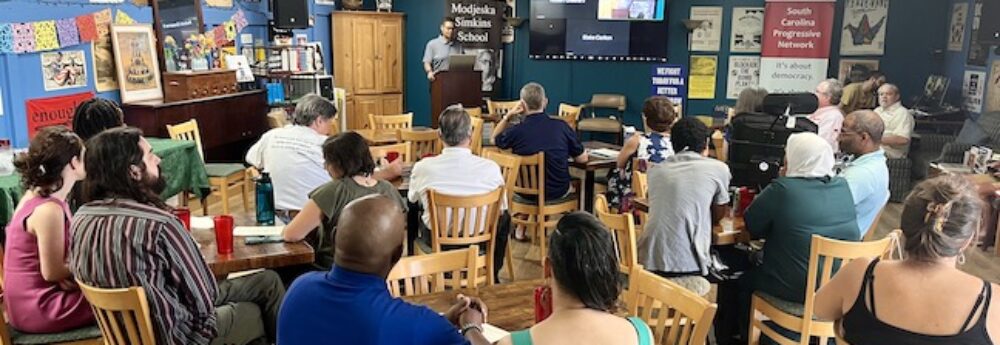
SC Progressive Network Director Brett Bursey talks about the state’s Democratic Party.
Monthly Archives: January 2008
Down the rabbit hole: nukes closer to being “renewable” in South Carolina
By Tom Clements
Friends of the Earth, Columbia
Get into a mind warp and come with me down the nuclear rabbit hole on this mad ride…
On Jan. 29, after dealing with legislation allowing alligator hunting, the members of the South Carolina House Agriculture Committee got down to the business at hand of defining nuclear power as renewable energy. While there was some discussion, much of it quite confused and simply the espousal of pro-nuke positions, the bill passed by a vote of 12-5.
Now, the definition of “renewable energy resources” in South Carolina includes “nuclear energy” and the bill moves to the full House. The bill is likely to come up as early as Tuesday, Feb. 5, where it is very likely to pass and be sent to Gov. Sanford for his signature.
While it may strike you as ridiculous or impossible that this is happening, recall that many of these legislators are hard-core “conservatives” who could give a rat’s ass about reason, logic, science, public opinion, or being fiscally conservative. They might well affirm some southern stereotypes that come to mind. They are acting simply to serve the nuclear industry (Duke Energy), which has as many lobbyists down at the legislature as there are alligators down in the swamp, or road-kill possum on a country road.
Here’s the key language of the bill:
“For purposes of this chapter, ‘renewable energy resources’ means solar photovoltaic energy, solar thermal energy, wind power, hydroelectric, geothermal energy, tidal energy, recycling, hydrogen fuel derived from renewable resources, biomass energy, nuclear energy, and landfill gas.”
One thoughtful legislator commented that you could be driving down the road and see two horses in a field and say that one of them was a mule. While you could call one of the horses a mule that doesn’t change reality and make it a mule. But, hey, in South Carolina why not try to define reality as one wants it to be, or better, as Duke Energy wants it to be…? The leadership of President Bush has been a sterling example of this, after all.
Political stimulus
by Sheldon Richman
Not understanding basic economics is dangerous because you’re vulnerable to political con games foisted by unscrupulous politicians. Economics properly conceived is just common sense about human activity. An examination of the proposed economic stimulus will make this clear.
Nearly all politicians claim that the economy needs a stimulus that only they can provide. That is odd right off the bat. Politicians produce nothing; they spend other people’s money and, in the process, interfere with people’s productive activities. Why would anybody think they could stimulate an economy?
A Republican president and Democratic congressional leaders are converging on a $150 billion package of tax rebates and business incentives. This is said to be the needed boost to keep “the economy” from falling into a recession. Democrats insist it’s teetering on the edge of recession. Republicans prefer to say the economy may be entering a “slowdown.”
Take AFL-CIO’s online health care survey
The AFL-CIO has launched its largest-ever online survey to capture Americans’ real experiences with our broken health care system. Survey responses will be given to the presidential candidates, every U.S. senator and representative, every candidate for Congress and state and local officials in every state in our country. The AFL-CIO expects many thousands of responses, which will make this survey one the largest data sets available on individuals’ and families’ health care experiences. The survey is available here.
“You don’t have to look far to see how broken and expensive health care in America is,” AFL-CIO President John Sweeney said. “We are doing this survey because we want to be sure every leader in our country understands exactly what’s going on – every elected official from mayor right on up to the top, and every candidate.”
Questions cover such topics as:
* Whether Americans are going into debt because of medical bills;
* Whether they are instead skipping follow-up visits, treatments and prescriptions because they can’t afford to pay for them;
* Whether people are locked in to jobs for fear of losing health insurance;
* What Americans are paying out of pocket each year for health care.
Perhaps most importantly, the survey will invite respondents to tell their own personal stories, in as much detail as they choose.
The survey will run for one month and is open to anyone. Participants can choose to keep their responses anonymous or have them published online with their first name.
In addition to reminding candidates what voters are going through, the results influence the legislative debates about policy reform.
“No doubt, special interests like insurance and pharmaceutical companies will try to scare Americans into accepting the unacceptable system we have now,” Sweeney said. “The results of this survey will keep America on track, reminding everyone of how little there is to lose and how deeply the problems run.”
Book on Strom a must-read
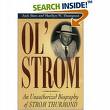
I just finished reading the only honest book ever written about South Carolina politics. I had avoided it like the plague because I had mistakenly thought since 1998 that the authors were paying homage to an aging Strom Thurmond. Boy was I wrong! Ol’ Strom by Jack Bass and Marilyn Thompson is an unvarnished expose of every politician of any importance in SC since 1876…in a single context…as they related to the life of Strom Thurmond. It is at once shocking, fascinating, embarrassing and laugh-out-loud funny as Bass and Thompson connect all the political dots of South Carolina’s last century.

I actually felt personally cleansed after reading the second half of the book…mostly because at 10:15 PM I realized that I had been sitting in the Jacuzzi for six hours riveted to this book! I highly recommend it to anyone with even a passing interest in South Carolina history or politics. It’s a great read.
Charlie Smith, Charleston
Sign petition urging GOP to support clean elections
By David Donnelly
Director, Campaign Money Watch
Last night as I was watching President Bush’s final State of the Union address I was struck by his unwillingness to recognize the need for change in this country. War profiteering, global warming, poor health care—nothing’s changed. He promoted a weak version of earmark reform, but it’s too little, too late, and doesn’t address the real problem.
Last week 5,000 people signed a petition asking the Republican presidential candidates to support full public financing of elections like the three leading Democratic candidates.
Will you join us? Sign our petition today!
Once we collect signatures for this petition, we’ll fax the Republican presidential candidates a letter the day before Super Tuesday, February 5th, to urge them to support full public financing of elections.
From big campaign contributions to the influence of bundlers and lobbyists, the role of campaign cash in our electoral process has gotten worse. The Republicans are pretending the problem doesn’t exist. They need to hear from people like you that you demand real change in Washington.
Let’s tell the Republican presidential candidates that Washington needs full public financing of elections.
We need to end the status quo in Washington. Thanks for your help.
The beginning of the end
By William Rivers Pitt
t r u t h o u t | Columnist
And when he had opened the seventh seal, there was silence in heaven about the space of half an hour.
– Revelations 8:1, King James Bible
George W. Bush’s State of the Union (SOTU) speeches have been the basis for a new kind of drinking game for several years now, basically because the things have always needed some kind of actual substance from somewhere, and because it was a good way to dull the pain of it all. The rules: 1. When he says the word “terra” or “terra-ists,” take a drink. 2. When he says “tax cuts,” take a drink. 3. When he says “Iraq,” take a drink. 4. When he says “nook-yuh-lerr,” take a drink and a shot and a good swift kick to the head. Et cetera.
But that’s just one night out of the year. Reality has proven to be far more alcoholic in nature. For seven years now, the whole phenomenon of this government has been one long drinking game played out each and every day. The rules of this game? 1. Say the words, “George W. Bush is in charge of the country.” 2. Turn off the TV. 3. Just drink.
The true worth of South Carolina’s primary
By Elizabeth G. Hines
The Women’s Media Center
I’ve been giving thanks quite a lot this election season: thanks that the field of candidates looks different from ever before; that we who are not white men can believe that our nation has a place for us in its leadership, too. And I’ve been giving thanks that the advent of this diverse slate of candidates has created just a little space in which we Americans can begin to address, on a national level, the issues of race and gender that have plagued us since our very beginnings as a country. We may not yet be good at talking about those issues, but at least now we’re trying.
Today, however, I am here to admit that my greatest measure of thankfulness has recently settled on nothing so predictable, for a black woman, as seeing Clinton and Obama’s faces plastered across every newspaper and television screen from here to Tallahassee. No, today I want to give thanks for the state of South Carolina.
That’s right, South Carolina. The first state to secede from the Union when that pesky “War of Northern Aggression” became inevitable. Hotbed of slaveholding activities as late as 1860, with 45.8 percent of all white families holding slaves – the highest rate in the nation. Home to legendary states rights leader and segregationist presidential candidate Strom Thurman. And the last place in the USA where the Confederate flag was allowed to retain its place of so-called honor, flying atop the State House dome until the year 2000 – 135 years after the abolition of slavery, in case you’re counting.
Notes on South Carolina primary
By Harry Targ
Professor, Purdue University
I confess. I have been a supporter of the presidential candidacy of John Edwards (particularly since Dennis Kucinich was made to disappear). I think his clear populist stance, his anti-corporate agenda, and his critique of the centrist Democratic Leadership Council represent an advance over the ambiguous and limited centrist politics of Hillary Clinton and Barak Obama and the way John McCain will reframe himself if he is the Republican Party nominee.
A cursory examination of media framing of national political life over the last thirty years would suggest that populist candidates, who verbalize even modest condemnations of corporate power, face public marginalization. It happened to Howard Dean and Dennis Kucinich and it is happening to John Edwards. Corporate media vigorously oppose any political forces at home or abroad who are anti-corporate and who embrace a grassroots approach to policymaking. “The people” are not and cannot be seen as capable of shaping their own political destinies. In the end, it is the corporate elite who must rule.
Having admitted my political “biases,” I have some thoughts about the potential political significance of the Democratic Party primary election in South Carolina. First, the campaign tactics of candidate Clinton and particularly former President Clinton should finally put to rest the popular view that they are crusaders against racism in American life. President Clinton did everything he could to remind voters that Barak Obama was after all an African American and that this election was occurring in South Carolina. In a totally irrelevant response to a reporter’s question after the results were announced President Clinton reminded the reporter and the audience that Jesse Jackson carried South Carolina in the 1980s; i.e. the outcome on Saturday will not count and it will not count because Obama, like Jackson, is an African American.
Funnies