
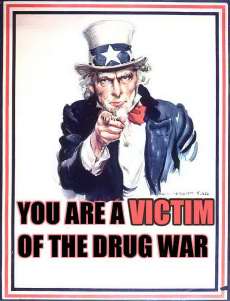
War on the war on drugs loses warrior

war-on-drugs.jpg

South Carolina reform organization closes shop
By Skip Johnson

President of South Carolinians for Drug Law Reform

Norm Stamper, retired chief of police in Seattle, says America’s so-called war on drugs “has arguably been the single most devastating, dysfunctional social policy since slavery.” His words are being heard. All over America – the main exceptions being South Carolina and other Southeastern states – people are making concrete progress in changing that policy. For example:

Twelve states have enacted medical marijuana bills; California alone has more than 1,000 shops selling marijuana today to sick and dying people who have prescriptions from their doctors.

Delaware, New Jersey and D.C., among others, have new needle exchange programs in operation that are cutting back on the spread of AIDS, Hepatitis-C and other wasting diseases. Needle exchanges, illegal in most states, are also protecting police officers and medical personnel from being accidentally stuck.

Local governments in Colorado and several other states have ordered their police departments to put marijuana arrests on the bottom of their list of priorities, thus freeing up police to go after real criminals and easing pressure on the courts and prisons.

Nationally, only recently did the U.S. Sentencing Commission toss out guidelines that dictated penalties involving crack cocaine be 100 times harsher than penalties involving powdered cocaine, realizing that the two are just two versions of the same thing. (As is true with most drug laws, the crack/powder discrepancy was a racist thing: White people prefer powdered cocaine; blacks prefer crack. So black people were getting punished 100 times harsher than white people for the doing the same thing.) The commission found the difference so abhorrent that it made its decision retroactive, meaning some 19,500 inmates, most of them black, can seek reductions in their sentences.

In each case change came only after grassroots efforts forced it. In South Carolina, however, because too few people are willing to work for change, South Carolinians for Drug Law Reform is folding.

I’m sad about that because we are the only organization in South Carolina that is devoted exclusively to reforming our cruel, racist, counterproductive drug laws.

Continue reading

Stop stalkers before they become headlines

By Marianne Hill

She could have been my daughter, or my neighbor’s daughter. Carnesha Nelson was a bright, attractive 19-year-old college student who unfortunately became the obsession of a young man who worked on her campus at the University of Mississippi. He hounded her relentlessly, and wouldn’t take no for an answer. The night he assaulted her, she ran screaming from him, pounding on dormitory doors. Fellow students called the police, but did not let her in. He caught and killed her.

January is stalking awareness month, an appropriate time to assess our treatment of stalkers, and unfortunately “awareness” is lacking. Most are not aware that stalking that ends in violence is not uncommon. Each year there are many young women who say no to boyfriends and suitors, and lose their lives as a result. Over 1,100 women were killed by intimate partners in 2005, and another 860 by male acquaintances, with women from 18 to 30 years old the most at risk. However the number of women killed by stalkers is only a fraction of those affected by the violence: over one million protective orders are issued annually by the states to protect women from assault or stalking. Stalking is a growing problem on college campuses where over 20 percent of college women report fearing for their safety as a result of being stalked, according to a 2004 study cited by the National Center for Victims of Crime.

The suffering inflicted by stalking is great. Fearing for their safety, victims will often move, change jobs, or drop out of college and training programs to elude their pursuers. If they rely instead on protective orders, they can expect to find an angry stalker taunting them at their home or workplace: over 69 percent of protective orders for women are violated, according to a 1996 Justice Department survey. At times the stalker is not even served with papers notifying him of the protective order, since budget priorities lie elsewhere. In many states, some victims cannot even apply for protective orders: teens under 18 years old or women who have never dated their stalkers may not have this legal recourse. These same women may also be ineligible for access to women’s shelters.

Continue reading