By Brett Bursey
Director, SC Progressive Network
When I asked the 62 young people at Fairfield High school’s Teen Institute what “democracy” was last week, hands shot up. “One person, one vote,” one said. “Rule of the people,” said another. When I asked what country leads the world in democratic participation, a chorus of “USA” broke out.
They were shocked to find that the land of the free and home of the brave doesn’t rank in the top ten. In fact, the USA doesn’t even rank in the top 100.
The voting-age population in 138 other countries turn out at higher numbers than in the United States. In fact, according to the International Institute for Democracy and Electoral Assistance’s “Global Report on Voter Turnout,” the U.S. ranks 139th, between Armenia and Nigeria, with an average of 47 percent of our voting-age population participating in elections.
So, no, the USA is not number one. What’s more, the Census puts South Carolina 34th in state rankings for voting-age participation in elections.
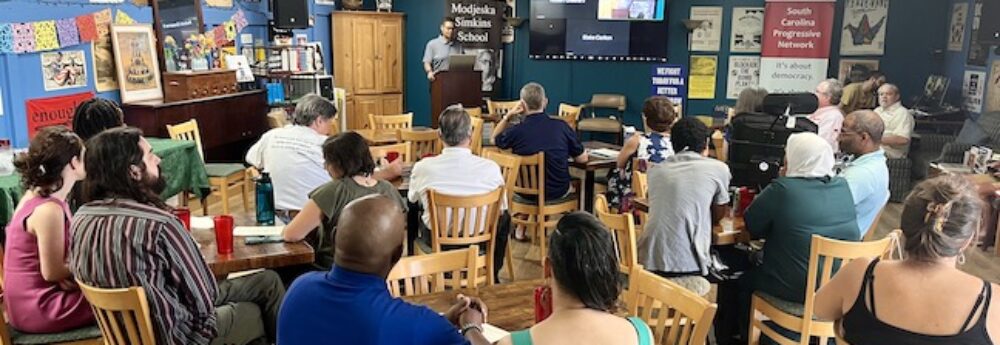
Which brings us back to Fairfield High School and the discussion on democracy. I went there to urge the Teen Institute to sign on to the SC Progressive Network’s “Missing Voter Project” (MVP), which is working to identify and engage South Carolina’s voting age-population (VAP) that isn’t registered or doesn’t regularly vote.
In the 2006 election, about 47 percent of the state’s registered voters cast a ballot – about 37 percent of the VAP. It gets worse. In Fairfield County, only 136 citizens between 18 and 21 – about 10 percent of that age group – voted.
In Fairfield, 79 percent of the county’s children qualify for a free lunch. The per capita income for the county is about $21,000. Twenty percent of the population lives below the poverty line, including 25 percent of those under age 18. Drop-out rates are high, good jobs are scarce. Fairfield County, which is 60 percent black, has not had a black representative in the State House since Reconstruction, some 110 years.
Why people aren’t voting is a complex equation of historic and systematic disenfranchisement that may take generations to overcome. Voter registration in this state was once limited to white, property-owning males, and has historically been used to restrict access to the ballot box, not facilitate it.