Anti-choice posters banned from State House

Columbia Christians for Life issued this press release today. Steve Lefemine (who often travels with large posters with photos of bloody fetuses) and Johnny Gardner (who prefers the doll-on-a-stick prop) for years have been fixtures at public gatherings and at the State House.

*****************

BANNED FROM SC STATE HOUSE:
“Jesus,” “Ten Commandments,” “Pre-Born” and other signs no longer “the people’s house”

Contact, Steve Lefemine, (803) 794-6273

On Wednesday, April 29, officers with the SC Bureau of Protective Services (State Capitol police) stopped two Christian pro-life ministry leaders, who for years have been lobbying the Republican-majority SC Legislature to pass SC Personhood bills to END abortion in South Carolina, from entering the SC State House with Biblical and Pro-Life signs, as had been allowed for multiple years (digital date-stamped photos going back to 2005 are available).

Johnny Gardner, dir., Voice of the Unborn was even prevented from taking a small baby stroller with two baby dolls, into the Capitol. Steve Lefemine, dir., Columbia Christians for Life was stopped from using two signs in the Capitol, one sign saying, “JESUS Saves, Forgives & Heals” and then the “Ten Commandments” with all 10 listed; and a second sign, with a photo of an 8-Week Pre-Born Baby and then “ABORTION KILLS CHILDREN” on one side, and on the other side, an enlarged House Roll Call budget vote in 2002 that funded abortion, birth control, and sterilization (as the SC House and Senate continue to do each year to this day).

Gardner and Lefemine were shown copies of SC Code Sec. 10-11-330 which prohibits disorderly conduct, and also prohibits anyone “to parade, demonstrate or picket within the capitol building.” Notwithstanding this statute, free speech expression in the form of signs has been allowed inside the State House in both the First Floor and Second Floor lobbying areas that are open to the public, for a number of years. The ban applies to all signs except those displayed at news conferences held in the Capitol.

Gardner and Lefemine have worked in the State House for years attempting to influence the Republican-majority SC Legislature to do their God-given duty and protect pre-birth humans from being murdered in the wombs of their mothers. Despite more than 50 bill co-sponsors in the SC House, and more than a dozen in the SC Senate, the Republican leadership in the SC House and SC Senate is not supporting the legislation. Neither is Republican Governor Mark Sanford. The 11-year-old personhood legislation to END abortion in SC was first introduced in the SC House and SC Senate in 1998.

Gardner and Lefemine were able to enter the Capitol Building on April 29 after leaving their items behind. Upon investigation, Lefemine learned that a number of parties had agreed to begin enforcement of the sign ban, including the Sergeant at Arms for the Senate, and the Sergeant at Arms for the House, the Field Commander for the Bureau of Protective Services, and others. Noticeably absent from the list of those involved in this decision to chill free speech in what has previously been known as “the people’s house” was the State House Committee chairman, who has scheduled a Tuesday, May 12 meeting in the Blatt Building, Room 318, to address the matter. (Time TBD est. approx. 2 PM) Comment by the public is planned.

3e7d89

Safety issues revealed at SRS nuclear facility

Contractors used substandard materials
By James Rosen

jrosen@mcclatchydc.com

WASHINGTON — Contractors at the Savannah River Site — one of the country’s major nuclear-weapons complexes — repeatedly procured dangerous construction materials and components that failed to meet federal safety standards, according to a recently completed internal government probe.

One of the substandard materials revealed at the Savannah River Site on the South Carolina-Georgia border “could have resulted in a spill of up to 15,000 gallons of high-level radioactive waste,” the inspector general of the U.S. Energy Department found.

The five-month investigation also disclosed the purchase of 9,500 tons of substandard reinforcing steel at the SRS site near Aiken.

The faulty steel was discovered after a piece of it broke during construction of a facility that will convert spent weapons plutonium and uranium into mixed-oxide — or MOX — fuel for civilian reactors.

Replacement of 14 tons of the substandard “rebar” — the reinforcing steel — that had already been installed cost $680,000 and caused new delays in completing the $4.8 billion MOX facility, the investigation disclosed.

Among other questionable components identified in the probe were piping, steel plates, an unusable $12 million “glovebox” (used to handle contaminated materials), furnace module doors and robots used to eliminate human exposure to radiological and chemical materials.

In an April 23 memo to Energy Secretary Steven Chu, Inspector General Gregory Friedman said contractors and subcontractors that build, supply and install equipment at SRS facilities ignored safety regulations developed by the American Society of Mechanical Engineers.

“We identified multiple instances in which critical components did not meet required quality and safety standards,” Friedman wrote to Chu.

The Savannah River Site produced tritium, plutonium-239 and other materials used to make nuclear weapons from 1954 to 1991, when the United States stopped making atomic bombs with the end of the Cold War.

Continue reading

The Best 21st Birthday Ever!

By Sara Tansey
Jenkinsville, SC

For months, community members in Jenkinsville, SC, have been meeting, organizing, and growing more vocal about their frustrations with the local utility that wants to build two more reactors in a community that already hosts one unit. So when I spoke with community members who were itching to move beyond just organizing to Nuclear Regulatory Commission deadlines, we set a date two Tuesdays from that Sunday. At the time, I didn’t realize that was the Tuesday of my 21st birthday. When it hit me, I knew it was going to be perfect.

So last night, we met at the local park, proudly owned and operated by the same utility that owns and operates the nuclear facility in Jenkinsville. It boasts a “scenic view,” and it sure is a view. Down by the water’s edge are covered picnic tables, a bit of beach for the locals to enjoy, a fishing dock and right across the water sits VC Summer. Beautiful!

We gathered around one of the picnic tables, enjoyed the summer weather and a cooling breeze off of the lake. And as we — community leaders, youth activists and other no-nuke activists — plotted how to stop two more reactors from being built in this community, we pulled strength and determination from the vision of devastation that lay across the water.

A vision of economic and human health devastation. SCE&G has stated in their own environmental report that less than 10 percent of new jobs will go to residents of the county, let alone the surrounding community, and that they do not expect any economic stimulation for the Jenkinsville area as a result of expansion.

Furthermore, cancer rates have increased since the introduction of the first reactor, and many local residents live off of the land. They have home gardens, fish from the lake and rivers and hunt local game to feed their families.

So sharing that community and mutual passion, creating next steps and a plan we all worked on together, knowing that we were organizing to do something to humble that boastful and unsuspecting utility that built a park and thought their contributions to the community ended there, was the best 21st birthday gift I could have asked for. Knowing that each one of us sitting around that picnic table was determined with our lives to stop this proposed expansion gave me goosebumps that I blamed on the water’s winds and that, in this southern heat today, I cannot excuse away.

To learn more about the community organizing efforts in Jenkinsville, email Sara Tansey at Sara@climateaction.net and stay tuned!

Today is Equal Pay Day

April 28 is Equal Pay Day, and workers across the country will commemorate the day by reaffirming their determination to make sure women are paid equally as men for the same work. Equal Pay Day symbolizes how far into the year a woman must work, on average, to earn as much as a man earned the previous year.

Equal Pay Day 2009 comes at an exciting time for those who support equal pay for women. President Barack Obama signed the Lilly Ledbetter Fair Pay Act into law on Jan. 29 and established a White House Council on Women and Girls in March. Yet more than 45 years after the Equal Pay Act was signed, women in the United States still earn only 78 cents for every dollar a man earns — even with similar education, skills and experience. And African American and Hispanic women earn even less.

Members of the Coalition of Labor Union Women will commemorate Equal Pay Day with rallies around the country in support of the Paycheck Fairness Act and the Employee Free Choice Act.  CLUW is urging all workers to wear red on Equal Pay Day to symbolize how far women and minorities are “in the red” with their pay!

While the Ledbetter Fair Pay Act ensures workers can seek restitution for unequal pay, the Paycheck Fairness Act, which still needs Senate approval, would update the Equal Pay Act by creating stronger incentives for employers to follow the law, empower women to negotiate for equal pay and strengthen federal outreach and enforcement efforts. It also would close a significant loophole in the Equal Pay Act to allow for full compensation for sex-based wage discrimination. 

Says CLUW President Marsha Zakowski: Two bills in Congress would dramatically change the economic lives of women.  Union women earn, on the average, 32 percent more than unorganized women. The Employee Free Choice Act would allow women and men workers to form unions at their work places without fear of employer intimidation and unlawful firings. The Paycheck Fairness Act would correct wage discrimination.

You can act now to help women workers gain equal pay. Urge your state’s representatives and senators to vote for the Employee Free Choice Act and the Paycheck Fairness Act by calling the U.S. Capitol switchboard at 202-224-3121.

A recent study by the Center for Economic and Policy Research found that for the years 2004-2007, union women were much more likely to have health insurance (75.4 percent) and a pension (75.8 percent) than women workers who were not in unions (50.9 percent for health insurance, 43 percent for pensions).

Equal Pay Day originated in 1996 as a public awareness event to illustrate the gap between men’s and women’s wages. The day, observed on a Tuesday in April, symbolizes how far into the year a woman must work, on average, to earn as much as a man earned the previous year. (Tuesday is the day on which women’s wages catch up to men’s wages from the previous week.)

Convention Sends Message to Democratic Elected Officials

By Clayton Seufert, Charleston

Moments before the gavel fell on the South Carolina Democratic Convention on Saturday, the Democratic Party faithful decided to send a loud message; that their party supports collective bargaining and expects Democratic elected officials to do the same.

As the convention leaders moved to complete their scheduled business, and took up a planned addition to the platform stating the party’s support of the federal Employee Free Choice Act, the convention members decided they had a little more to say. 

Progressive Caucus leader Brett Bursey addressed the Chair and read a motion to amend the planned resolution to not only include the party’s support of the pending legislation, but added that the party “opposes all state legislative efforts to obstruct the Act, or to impose further burdens on the democratic rights of working people to organize.”  These changes, clearly aimed at bills currently being discussed in the General Assembly, designed to urge defeat or attempt to circumvent the Employees Free Choice Act if passed.

One such bill, H. 3305, aims to take away from workers the choice the Act gives them between majority sign-up and an election by changing the SC Constitution.  H. 3305 was initiated by Republican legislators, but given some support by a limited number on the Democratic side of the aisle. 

The decision of those Democratic legislators didn’t seem to sit well with the convention delegates — as the motion to add the stronger language against state laws subverting “workers rights” was seconded by nearly all present, had zero discussion against and passed with “none opposed.”

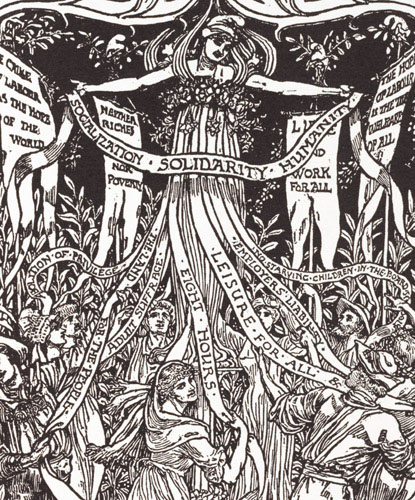
Celebrate May Day

And Help Support the SC Progressive Network!

May 1  •  5:30-9pm

08maypole1


Modjeska Simkins House, 2025 Marion St., downtown Columbia

$5 donation at the door

$25 buys you admission, Network membership and 3 drink tickets

(Wow! What a great deal!)

• Door prizes, costume contest, games and general tomfoolery 

• Dress as your favorite revolutionary hero

• Dance around the May Pole

• Nationally renowned poet and performer Stacie Boschma

• Revolutionary Dance Hall with DJ Pandora N’A Box

• Affordable cash bar, free hors d’oeuvres

Proceeds benefit the SC Progressive Network!

For details, call 803-808-3384 or email network@scpronet.com or jpdawkins@gmail.com.


Congress Takes up Hate Crimes Bill

Help us fight to get the Federal hate crime laws passed. Tell your legislator to act!

Last week I sent a letter and a copy of the actual voice mail left the night of Sean’s murder to our SC representatives in the House and Senate, as well as to President Obama and First Lady Obama to ask for their help to get this legislation passed.

Thank you,
Elke Kennedy
Sean’s Last Wish

Elke’s son, Sean Kennedy, was murdered last year in Greenville. He is featured in the video. Take action by clicking here.

Gilda for Governor?

rallygilda

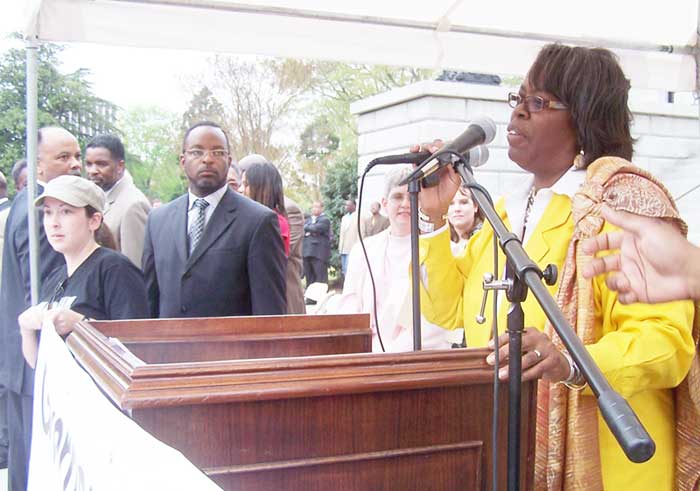
Gilda Cobb-Hunter (D-Orangeburg) speaks at the People’s Stimulus Rally April 1 at the State House.

*****************

It’s been seven long years since a movement to draft Gilda Cobb-Hunter to run for governor ran into a roadblock: the prospective candidate herself. “South Carolina isn’t ready for a black woman to be governor,” she said. She declined to enter the race against Jim Hodges, and Mark Sanford was elected governor.

The buzz among friends who know her best is that she is open to reconsidering a run for governor or, perhaps, taking on Sen. Jim DeMint for his US Senate seat.

A lot has changed in seven years, not the least of which is that we have a black man in the White House. White men — from president, to governor to the legislature — have proven their inability to meaningfully address the problems facing our state and nation; it may well be time for Gilda to reconsider her earlier hesitancy.

The Democratic Party is fielding some nice guys to contend for its nomination for governor. Sen. Vince Sheheen of Camden, Rep. Harry Ott of Calhoun County, and Mullins McLeod of Charleston are names being mentioned. But they don’t resonate with the demand for substantive change that could inspire new South Carolina voters. We can’t expect their candidacies to be far removed from the traditional Democratic strategy of playing to the right of center to pick off a couple of percentage points from the Republican vote. This is the “Republican Lite” strategy that has failed for the past 30 years.

But what if a bold candidate spoke to the 43 percent of South Carolinians who did not vote in the last election?

To put it in perspective, McCain got 1,034,896 votes in South Carolina’s last general election; Obama got 862,449. That adds up to 1,897,345 South Carolinians who voted. Sitting it out were 1,472,048 of the voting-age population (24 percent of them registered voters) who didn’t vote. That’s an untapped market of 43 percent of folks in this state who could vote but chose not to.

We only need to mobilize 12 percent of the people who don’t vote to turn the state blue. Of all the Democratic candidates mentioned, Gilda has the magic to make this happen. She is the one person in the legislature who be counted on to vote in the interest of working people, minorities and the disenfranchised. Her candidacy for governor or US Senate would inject a level of enthusiasm into the race — helping all Democratic candidates — that nobody else could provide.

What do you think? Email scprogressivecaucus@earthlink.com to voice your opinion. Should Gilda run for governor, US Senate, or stay in the State House?

gilda2

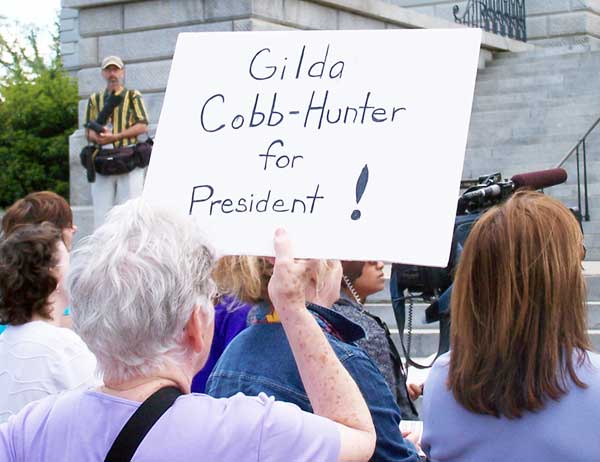
Sign spotted at a rally a few years ago suggests how loved Gilda is among her constituents.

Alice, Mad Hatter, Rabbit, Queen and Courtier Infiltrate Tea Party With No Nukes Message

By Tom Clements, Columbia

Well, we couldn’t resist taking advantage of the call to the fringe to gather at the South Carolina capitol to protest on tax day. As the whole event here was definitely down the rabbit hole, we decided to go in tea party costume and take a no-taxes-for-nuclear-socialism and no-taxes-for-nuclear bailout to the center of the rally. While there was some concern that our message might get mixed in with the rest of the “messages,” we kept it focused on no-taxes-for-nukes, and I think we pulled it off.

tea

Leslie Minerd, Tom Clements (in rabbit suit), Susan Corbett and Tim Liszewski

To much notice, we worked our way through the crowd and were eventually able to get almost behind the speaker’s podium on the steps of the state capitol, before a couple of thousand angry people protesting against, well, I couldn’t quite tell. Most were too slow to notice that we were protesting the kind of big government they might love, but there were a number of perplexed looks once they paused to read our signs.

Our Rabbit even hopped up and shook Sen. DeMint’s hand right after he spoke, carrying a no-nuclear-pork sign, and the Rabbit tried to shake Gov. Sanford’s hand but the pro-nuke gov scurried off down his usual rabbit hole and back into his wonderland when he noticed that the Big No-Nukes Bunny was approaching.

Anyway, we made it out alive and it was some fun to carry the no-nukes message into the thick of the rally here.