The true worth of South Carolina’s primary

By Elizabeth G. Hines
The Women’s Media Center

I’ve been giving thanks quite a lot this election season: thanks that the field of candidates looks different from ever before; that we who are not white men can believe that our nation has a place for us in its leadership, too. And I’ve been giving thanks that the advent of this diverse slate of candidates has created just a little space in which we Americans can begin to address, on a national level, the issues of race and gender that have plagued us since our very beginnings as a country. We may not yet be good at talking about those issues, but at least now we’re trying.

Today, however, I am here to admit that my greatest measure of thankfulness has recently settled on nothing so predictable, for a black woman, as seeing Clinton and Obama’s faces plastered across every newspaper and television screen from here to Tallahassee. No, today I want to give thanks for the state of South Carolina.

That’s right, South Carolina. The first state to secede from the Union when that pesky “War of Northern Aggression” became inevitable. Hotbed of slaveholding activities as late as 1860, with 45.8 percent of all white families holding slaves – the highest rate in the nation. Home to legendary states rights leader and segregationist presidential candidate Strom Thurman. And the last place in the USA where the Confederate flag was allowed to retain its place of so-called honor, flying atop the State House dome until the year 2000 – 135 years after the abolition of slavery, in case you’re counting.
Continue reading

Notes on South Carolina primary

By Harry Targ
Professor, Purdue University

I confess. I have been a supporter of the presidential candidacy of John Edwards (particularly since Dennis Kucinich was made to disappear). I think his clear populist stance, his anti-corporate agenda, and his critique of the centrist Democratic Leadership Council represent an advance over the ambiguous and limited centrist politics of Hillary Clinton and Barak Obama and the way John McCain will reframe himself if he is the Republican Party nominee.

A cursory examination of media framing of national political life over the last thirty years would suggest that populist candidates, who verbalize even modest condemnations of corporate power, face public marginalization. It happened to Howard Dean and Dennis Kucinich and it is happening to John Edwards. Corporate media vigorously oppose any political forces at home or abroad who are anti-corporate and who embrace a grassroots approach to policymaking. “The people” are not and cannot be seen as capable of shaping their own political destinies. In the end, it is the corporate elite who must rule.

Having admitted my political “biases,” I have some thoughts about the potential political significance of the Democratic Party primary election in South Carolina. First, the campaign tactics of candidate Clinton and particularly former President Clinton should finally put to rest the popular view that they are crusaders against racism in American life. President Clinton did everything he could to remind voters that Barak Obama was after all an African American and that this election was occurring in South Carolina. In a totally irrelevant response to a reporter’s question after the results were announced President Clinton reminded the reporter and the audience that Jesse Jackson carried South Carolina in the 1980s; i.e. the outcome on Saturday will not count and it will not count because Obama, like Jackson, is an African American.

Continue reading

War on the war on drugs loses warrior

war-on-drugs.jpg

South Carolina reform organization closes shop
By Skip Johnson

President of South Carolinians for Drug Law Reform

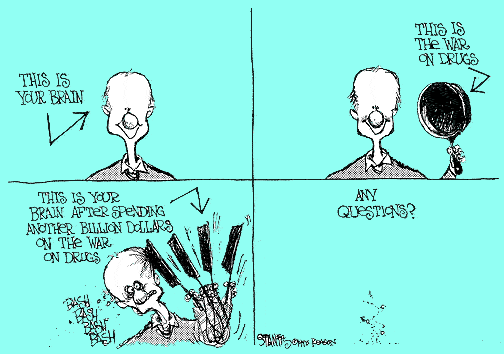
Norm Stamper, retired chief of police in Seattle, says America’s so-called war on drugs “has arguably been the single most devastating, dysfunctional social policy since slavery.” His words are being heard. All over America – the main exceptions being South Carolina and other Southeastern states – people are making concrete progress in changing that policy. For example:

Twelve states have enacted medical marijuana bills; California alone has more than 1,000 shops selling marijuana today to sick and dying people who have prescriptions from their doctors.

Delaware, New Jersey and D.C., among others, have new needle exchange programs in operation that are cutting back on the spread of AIDS, Hepatitis-C and other wasting diseases. Needle exchanges, illegal in most states, are also protecting police officers and medical personnel from being accidentally stuck.

Local governments in Colorado and several other states have ordered their police departments to put marijuana arrests on the bottom of their list of priorities, thus freeing up police to go after real criminals and easing pressure on the courts and prisons.

Nationally, only recently did the U.S. Sentencing Commission toss out guidelines that dictated penalties involving crack cocaine be 100 times harsher than penalties involving powdered cocaine, realizing that the two are just two versions of the same thing. (As is true with most drug laws, the crack/powder discrepancy was a racist thing: White people prefer powdered cocaine; blacks prefer crack. So black people were getting punished 100 times harsher than white people for the doing the same thing.) The commission found the difference so abhorrent that it made its decision retroactive, meaning some 19,500 inmates, most of them black, can seek reductions in their sentences.

In each case change came only after grassroots efforts forced it. In South Carolina, however, because too few people are willing to work for change, South Carolinians for Drug Law Reform is folding.

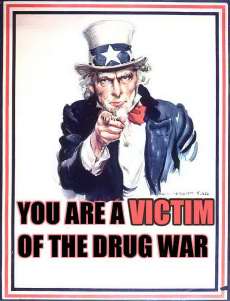
I’m sad about that because we are the only organization in South Carolina that is devoted exclusively to reforming our cruel, racist, counterproductive drug laws.

Continue reading

Stop stalkers before they become headlines

By Marianne Hill

She could have been my daughter, or my neighbor’s daughter. Carnesha Nelson was a bright, attractive 19-year-old college student who unfortunately became the obsession of a young man who worked on her campus at the University of Mississippi. He hounded her relentlessly, and wouldn’t take no for an answer. The night he assaulted her, she ran screaming from him, pounding on dormitory doors. Fellow students called the police, but did not let her in. He caught and killed her.

January is stalking awareness month, an appropriate time to assess our treatment of stalkers, and unfortunately “awareness” is lacking. Most are not aware that stalking that ends in violence is not uncommon. Each year there are many young women who say no to boyfriends and suitors, and lose their lives as a result. Over 1,100 women were killed by intimate partners in 2005, and another 860 by male acquaintances, with women from 18 to 30 years old the most at risk. However the number of women killed by stalkers is only a fraction of those affected by the violence: over one million protective orders are issued annually by the states to protect women from assault or stalking. Stalking is a growing problem on college campuses where over 20 percent of college women report fearing for their safety as a result of being stalked, according to a 2004 study cited by the National Center for Victims of Crime.

The suffering inflicted by stalking is great. Fearing for their safety, victims will often move, change jobs, or drop out of college and training programs to elude their pursuers. If they rely instead on protective orders, they can expect to find an angry stalker taunting them at their home or workplace: over 69 percent of protective orders for women are violated, according to a 1996 Justice Department survey. At times the stalker is not even served with papers notifying him of the protective order, since budget priorities lie elsewhere. In many states, some victims cannot even apply for protective orders: teens under 18 years old or women who have never dated their stalkers may not have this legal recourse. These same women may also be ineligible for access to women’s shelters.

Continue reading

Obama vs. Billary

By Scott Galindez
t r u t h o u t | Perspective

The race for the Democratic Party nomination for president has increasingly become a three-way race. The problem for John Edwards is he is no longer the third person in the race, Bill Clinton is.

To be fair, Edwards was the big winner in Monday night’s debate in South Carolina, but most observers think it is too late to save his campaign.

When I talked to Latino voters in Nevada who supported Hillary, they all talked about Bill Clinton’s record, not Hillary’s. Except for the exchange in Monday night’s debate, the strongest attacks against Obama have come from the former president, not his opponent.

In Nevada, Hillary was able to deny any connection to a lawsuit to prevent shift workers from voting on the strip, while Bill blew up at a reporter while defending the lawsuit. It was Bill that tried to claim Obama has not opposed the war from the beginning, based on his votes for funding, votes he has in common with Hillary, who now claims to oppose the war despite the same votes. It was Bill that claimed that Obama said he agreed with the ideas of Ronald Reagan when he clearly didn’t.

Continue reading

Get your emergency ballot here!

To address concerns that precincts around the state may run out of emergency ballots if voting machines fail during this Saturday’s Democratic primary, the SC Progressive Network is providing voters with their own emergency ballot that they can print and take with them to the polls.

IMPORTANT: Please note that if your precinct runs out of state supplied ballots, you can vote on any scrap of paper. Do not leave a poll where the machines are not working without casting a paper ballot. Do NOT try and vote on paper if the machines are working. If you insist on voting on paper when the machines are working, your ballot will go in with the contested ballots that will not be counted until the Thursday after the polls close – if at all.

You can print your own emergency ballot by downloading this file:
emergencyballot.pdf

If you encounter problems at the polls, please call the Network’s office to lodge a report by calling 1-803-808-3384. If warranted, the reports will be compiled and circulated to election officials and lawmakers as a resource to help guide us through the uncharted waters created by South Carolina’s new touch-screen voting machines.

The lie that won’t die

Obama as “radical muslim”
By Ed Madden, Columbia

I ran into a friend in the grocery store, and we started talking about politics.

“I hope you’re not planning to vote for that Obama,” he said.

Why? “You know he’s a Muslim.”

Living in South Carolina, you get used to hearing the national news talk about the nasty politics of our state. We are the land of push polls and Lee Atwater—the state that famously spread false rumors about McCain’s child in the last election, the state that saw religious prejudice alive and well in fake Christmas cards sent out last month to attack Romney. It’s become the standard intro to national stories about the Republican primary here—as predictable as the inevitable Confederate flag question at the debates.

But here I was, talking with a friend in Kroger—a friend whose opinion I valued—hearing that Barak Obama was a radical Muslim who refused to put his hand on the Bible when he was sworn in. “He won’t put his hand on the Bible,” he repeated.

Continue reading

Preparing for voting machine problems in SC’s upcoming Democratic primary

votehere1.jpg

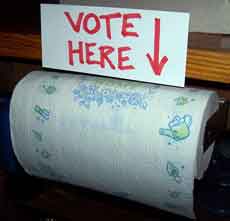
A paper towel may be used as a valid ballot if the voting machine fails you when you’re at the polls, advises SC State Election Commission spokesperson Chris Whitmire.

******************************

The South Carolina Progressive Network held a press conference yesterday to address voting irregularities in last weekend’s Republican presidential primary here. Problems were reported in Horry and Florence counties with voting machines that were not prepped properly. As a result, the touch-screen computers were not working when voters showed up at over 300 precincts in Horry County. Machines in both counties were programmed with the wrong date, and wouldn’t close at the end of the day. Hard numbers are unavailable, but reports indicate that at least some early voters were turned away in several precincts.

The problems at the polls were further exacerbated by election workers’ failure to have the requisite number of emergency ballots on hand.

The Network held the press conference on Jan. 23 to alert the public to potential problems in this Saturday’s Democratic primary, and to urge those going to the polls to be prepared, if the machines malfunction, to vote on paper. Any paper will do, including “paper towels,” according to the state Election Commission’s Chris Whitmire.

Also, if voters encounter problems at the polls they are urged to call the Network at 800-849-1803 or 803-808-3384 to seek help and to lodge a report.

Here are some clips from yesterday’s press conference. Speakers are Network Director Brett Bursey (left) and state Sen. Phil Leventis (D-Sumter). In the background are (on left) Donna Dewitt, Network Co-chair and SC AFL-CIO president, and Liz Deas of the SC Voter Education Project.

Below are links to news stories published after the press event.

Columbia’s Fox News

The State

Associated Press