Robin Hood in reverse in the US: seven examples

by Bill Quigley
Truthout

The rich have been getting richer and the poor and the middle class have been getting poorer in the US recently. Here are seven examples.

  1. Between 1948 and 1979, the richest 10 percent of families in the US claimed 33 percent of average income growth. Between 2000 and 2007, the richest 10 percent claimed a full 100 percent of average income growth in the US, according to the Economic Policy Institute.
  2. Business taxes were cut from 46 to 34 percent 25 years ago, according to ProPublica. But today, 115 of the big 500 companies listed on Standard and Poor’s stock index paid federal and other taxes of less than 20 percent over the last five years, according to David Leonhardt of The New York Times.
  3. General Electric’s tax rate for last year was seven percent, according to ProPublica.
  4. The top five percent of US households claim 63 percent of the entire country’s wealth. The bottom 80 percent hold just 13 percent of the growth, according to the Economic Policy Institute.
  5. Last year, John Paulson, a hedge fund manager “earned” $4.9 billion, according to The New York Times. Ten years ago, it took 25 such managers to collectively earn that much. Last year, the top 25 hedge fund managers pocketed (a much better word) a total of $22 billion. It would take over 440,000 people each earning $50,000 a year to match that amount.
  6. A federal development program intended to help poor communities, the New Market Tax Credit, instead funnels up to ten billion taxpayer dollars to big corporations like JPMorgan Chase & Co, Goldman Sachs and Prudential to build luxury hotels, office buildings and a car museum. Bloomberg Markets Magazine pointed to the Blackstone Hotel in Chicago, which was renovated for $116 million. Prudential got $15.6 million in tax credit from the US Treasury for helping fund the project because the hotel was in a census zone that included two colleges that housed a lot of lower income students.
  7. According to the Financial Times, there are now more people living in poverty in the US than at any time in the last 50 years. Foreclosure filings were nearly four million in 2010, up 23 percent since 2008, according to RealtyTrac.

Now’s your chance to weigh in with US Justice Dept. on SC’s new voter photo ID law

If you, or someone you know has a hard time getting a state issued photo ID, download a Dept. of Justice Comment Form. Fill it out online and print it out (this form can not be saved and must be printed). Sign it and follow the mailing instructions at the end of the form.

Anyone can comment directly to the Department of Justice through email to: vot1973c@usdoj.gov. Put in subject line: “2011-2495: Comment”. Or comments can be mailed to:
Chief, Voting Section, Civil Rights Division
Room 7254 – NWB, Department of Justice
950 Pennsylvania Ave., N.W., Washington, DC 20530
(Include the submission # 2011-2495 at the top of your letter.)
Or fax comments to the Dept. of Justice at 202-616-9514 with the same heading.

Got questions? Call the SC Progressive Network at 803-808-3384.

Michael Moore flick to launch Network’s free monthly movie night

The SC Progressive Network has occasionally shown movies in the backyard of our office in Columbia. This month, we’re making it a regular attraction (every 4th Tuesday), beginning with Michael Moore’s Capitalism, A Love Story on July 26.

And because of the beastly weather, we’re moving indoors. The movie will be shown at Conundrum Music Hall, 626 Meeting St. in West Columbia at 6pm. (Big thanks to proprietor Tom Law for offering his new venue to us!) Free and open to the public. Popcorn on the house.

On Aug. 23, we will show the documentary Salud!, about Cuba’s health care system.

For more information, call the Network at 803-808-3384 or email network@scpronet.com.

Latest news from Network’s photo ID campaign

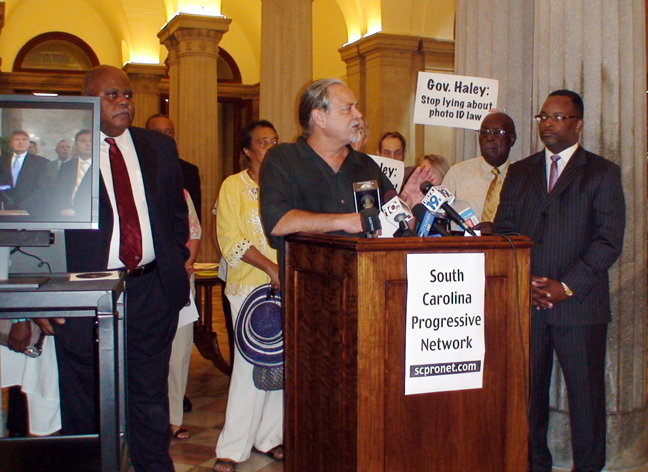
On July 8, the SC Progressive Network held a second press conference on the photo ID law to clear up misconceptions repeated by the governor and lawmakers, and to invite the public to submit comments to the US Dept. of Justice, which is reviewing the new law to consider whether it abridges the minority vote.

See more photos from the media event here.

Below is a sample of the media coverage the press conference generated.

Group seeks those impacted by new SC voter ID law

JIM DAVENPORT, Associated Press
July 8, 2011
South Carolina voting rights advocates said Friday they are looking for voters who might not be able to have their votes counted next year under one of the nation’s toughest voter identification laws. The South Carolina Progressive Network is trying to identify some of the nearly 180,000 people who are now registered to vote but who lack the state- or federal-issued photographic identification called for under the new law. Those people would be able to cast provisional ballots, but would have to show the required identification within three days to have their votes counted. Read more:

Critics challenge ‘Voter ID’ plan

By GINA SMITH
The State
When Delores Freelon was born in 1952, her mother could not decide on a name for her. So the space on the birth certificate for a first name was left blank. In the decades since, the incomplete birth certificate did not prevent Freelon from getting her driver’s license and voter registration card in the various states she has lived, including Texas and Louisiana.
But a measure — already passed by the General Assembly and signed by Gov. Nikki Haley — will create new hurdles for Freelon and others to vote. Read more:

Group aims to block voter ID law
Opponents push for rejection by U.S. Justice Dept.

BY YVONNE WENGER
The Post and Courier
COLUMBIA — The S.C. Progressive Network issued a warning Friday to the nearly 25,000 registered voters in the tri-county area without a state-issued photo ID: You could run into trouble the next time you go to the polls. The advocacy organization is urging the U.S. Department of Justice to reject a new South Carolina law that will require all voters to carry a picture ID to cast a ballot in future elections. The state’s Republican leadership pushed for the new law, citing a need to guard against voter fraud even though there has been no substantive proof of widespread voter fraud for years in the state. Read more:

Progressives Push to Stop Implementation of Voter ID Law

BY COREY HUTCHINS
Free Times
Five TV cameras, two reporters from The State, one from The Associated Press, a reporter from the Charleston Post & Courier and another from the South Carolina Radio Network, among others, swarmed around a podium in the lobby of the State House July 8, as South Carolina Progressive Network director Brett Bursey warned voters here that they might have trouble casting a ballot under a new state law. It comes during a time of a national pushback against such regulations.

Read more:

Governor, lawmakers mislead public on SC’s photo ID law, now under review at Justice Dept.

SC Progressive Network to hold press conference to clear up misunderstanding and to invite public comment

The US Dept. of Justice is now receiving comments on South Carolina’s new photo ID law as it considers whether it abridges the minority vote. The SC Progressive Network will host a press conference at 11:45am on Friday, July 8, in the downstairs lobby of the State House to clear up public misunderstanding stemming from misinformation being repeated by the governor and GOP legislators.

The Network will share with reporters the only attachment supporting the state’s filing: a one-page letter from bill sponsor Rep. Alan Clemmons, who writes that he filed the bill because “It is an unspoken truth in South Carolina that election fraud exists.”

The Network, which for 15 years has been advocating voting rights, is making its case to the Dept. of Justice that our state’s ID law, the nation’s most restrictive, will suppress the vote, especially among seniors and the poor. In South Carolina, a birth certificate is required to get the state-issued card, and the law provides no exceptions, as do similar laws in other states.

It is clear that at least some of the estimated 200,000 registered SC voters who don’t have a photo ID will not be able to vote in the next election because they won’t have their papers in order.

The press conference will include the showing of a brief video clip of Gov. Nikki Haley signing the bill into law, where she defends the law by stating that a photo ID is necessary to buy Sudafed or to get on an airplane. To a reporters’ question about what sorts of ID are acceptable, Rep. Bobby Harrell says, “If you can fly with it (photo ID), you can vote with it.” That simply isn’t true.

At Friday’s press conference, two South Carolina voters will testify that, contrary to Gov. Haley and Rep. Harrell’s assertions, they can buy Sudafed and fly with the IDs they have; what they can’t do is vote in South Carolina.

The Progressive Network is collecting statements from people around the state who are having trouble meeting the state’s new ID requirements and will forward them to the Justice Department. Also, the public may make comments by email to: vot1973c@usdoj.gov. In the subject line put: “2011-2495: Comment”. Or comments may be faxed to: 202-616-9514.

For more information contact the SC Progressive Network at 803-808-3384 or network@scpronet.com. See background on the photo ID law and video clips of voters disenfranchised by the new law at SC Progressive Network.

New photo ID law makes it harder to vote in South Carolina than anywhere in the country

By Becci Robbins
SC Progressive Network

You could forgive voters for being confused about South Carolina’s photo ID law. Debate on the bill went on so long their eyes glazed over years ago. It’s hard to be as charitable to Gov. Nikki Haley, who twists the truth every time she defends the law she helped push through.

The governor argues that if we need a photo ID to buy Sudafed or to board a plane, we should need one to vote. Sounds reasonable, but neither pharmacies nor airlines require a state-specific ID, as this law does. And to get a SC photo ID you need to produce a birth certificate. For some people, that’s a problem.

Finally, we are number one! Sadly, it’s in voter suppression.
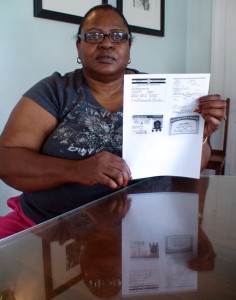
These documents aren’t enough for Delores Freelon to vote.

The National Conference of State Legislatures has identified seven states as having the most restrictive photo ID requirements for voting: Georgia, Kansas, Texas, Indiana, Wisconsin, Tennessee and South Carolina. All require voters to show a photo ID, but states vary in what kind and how hard it is to get.

  • In Georgia, if voters are already registered, they automatically get a new photo ID voter registration card.
  • In Kansas, voters can use a driver’s license from out of state, any accredited college ID, or government-issued public assistance cards. Voters over 65 may show expired ID.
  • In Texas, you can get ID to vote with your concealed weapons permit, your boating license, insurance policy or beautician’s license. Or you can vote a provisional ballot if you will incur fees in order to vote. Voters over 70 are exempt.
  • In Indiana, those without a photo ID get their provisional vote counted by claiming the fees to get the required documents were a burden.
  • In Wisconsin, voters can use any state driver’s license, Social Security card or student ID.
  • In Tennessee, a driver’s license from any state allows you to vote.
  • In South Carolina, voters must produce a birth certificate to get the state-issued photo ID required to vote. No exceptions. (If you vote a provisional ballot, that won’t count unless you present your state-issued photo ID within three days.)

Numbers are hard to project, but it is clear that some of the nearly 200,000 registered South Carolina voters who don’t have their papers in order will not be able to vote in the next election.

Even though there are no cases of the kind of fraud this law is purported to prevent, our cash-strapped state will spend at least the $700,000 supporters say it will cost to implement. Opponents say it will cost two to three times that much to educate poll workers and the public about the new law. The governor has said you can’t put a price on the sanctity of the vote.

She should tell that to Delores Freelon, a Columbia resident and registered voter who won’t be able to vote in the next election because she has a Louisiana driver’s license and can’t get her birth certificate from California in time. What about the sanctity of her vote? What about Ms. Kennedy in Sumter, whose birth certificate lists her first name as Baby Girl, meaning she’ll have to go to court to get her papers straight in order to get a photo ID? Or Larrie Butler, who was born at home in Calhoun County in 1926 and is being told he needs records from an elementary school that no longer exists in order to establish a birth certificate?

Stories like these are coming in from around the state. The SC Progressive Network, which for 15 years has been advocating for voting rights, is fielding calls from people with questions about the new law or having problems meeting the ID requirements.

The lucky ones will still get to vote, but only after jumping through hoops and paying fees at various state agencies. Some will have to amend their birth certificates by going to court, at considerable cost. People without a car, a computer or short on money are simply out of luck. The disenfranchised will be primarily seniors and the poor. Many of them will be people of color who have voted all their lives.
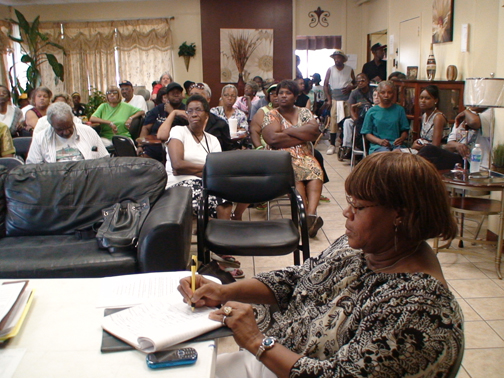
The Network is working to educate the public about the new law.

This quiet whittling away of the vote is no accident. It is, in fact, the point. It’s the pattern being repeated in GOP-controlled legislatures across the country.

In South Carolina, we have a brief chance to challenge this law. Because of our state’s history of disenfranchising people of color, ours is one of seven states that must get pre-clearance from the US Dept. of Justice (DOJ) before new voting laws can go into effect. Once the state attorney general files the case, DOJ has up to 60 days to consider whether the law suppresses the minority vote.

The SC Progressive Network is gathering statements to forward to DOJ documenting voters’ experiences. We need volunteers around the state to help find citizens who will have a hard time meeting the new voting requirements. If you want to help, call the Network at 803-808-3384 or see scpronet.com for details.

See video clips of Delores Freelon and Larrie Butler telling their stories.
Another casualty of the SC voter photo ID law

Delores Freelon will not be able to vote in the next election because she can’t meet the requirements of the new photo ID law in time. She is one of nearly 200,000 South Carolina voters who don’t have a current, state-issued photo ID at risk of being disenfranchised. Please help us get this law thrown out. Call 803-808-3384 or see scpronet.com for details.

Don’t miss our 15th annual spring gathering!

Join us for a day of fellowship with allies and mapping strategy for the coming months. The event is free and open to anyone interested in promoting a progressive agenda in the Palmetto State.

11:30 – 12:30 – Registration and lunch. Lunch is $10; please RSVP for lunch at network@scpronet.com or 803-808-3384.

12:30 – Introductions and welcome. Overview of the Network’s goals, strategies and tactics. Reports from the field.

1:30pm – Policy work
• Review our moral budget campaign and look ahead to the budget in the coming legislative session
• Understanding SC’s new voter photo ID law and our campaign to stop it in the Justice Department
• “Are your papers in order?” A look at SC’s pending anti-immigrant legislation
• Redistricting. What’s happening and what are the implications
• SC organized labor under assault; what can we do?
• Reproductive rights: victories and challenges in SC
• Hate crimes legislation: an update

2:30 – Policy priorities for the coming year

3:00 – Break

3:15 – Network Education Fund business (501-c-3)
• How can the Network Education Fund better serve your organization?
• Financial report and fundraising.
• Communications report
• By-laws changes

3:45 – Progressive Network individual members business (501-c-4)
• Movement building, political parties and strengthening our base
• ProVote – mapping strategy
• The Network’s relationship with national organizations. How can we work more collaboratively?
• Summer projects
• Fall retreat: making plans for our next statewide gathering

5pm: Meet and mingle