State Election Commission Complicates Voting Procedures for Ex-offenders

Voting Rights Remain Unclear for SC Citizens Who Have Served Their Sentences

In light of a recent study that revealed confusion among county election directors regarding procedures for ex-offenders’ voting rights, the State Election Commission (SEC) yesterday sent a memorandum to the 46 county election directors advising them that they “may ask the voter for proof of completion of their sentence, but this is not required by law.”

This discretionary additional requirement may depress the vote among ex-offenders, said Brett Bursey, director of the SC Progressive Network. “If additional proof is not required by law, the State Election Commission should be advising the counties not to require proof that an offender has completed a sentence. This added requirement burdens the 18,000 citizens a year who have paid their debt to society, and may result in them not voting.”

South Carolina’s voter registration form includes a “Voter Declaration” that the registrant must sign, and face criminal penalties for falsely taking the oath. No additional proof is required to prove their US citizenship or mental competency. Ten counties accept the oath as proof that the registrant is not serving a criminal sentence.

On Sept. 17, the SC Progressive Network and the SC ACLU held a press conference to release the results of a study that found county election directors around the state had different methods of dealing with ex-offenders who wanted to register to vote. The study concluded that, since there were no laws regulating the procedure, all counties should simply allow ex-offenders to register by signing the registration form.

“We daily encounter citizens who tell us they can’t vote because they are ex-offenders.” Bursey said. “Unfortunately, the citizens don’t know the laws, the county election boards don’t know the laws, and the State Election Commission is unwilling to define the laws.”

While the SEC has recognized that there is no law requiring ex-offenders to provide proof of completion of sentence to register, its officials claim they are unable to direct the independent county election boards not to do so.

When asked if they will issue a press release advising ex-offenders of their right to register, an SEC spokesperson said, “That’s not our job.”

Sept. 24 SC Election Commission memorandum:

Any person who is convicted of a felony or an offense against the election laws is not qualified to register or to vote, unless the disqualification has been removed by service of the sentence, unless sooner pardoned.  Service of sentence includes completion of any prison/jail time, probation, parole, and payment of restitution.

Federal and state courts provide the SEC with lists of persons convicted of felonies or crimes against the election laws. Those persons are removed from the state’s list of active, registered voters. The SEC notifies each voter whose name is deleted from the list. Voters have 20 days from the date the notice is mailed to appeal. Appeals must be made to the SEC.

Once a person who was convicted of a felony or offense against the election laws serves their sentence; they may register or re-register.

The following process should be followed for voters who are re-registering after being made inactive due to a conviction.

• The voter must re-register with the county voter registration board by submitting a voter registration application.
• The board makes the final determination of whether the voter meets the qualifications to register.
• The board may ask the voter for proof of completion of their sentence, but this is not required by law.
• The voter is either added as a new voter or reinstated to the voter registration system
• If the board determines a voter should be reinstated to active status, the board must notify the SEC in writing. Once notification is received, the SEC will reinstate the voter.

Thank you,

Chris Whitmire
Public Information Officer

South Carolina State Election Commission 
Post Office Box 5987
Columbia, S.C. 29250
Tel: 803.734.9070
Fax: 803.734.9366
Pride ’08

Gay rights activists marched in downtown Columbia on Sept. 20, then joined thousands at Finlay Park to celebrate South Carolina’s annual Pride Festival. SC Progressive Network member groups with booths on the park grounds were: AFFA, Garden of Grace United Church of Christ, SC Equality, SC GLPM, PFLAG, SC Gay and Lesbian Business Guild and Sean’s Last Wish. The Progressive Network’s Missing Voter Project continued its voter registration drive, and brought in new individual members to our coalition.

It was a day of fun fellowship and solidarity. Congratulations to all the organizers for a successful Pride Week!

For Pride photos, click here. (Thanks to Jim Blanton, Ed McClain and Sarah Gibb for contributing snapshots.)

Ex-felons’ voting rights fool officials

Survey finds almost half are unclear on certain aspects of the law

By Gina Smith

The State

S.C. election officials lack knowledge of some voting rules for people with criminal records, according to a new survey. Wednesday, representatives from the ACLU and the S.C. Progressive Network released a survey of election officials in each of South Carolina’s 46 counties.

On questions like whether people with misdemeanor convictions and people with out-of-state felony convictions may vote, an average of 48 percent of officials got it wrong. On basic eligibility questions, like whether residents with felony records could vote, officials fared much better, with about 5 percent getting the answer wrong.

“The history in South Carolina is preventing people from voting, and we’re still living that history,” said Brett Bursey, director of the S.C. Progressive Network. Several people the Network attempted to register to vote recently thought they couldn’t vote because of past incarcerations.

“The people on the streets don’t understand (the rules), and if they go to their election commission, they’re going to get this kind of wrong information,” Bursey said.

The two organizations hope the survey will result in more training for election officials. They also want the state to notify people when they regain their right to vote.

The State Election Commission, which oversees the 46 county election commissions, is questioning the survey’s methodology.

“I don’t know what to think about the survey,” said Chris Whitmire, commission spokesman. “I don’t know how it was conducted and who they talked to at the (election commission) offices, how were the questions asked and if there was any bias in the questions.” Whitmire also noted some of the questions were misleading.

Under South Carolina law, those convicted of felonies are prohibited from voting until they complete their sentences, including parole and probation. Those convicted of violating any election law – felonies or misdemeanors – are also prohibited from voting until their sentences have been served. Then, the right to vote is restored.

If convicted of any other misdemeanor, the person loses the right to vote while incarcerated.

All employees of the state’s election commissions must complete a state certification program, Whitmire said. An additional class is required annually.

Survey questions were asked of whoever answered the phone at the election commissions, to simulate the experience of regular callers, said Rachel Bloom of the ACLU.

Whitmire said the election commission may send a letter to the county commissions, reiterating voting rules to workers.

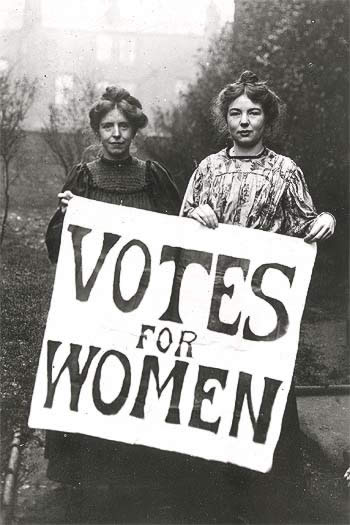
Women’s Equality Day

Today marks the anniversary of women’s securing the right to vote, in 1920, after 72 years of struggle.

We’ve come a long way. But we have a long way to go. Consider:

• Women lack equal pay, making $.77 for every dollar men earn.

• The US has no guaranteed medical leave for childbirth. (168 countries do.)

• The US is near the bottom of the list in our public support for quality child care for children of working parents.

• Access to affordable birth control is under attack.

• Reproductive rights are threatened.

• Women make up 16 percent of representatives in Congress.

votes-women.jpg

Making Money on a New Cold War

By Morgan Strong
Consortium News

The Russia-Georgia clash has generated heated anti-Moscow rhetoric from John McCain and U.S. neoconservatives about a new Cold War, a prospect that most people might see in a negative light but which many military contractors surely view as a financial plus.

One unstated reality about revived tensions between Washington and Moscow is that it will mean a bonanza in military spending – billions of additional dollars for anti-missile weapons systems, larger armies, construction of new bases in Eastern Europe, etc.

Indeed, the spending on Cold War II could dwarf what military contractors are now making on the “war on terror” – and the prospect of spending on both conflicts simultaneously should make arms industry executives drool.

Others who stand to profit grandly from a new East-West showdown include tough-talking politicians and their friends in Washington think tanks – like Heritage, AEI and CSIS – that have long fattened up on contributions from the defense industry and related corporations.

There would be losers, too, like taxpayers who would see more of their dollars go to “national security” and less to domestic needs, from repairs to the crumbling infrastructure to the costs of health care, education, the environment and Social Security.

But, in many ways, the exploitation of Cold War fears – to divert money away from domestic needs to the coffers of what Dwight Eisenhower dubbed “the military-industrial complex” – is nothing new.

Arguably, the original Cold War ended under Eisenhower’s former Vice President, Richard Nixon, who as President returned from Moscow in 1972 carrying a strategic agreement that he had reached with what was already a rapidly decaying Soviet Union.

“In Moscow, we witnessed the beginning of the end of that era which began in 1945,” Nixon said. “With this step, we have enhanced the security of both nations. We have begun to reduce the level of fear, by reducing the causes of fear, our two peoples, and for all the peoples of the world.”

Nixon unveiled a new era of realpolitik cooperation between Washington and Moscow that he called “détente.”

However, while reducing fears and lowering tensions might be good news for many people, it wasn’t welcomed by the corporations that profited from the fears and the tensions, nor by the intellectual hired guns who had built lucrative careers in politics, media and academia by exaggerating those fears and exacerbating those tensions.

Continue reading

Greenville activist featured in new book

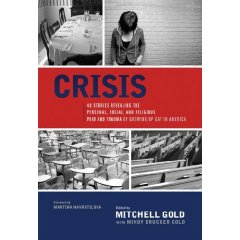
crisis.jpg

Sean’s Last Wish founder Elke Kennedy is featured in the soon to be released book CRISIS, 40 Stories Revealing the Personal, Social, and Religious Pain and Trauma of Growing Up Gay in America. It is edited by Mitchell Gold, founder of Faith in America, with Mindy Drucker.

CRISIS is an expose of the fear, isolation, depression, and even suicidal feelings young gay people face from the time they realize they are gay until they have a healthy coming out. For many gay adults, the traumatic teenage years are buried in memory as a painful time to be left behind and forgotten. But, those who bravely recalled and contributed their stories to CRISIS describe experiences that are unfortunately universal for gay youth. 

Well-known successful members of the gay community, such as Bishop Gene Robinson, actor Richard Chamberlain, ambassador Jim Hormel and US Reps Tammy Baldwin and Barney Frank, share what it was like to live a lie every day, without support from family, friends, church, or school-and how they triumphed over the challenges. And a number of young people detail personal experiences that make clear the same challenges unfortunately continue today.

CRISIS is designed to make parents, clergy, teachers, politicians, and the media aware of the ongoing crisis young gay people experience in our culture today and understand how to stop it.

In addition to being an inspiring and helpful personal resource, it is an excellent gift for that someone you know whose heart and mind you’d like to transform from hostility to love and from rejection to acceptance. 

CRISIS will be published in mid-September. Pre-orders are available now at Amazon.com and CrisisBook.org.

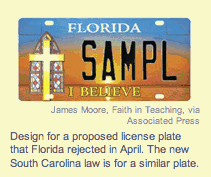
“I Believe” license plates up for debate

On Sunday, Aug. 10, at 7pm the Unitarian Universalist Fellowship in Columbia will hold a panel discussion about the proposed South Carolina “I Believe” license plates, which has resulted in a lawsuit. (See earlier post for background on the controversy.)

The panel will include Kevin Hall, an attorney with Nelson Mullins, the law firm that will be defending the Dept. of Motor Vehicles in the lawsuit. He will join the Rev. Michael Frisina, pastor of Calvary Chapel, and one of his parishioners, Carl Sohm, in defending the constitutionality of the plate. Speaking in opposition to the plate will be two of the plaintiffs in the lawsuit: the Rev. Dr. Tom Summers, a retired United Methodist minister, and the Rev. Dr. Monty Knight, pastor of the First Christian Church of Charleston and president of the Charleston AU chapter.

The UU Fellowship is at 2701 Heyward St., corner of Heyward and Woodrow in Shandon.

believecaption.gif

Network offers free training to maximize voter registration with state-of-the-art tools

By Becci Robbins

The SC Progressive Network is gearing up its Missing Voter Project to find, engage and register South Carolinians who aren’t voting. In the 2004 presidential year election, slightly less than half of the voting-age population turned out, putting South Carolina 42nd in voter participation. In 2006, for mid-term elections, slightly more than a third showed up at the polls (35 percent).

mvp_logo3.jpg

“There is nothing more important to a healthy democracy than an engaged citizenry,” said Network Director Brett Bursey. “Americans should be alarmed at how the monied interests in this country have hijacked the electoral process. Ordinary citizens are getting the short end of the stick by not participating in elections.”

The US ranks 138th in the world in voter turn out, falling between Armenia and Nigeria, according to a 2002 study by the International Institute for Democracy and Electoral Assistance, based in Stockholm.

“While we are busy trying to export democracy around the world, ironically, too many of us are not practicing it here,” said Rev. Dr. Bennie Colclough, who serves as the Network’s Cochair. “This could have something to do with the fact that we are the only wealthy nation that doesn’t provide education and health care to its citizens as part of their democratic social contract.”

The Missing Voter Project is designed to take voter registration beyond traditional party building or drumming up support for a specific campaign or candidate. The MVP is an effort to engage new voters in a larger movement for social change based on citizen empowerment.

“I can’t tell someone that registering and voting is going to improve their life,” Bursey said.” The system itself is broken. Due to the creation of ‘safe’ districts for incumbent legislators, we have the least competitive legislative races in the nation, with most seats being uncontested. And the sad reality is that 98 percent of the candidates who spend the most money are the ones who win. That’s not an election, it’s an auction.”

The Missing Voter Project is a civic engagement program with a special emphasis on minority youth. Since 2004, the MVP has provided street maps identifying unregistered and infrequent voters in minority precincts throughout rural South Carolina, and has registered more than 6,000 voters. About half of South Carolina’s black population is registered, and about half of those registered turn out to vote. The service has been offered statewide to other nonprofits to enhance their voter registration work.

The Missing Voter Project is built on the idea that registering and voting is simply the first step to building power at the grassroots level. The intention is to create a movement of voters with enough power to help set political priorities that meet their needs rather than the needs of politicians and corporate interests.

“Most folks in this state are not voting because they don’t believe it will make a difference,” Bursey said. “But imagine how we could change life in South Carolina if we didn’t leave running the government to those with access to wealth. It’s a long-term effort we are proposing, but people are hungry for change. We want to offer them a way to make it happen.”

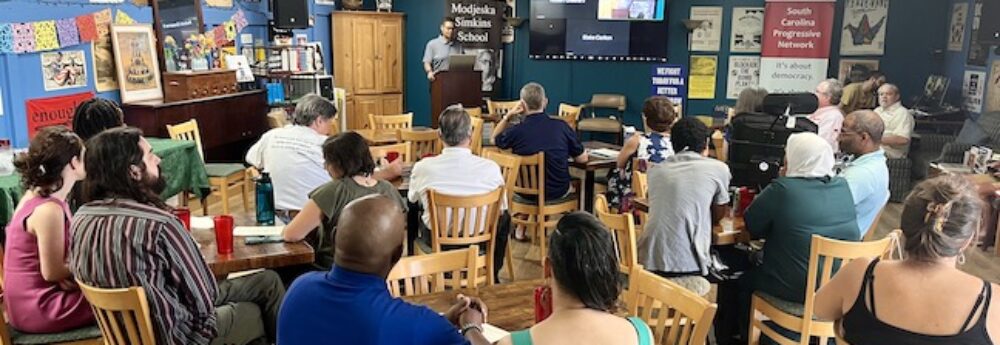
The Network is organizing free, nonpartisan voter registration training sessions throughout the state to show groups and individuals how to use high-tech maps to maximize their registration efforts. The two-hour training sessions are 7-9pm in the following cities:

Winnsboro: Aug. 9, Glover’s Memorial Chapel, 423 N. Congress St. (Network will partner with Sigma Theta, Fairfield Co. NAACP, SC Voter Education Project)

Charleston: Aug. 14, Morris Brown Church, 13 Morris St. (Network will partner with Charleston NAACP, SC Voter Education Project)

Columbia: Aug. 19, St. John’s Baptist, corner of Farrow and Beltline: (Network will partner with Columbia NAACP, Delta Sigma Theta Sorority, SC Voter Education Project)

Greenville: Aug. 21: Mt. Pleasant Community Center, 715 S Fairfield Rd: (Network will partner with Greenville NAACP, League of Women Voters, SC Voter Education Project)

Subscribe to Missing Voter Project
Email:
Visit this group

Faith matters

Check out Publishers Weekly’s review of Candace Chellew-Hodge’s forthcoming book, Bulletproof Faith. Rev. Chellew-Hodge serves as a pastor at the Garden of Grace United Church of Christ (a member of the SC Progressive Network) in Columbia and edits the online publication Whosoever.

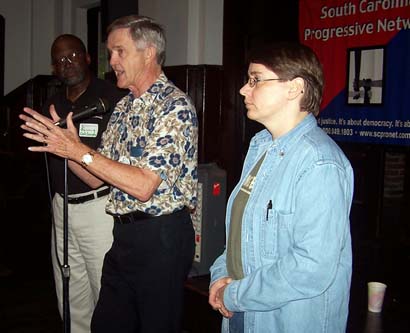
revs.jpg

Rev. Candace Chellew-Hodge (right) joins Rev. Tom Summers (center) and Rev. Bennie Colclough in facilitating a group discussion at a Network retreat at Penn Center.

SC ACLU: up from the ashes

By Becci Robbins and Brett Bursey
SC Progressive Network

About 25 activists met yesterday in Columbia to talk about the future and direction of the South Carolina chapter of the American Civil Liberties Union, which in April was taken over by the national after years of poor management and in-fighting. While the national organization has twice before taken over a state chapter, this is the first time in the ACLU’s nearly 90-year history that it has done so without the affiliate’s blessing.

It’s too bad that it has come to this, but it appears it was the only way the SC ACLU was ever going to get out of the ditch it has been mired in for more than a decade. Under the leadership of libertarian David Kennison, the chapter has been at ideological odds with the national organization and has alienated longtime SC ACLU supporters and board members.

It didn’t help that the SC ACLU hired a series of executive directors who ranged from inept to corrupt. The last director was fired after it was discovered that her law license had been suspended and that she was stealing money from the chapter.

Tension deepened two years ago, when the chapter became the only state affiliate to sign onto a Web site criticising the ACLU’s national director, Anthony Romero. Kennison has argued that the chapter take-over is tied to his past criticism of Romero. (You can read more about this dispute in The Nation.)

All this drama has not come without a price. While the SC ACLU has been battling with itself, abuses of civil liberties have gone unchallenged. Absent, too, has been a clear and consistent voice in the South Carolina media addressing privacy concerns, chronic problems regarding the separation of church and state, and a host of other legal and legislative matters.

Yesterday’s meeting in Columbia was the first in a series that the ACLU will hold across the state in an effort to gather input and chart a new course. If you want to add your two cents, the organization is soliciting feedback through an online survey.

We wish the new SC ACLU well.