Category Archives: Network News/Events
Honoring Rep. Gilda Cobb-Hunter
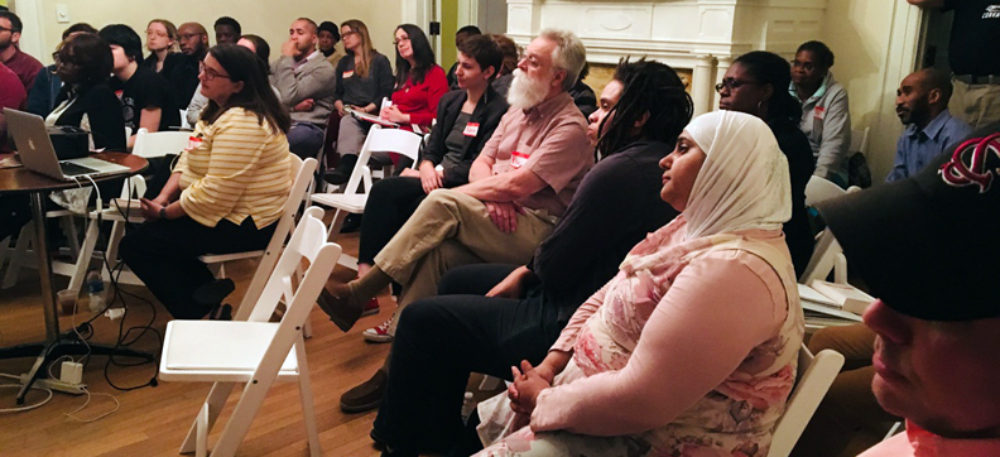
Friends of Rep. Gilda Cobb-Hunter (D-Orangeburg) gathered at the historic Robert Mills House in downtown Columbia on May 22 to honor the legislator for her commitment to progressive values and her long history of speaking truth to power.
Remembering Sean Kennedy
Family and friends gathered in a downtown Greenville park on May 16 to honor the memory of Sean Kennedy on the first anniversary of his murder. His mother, Elke Kennedy, has campaigned tirelessly in the past year to educate the public and to promote passage of hate crimes legislation in South Carolina. She established Sean’s Last Wish Foundation to further that work.
After an emotional ceremony, the crowd filed down to the Falls Park bridge and dropped daisies into the Reedy River.
Read an earlier blog post about Sean here.
Bush operative pushes voter-ID law
By Jason Leopold
Consortium News
A senior legal adviser to the Bush-Cheney 2004 reelection campaign is working behind the scenes to help enact a Missouri state constitutional amendment that critics say would suppress the vote in the key battleground state this November by requiring voters to show proof of citizenship.
Mark “Thor” Hearne, Bush-Cheney’s national counsel in 2004 and now a partner in the St. Louis, Missouri, firm of Lathrop & Gage, has been collaborating with Missouri’s Republican state Rep. Stanley Cox, the sponsor of the constitutional amendment, Cox’s office confirmed this week.
For years, Hearne has been a leading Republican figure demanding stricter voter-identification laws and popularizing claims about widespread voter fraud, although many election experts dismiss such alarms as hyperbole.
During the 2004 campaign, Hearne reportedly worked with White House political adviser Karl Rove on “voter fraud” issues and spearheaded GOP efforts to challenge voter-registration drives by pro-Democratic groups.
According to a posting at his law firm’s Web site, “Hearne traveled to every battleground state and oversaw more than 65 different lawsuits that concerned the conduct of the election.”
Hearne also has shown up as a background figure in the Bush administration’s scandal that erupted over the firing of nine federal prosecutors, some of whom came under White House criticism for not seeking pre-election voter fraud indictments in 2006.
More recently, Hearne has been instrumental in pushing state lawmakers to pass strict voter identification laws in Missouri, New Mexico, Indiana and other states. The Indiana voter-ID law recently was upheld by the conservative majority on the U.S. Supreme Court.
Hearne conducted much of this work through his now defunct organization, the American Center for Voting Rights (ACVR), which called itself a non-partisan group defending voter rights and seeking to enhance public confidence in the fairness and outcome of elections.
However, an investigation into ACVR by blogger Brad Friedman reported that it concentrated on stricter voter-ID laws. “Thor Hearne helped to write that Indiana law, then Thor Hearne submitted an amicus brief to the Supreme Court on behalf of Republican U.S. Congress members in support of it.”
GOP Strategy
Rather than an epidemic of illegal voters casting ballots, some election experts point to a nationwide Republican strategy of exploiting those concerns to depress the voting of low-income and minority citizens and thus boost the chances of GOP candidates.
Joseph Rich, formerly chief of the voting section in the Justice Department’s Civil Rights Division, said that under the Bush administration the department “shirked its legal responsibility to protect voting rights.”
“Over the last six years, this Justice Department has ignored the advice of its staff and skewed aspects of law enforcement in ways that clearly were intended to influence the outcome of elections,” Rich wrote in a March 29, 2007, op-ed in The Los Angeles Times.
“From 2001 to 2006, no voting discrimination cases were brought on behalf of African American or Native American voters. U.S. attorneys were told instead to give priority to voter fraud cases, which, when coupled with the strong support for voter ID laws, indicated an intent to depress voter turnout in minority and poor communities.”
Missing Voter Project is up and running
US Fair Vote has taken note of the SC Progressive Network‘s Missing Voter Project. Check out the blog here.
The voter engagement initiative is gaining traction in Fairfield County. We hope to use it as a model that can be replicated in other counties. It’s a project with great potential, and we’re excited to be doing hands-on work in rural communities. Stay tuned.
Progressive comrades: read this! Quiz on Friday.
What Obama can’t do for the progressive movement
By Joe Brewer and Evan Frisch
t r u t h o u t | Perspective
This is an exciting time for progressives. An inspiring new approach to politics has mobilized millions of politically ambivalent citizens. There is, for the first time in our lives, a genuine optimism that we can reclaim our country from a corrupt and morally bankrupt extremist group that has hijacked the discourse – and thus the dominant institutions – of the body politic.
And yet, there are dangers far greater than the smears we have seen so far.
As members of the Rockridge Institute, we have been unable to comment on the promise of the Obama campaign, and the perils progressives face in its midst, due to the restriction against partisan activities by 501(c)(3) nonprofits such as ours. The Rockridge Institute closed this week and, so, we are able to comment directly on our analyses of political campaigns. Now that we are free from legal constraints, we feel the need to help our fellow progressives prepare to face the challenges that lie ahead.
First, a note about the Rockridge Institute. This nonpartisan progressive think tank was founded by George Lakoff to shift the political debate through insights and analyses from the cognitive sciences. You can read the announcement declaring the end of the Rockridge Era here. In this article, we call for a new era for progressive politics informed by the opportunities and pitfalls we discovered through our work at this small shop based out of Berkeley, California.
A Wake Up Call for Progressives
Obama has ignited the civic passions of millions with an inspiring call to transcend the politics of the past and deliver on the promise of a more perfect union. His campaign is grounded in the fundamental American values and principles that have brought about progressive changes throughout our history. The success of this approach, though often criticized in the media, exemplifies a basic tenet that Lakoff and the Rockridge Institute have advocated for a long time, namely that voters are motivated by shared values and authenticity.
The Clintons and others criticized Obama when he rightly pointed out “Republicans were the party of ideas,” in recent decades, because they “were challenging conventional wisdom.” At a time when his opponents were trying to represent Obama as too far to the right, they linked these comments to his insightful observation that Ronald Reagan had successfully “changed the trajectory of America,” which they spun as Reagan worship. A key insight missed by the media during that trifle is that conservatives have indeed shifted the common sense of our nation – for the worse. For decades, conservative think tanks have churned out and propagated strategic initiatives that have undermined the founding principles of the United States. Meanwhile, progressives have been stuck in reaction mode, struggling to defend the policies of the past, issue by issue.
It has been an uphill battle to get progressives to recognize the need to (a) challenge the conservative principles behind all of their policies and (b) advance progressive principles to replace them. So, for example, when conservatives call for privatization of the central functions of government, progressives recoil in disgust. But when asked how to respond to privatization and the defunding of successful social programs, progressives remain stuck in the reaction trap and position themselves against the conservative thrust.
When prodded about their stance, they generally lack a proactive progressive response – such as the recognition that government has a positive moral mission to protect and empower its people, which led to a large middle class and our historic prosperity. An expansive middle class doesn’t happen naturally as the conservatives have worked to convince us. (Nor will global climate change just go away.) It takes community understanding of shared prosperity achieved through an infrastructure of government support and protection. But progressives aren’t getting this understanding out there. While the rich get richer and the middle class struggles, while we wait for polluters to voluntarily clean up their act, too many people continue to believe that middle class prosperity and clear skies just happen.
This lack of a coherent progressive vision leads to the creation of many single-issue organizations that simply react to conservative efforts to privatize, defund and dismantle X, Y or Z. Such organizations compete with each other for resources and fail to establish a public understanding of the vital role of government. It may be obvious to the people who work in these organizations, but it’s not the current common sense. Why not? Why aren’t good works enough? Because, everyday for the last 40 years, conservatives have been investing in long-term strategic efforts to undermine public appreciation for the positive and necessary role of government in a thriving society. Even failures, such as the disastrous response to Hurricane Katrina, enable conservatives to strengthen the perception that we can’t count on government to protect us. Too many people cannot separate Republican governing failures from government itself. And, so, we acquiesce to Republican privatization – instead of strengthening the Federal Emergency Management Administration, we get a transfer of governance to private companies like Halliburton and Blackwater.
Free online course on barriers to voting starts April 21
As the 2008 election approaches, few issues have been identified as greater concern to voters than the economy. Actually voting, unfortunately, is not always so simple.
Tough to Vote, Tough to Get By: Economic Insecurity and Barriers to Civic Participation, a free online course organized by Demos and YP4, is now enrolling.
Over six weeks, you’ll cover the following topics:
Not Getting By: A Look at Economic Insecurity
Debt: De facto safety net
Middle class insecurity
Youth economics
Election Reform: Breaking Through Barriers to Voting
Allegations of voter fraud and voter ID laws
Understanding the potential of the National Voter Registration Act (NVRA)
Improving access to the polls – the case for Election Day registration
Sign up for the free course here.
This course starts April 21 and runs through May 30; enrollment will be open until April 28.
Network members make news
The SC Progressive Network is always proud of its members, but this week several of them got the media attention they so deserve. Read about what they’re up to, and be inspired by their dedication to work and community.
South Carolina Coalition for Healthy Families helped successfully defeat a bill that would have required women view an ultrasound before obtaining an abortion. A compromise was reached that changed the language to “allow” rather than “require” a woman view an ultrasound image. You can link to the bill here. Read more in The State, the Greenville News, and WIS News 10.
Conchita Cruz, an organizer for Coalition for New South Carolinians, was featured on the cover and lead story in Free Times.
Ed Madden, a longtime Network activist who has served on our executive committee and on the boards of SC GLPM and SC Equality Coalition, was featured in the arts section of Free Times for his debut poetry book, Signals. Join him for his launch party on April 20 at the Hunter Gatherer Pub, 900 Main St., in Columbia and on April 23, 7-9pm, at if Art Gallery, 1223 Lincoln St. Madden describes the book as “meditations on personal and cultural memory, race, and sexuality in the New South.” It includes several poems on the politics of race and sexuality in Southern culture, and at least two poems written at and about SC Progressive Network events.
And the Unitarian Universalist Fellowship in Columbia’s effort to “go green” was featured in The State.
Great work, comrades!
Sean’s last wish
Elke Kennedy sent this piece around to friends today. After her son’s death, she founded Sean’s Last Wish (a Network member) to work for passage of hate crimes legislation in South Carolina. The editorial was published in Washington Blade.
Gay man’s killer should be the last homophobe to get away with murder.
By Jeff Marootian
SEAN WILLIAM KENNEDY would have turned 21 on April 8, but his life was taken from him last May when he was beaten to death while walking home from a bar in Greenville, S.C.
After an evening of fun with friends, you’re happy as you walk toward the comforts of home. A car speeds up beside you. An unfamiliar man jumps out. He calls you a faggot and punches you in the face knocking you out. As you fall, unconscious, your head cracks on the curb.
Stephen Moller, who issued that blow to Sean’s head, later left this voicemail for a friend of Sean’s: “You tell your faggot friend that when he wakes up he owes me $500 for my broken hand.”
As punishment, Moller will likely serve less than a year in jail for an act of violence motivated by hate and fear. Less than a year for ending the promising life of a mother’s son, brother to loving siblings and a friend to many.
In Sean’s case, the prosecutors claim they cannot prove “malicious intent” — that Moller intended to kill Kennedy.
So, they have formally charged him with involuntary manslaughter. While this carries a maximum sentence of five years, Moller will likely be set free with little to no time actually served.
A JURY SHOULD have the option to decide if this is a hate crime and prosecutors should have the option to ask for such a verdict. Sadly, hate crimes laws do not exist in South Carolina and the federal statute for hate crimes does not include sexual orientation and gender identity. The major force of hate crimes laws lies in the generally included “penalty enhancement” clause that empowers the court to increase the penalty for someone convicted of such a crime. Sean’s killer should spend more than one year in jail.
Having spent five years working as a civilian in a law enforcement agency, I have heard most of the arguments from all sides of the hate crimes issue.
There has been a great deal of meaningful debate about their effectiveness and concern over their justification. Proving that hatred is a motivation can be both costly and untenable, but this cost pales in comparison to the cost of letting offenders slip through a faulty system.
SINCE SEAN KENNEDY’S death, there have been several other high profile incidents that involved killing motivated by hate and fear. No single law will end the cycle of ignorance that leads people to this type of violence.
Our energies must be focused on changing the root causes of this kind of violence, and the criminal justice system must be united and unwavering in handling these types of crimes. Sean is sadly not the last LGBT youth to be killed because of who he was, nor was he the first.
We should work to honor Sean’s last wish that his killer must be among the last to be prosecuted under a sieve-like system that lets Moller slip through.
For more information about the passage of hate crimes laws, visit www.seanslastwish.com.
Mind the pay gap
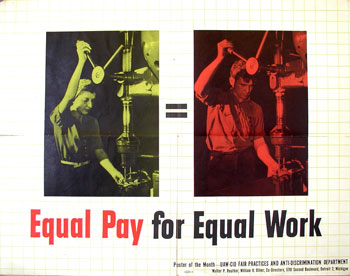
UAW-CIO Fair Practices and Anti-discrimination Department poster c.1950
By Mary Beth Maxwell
Recent headlines reveal what many of us already know — Americans are witnessing the highest inflation rates seen in over 20 years. According to the U.S. Department of Agriculture, food prices climbed nearly five percent in 2007, and as housing and energy costs skyrocket out of control, working families are getting squeezed. In these difficult times, we should also be reminded that women face even greater financial struggles when weathering this economic storm.
With the observance of Equal Pay Day on April 24, we mark how far into each year a woman must work to earn as much as a man did in the previous year. Recent wage data from the Bureau of Labor Statistics does not give cause for celebration. In 2007, women earned only 80 cents for every dollar a man earned. This pay gap was substantially greater for minorities, with African-American women making only 70 cents and Hispanic women making only 62 cents for every dollar earned by their male counterparts. While women are more reluctant to negotiate salaries and are often employed in underpaid professions, one grim reality remains — gender-based discrimination still inherent in our society has largely caused the pay gap that persists today.