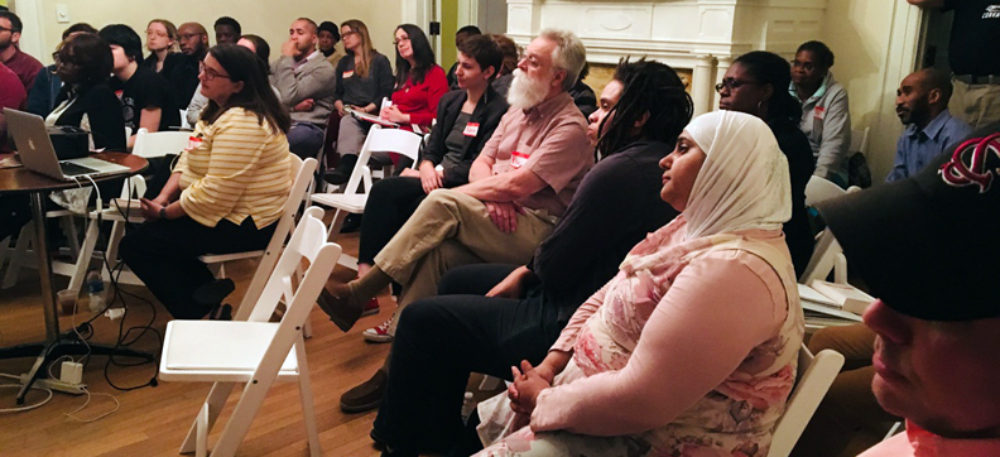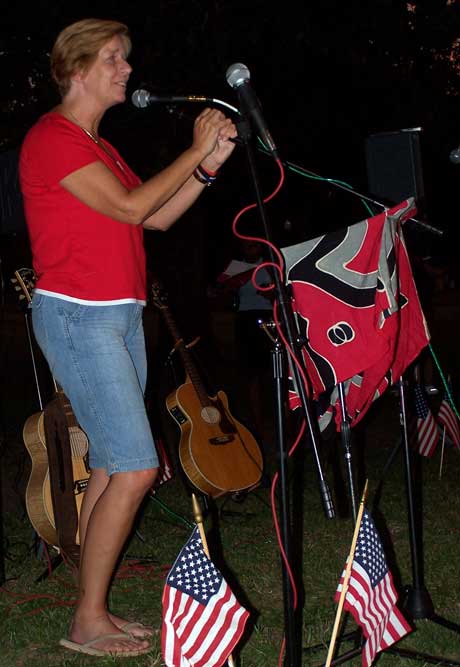
Cindy Sheehan speaks at a Columbia rally on Sept. 14, 2005.
The SC Progressive Network helped bring Cindy Sheehan to Columbia in the fall of 2005 for a rally and candlelight vigil at Martin Luther King Park. She and a handful of other family members of soldiers killed in Iraq stopped by on a 42-city, 28-state Bring Them Home Now Tour. It was an ambitious project, and it was easy to read the exhaustion on their faces. Day after day, they drove many miles, ate bad food, slept where they could, and told their awful stories.
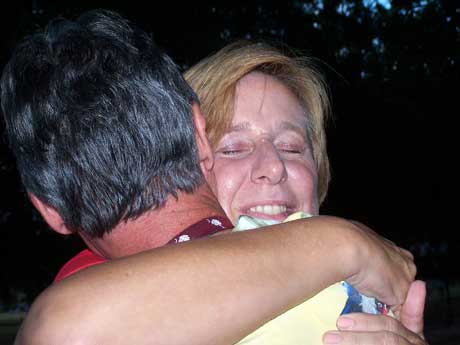
Cindy hugs Stan Goff – former Democracy South colleague and an organizer of the “Bring Them Home Now Tour” – before addressing the crowd of about 200.
I met Cindy briefly and was struck by her warmth. But what stuck with me was how very tired she appeared. It was impossible not to admire her sense of commitment and depth of passion. At the risk of sounding trite, she truly was an inspiration to me and other activists starved for leadership and a consistent, clear voice in the anti-war movement.
That said, I was uneasy to hear last week about Cindy’s intention to run for Nancy Pelosi’s seat. While the Speaker has been a major disappointment – as have her spineless Democratic cohorts on the Hill – Cindy stands little chance of mounting a serious challenge. And while I’m glad that Cindy is back in the game, I wish she would stick to the platform she has worked so hard to construct for herself. I worry that her campaign for Congress will only make her look foolish and ineffective. The piece below, written by one of her supporters, does nothing to quell my fears.
Becci Robbins
*********
A Personal Vision for Cindy Sheehan’s Campaign
by Daniel Ellsberg
[Remarks of Daniel Ellsberg at a press conference Aug. 9, 2007, at which Cindy Sheehan announced her independent candidacy for the 8th Congressional District of California, an office now held by Nancy Pelosi, Speaker of the House.]
I don’t speak for Cindy Sheehan – whom I admire unreservedly – or for her campaign. When I say “we†in what follows, I’m really just giving my own perspective on this campaign, as one of her supporters.
I see this campaign as aiming much higher than putting Cindy Sheehan in Congress in 2009. Well before that time, we aim to help restore our Constitution, to end a war and avert starting a new one, and to remove from power two officials – George W. Bush and Richard Cheney – who block those objectives before they can do more harm in their remaining months in office.
That’s an ambitious project; but there’s a clear path to achieving it. We will work to change public awareness and, as a result, Nancy Pelosi’s policies as Speaker of the House well before the election, by revealing to the public real alternatives to the courses she and the Democrats have followed so far, and demonstrating the breadth and strength of public support for those alternatives.
The truth is that Democrats, and even Republicans, can do much better than they have been doing, under Pelosi’s leadership in the House, to protect our freedoms and our security. In this campaign we will publicize specifics of what can and should be done, and let the public tell the politicians which approach they want.
One essential demand is for Pelosi to encourage, rather than to block, Congressional investigations of past and ongoing administration deception, unwisdom, illegality and unconstitutionality in pursuing an aggressive war and in curtailing our rights. Such investigations, calling forth testimony under oath of current and former officials many of whom are eager to tell the truth at last, as well as demonstrating continued administration stonewalling, will almost surely lead to what does not yet exist: irresistible pressure from a belatedly-informed public for the impeachment and removal of Bush and Cheney.
Further, we need Pelosi’s leadership in rescinding the unconstitutional parts – which will not leave much – of the Patriot Acts, the Military Commissions Act and the recent, outrageous legislation purporting to legalize warrantless wiretaps and data mining. And – absolutely essential to ending our war in Iraq, ever – public pressure is needed to demand that Congress defund our indefinite occupation, providing funds only for the orderly, safe withdrawal of all our troops, contractors and bases on an announced time-table.
If this campaign can help bring about even the first of these, it will also, almost incidentally, put Cindy Sheehan within reach of success in the election. This is, in fact, a historic campaign opportunity, exploiting an opening unique in American politics. At this moment, Cindy appears to face insuperable odds, opposing without party support a powerful, heavily-funded incumbent. But we aim to change that. All we are asking is for Nancy Pelosi to do what she should: to uphold her oath of office, which is not to obey a Commander-in-Chief or to enlarge a Democratic majority but to uphold and defend the Constitution.
If we can induce her to do that, then a year from now Cindy Sheehan should be running for an open seat, or against a brand-new incumbent appointed by our Republican governor. Nancy Pelosi, third in line for succession when Bush and Cheney are impeached and removed, will be in the White House. That will, as it happens, leave an open field for Cindy.
So you see, it’s nothing personal for us. After all, as representatives of big business go, Nancy Pelosi is better than most. We don’t aim to kick her out of politics, we aim to kick her upstairs. And there’s a bonus: President Pelosi as a write-in candidate in November. She’s far from ideal, from the point of view of members of this campaign, but for a Democrats we could do a lot worse. Off the record, some of us see this as the best strategy for keeping Hillary out of the White House without letting a Republican in.
So there it is: a vision for 2009 that can evoke some real enthusiasm: Cindy in the House, Pelosi in the White House, the US out of Iraq. Our Constitution back, and Bush and Cheney under criminal indictment.
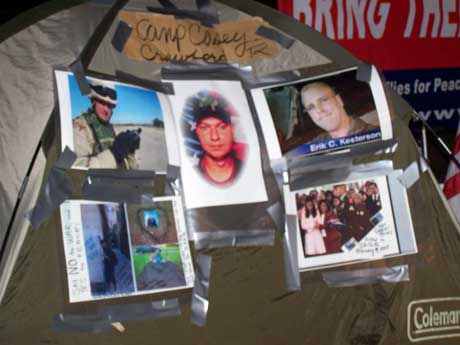
A makeshift memorial to Cindy’s son, Casey (in center photo), who was killed in Iraq.