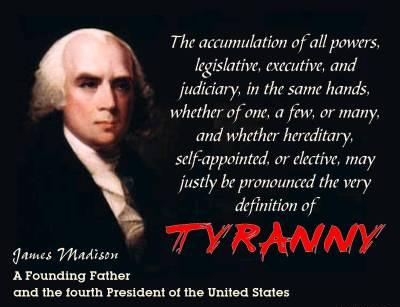
Our webmaster, Steve, poses a question after hearing the news of Bush protesters’ recent court win:
Feds pay $80,000 to couple arrested for wearing Bush protest T-shirts: Read story at ABC News.
How much are the Feds paying Brett, again?
-s
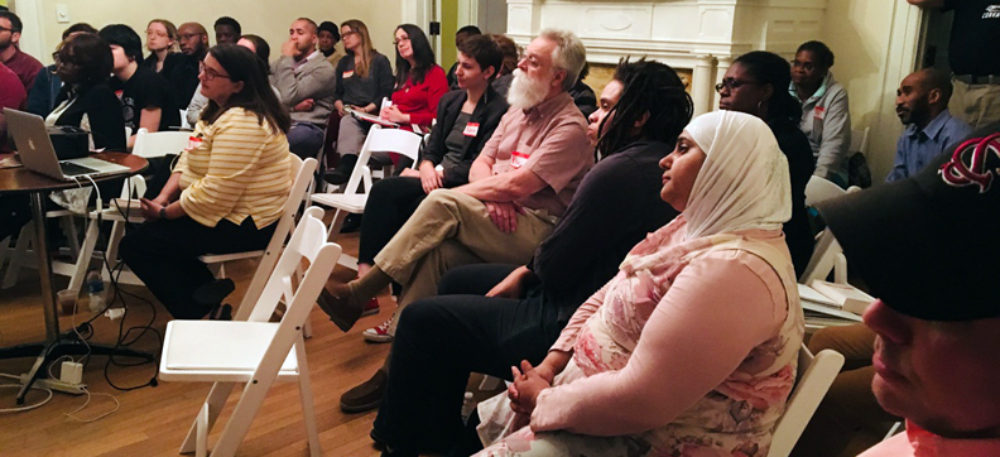
Our webmaster, Steve, poses a question after hearing the news of Bush protesters’ recent court win:
Feds pay $80,000 to couple arrested for wearing Bush protest T-shirts: Read story at ABC News.
How much are the Feds paying Brett, again?
-s

Columbia’s Garden of Grace United Church of Christ honored the Network this morning with its annual community service award to recognize the work our members are doing to advance gay rights in South Carolina. “Equality comes in one size,” said Brett Bursey as he accepted the plaque from Pastor Andy Sidden. “And it fits everyone.”
Today Garden of Grace celebrated its 14th year with ice cream and a slide show trip down Memory Lane. The photo montage tracked the history of the congregation, including the building of the new church on Atlas Road, where they moved two years ago.
It was our first service at the church, and we were gratified to see how diverse a congregation it was. (Looked kind of like a Network meeting.) Congratulations to all of them for creating and sustaining a faith community that excludes no one and reflects the true values of a loving Christ. Here in the Bible Belt, ironically, that’s sometimes hard to find.
Becci Robbins
School Choice Not the Best Option for African American Children
By Hayes Mizell
Resting in their heavenly repose, South Carolina’s civil rights pioneers of the 1930s and 1940s must be scratching their heads. A prominent African-American state senator, also a Democrat and minister, says many of his generational peers are longing for the days of racially segregated schools. Another minister says most African-American children “fared better when we were segregated.â€
These leaders are understandably frustrated. Too many children are not reaping the academic gains that African-Americans hoped would follow public school desegregation. On last year’s state achievement test, more than 40,000 African-American students in grades three through eight scored “Below Basic†in English/Language Arts. An average of 60 percent of all African-American students in third through eighth grade performed at the Below Basic level in science.
There is some good news. Thousands of African-American students are performing well, scoring at the highest levels, “Proficient†or “Advanced,†on the state test. However, thousands more have the unrealized potential to do so.
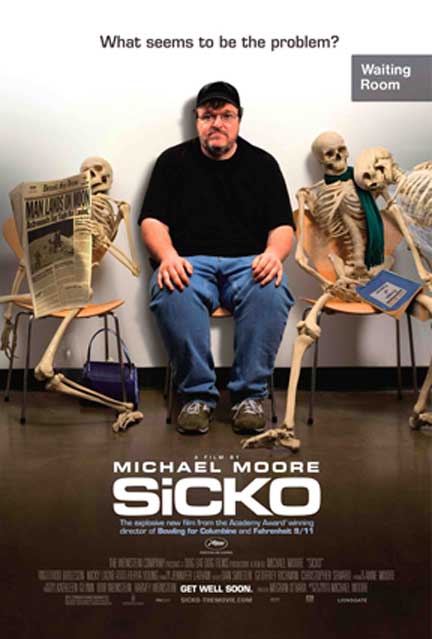
The SC Progressive Network and the newly formed group South Carolinians for Universal Health Care will hold a special screening of Michael Moore’s documentary SICKO at 3pm on Aug. 26 to promote public awareness of the need and practicality of universal health care.
SICKO will be shown at the Nickelodeon Theatre, 937 Main St. in Columbia. The screening will be followed by a public discussion led by a panel of experts.
Tickets are $10. Proceeds go to the host organizations to promote universal health care. Tickets are limited. For reservations, call the Network at 803-808-3384.
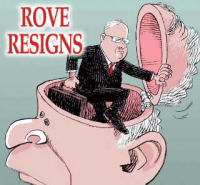
So Bush’s “brain” will leave office at the end of the month. After all the damage Karl Rove has wreaked upon this country, that’s IT? He simply walks away? As John Edwards said about the matter: “Goodbye. Good riddance!”
Lest you start getting misty, here are a few choice quotes from the master puppeteer:
ON VOTING
As people do better, they start voting like Republicans – unless they have too much education and vote Democratic, which proves there can be too much of a good thing.
ON 9/11
Conservatives saw the savagery of 9/11 in the attacks and prepared for war; liberals saw the savagery of the 9/11 attacks and wanted to prepare indictments and offer therapy and understanding for our attackers.
ON THE IRAQ WAR
Cindy Sheehan is a clown. There is no real anti-war movement. No serious politician, with anything to do with anything, would show his face at an anti-war rally.
ON DEMOCRATS
I think it’s dawning on some Democrats that obstructing the Patriot Act, like they’ve been obstructing everything else, is bad for them politically. At the core, we are dealing with two parties that have fundamentally different views of the world and fundamentally different views on national security. Republicans have a post-9/11 view of the world, and Democrats have a pre-9/11 view of the world.
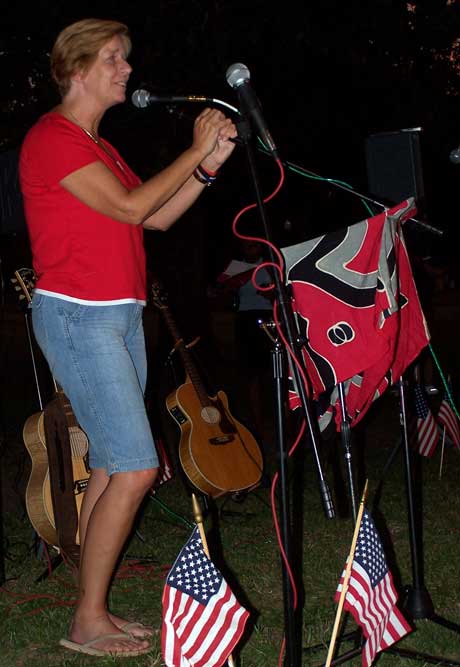
Cindy Sheehan speaks at a Columbia rally on Sept. 14, 2005.
The SC Progressive Network helped bring Cindy Sheehan to Columbia in the fall of 2005 for a rally and candlelight vigil at Martin Luther King Park. She and a handful of other family members of soldiers killed in Iraq stopped by on a 42-city, 28-state Bring Them Home Now Tour. It was an ambitious project, and it was easy to read the exhaustion on their faces. Day after day, they drove many miles, ate bad food, slept where they could, and told their awful stories.
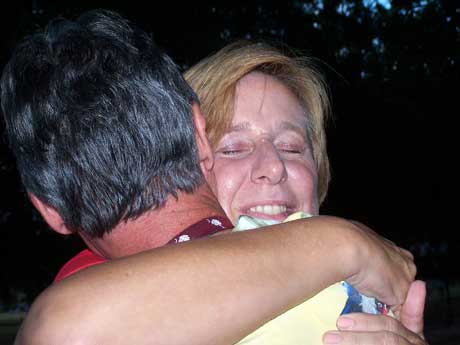
Cindy hugs Stan Goff – former Democracy South colleague and an organizer of the “Bring Them Home Now Tour” – before addressing the crowd of about 200.
I met Cindy briefly and was struck by her warmth. But what stuck with me was how very tired she appeared. It was impossible not to admire her sense of commitment and depth of passion. At the risk of sounding trite, she truly was an inspiration to me and other activists starved for leadership and a consistent, clear voice in the anti-war movement.
That said, I was uneasy to hear last week about Cindy’s intention to run for Nancy Pelosi’s seat. While the Speaker has been a major disappointment – as have her spineless Democratic cohorts on the Hill – Cindy stands little chance of mounting a serious challenge. And while I’m glad that Cindy is back in the game, I wish she would stick to the platform she has worked so hard to construct for herself. I worry that her campaign for Congress will only make her look foolish and ineffective. The piece below, written by one of her supporters, does nothing to quell my fears.
Becci Robbins
*********
A Personal Vision for Cindy Sheehan’s Campaign
by Daniel Ellsberg
[Remarks of Daniel Ellsberg at a press conference Aug. 9, 2007, at which Cindy Sheehan announced her independent candidacy for the 8th Congressional District of California, an office now held by Nancy Pelosi, Speaker of the House.]
I don’t speak for Cindy Sheehan – whom I admire unreservedly – or for her campaign. When I say “we†in what follows, I’m really just giving my own perspective on this campaign, as one of her supporters.
I see this campaign as aiming much higher than putting Cindy Sheehan in Congress in 2009. Well before that time, we aim to help restore our Constitution, to end a war and avert starting a new one, and to remove from power two officials – George W. Bush and Richard Cheney – who block those objectives before they can do more harm in their remaining months in office.
That’s an ambitious project; but there’s a clear path to achieving it. We will work to change public awareness and, as a result, Nancy Pelosi’s policies as Speaker of the House well before the election, by revealing to the public real alternatives to the courses she and the Democrats have followed so far, and demonstrating the breadth and strength of public support for those alternatives.
The truth is that Democrats, and even Republicans, can do much better than they have been doing, under Pelosi’s leadership in the House, to protect our freedoms and our security. In this campaign we will publicize specifics of what can and should be done, and let the public tell the politicians which approach they want.
One essential demand is for Pelosi to encourage, rather than to block, Congressional investigations of past and ongoing administration deception, unwisdom, illegality and unconstitutionality in pursuing an aggressive war and in curtailing our rights. Such investigations, calling forth testimony under oath of current and former officials many of whom are eager to tell the truth at last, as well as demonstrating continued administration stonewalling, will almost surely lead to what does not yet exist: irresistible pressure from a belatedly-informed public for the impeachment and removal of Bush and Cheney.
Further, we need Pelosi’s leadership in rescinding the unconstitutional parts – which will not leave much – of the Patriot Acts, the Military Commissions Act and the recent, outrageous legislation purporting to legalize warrantless wiretaps and data mining. And – absolutely essential to ending our war in Iraq, ever – public pressure is needed to demand that Congress defund our indefinite occupation, providing funds only for the orderly, safe withdrawal of all our troops, contractors and bases on an announced time-table.
If this campaign can help bring about even the first of these, it will also, almost incidentally, put Cindy Sheehan within reach of success in the election. This is, in fact, a historic campaign opportunity, exploiting an opening unique in American politics. At this moment, Cindy appears to face insuperable odds, opposing without party support a powerful, heavily-funded incumbent. But we aim to change that. All we are asking is for Nancy Pelosi to do what she should: to uphold her oath of office, which is not to obey a Commander-in-Chief or to enlarge a Democratic majority but to uphold and defend the Constitution.
If we can induce her to do that, then a year from now Cindy Sheehan should be running for an open seat, or against a brand-new incumbent appointed by our Republican governor. Nancy Pelosi, third in line for succession when Bush and Cheney are impeached and removed, will be in the White House. That will, as it happens, leave an open field for Cindy.
So you see, it’s nothing personal for us. After all, as representatives of big business go, Nancy Pelosi is better than most. We don’t aim to kick her out of politics, we aim to kick her upstairs. And there’s a bonus: President Pelosi as a write-in candidate in November. She’s far from ideal, from the point of view of members of this campaign, but for a Democrats we could do a lot worse. Off the record, some of us see this as the best strategy for keeping Hillary out of the White House without letting a Republican in.
So there it is: a vision for 2009 that can evoke some real enthusiasm: Cindy in the House, Pelosi in the White House, the US out of Iraq. Our Constitution back, and Bush and Cheney under criminal indictment.
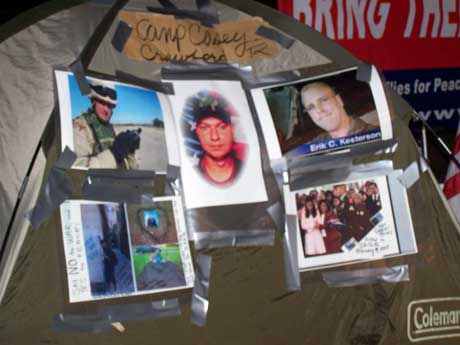
A makeshift memorial to Cindy’s son, Casey (in center photo), who was killed in Iraq.
The Convergence for Climate Action’s Southeast gathering is happening quietly this week in the mountains near Asheville.

This is the first of what the organizers hope to be an annual event. The primary goals, according to a handout, are “to overcome feelings of isolation and helplessness by bringing people together to create a community of resistance. We hope the convergence inspires people to take action, share ideas and start organizing in their own localities and spheres of interest. (For details, you can check out their web site. For background on the issues and ways to plug into the movement, see the Nuclear Information and Resource Service’s Web site.)
The week’s schedule is packed with workshops designed to grow awareness and build organizing skills among participants, who came from as far as Florida and DC to join the gathering. Workshops included media and fundraising training, puppet building and street theater, and panel discussions on a variety of topics.
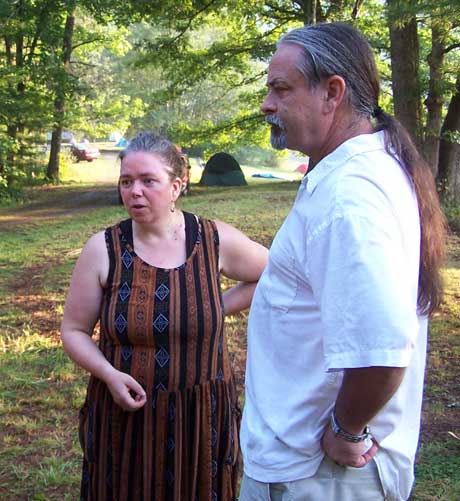
Network Director Brett Bursey chats with Mary Olson, director of Nuclear Information and Resource Service (NIRS).
On Friday, Brett was invited to speak on a panel titled “Elders of the Movement.” He and the others on the panel talked about how and why to fight the fallout of corportate greed and environmental exploitation that is destroying our country. The panel held court in a campfire circle that included kids as young as 10 and seniors old enough to nod out during the discussion.

Event organizer Glenn Carroll, center, directs preparations for a Nagasaki remembrance Friday evening.

Vegetarian meals were eaten al fresco.
As fellow organizers, we were gratified and energized by our time at the camp. With so much work to be done and such paltry resources to do it, we take strength in knowing there are more of “us” (people who care about the health of the planet and all of its residents) than “them” (corporate and political interests that benefit from the current power structure). We just need to mobilize and harness that energy.
We look forward to next year’s gathering.
Becci Robbins
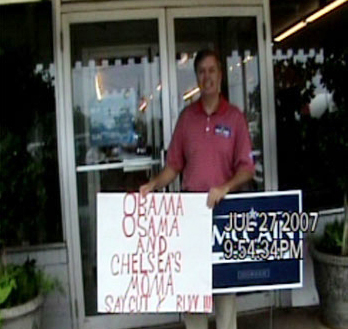
This photo of Sen. Lindsey Graham was posted on TMZ’s site, of all places. Almost as interesting as the image – which may or may not be real (consider the source) – are the comments from the rabble. Yikes.
There is good news about the Collaborative for Community Trust in today’s paper. I’m glad to learn that the Simkins house will be saved and, perhaps, put to good community use. But how did this situation get so bad in the first place?
Cleve Sellars, who is on the board, wouldn’t comment on Catherine Fleming Bruce – who has badly mismanaged the Collaborative. Question is, where in the world has he and the rest of the board BEEN all this time? Seems to me that Bruce is not the only one to blame for running the Collaborative into a ditch.
Warren Bolton, who is on the editorial staff at The State, has been a longtime Collaborative board member. Sadly, he with the bully pulpit wasted an opportunity to shed light on the matter before it got to this point.
If you missed it, here’s a link to the story.
And if you haven’t seen the Simkins house, you can take a nifty virtual tour here.
Here is a letter from Ms. Bruce that ran in last week’s Free Times after the paper ran an editorial skewering her.
Simkins Restoration Requires Public-Private Partnership
I write today to personally acknowledge the support and encouragement shown by individuals, organizations, municipalities and corporations over the years to the Collaborative for Community Trust in its efforts with regard to the Modjeska Simkins House (City Watch, “Modjeska Simkins Deserves Better,†July 18). This has been a long and arduous journey for myself and for the Collaborative board, with our only concern being the preservation of a historically significant civil rights building that once bore an “uninhabitable†notice and whose legacy was on the brink of being lost forever. It is this passion that has kept the Simkins project afloat since 1995.
It is our wish and our agenda that our community have the civil rights centerpiece that we have worked all these years to bring to fruition. We took action so that Columbia might join the ranks of other Southern cities in embracing our role in the American civil rights movement through this facility.
The purchase, restoration and operation of a historic site is a gargantuan task, and even more so with a paucity of staff support and resources. Many would never have attempted it, as historic preservation is most often taken up these days by developers or well-financed institutions. But had the Collaborative not stepped up 12 years ago, the Simkins House would not be here today.
Even so, the restoration of the Simkins House could never have been accomplished by the energies of any private individual or private group alone. The nature of historic preservation mandates a public-private partnership. It cannot, nor was it ever intended to glorify, enrich or exalt any one person. When I got involved, I considered this preservation work to be a public service to the community. I had guidance from our board, help in submitting appropriate reports from our accountant and the encouragement of many friends. I hope that other ordinary people will continue to step out on faith to preserve history in their communities. The Collaborative board and myself took the risk, and while it required extreme personal sacrifice and challenge, I am grateful for their commitment.
I, along with the full board of the Collaborative for Community Trust, continue to pledge our full efforts to a successful Modjeska Simkins House as it benefits from ever broadening levels of support and partnerships.
Catherine Fleming Bruce
President, Collaborative
for Community Trust