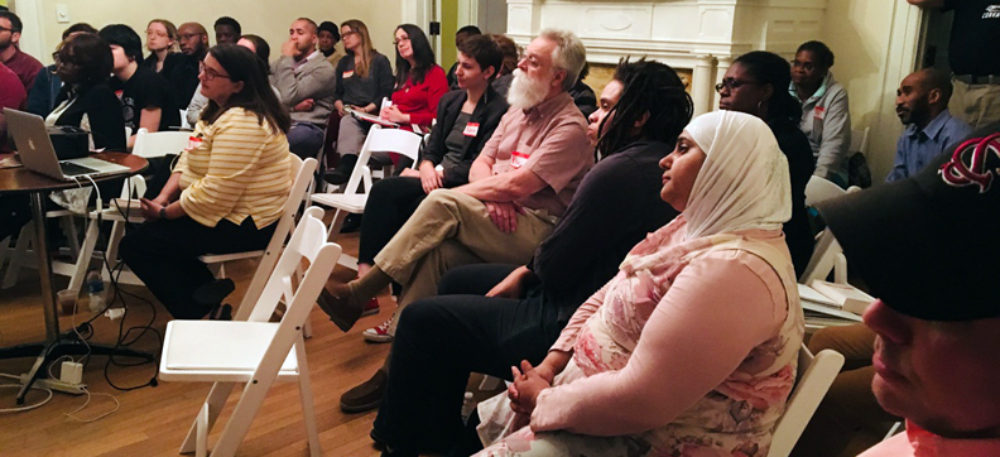
Movie Night to feature “The Shock Doctrine”
Progressive Network Movie Night
Aug. 23, 7pm
Conundrum Music Hall, 626 Meeting St. West Columbia
Free and open to the public
Directed by award-winning filmmakers Michael Winterbottom and Mat Whitecross (co-directors of THE ROAD TO GUANTANAMO), THE SHOCK DOCTRINE is a feature (94 min.) documentary based on Naomi Klein’s bestselling book of the same name. THE SHOCK DOCTRINE is a gripping and incisive deconstruction of how free market policies have come to dominate the world through the exploitation of disaster-shocked people and countries. THE SHOCK DOCTRINE radically challenges the myth that the global free market triumphed on the wings of democracy.
Both the film and the book argue that both big business and governments overexploit natural disasters, economic crises and wars with the very aim of pushing through radical free market policies. Naomi Klein calls this “disaster capitalism.” The film traces the doctrine’s beginnings in the radical theories of Milton Friedman at the University of Chicago, and its subsequent implementation over the past 40 years in countries as disparate as Augusto Pinochet’s Chile, Boris Yeltsin’s Russia, Margaret Thatcher’s Great Britain, and most recently through the invasions of Afghanistan and Iraq.
Save SC embarrassment, money: eliminate lieutenant governor
By John Crangle
SC Common Cause
The time is long past when the do-nothing job of lieutenant governor should be abolished. The taxpayers of South Carolina waste $1 million per year to have a part-time employee wear a purple robe and carry a wooden mallet three days a week from January to June and wait, usually in vain, for the governor to die, resign or get impeached.
Once in great while he votes to break a tie in the Senate. Of course, there is no reason a tie must be broken; a tie means the motion fails.
To keep hyperactive Andre Bauer busy, the Office of Aging was shifted to the lieutenant governor’s office. Of course, there is no reason a state agency could not do the job.
Otherwise, too often the lieutenant governor gets in trouble.
The current and previous lieutenant governors have been an embarrassment to the state. Ken Ard is the worst of the lot. His predecessor, Andre Bauer, was more the victim of low impulse control; Andre’s wild driving in a state car was more like a teenage kid on a Saturday night than a crooked politician.
There was a time (perhaps when the South Carolina Constitution was written in 1895) when the lieutenant governor might do something. Governors did die — life expectancy in the 1800s was only 40. And from 1900 to 1970, eight lieutenant governors were later elected as governors, but it has not happened since then; and only one lieutenant governor in the past half century has replaced a governor, when Gov. Donald Russell resigned in 1965.
The job has no future, as Adam Bean in a recent article clearly explained: Seven of the past eight lieutenant governors all tried and failed in their runs for governor; and the eighth failed in her run for Congress. Except for Earle Morris, it was the end of their political careers; and Morris ended his career in prison.
In the future, candidates for lieutenant governor will probably all be like Ken Ard — obscure figures with a thin resume. As the influence of newspapers and local television news fades, the monopolistic power of television political advertising has become blinding. This means that the candidate with little or no public record has a greater advantage than before. Whereas experienced state legislators have had to make many difficult votes on hard tax-and-spending issues, both Ard and Nikki Haley showed that doing nothing in public office is really an asset, allowing the candidate to create a Captain America persona of imaginary powers without showing the scar tissue of decades of political combat.
With enough campaign money, a candidate can buy himself a fake political identity just like he can buy a fake ID card. Big money buys political consultants, scripted TV ads and lots of air time. Even if the candidate is too homely to be fixed by the make-up lady, he can be computer enhanced and programmed on TV; the voters don’t have X-ray vision to see inside an empty head.
There will be no need for a lieutenant governor in the future as there is no need now. If the governor goes, the Constitution provides a line of succession to the president pro tem of the Senate and the speaker of the House. The latter two officers are well-equipped to take over. They have served many years in the General Assembly, and they have been selected by their colleagues, who have confidence in their ability and leadership. Such people (currently Sen. Glenn McConnell and Rep. Bobby Harrell) are much better equipped to be governor than Ken Ard, whose only prior office was as Florence County councilman. We can be assured that the president pro tem and the speaker will be able to work constructively with other legislators.
Eliminating the position of lieutenant governor will require a constitutional amendment. Both the Senate and House must vote by two-thirds super majorities to amend. At the next general election, the voters in referendum must approve the proposed amendment by majority vote; finally, both houses must vote by simple majority to ratify the amendment. This done, the useless office of lieutenant governor is thrown on the trash heap of history, and the taxpayers will save $1 million per year and whatever embarrassment and cheap laughs the future might otherwise hold.
John Crangle is a Columbia attorney and chair of Common Cause South Carolina, a longtime member of the SC Progressive Network.
Keith Olbermann skewers debt deal
Robin Hood in reverse in the US: seven examples
by Bill Quigley
Truthout
The rich have been getting richer and the poor and the middle class have been getting poorer in the US recently. Here are seven examples.
- Between 1948 and 1979, the richest 10 percent of families in the US claimed 33 percent of average income growth. Between 2000 and 2007, the richest 10 percent claimed a full 100 percent of average income growth in the US, according to the Economic Policy Institute.
- Business taxes were cut from 46 to 34 percent 25 years ago, according to ProPublica. But today, 115 of the big 500 companies listed on Standard and Poor’s stock index paid federal and other taxes of less than 20 percent over the last five years, according to David Leonhardt of The New York Times.
- General Electric’s tax rate for last year was seven percent, according to ProPublica.
- The top five percent of US households claim 63 percent of the entire country’s wealth. The bottom 80 percent hold just 13 percent of the growth, according to the Economic Policy Institute.
- Last year, John Paulson, a hedge fund manager “earned” $4.9 billion, according to The New York Times. Ten years ago, it took 25 such managers to collectively earn that much. Last year, the top 25 hedge fund managers pocketed (a much better word) a total of $22 billion. It would take over 440,000 people each earning $50,000 a year to match that amount.
- A federal development program intended to help poor communities, the New Market Tax Credit, instead funnels up to ten billion taxpayer dollars to big corporations like JPMorgan Chase & Co, Goldman Sachs and Prudential to build luxury hotels, office buildings and a car museum. Bloomberg Markets Magazine pointed to the Blackstone Hotel in Chicago, which was renovated for $116 million. Prudential got $15.6 million in tax credit from the US Treasury for helping fund the project because the hotel was in a census zone that included two colleges that housed a lot of lower income students.
- According to the Financial Times, there are now more people living in poverty in the US than at any time in the last 50 years. Foreclosure filings were nearly four million in 2010, up 23 percent since 2008, according to RealtyTrac.
Now’s your chance to weigh in with US Justice Dept. on SC’s new voter photo ID law
If you, or someone you know has a hard time getting a state issued photo ID, download a Dept. of Justice Comment Form. Fill it out online and print it out (this form can not be saved and must be printed). Sign it and follow the mailing instructions at the end of the form.
Anyone can comment directly to the Department of Justice through email to: vot1973c@usdoj.gov. Put in subject line: “2011-2495: Comment”. Or comments can be mailed to:
Chief, Voting Section, Civil Rights Division
Room 7254 – NWB, Department of Justice
950 Pennsylvania Ave., N.W., Washington, DC 20530
(Include the submission # 2011-2495 at the top of your letter.)
Or fax comments to the Dept. of Justice at 202-616-9514 with the same heading.
Got questions? Call the SC Progressive Network at 803-808-3384.
One of the One Percent
Mike Miller of The Cedar Creek Boys
Michael Moore flick to launch Network’s free monthly movie night
The SC Progressive Network has occasionally shown movies in the backyard of our office in Columbia. This month, we’re making it a regular attraction (every 4th Tuesday), beginning with Michael Moore’s Capitalism, A Love Story on July 26.
And because of the beastly weather, we’re moving indoors. The movie will be shown at Conundrum Music Hall, 626 Meeting St. in West Columbia at 6pm. (Big thanks to proprietor Tom Law for offering his new venue to us!) Free and open to the public. Popcorn on the house.
On Aug. 23, we will show the documentary Salud!, about Cuba’s health care system.
For more information, call the Network at 803-808-3384 or email network@scpronet.com.
Latest news from Network’s photo ID campaign
On July 8, the SC Progressive Network held a second press conference on the photo ID law to clear up misconceptions repeated by the governor and lawmakers, and to invite the public to submit comments to the US Dept. of Justice, which is reviewing the new law to consider whether it abridges the minority vote.
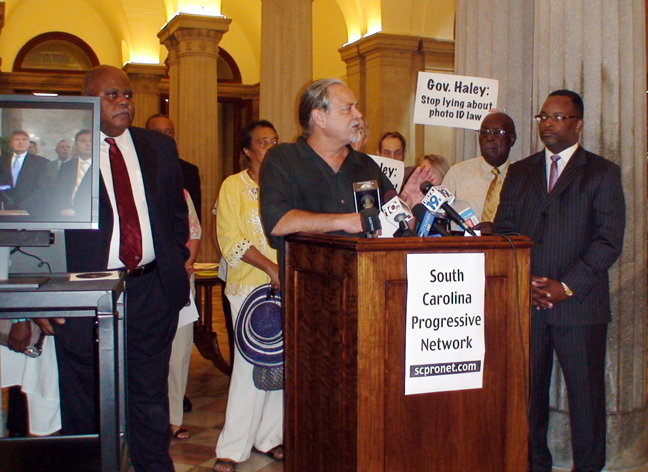
See more photos from the media event here.
Below is a sample of the media coverage the press conference generated.
Group seeks those impacted by new SC voter ID law
JIM DAVENPORT, Associated Press
July 8, 2011
South Carolina voting rights advocates said Friday they are looking for voters who might not be able to have their votes counted next year under one of the nation’s toughest voter identification laws. The South Carolina Progressive Network is trying to identify some of the nearly 180,000 people who are now registered to vote but who lack the state- or federal-issued photographic identification called for under the new law. Those people would be able to cast provisional ballots, but would have to show the required identification within three days to have their votes counted. Read more:
Critics challenge ‘Voter ID’ plan
By GINA SMITH
The State
When Delores Freelon was born in 1952, her mother could not decide on a name for her. So the space on the birth certificate for a first name was left blank. In the decades since, the incomplete birth certificate did not prevent Freelon from getting her driver’s license and voter registration card in the various states she has lived, including Texas and Louisiana.
But a measure — already passed by the General Assembly and signed by Gov. Nikki Haley — will create new hurdles for Freelon and others to vote. Read more:
Group aims to block voter ID law
Opponents push for rejection by U.S. Justice Dept.
BY YVONNE WENGER
The Post and Courier
COLUMBIA — The S.C. Progressive Network issued a warning Friday to the nearly 25,000 registered voters in the tri-county area without a state-issued photo ID: You could run into trouble the next time you go to the polls. The advocacy organization is urging the U.S. Department of Justice to reject a new South Carolina law that will require all voters to carry a picture ID to cast a ballot in future elections. The state’s Republican leadership pushed for the new law, citing a need to guard against voter fraud even though there has been no substantive proof of widespread voter fraud for years in the state. Read more:
Progressives Push to Stop Implementation of Voter ID Law
BY COREY HUTCHINS
Free Times
Five TV cameras, two reporters from The State, one from The Associated Press, a reporter from the Charleston Post & Courier and another from the South Carolina Radio Network, among others, swarmed around a podium in the lobby of the State House July 8, as South Carolina Progressive Network director Brett Bursey warned voters here that they might have trouble casting a ballot under a new state law. It comes during a time of a national pushback against such regulations.
Governor, lawmakers mislead public on SC’s photo ID law, now under review at Justice Dept.
SC Progressive Network to hold press conference to clear up misunderstanding and to invite public comment
The US Dept. of Justice is now receiving comments on South Carolina’s new photo ID law as it considers whether it abridges the minority vote. The SC Progressive Network will host a press conference at 11:45am on Friday, July 8, in the downstairs lobby of the State House to clear up public misunderstanding stemming from misinformation being repeated by the governor and GOP legislators.
The Network will share with reporters the only attachment supporting the state’s filing: a one-page letter from bill sponsor Rep. Alan Clemmons, who writes that he filed the bill because “It is an unspoken truth in South Carolina that election fraud exists.”
The Network, which for 15 years has been advocating voting rights, is making its case to the Dept. of Justice that our state’s ID law, the nation’s most restrictive, will suppress the vote, especially among seniors and the poor. In South Carolina, a birth certificate is required to get the state-issued card, and the law provides no exceptions, as do similar laws in other states.
It is clear that at least some of the estimated 200,000 registered SC voters who don’t have a photo ID will not be able to vote in the next election because they won’t have their papers in order.
The press conference will include the showing of a brief video clip of Gov. Nikki Haley signing the bill into law, where she defends the law by stating that a photo ID is necessary to buy Sudafed or to get on an airplane. To a reporters’ question about what sorts of ID are acceptable, Rep. Bobby Harrell says, “If you can fly with it (photo ID), you can vote with it.” That simply isn’t true.
At Friday’s press conference, two South Carolina voters will testify that, contrary to Gov. Haley and Rep. Harrell’s assertions, they can buy Sudafed and fly with the IDs they have; what they can’t do is vote in South Carolina.
The Progressive Network is collecting statements from people around the state who are having trouble meeting the state’s new ID requirements and will forward them to the Justice Department. Also, the public may make comments by email to: vot1973c@usdoj.gov. In the subject line put: “2011-2495: Comment”. Or comments may be faxed to: 202-616-9514.
For more information contact the SC Progressive Network at 803-808-3384 or network@scpronet.com. See background on the photo ID law and video clips of voters disenfranchised by the new law at SC Progressive Network.