SC’s Unemployment Crisis

By Rep. Anton J. Gunn

On Tuesday, I was invited by Gov. Mark Sanford to attend a roundtable meeting with business leaders, employment experts, policymakers and politicians to look deeper into the unemployment crisis facing our state. I was surprised to see only a handful of lawmakers from the House and Senate at the meeting. It seems to me that this issue is too important to the people of our state for only a handful — less than 25 of the 170 members in the General Assembly — to attend the meeting. We have to do better.

Nevertheless, I gained a great deal more information about the crisis at the meeting. The problems of the unemployed in our state are much bigger than just helping people find a job. It also involves taxes on businesses, workforce development, agency coordination, personal responsibility and eliminating political infighting. The crisis of the unemployed in our state did not just happen overnight. It is a culmination of an outdated and underfunded insurance system, vague information from employers and workers, lack of coordination between multiple state agencies and most importantly inefficient and ineffective leadership that fell asleep at the wheel (including the General Assembly, Governor’s Office and the leadership at the Employment Security Commission). Yes, this problem grew over a period of years and most of our state’s leaders had no knowledge or willingness to do anything to address the crisis that was looming. To me it seems as if we knew we were on the Titanic and that there was an Iceberg in the water but we didn’t do anything to avoid hitting it. Now we (and the whole nation) see that once again South Carolina has dropped the ball.

If you don’t believe that we have dropped the ball, here are a few stats that I found interesting from the meeting:
* 25% of people that file Unemployment Claims in SC, our state doesn’t have any information on their educational level. How can we help people find jobs if we don’t know their education level?
* 22.8% of the claims from Jan 2006 – June 2009 were for misconduct. 56% of those claims received pay. What was the misconduct? No one could tell us a definitive answer but we heard misconduct was mostly thefts and drug use.
* 17.6 percent of claims were filed by employers. Which means some companies are laying off workers and helping them to file unemployment and then calling it as vacation leave time or “Unemployment Insurance Holiday” but they never really separated from the workers and they hire them right back. Why would they do this? See the next three bullets below.
* SC is only 1 of 9 states that still allows employers to filed claims for workers.
* 3% of companies account for 30% of benefits charged yet pay only 8% of contributions into the system.
* SC also is only 1 of 6 states (soon only 1 of 4) that still uses the Federal Minimum Wage Base of $7,000 to collect unemployment payments. The national average is $14,302 and the national range is from $7,000 to $35,700.
* SC has the 11th-highest Exhaustion Rate (meaning, we aren’t helping people to find jobs fast enough before their benefits run out).

Now that we have all of this background information we must move forward and figure out how to fix this situation and the current crisis that has just caused some 30,000 unemployed South Carolinians to lose their unemployment benefits even though they have not found gainful employment. Well, there is some good news and some not-so-good news. The good news is the South Carolina House of Representatives will be returning to Columbia on Tuesday, October 29th to address the issue facing unemployed workers. It also seems there is a willingness by most General Assembly members to support a change in our laws that would allow South Carolina to draw down more federal recovery dollars to provide “extended unemployment benefits” to those 30,000 workers who were just cut off of unemployment benefits. So to all of those workers who are now out of benefits, I do not expect there to be a fight over accepting Stimulus money. So, we hope that help is on the way to you and your family.

The not-so-good news is that there are countless other unemployed South Carolinians who had their benefits cut off long ago (but are still without gainful employment) who no one is talking about. What about those unemployed workers whose benefits were previously terminated? Where are they? Where are the jobs for these workers? What is being done to help them get back to work?

These questions are the things that we as state lawmakers must provide answers? I learned at Governor Sanford’s Unemployment Roundtable that these answers are not easy to come by. It is not as simple as recruiting business to our state and creating jobs. We are creating jobs in South Carolina. The problem is we are losing jobs too. So while, getting companies to locate in South Carolina and creating jobs is a great start; we as lawmakers need to understand it’s just as important to get people back into the workforce when we lose a job in South Carolina. To get people back into the workforce requires a comprehensive approach to understanding the problem so that we can understand the best solution in our state.

To come up with a solution to this crisis is going to require both parties, along with experts, business community and unemployed workers as well (I was shocked that nearly no one in the meeting had ever needed a job and couldn’t find one. Hence we have many people making decisions about our system but have never had to use our system). I think it’s important to hear from unemployed workers on possible solutions. We need their voices too. We are all in this together. We all need to understand this problem and understand what the solutions need to be. Whatever solutions we come up with will require reforms of the agencies involved in unemployment and workforce development. I was glad to vote for H. 3442, sponsored by Rep. Kenny Bingham, last session that would have begun the reform process to start addressing these unemployment issues by consolidating several agencies under the Governor’s office and renaming it the Department of Workforce Development, but this legislation was sent back to the drawing board in committee for many reasons that I don’t clearly understand. It probably had more to do with the pettiness of our politics, rather than substantive issues with reforming the Employment Security Commission.

We now see how much more this problem is crippling our state and our friends and neighbors who are still struggling to find work. Let’s hope next week when we return to Columbia for the emergency session to extend unemployment benefits that we can get started on solving our long-term unemployment crisis, rather than doing what we normally do. Which is taking a short-term view to come up with a short-sighted solution to a big problem but never do anything to systemically fix (change) the long-term nature of the problem. We must change the unemployment/workforce development system if we hope to prevent the crisis in the future. If we don’t see the need to do it now, when will we ever see the need?

I know I see the need to change the system and I am working on several proposals that I think will address the current crisis for workers who have exhausted their benefits recently as well as those who were cut off dating back to January 31, 2009. I am also working with several colleagues to come up with some long-term reforms that improves our financial stability and encourages more coordination in workforce development and minimizes the abuse in the current system that has exacerbated this crisis.

I also want to hear from you about solutions to this crisis. If you have ideas for suggestions for reducing unemployment or reforming the system, please feel free to call my office at 803-212-6794.
Legislators Drop Ball on Helping Unemployed

South Carolina Democrats spoke out today in response to news that thousands of unemployed South Carolinians will not receive five months of unemployment benefits because legislators failed to introduce a bill enabling the state to seek funds from the federal government. Congress made money available temporarily through the $787 billion stimulus package that would extend unemployment benefits in states with the highest jobless rates. Taxpayers wouldn’t have had to pay this money back to the federal government. South Carolina was only one of two states eligible not receiving the benefits.

“The Republican-controlled South Carolina House and Senate really let our state’s unemployed workers down by not doing their jobs. The GOP leadership in the General Assembly has been so busy engaged in an intraparty fight with Governor Mark Sanford over power and political ideology that they’ve forgotten about the thousands of South Carolinians that remain unemployed due to their disastrous policies over the last seven years. You would think the Republican legislative leadership would realize their constituents are hurting and deserve more than just being just overlooked,” said South Carolina Democratic Party Executive Director Jay Parmley.

Making the Case for Universal Broadband Access in SC

broad
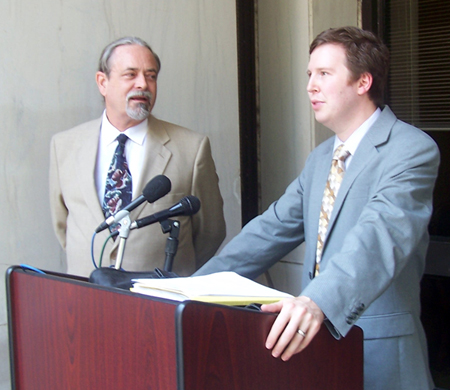
SC Progressive Network Director Brett Bursey (left) and Sascha Meinrath, Director of New America Foundation’s Open Technology Initiative, speak at a press conference before a recent legislative hearing on the broadband transition.

On Sept. 18, Bursey was a guest on Frank Knapp’s U Need 2 Know radio program to talk about the latest developments in South Carolina’s broadband debate. Listen to the show’s audio stream here

[audio:http://www.scpronet.com/wordpress/wp-content/uploads/2009/09/BrettBursey9-18-09.mp3]

Bill Fletcher Talks About Organized Labor on Bill Moyers Journal

fletcherBill Fletcher, Jr., will keynote the SC Progressive Network’s fall retreat Oct. 3-4.

With public support for labor unions at its lowest point in 70 years, Bill Moyers on Sept. 18 talked with experts Bill Fletcher, co-author of SOLIDARITY DIVIDED: THE CRISIS IN ORGANIZED LABOR AND A NEW PATH TOWARD SOCIAL JUSTICE and Michael Zweig, director of the Center for the Study of Working Class Life at SUNY Stony Brook, about the state of organized labor.

Click here to watch.

Bill Fletcher will be the keynote speaker at the SC Progressive Network’s fall retreat at Penn Center Oct. 3-4. See our web site for details. Call 803-808-3384 to register for the retreat, which is open to anyone interested in improving the quality of life in South Carolina.

The Other Race Battle Behind Joe Wilson’s Outburst

By Chris Kromm
Facing South

Ever since Rep. Joe Wilson’s Tourette’s-like outburst of “you lie!” during President Obama’s health care address last week, debate has swirled about the role of race in the incident.

Jimmy Carter himself said he thought Rep. Wilson’s rebuke was “based on racism,” and here at Facing South we were among the first to point to the Congressman’s checkered record on black/white relations — such as his 1999 claim during South Carolina’s confederate flag debate that “the Confederate heritage is very honorable.”

But the focus on Wilson v. Obama alone misses another important — and growing — factor in the politics of race in South Carolina and the country: immigration.

It’s no coincidence that the line in Obama’s address that forced Wilson to his feet focused on whether the Democratic health bill would cover immigrants who aren’t in the country legally. Rep. Wilson has been at the forefront of the nativist — and at times openly xenophobic — right-wing movement against not only undocumented immigrants, but immigration in general.

In many ways, the Palmetto State is ground zero for the immigration debate. According to a Facing South analysis of U.S. Census data, South Carolina has had the fastest-growing Latino population in the entire country two years in a row.

That rapidly-changing racial reality is coming full- force against a deeply conservative political culture embodied by Rep. Joe Wilson. Wilson is a member of the House Immigration Reform Caucus, launched in 1999 by anti-immigrant spokesman ex-Rep. Tom Tancredo (R-CO). As Political Research Associates reports:

According to caucus member Rep. Tom Price (R-GA), the main goals of the congressional group are to combat the purportedly “explosive growth” in “illegal immigration” to the United States, reverse the growth of legal immigration, and halt efforts to provide what he calls a “mini-amnesty” for undocumented migrants.

From his perch at the caucus, Rep. Wilson has been a leader in pushing a right-wing nativist agenda. Rep. Wilson has spearheaded legislation to:

* Declare English as the official language of the U.S. (February 2007)

* Make government services available only in English (March 2008)

* In May 2004, he sponsored a bill to have undocumented people be reported to the police if they tried to receive emergency medical care.

Rep. Wilson has openly aligned with the most radical elements of the anti-immigrant movement. This includes the vigilante border patrol group the Minuteman Project, which has been linked to extreme right and racist elements.

Indeed, Rep. Wilson had been so supportive of Minuteman that there was a deep sense of betrayal when in 2005 Wilson expressed mild reservations about “Operation Spotlight,” the group’s plan to expand its vigilante activities beyond the Mexico-U.S. border to raid businesses suspected of hiring undocumented employees.

But the Minutemen PAC has put those quibbles aside over the last week, immediately sending out an appeal to defend the Congressman against “leftist attacks” for his interruption of the president. Click here to see the email appeal.

Other leading elements of the anti-immigrant movement have also swung behind Rep. Wilson. For example, as Stephanie Mencimer reporter in Mother Jones, the Americans for Legal Immigration PAC has urged its members nation-wide to support Wilson.

What does this all tell us? Racial politics are changing in the South — especially in a state like South Carolina. And while Rep. Wilson’s Obama outburst rightfully raised a discussion about the persistence of Old South mindsets, the incident shows how New South tensions over race and immigration threaten to be just as explosive.

Register today for the Network’s annual grassroots retreat at historic Penn Center

LowcountrySunset

SC Progressive Network Fall Retreat
Oct. 3 – 4
Historic Penn Center, St. Helena Island (near Beaufort) SC

Get away to the Lowcountry to talk politics, build alliances, sharpen organizing skills and recharge your batteries. Find out what’s happening in South Carolina’s progressive community and how you can help grow a grassroots movement for social equality and political power. Come for a day or for the whole weekend.

Guest speakers include acclaimed labor and civil rights activist Bill Fletcher and SC Rep. Joe Neal, who will offer critical analysis and perspective on our state and nation. The most important component of the weekend will be the participants themselves, who will take a hands-on approach to advancing our issues in the coming year.

On Saturday afternoon, participants will break into caucuses to map strategy on the following issues:
• Workers’ Rights
• Waging Peace
• Racial Justice
• Environmental Protection
• LGBTQ Organizing
• SC Death Penalty

The weekend begins at 10am on Oct. 3 and runs through 2pm on Oct. 4. Full package is $100, and includes conference materials, all meals and overnight accommodations. Day-only registration is $10. Car pools available from Columbia, Greenville and Charleston. Call 803-808-3384 if you can offer or need a ride.

See the weekend’s full agenda by clicking here.

To register, call 803-808-3384 or download the registration form by clicking here.

Why I’m going to the big gay march on Washington

By Beth Sherouse
Columbia, SC

Since movement veteran Cleve Jones announced plans for a national gay rights march on Washington following the passage of California’s Prop. 8 last November, reactions from the LGBT community have been mixed. Supporters of October’s National Equality March are adopting a grassroots lobbying strategy, demanding “Equal protection in all matters governed by civil law in all 50 states,” and promoting a more direct appeal to the federal government for LGBT rights. Lukewarm supporters and skeptics of the march, mainly organizations like the Human Rights Campaign and state Equality groups, are concerned that the march will drain resources from the state-by-state approach for marriage equality. Critics of the march movement are also concerned that this march may share the fate of previous gay rights marches in ’79, ’87, ’93, and 2000, which seem to have accomplished little.

I have been a supporter of HRC for most of my adult life, and I have worked with both state, local, and campus organizations in South Carolina and Georgia. While I will continue to support such organizations, I think a national approach offers more hope for me and other South Carolinians than anything HRC or state-by-state marriage equality can offer.

South Carolina is one of only five states that has no hate crimes laws; other than a limited policy in the city of Columbia, there are no laws banning discrimination in employment or housing based on sexual orientation or gender identity; and the 2006 constitutional amendment prohibiting same-sex marriage in SC passed by 78%. For people who do not live in California or Massachusetts, for those who are part of otherwise disadvantaged communities, for those who live in constant fear of employment discrimination and physical violence because their states give them no protection, for those whose lives and relationships are invisible to most of America, marriage equality in progressive states is nothing more than a symbolic victory, and symbols cannot help them provide for their families or protect themselves from discrimination.

I do not plan to spend the rest of my life in SC. But for those LGBT folks who call South Carolina home, gay marriage fights in states like Maine and California offer little more than momentary comfort against communities in which they will remain second-class citizens for the foreseeable future unless the federal government intervenes. The state-by-state approach to equality seems meaningless in a state that has historically been several decades behind the rest of the country in terms of civil rights. If the federal government had left the battle for desegregation up to states to fight on their own, de jure segregation would arguably still be in place here in SC and a few of its neighboring deep South states.

We need to build support behind a federal gay rights agenda, because if we leave our rights up to the conservative majorities in states across the nation, we will never achieve equality. LGBT Americans should ALL enjoy the same civil rights as their heterosexual counterparts, whether they live in San Francisco or Atlanta, New York or Charleston. The federal government must step in and defend our civil rights in places where our community cannot adequately defend itself, and we must show Washington lawmakers that we are looking to them to change laws as we go about the work of changing hearts and minds.

So this is why we march on Washington on Oct. 10-11. We march because at no time in our nations’ history have gays, lesbians, bisexuals, and transgender people been more visible and political. We march because marriage is but one of the many rights and privileges that we deserve as citizens of this country, and because it is time for the Obama administration to make good on its promises to the LGBT community. We march because as Americans, our civil rights should not depend on our sexual orientation or gender identity, nor should they depend on what state we live in. We march because visibility matters and is the key to dismantling the foundations of prejudice and discrimination. And we march with the hope that standing in solidarity with each other and asserting our place in this nation has transformative potential.

NOW launches blog on Women’s Equality Day

The National Organization for Women is celebrating Women’s Equality Day this year by launching Say It, Sister! — a new blog designed to inform, inspire and instigate feminist activism.

Women’s Equality Day marks the passage of the 19th Amendment to the U.S. Constitution, which guaranteed women the right to vote. For more than 70 years, the foremothers of feminism campaigned for women’s equality at the polls, and they finally achieved victory in 1920.

Nearly a century later, the ballot box remains vital to protecting and advancing women’s rights, but the way we educate voters and petition our government has changed dramatically. The Internet has brought us unprecedented organizing power, and there’s little doubt that suffragists like Susan B. Anthony, Elizabeth Cady Stanton and Sojourner Truth would have welcomed this tremendous opportunity to amplify their voices and reach out to women across the country and around the globe.

In the tradition of those great feminists, Say It, Sister! will bring women’s rights supporters together to motivate and strengthen each other in our mission to end all forms of sex discrimination. The blog will serve as a place where NOW leaders speak their minds, call women and men to action, encourage feedback and facilitate a lively dialogue.

“I am thrilled to launch NOW’s blog, Say It, Sister!, on Women’s Equality Day,” said NOW Action Vice President Erin Matson. “As Elizabeth Cady Stanton said so long ago, there are many hungry people out there. Well, now we have this incredible power to nourish them and point them in the right direction to make change, and that’s just what we plan to do!”

To the Tea Party People

You didn’t get mad when Cheney allowed energy company officials to dictate energy policy resulting in suffering and death in western states.

You didn’t get mad when a covert CIA operative got outed.

You didn’t get mad when the Patriot Act got passed.

You didn’t get mad when we illegally invaded a country that posed no threat to us.

You didn’t get mad when we spent over $600 billion(and counting) on said illegal war.

You didn’t get mad when over 10 billion dollars simply „disappeared‰ in Iraq.

You didn’t get mad when you saw the Abu Ghraib photos.

You didn’t get mad when you found out we were torturing people & children.

You didn’t get mad when the government was illegally wire tapping Americans.

You didn’t get mad when we didn’t catch Bin Laden.

You didn’t get mad when you saw the horrible conditions at Walter Reed.

You didn’t get mad when we let a major US city drown.

You didn’t get mad when the deficit hit the trillion dollar mark during the
Bush years after he inherited a surplus from Clinton.

You finally got mad when.. when… (wait for it… ) when the government decided that people in America deserved the right to see a doctor if they are sick.

Yes, illegal wars, lies, corruption, torture, stealing your tax dollars to make the rich richer, are all okay with you, but helping other Americans…

That about right?