Network still fighting privatization of SC ETV broadband
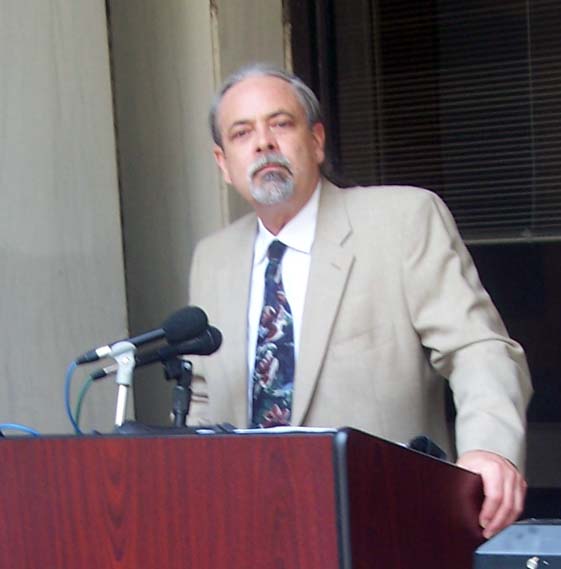
Sascha Meinrath, Director of New America Foundation’s Open Technology Initiative, speaks at a press conference before the hearing.
A three-hour meeting of a legislative subcommittee Aug. 5 gave opponents of privatizing SC ETV’s broadband spectrum their first opportunity to challenge the contract that privatizes the system. The SC Progressive Network presented testimony that the state should retain control of 25% of the spectrum for public use. This “mid band” portion of the spectrum would allow robust wireless Internet statewide.
The contract now under consideration could result in the public losing control of the nation’s only unified, statewide broadband system.
The subcommittee decided that further study of the contract terms were necessary.
The proposed contact leases the statewide educational broadband system to Clearwire and Digital Bridge for 30 years.
Sen. Harvey Peeler and Rep. Gilda Cobb-Hunter, who represent rural counties, were concerned that the contract doesn’t require the companies to provide service in rural and under-served areas.
Sascha Meinrath, Director of New America Foundation’s Open Technology Initiative, testified and responded to questions regarding the practicality of adopting the system for public access. Meinrath’s participation provided the Network with the necessary technical side of issue. Meinrath’s comments on the historical under-valuation of public airwaves was of particular interest to the subcommittee.
Sen. Glen McConnell, chair of the subcommittee, gave all interested parties until Aug. 14 to submit additional information on:
* The value of public retention of 25% of the spectrum. What will it cost to set up and maintain public access WiMax systems and how will it be paid for (by off setting cost of public entities leasing service, etc.). We have to show that giving up $35 million in lease revenue over the 30 years of the lease is a good deal for the state and taxpayers. Can we show that the value of the licensed spectrum will increase?
* The contract calls for the vendors to provide three free, regular subscription broadband services in each area of the 67 licenses. Are there places where Clearwire, or other vendors, provided more free incentives for lucrative contracts?
* The companies are being asked to provide examples of how they provide service to rural areas to address the problem that the contract allows service to be “market driven.”
SC Progressive Network Director Brett Bursey addresses the media at a press conference before the subcommittee hearing.
Letters that support public control of 25% of the state’s educational broadband system should include specific cost savings and applications. Address your letters to: Sen. Glenn McConnell, Chairman, Joint Bond Review Subcommittee on the EBS. Send your comments to the Progressive Network at network@scpronet.com or PO Box 8325, Columbia SC 29202.
Leases on table for state’s broadband
A legislative subcommittee took testimony Wednesday about a controversial plan to lease ETV’s excess spectrum to private companies, Clearwire and Digital Bridge Communications.
A plan being considered by the state would lease out all but 5 percent of ETV’s excess capacity. The two companies will pay nearly $143 million to the state over a 30-year lease agreement and build wireless broadband networks that residents and businesses could subscribe to for a fee.
The S.C. Progressive Network and others want the state to retain a larger portion of the spectrum for future educational and governmental needs.
No conclusion was reached by the subcommittee. The State Budget and Control Board will have the final say.
SC’s Broadband Transition Provides Unique Opportunity
By Brett Bursey
Director, SC Progressive Network
South Carolina is on the edge of blowing a unique opportunity to be number one in something good, for a change.
Ours is the only state in the nation that
* owns all the educational broadcasting licenses the FCC has issued to that state;
* has a statewide, unified system; and
* supports its entire educational broadcasting infrastructure with state tax dollars.
When the FCC mandated the switch to digital broadcasting, it opened the door for South Carolina to own — or lease to private companies — the nation’s only public, statewide wireless Internet system.
On Aug. 5, a legislative subcommittee will hear testimony on the terms of a contract to lease all of the state’s educational broadband capacity to two private companies. The SC Progressive Network has been urging the state to retain control of 25% of the spectrum for public use.
“Throughout telecommunications history, policy-makers have routinely under-estimated the utility of the public airwaves,” said Sascha Meinrath, Director of New America Foundation’s Open Technology Initiative, who will testify at the hearing. “South Carolina has a once-in-a-generation opportunity to deploy affordable broadband for all residents. It would be a shame for the State to squander such a valuable spectrum asset for pennies on the dollar. This is an issue of prioritizing long-term progress over short-term gain.”
With a clear plan and the political will, we can use the licenses and infrastructure we already own to address big problems. It’s a relatively small investment that would yield long-term rewards for education, job growth and innovative health care delivery. We are now spending millions of public dollars through hundreds of individual leases with private providers to local governments and public institutions.
Until relatively recently, electricity was considered a luxury. When electricity wasn’t reaching homes in rural South Carolina, co-ops were created as publicly owned utilities to power areas it wasn’t profitable for corporations to serve.
Internet access remains a luxury not available everywhere. Geography and income often determine whether your neighborhood has access. (A 2008 Census report found that only 39% of SC households do.) The current contract only requires the companies to provide minimal service in unserved and under-served areas.
It will take time and money to build our broadband access across the state. But it can be done over time. One WiMAX unit can serve a 10-mile radius with robust broadband for less than $100,000. Richland County is spending $300,000 annually on Internet service, and USC just signed a $840,000 annual contract with AT&T for a campus Wifi system. A public WiMAX/Wifi system for the entire county could be paid for by what USC will spend in several years. The public would own the system and it would cost a fraction to maintain.
If the contract leases out all the available spectrum to private companies for the next 30 years, much of South Carolina will remain in the digital dark, with public institutions across the state paying high rent for decades to come.
Unfortunately, the commission operated mostly in executive session, and the contract is still secret. The Commission was mandated to consider “the costs and benefits, both monetary and societal, that would be borne by or inure to the public at large, as well as the public to be served.” If the contracts are approved as written, it will have failed.
Robert Rini, a DC attorney who specializes in FCC law, was hired by the commission to help draw up the contracts. In November he recommended that the state should retain control of 25% of the spectrum for public use and that this would “not appreciably” reduce the value of the remaining 75%. The commission ignored his advice.
The commission never did a cost-benefit analysis of the public retaining control over 25% of the state-owned spectrum. The $35 million the current leases will bring in over the next 30 years, divided by 46 counties, comes to about $25,000 per county.
Not on the table when the commission crafted its contracts is the $7 billion in federal stimulus grants for broadband development. Experts around the country are mystified that South Carolina didn’t propose a coordinated state plan to apply for a grant to fund a statewide broadband service.
Each state has been assured of at least one grant. For likely much less than the total of all the local grants submitted, we could have had a winning proposal for a statewide public system that would be the envy of 49 other states. It’s not too late. If we retain control of the spectrum the contract intends to lease out, we can use the value of the licenses and spectrum for the 80-20% state matching funds for the next two rounds of stimulus grants.
The Joint Bond Review Board subcommittee — which includes Sen. Glenn McConnell, Sen. Harvey Peeler, Rep. Dan Cooper and Rep. Gilda Cobb-Hunter — now has the chance to order a study on the benefits of public ownership of 25% of the educational broadband spectrum and make an informed decision that takes South Carolina’s long term public interest to heart.
Minimally Adequate? You decide.
Sen. Sessions, race and impartiality
By Sue Sturgis
Facing South
There’s more than a little irony in some of the questioning U.S. Sen. Jefferson Beauregard “Jeff” Sessions III has subjected Supreme Court nominee Sonia Sotomayor to during this week’s confirmation hearings.
The Alabama Republican — the top GOP member of the Senate Judiciary Committee and a former prosecutor and state attorney general — has led the charge for his party, raising concerns about Sotomayor’s impartiality.
In particular, Sessions and other Republicans have expressed worries about Sotomayor’s comment in a 2001 lecture that “a wise Latina woman with the richness of her experience would more often than not reach a better conclusion than a white male who hasn’t lived that life.”
“That’s troubling me,” Sessions said at one point during the hearings. “That’s not impartiality.”
Responding to Sessions, Sotomayor said she made the remark in the context of a speech to young Latino students and lawyers that aimed to make them believe their life experiences were valuable, but that ultimately it was a “rhetorical flourish that fell flat.”
But what of Sessions’ own racial impartiality? After all, his 1986 nomination by President Ronald Reagan for a federal judgeship was killed by the Senate Judiciary Committee over his history of racist actions and comments.
A year before Reagan nominated him, Sessions — who was then serving as U.S. Attorney for the Southern District of Alabama — was involved in a controversial and ultimately unsuccessful voter fraud prosecution of three civil rights workers, including a former aide to Martin Luther King Jr. As writer Sarah Wildman described the case in a 2002 story in The New Republic:
The three had been working in the “Black Belt” counties of Alabama, which, after years of voting white, had begun to swing toward black candidates as voter registration drives brought in more black voters. Sessions’s focus on these counties to the exclusion of others caused an uproar among civil rights leaders, especially after hours of interrogating black absentee voters produced only 14 allegedly tampered ballots out of more than 1.7 million cast in the state in the 1984 election. The activists, known as the Marion Three, were acquitted in four hours and became a cause célèbre. Civil rights groups charged that Sessions had been looking for voter fraud in the black community and overlooking the same violations among whites, at least partly to help reelect his friend Senator Denton.
Other Sessions’ comments that came to light in those hearings, according to TNR:
* He criticized the National Association for the Advancement of Colored People and the American Civil Liberties Union as “un-American” and “Communist-inspired” and said they “forced civil rights down the throats of people.”
* He called a white civil rights attorney a “disgrace to his race” for litigating voting rights cases.
* He once said he used to think Ku Klux Klan members were “OK” until he found out some of them were “pot smokers.”
* He called Thomas Figures — a black former assistant U.S. Attorney in Alabama — “boy” to his face, and after hearing Figures criticize a secretary warned him to “be careful what you say to white folks.”
Even Sessions’ own home state senator, the late Howell Heflin, voted against his nomination.
Despite being rejected for the federal judgeship, Sessions went on to be elected Alabama attorney general in 1994. Two years later he was elected to the U.S. Senate, where he has earned a 7% approval rating from the NAACP.
Curiously, Sessions’ history of racial insensitivity has been overlooked in the mainstream press. On July 14, for example, five major U.S. newspapers reported on Sessions’ opening statement at Sotomayor’s confirmation hearing without any mention of his 1986 rejection by the Senate Judiciary Commission for the racially charged comments, reports Media Matters for America.
Postal Crisis 2009
SC Peace Activist to Travel to Israel and Palestine
Longtime Carolina Peace Resource Center activist and SC Progressive Network member David Matos will be traveling on an Interfaith Peacebuilder delegation to Israel and Palestine at the end of July. Over two weeks, the delegation will meet with Israelis and Palestinians working for peace and reconciliation, while investigating the facts of the ground; then, upon returning home, the delegates will share their experiences with several American audiences at this crucial time for peace-making. Please support this effort!
How?
1. Make a generous donation to support the expense of this trip. Make your tax-deductible donation payable to “Carolina Peace Resource Center” for “David Matos-IP Trip” and mail to P.O. Box 7933, Columbia, SC 29202. Your donation will be used to help defray the hefty costs of participating in this delegation, not the operations of the Carolina Peace Resource Center. The Carolina Peace Resource Center is a 501(c)3 nonprofit organization.
2. Organize a Speaking Engagement. Upon his return in August, David will be eager to speak to audiences, share his pictures in a slideshow and discuss what we can do for peace. Contact the Carolina Peace Resource Center at 803-446-2772 or info@carolinapeace.org.
For more information about Interfaith Peacebuilders, click here.
PO Box 7933
Columbia, SC 29202
Support Single-Payer Health Care
As Congress moves forward with reform of our costly and dysfunctional health care system, it looks increasingly less likely that a single-payer plan (like the Canadian system) has a chance. The health insurance industry and other large corporate health care providers are heavily lobbying Congress to preserve the current system, with a few reforms that will allow them to continue doing business. One ray of hope, though, is that we can advance the opportunity for those states — like California — who want to adopt this most efficient and affordable approach to universal health care.
Under a single-payer system, there would be government funding and administration, with private delivery of services. Patients could choose their providers, and doctors could determine treatments without first having to get permission from insurers, as currently is the case in our mostly private, for-profit system. Individuals would pay for their health care through payroll contributions — just like they currently do with their Social Security and Medicare payroll deductions. No one would be denied care, no exclusions based on pre-existing conditions would be allowed, and women could not be charged higher rates because they use the system more for maternity and preventive care — as happens currently in the private individual market.
A handful of states — California, Pennsylvania, Illinois and others — may be ready to seriously consider state legislation that would establish just such plans. California has already passed two separate single-payer bills, but Republican Gov. Arnold Schwarzenegger has vetoed both. Advocates promise that they will pass another single-payer bill once the governor leaves office.
Rep. Kucinich wants to make sure that states can adopt their own single-payer plans. His amendment indicates that the single-payer system would “provide comprehensive health benefits to all residents of the State using progressive financing and provides measures to assure free choice of providers for covered services, to promote quality…”
Private insurers would not be able to offer insurance duplicating benefits provided under the state single-payer plan, and Health Maintenance Organizations (HMOs) would have to be non-profit entities. Sen. Sanders’ amendment, reportedly, is similar to the House amendment, which currently has 65 supporters. Support in the Senate is uncertain, but earlier this year 37 senators signed a statement supporting a “public plan option.”
It is difficult to predict exactly when these amendments will come up in committee, but please send your messages now urging your Congress members, especially the Democratic members of the House and Senate, to vote for these amendments and let their colleagues know of their support.