Irmo Principal Eddie Walker
The brouhaha over Irmo High School Principal Eddie Walker continues to brew in the wake of his announced resignation over the formation of a Gay/Straight Alliance group on campus. Claiming that the organization conflicts with his professional and religious beliefs, Walker is slated to leave at the end of the next school year.
That leaves a whole year for the community to wrestle with an issue most would rather leave, well, in the closet.
The first round in that public battle will be held tonight, when the Lexington-Richland 5 school board will hold its regularly scheduled meeting at 7pm. The agenda includes discussion of new policies for school clubs. A rally in support of gay students and their allies will be held at 6pm at Dutch Fork Elementary School, 7900 Broad River Road.
Here is the resignation letter submitted by Eddie Walker:
Dear Irmo Nation,
In March I told our faculty and staff, PTSO Board, and SIC that I would be remaining at Irmo High school for two more years. I was committed to stay through the 2009-2010 school year. I am currently in good health, am excited about the future of Irmo High school, am making new friends every day, and continuing to learn from my student heroes on a daily basis. In short I am excited about coming to work every day.
However due to a recent conflict involving my professional and religious beliefs I sent Dr. Angela Bain a letter of resignation effective June 30, 2009. On May 14, 2008, I was instructed by email to allow the formation of a Gay/Straight Alliance Club at Irmo High School. On May 15, 2008 I told Ms. Ann Pilat to allow the formation of this club for the 2008-2009 school year.
Allowing the formation of this club on our campus conflicts with my professional beliefs and religious convictions. I considered resigning this year but reconsidered because to not fulfill my written contract for the 2008-2009 school year would also conflict with my professional beliefs and religious convictions. In my opinion failure to fulfill my contract would constitute a breach of trust with School District Five of Lexington and Richland County, my student heroes, returning Irmo High School employees, and new employees who have chosen to work at Irmo High school for the 2008-2009 school year.
The formation of this club conflicts with my professional beliefs in that we do not have other clubs at Irmo High school based on sexual orientation, sexual preference, or sexual activity. In fact our sex education curriculum is abstinence based. I feel the formation of a Gay/Straight Alliance Club at Irmo High school implies that students joining the club will have chosen to or will choose to engage in sexual activity with members of the same sex, opposite sex, or members of both sexes.
I plan to tell our students via the intercom on Wednesday, May 21, 2008 that 2008-2009 will be my last year as Principal of Irmo High School. I don’t plan to go into detail but simply plan to let them know that I will be graduating with the class of 2008-2009 next year. I don’t intend to make a big deal out of this. Let’s get it over quick so we can close this year and have a great 2008-2009 school year. I intend to work with you and our students to make 2008-2009 the best year in our illustrious history. It is very important to me that the club sponsor and all students who join this club receive Golden Rule treatment from everyone.
My decision to resign is a personal choice based on my professional beliefs and religious convictions. I have prayed about the decision for a period of time and I have a peace about it. I would ask that you respect my choice as I respect your choice to disagree with me on this issue. I bear no malice towards anyone involved. If the people involved at the district level had chosen not to allow the club to form I am sure the district would have been sued and the current legal opinions and precedents indicate that in all likelihood the district would have lost.
Sincerely, Eddie Walker
Rove protégé to dig for dirt on Obama
By Jason Leopold
Timothy Griffin, a central figure in the U.S. Attorney scandal and a protégé of Republican political guru Karl Rove, reportedly has been hired to dig up dirt on likely Democratic presidential nominee Barack Obama.
FirstRead, a political Web site of NBC News, cited a Republican source as confirming that Griffin was being brought onboard by the Republican National Committee to handle opposition research on Obama.
Griffin hung up on me when I contacted him at his home and asked him to comment about the report. An RNC aide told me he could neither “confirm nor deny the report.”
Griffin’s return to the RNC as an opposition researcher – a post he held during the Bush-Cheney campaigns – would seem to mark a return to a “dirty tricks” style of campaigning that presumptive Republican nominee John McCain has vowed to avoid.
During the 2000 presidential campaign, Griffin handled “oppo” on Al Gore and, according to several RNC staffers, hung a poster behind his desk that paraphrased a line from “Gladiator”: “On my command – unleash hell on Al.”

On this Memorial Day
by Camillo “Mac” Bica
t r u t h o u t | Perspective
For many of us who have known war, it has been years since we faced the insanity of man’s inhumanity to man. Yet, it haunts us still. It is the nature of war, I think, that we can still recall with frightful realism, the rifle butt and bayonet that forced a weary body to continue the seemingly endless trek of the Bataan Death March, or appreciate the gentle beauty of a snowflake without recalling the blood stained snow banks of the frozen Chosin Reservoir. Not a day goes by, I think, that we do not recall the devastating screams of a comrade who died in our arms while taking and then giving back a useless and desolate hill top in the Central Highlands of Vietnam, or wake up screaming as we relive the horror of the bloodstained streets of Fallujah.
It is the nature of war, I think, that we shall never forget and need no holiday to remind us. As warriors, we may know little of the politics of diplomacy and international affairs. But no one knows war better than we who did the killing, and the dying, and the remembering, and the grieving. For we are neither war’s initiators nor its beneficiaries, we are its victims.
In war, we are conditioned to put aside the lessons of our youth, of our parents, teachers, and clergymen who stressed the importance of compassion, understanding and loving our fellow man. We are transformed into warriors capable of unleashing untold horrors and devastation. The legacy of war, therefore, is not of honor or glory, for such virtues can never be derived from causing the death and suffering of so many of God’s children. War is in fact hell as is living with the memories and nightmares.
On this Memorial Day, I do not celebrate the successes and victories of wars long gone or those currently being fought, as war is not a cause for celebration. Rather, it is a day like any other in which I remember and grieve the deaths of those who fought by my side and those against whom I fought. The warrior is conceived in the womb of battle, breathed life in the midst of suffering and death, and lived, loved and hated with such intensity that life ever after loses its meaning. I believe, sometimes, that death in war is benevolent, and those who died more fortunate than we who are condemned to live as penance for the sacrilege of war.
This bond or brotherhood of the warrior, or better, of victims, is sacred to us and it has become our purpose to ensure that those whose lives were sacrificed on the beaches of Normandy, at the Pusan Perimeter, at Khe Sahn, and in Haditha should never be forgotten. We certainly shall never forget them for they have touched our lives so deeply, and their young faces visit us so often in our dreams. And those of us who truly know war, will never allow others to forget them either, nor profane their memory by using their sacrifices to encourage other young men and women to march blindly off to battle for a cause that is misguided or nonexistent.
War has taught us that patriotism has its place as long as it is tempered with reason. And war has taught us that the suffering of children who inevitably do the fighting is so great that everything must be done to ensure that human life never again be wasted on the field of battle. For isn’t that why we made our sacrifices and those that we allege to remember and honor gave their lives. And war has taught us that when the frenzy of death and destruction has subsided and the smoke of battle has cleared, amidst the death and suffering that remains there are no winners, only shattered lives and grieving families and loved ones. And war has taught us that if those of us who know the insanity of war find solace in embracing the fantasy of glory and heroism and allow those blinded by greed, hatred, misunderstanding, and misguided patriotism, to again place our children on the battlefield unnecessarily, the very survival of our nation, perhaps, even of our species, may well be placed in jeopardy. War has taught us this.
We must mark this Memorial Day, then, not with parades and air shows that celebrate the instruments of destruction. Nor with picnics or sales at the mall. Rather, we must use it to remind all Americans of the tragedy of war, of its futility and waste. We must make them understand, distasteful though it may be, the true nature and the lessons of war.
Camillo “Mac” Bica, Ph.D., is a professor of philosophy at the School of Visual Arts in New York City. His focus is in Ethics, particularly as it applies to war and warriors. As a veteran recovering from his experiences as a United States Marine Corps Officer during the Vietnam War, he founded, and coordinated for five years, the Veterans Self-Help Initiative, a therapeutic community of veterans suffering from Post Traumatic Stress Disorder. He is a long-time activist for peace and justice, a member of the Vietnam Veterans Against the War, and a founding member of the Long Island Chapter of Veterans for Peace. Articles by Dr. Bica have appeared in Cyrano’s Journal, The Humanist Magazine, Znet, Truthout.org, Common Dreams, AntiWar.com, Monthly Review Zine, Foreign Policy in Focus, OpEdNews.Com, and numerous philosophical journals.
Honoring Rep. Gilda Cobb-Hunter
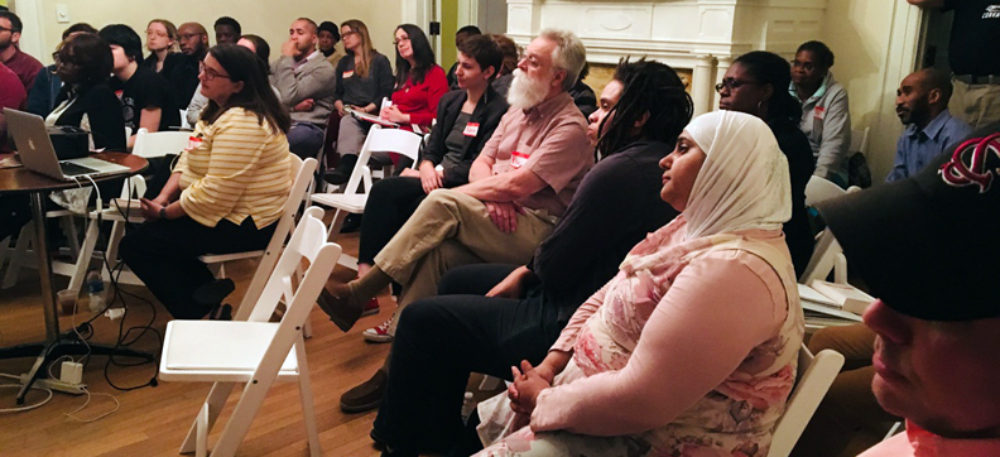
Friends of Rep. Gilda Cobb-Hunter (D-Orangeburg) gathered at the historic Robert Mills House in downtown Columbia on May 22 to honor the legislator for her commitment to progressive values and her long history of speaking truth to power.
River of resistance
How the American imperial dream foundered in Iraq
by Michael Schwartz
Tomdispatch.com
On February 15, 2003, ordinary citizens around the world poured into the streets to protest George W. Bush’s onrushing invasion of Iraq. Demonstrations took place in large cities and small towns globally, including a small but spirited protest at the McMurdo Station in Antarctica. Up to 30 million people, who sensed impending catastrophe, participated in what Rebecca Solnit, that apostle of popular hope, has called “the biggest and most widespread collective protest the world has ever seen.”
The first glancing assessment of history branded this remarkable planetary protest a record-breaking failure, since the Bush administration, less than one month later, ordered U.S. troops across the Kuwaiti border and on to Baghdad.
And it has since largely been forgotten, or perhaps better put, obliterated from official and media memory. Yet popular protest is more like a river than a storm; it keeps flowing into new areas, carrying pieces of its earlier life into other realms. We rarely know its consequences until many years afterward, when, if we’re lucky, we finally sort out its meandering path. Speaking for the protesters back in May 2003, only a month after U.S. troops entered the Iraqi capital, Solnit offered the following:
“We will likely never know, but it seems that the Bush administration decided against the ‘Shock and Awe’ saturation bombing of Baghdad because we made it clear that the cost in world opinion and civil unrest would be too high. We millions may have saved a few thousand or a few tens of thousand of lives. The global debate about the war delayed it for months, months that perhaps gave many Iraqis time to lay in stores, evacuate, brace for the onslaught.”
Whatever history ultimately concludes about that unexpected moment of protest, once the war began, other forms of resistance arose – mainly in Iraq itself – that were equally unexpected. And their effects on the larger goals of Bush administration planners can be more easily traced. Think of it this way: In a land the size of California with but 26 million people, a ragtag collection of Baathists, fundamentalists, former military men, union organizers, democratic secularists, local tribal leaders, and politically active clerics – often at each others throats (quite literally) – nonetheless managed to thwart the plans of the self-proclaimed New Rome, the “hyperpower” and “global sheriff” of Planet Earth. And that, even in the first glancing assessment of history, may indeed prove historic.
The New American Century Goes Missing in Action
It’s hard now even to recall the original vision George W. Bush and his top officials had of how the conquest of Iraq would unfold as an episode in the President’s Global War on Terror. In their minds, the invasion was sure to yield a quick victory, to be followed by the creation of a client state that would house crucial “enduring” U.S. military bases from which Washington would project power throughout what they liked to term “the Greater Middle East.”
In addition, Iraq was quickly going to become a free-market paradise, replete with privatized oil flowing at record rates onto the world market. Like falling dominos, Syria and Iran, cowed by such a demonstration of American might, would follow suit, either from additional military thrusts or because their regimes – and those of up to 60 countries worldwide – would appreciate the futility of resisting Washington’s demands. Eventually, the “unipolar moment” of U.S. global hegemony that the collapse of the Soviet Union had initiated would be extended into a “New American Century” (along with a generational Pax Republicana at home).
This vision is now, of course, long gone, largely thanks to unexpected and tenacious resistance of every sort within Iraq. This resistance consisted of far more than the initial Sunni insurgency that tied down what Donald Rumsfeld pridefully labeled “the greatest military force on the face of the earth.” It is already none too rash a statement to suggest that, at all levels of society, usually at great sacrifice, the Iraqi people frustrated the imperial designs of a superpower.
Sexism: alive and well in America
Discussing Sen. Hillary Clinton’s comments regarding sexism in the media’s coverage of her presidential campaign, CNN’s Jeffrey Toobin referred to a New York Times column that “talked about some of the humor in the campaign, and the punch line was a line that was – that Hillary Clinton was a ‘white bitch.'” CNN political contributor Alex Castellanos asserted, “And some women, by the way, are named that and it’s accurate.”
Read more at Media Matters.
Keeping it real
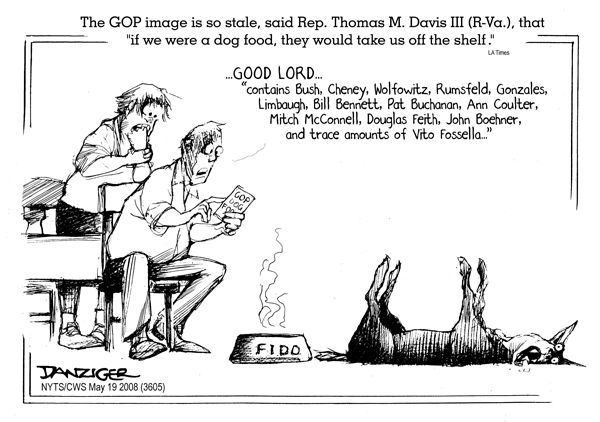
Funnies