Free speech not dead yet

Brett Bursey’s court hearing on Oct. 27 at the federal courthouse in Charleston went well. Judge Bristow Marchant did not throw the case out, and allowed the introduction of the White House Advance Manual that Bursey’s legal team believes shows a pattern and practice of suppressing free speech.

Judge Marchant’s options are: rule against Bursey, grant the writ and overturn the conviction, or order a new trial.

Attorney Michael Tigar posed the option of a new trial as only fair, since the judge agreed that the suppressed manual was relevant to the case.

The judge will issue a ruling in the coming weeks. We will post details here as they become available.

For background on the case, click here.

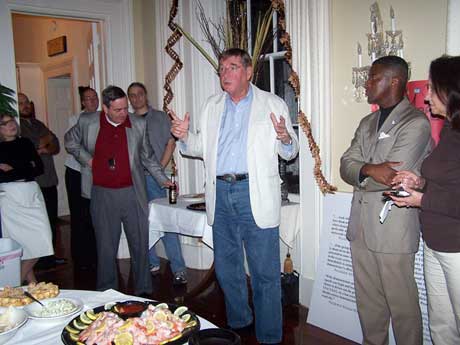
Duke Law professor Michael Tigar speaks at a reception Oct. 26 in Charleston on the eve of the hearing. For more photos of the reception, click here.

Vote today!

With a half-million new voters added to the rolls in South Carolina since the last presidential election, election officials are predicting record numbers turning out to vote on Nov. 4. Help cut congestion at the polls by taking advantage of South Carolina’s provision for “in-person absentee” voting.

To vote in-person absentee, you must be a registered voter and meet one of the following criteria:
• Students, their spouses and dependents residing with them
• Members of the Armed Forces, Merchant Marines, Red Cross, USO, government employees, their spouses and dependents residing with them
• For reasons of employment will not be able to vote on election day
• Physically disabled persons
• Persons on vacation
• Persons age 65 or older
• Persons admitted to the hospital as emergency patients on day of election or at least four days prior to the election
• Electors with a death or funeral in the family within 3 days before the election
• Persons attending sick or physically disabled persons
• Persons serving as jurors in a state or federal court on election day
• Certified poll watchers and poll managers

You may vote in-person absentee at your county voter registration office until 5pm on Nov. 3. For more details on voting, or to find your registration office, visit the SC Election Commission’s web site.

If you encounter problems while voting, please call the toll-free hotline for assistance: 1-866-OUR-VOTE. You will be provided free legal assistance, and your report will help provide a record to help election workers address weaknesses in the system and avoid problems in the future.

Free speech on trial

Rev. Dr. Neal Jones

Unitarian Universalist Fellowship of Columbia

Today as I write this (Monday, Oct. 27), a friend of mine and of many within our congregation, Brett Bursey, Director of the SC Progressive Network (of which our Fellowship is a member), is appearing in Federal Court in Charleston for a hearing on a Writ of Coram Nobis.  We pay lawyers to translate these legal Latin phrases for us.  This one translates as “the error before us.”  The error in question is an error that occurred in Brett’s original trial in 2003, in which he was convicted of threatening the President under a federal statute that governs “Presidential Assassination, Kidnapping, and Assault.”  What on earth did the otherwise peace-loving Brett Bursey do to the President?, you may be wondering.  

Well, at a political rally at the Columbia airport, at which President Bush was promoting local Republican candidates in the 2002 election, Brett was carrying a sign that read, “No More Wars for Oil.”  When Brett was ordered to move to a designated “free speech zone” a half-mile away, he refused.  Like many of us, Brett probably thought that the United States of America is a free speech zone.  He was wrong, and for this he was arrested.

Continue reading

Free speech vs. George Bush: the final showdown

Can the White House restrict the First Amendment based on political considerations? This will be the central question at a Federal Court hearing in Charleston, SC, at 10am on Oct. 27.

The hearing on a Writ of Coram Nobis, translated as “the error before us,” filed by Brett Bursey, will examine evidence suppressed at his trial in November 2003. A coram nobis petition applies to persons who have already been convicted and have served their sentence. Such motions cannot be used to address issues of law previously ruled upon by the court, but only to address errors of fact that were not known at trial or were knowingly withheld from judges and defendants by prosecutors that might have altered the verdict were they presented at trial. The writ argues that the government withheld evidence of White House involvement in segregating peaceful protestors from supporters of President Bush at presidential rallies. Bursey was arrested at a Bush rally in Columbia in October 2002 for refusing to be segregated from the general public.

Bursey, Director of the SC Progressive Network, is the only person ever convicted under a federal statute that allows the Secret Service to create a secure zone around presidential events. Bursey was arrested on state charges of trespass at an appearance of President Bush when he refused to go to an obscure “free speech zone” a half-mile away from the event. Four months after the arrest, state charges were found unconstitutional and dismissed. Federal charges were then brought by US Attorney Strom Thurmond Jr. under the statute that governs “Presidential Assassination, Kidnapping and Assault” (Title 18, United States Code, Section 1751(a)(1)(ii)).

“I argued at my trial that the Secret Service was being used as an armed political advance team by the president to keep protesters out of sight of the venue and the media,” Bursey said. He filed discovery motions and subpoenas during his trial for any White House directives to the Secret Service, but the government successfully moved to deny his efforts, calling them a “fishing expedition.”

Bursey has since discovered the White House Advance Manual that instructs the Secret Service to do what he alleged the agents had done. “There are several ways the advance person can prepare a site to minimize demonstrators,” the manual reads. “First, as always, work with the Secret Service and have them ask the local police department to designate a protest area where demonstrators can be placed, preferable not in view of the event site or the motorcade route” (pg. 32, Presidential Advance Manual).

Bursey was convicted of standing on the side of the road, 200 yards from the event, with a sign that read: No More Wars For Oil. His attorneys will argue that the White House and the Secret Service worked in concert with local police to deny the First Amendment rights of those opposed to the Bush Administration’s policies.

Bursey’s lead attorney, Michael Tigar, will be assisted by trial attorneys Lewis Pitts and Rauch Wise, Bursey’s trial counsel, and Columbia attorney Joyce Cheeks.

A member of the Duke University Law School faculty, Tigar is one of America’s leading constitutional lawyers. Justice William J. Brennan has written that Tigar’s “tireless striving for justice stretches his arms towards perfection.” In 1999, the California Attorneys for Criminal Justice held a ballot for “Lawyer of the Century.” Tigar was ranked third, behind Clarence Darrow and Thurgood Marshall.

Tigar is author or editor of more than a dozen books. He has also written three plays and dozens of law review articles. Tigar has represented The Washington Post, John Connally, Sen. Kay Bailey Hutchison, Scott McClellan, Rep. Ronald Dellums, Mobil Oil, Fernando Chavez, Lynne Stewart, Angela Davis and Terry Lynn Nichols. He has tried cases in many courts across the country, and argued seven cases in the U.S. Supreme Court, as well as dozens of federal appeals.

Attorney Lewis Pitts, left, and Brett Bursey.

•••••••

To hear an audio recording of Bursey’s statements during sentencing in 2003, click here.

Don’t ignore Constitution this election season

By Kathleen Taylor
American Civil Liberties Union

America is in the midst of an election season, nearing an Election Day with what likely will be far-reaching consequences. Public interest is extraordinarily high, and candidates are debating many critical issues. Yet we have heard little or nothing about the Constitution and its Bill of Rights – the touchstone of our individual freedoms.

The most significant words of the U.S. Constitution may be the first three: “We the people.” Not “I the King,” not “I the Grand Religious Leader,” not even “I the elected President.” Our governing structure was created by the people, and ensuring that it works for the people is a continuing legal, moral, and political journey.

All through the centuries, arguments about the Constitution’s meaning have persisted: What does it mean that only Congress can declare war? (Article I) What constitutes “high crimes and misdemeanors?” (Article II) Is taking an oath of office with your hand on the Bible a “religious test?” (Article VI) Under which conditions, if any, should explicit sexual language not be considered free speech? (Amendment 1) Is a urine test for drugs an “unreasonable search?” (Amendment 4)

The remarkable characteristic of the Constitution is that it offers bedrock principles—checks and balances, procedures, freedoms, responsibilities, protections—while at the same time responding to the needs of contemporary society. It’s not an accident; the founders wrote it that way on purpose. The Constitution is our civic compass. It points the way for courts, legislatures, and executive administrations. It guides us in times of war and of peace, of boom and of bust, and of everything in-between. It keeps us on the path of fair play, equal treatment, liberty, and security.

Or it does if we’re constantly vigilant.

Over the last two centuries, through activism, dissent, and dedication, citizens have expanded the scope and depth of our liberty. And today, more Americans enjoy the “blessings of liberty” than at any time in history.

Yet, in recent years, our federal government has grown more powerful and secretive, assuming powers it does not rightfully have. Our government has:

• spied on Americans without the approval of Congress or the courts;
• allowed the CIA to torture and abuse hundreds of people, including Americans, in secret prisons throughout the world;
• held prisoners indefinitely without charge;
• placed hundreds of thousands of Americans on terrorist watch lists without an explanation or opportunity to appeal; and
• restricted the free flow of scientific information and set up barriers to the use of scientific materials.

No matter who wins the election, we must remember that the Constitution applies to everyone. It applies to the least desirable among us and to those with whom we vehemently disagree on matters of politics, religion, or ethics. That’s the tough part. We need to be vigilant for all people, not merely the ones whom society favors.

This election season is an opportunity to think about what the Constitution has given us, as well as what we ourselves can do to make sure it survives — not just in letter, but in spirit. We can consider whether what’s been going on is consistent with the Constitution. We shouldn’t fall into the trap of “Well, it’s not me; it’s that awful other person who’s being tortured/spied upon/denied an attorney/discriminated against/harassed.” Any of us could be that person in the future.

Taylor is executive director of the American Civil Liberties Union of Washington. This commentary was supplied by American Forum, a nonprofit, nonpartisan, educational organization that provides the media with the views of experts on major public concerns in order to stimulate informed discussion.
Volunteer to enter voter registration data

The Richland County Voter Registration office needs volunteers on Saturday, Oct. 18, to help enter registration information at its office at 2020 Hampton St. in downtown Columbia. The great work that everyone has done in Richland has left the election office swamped. We can’t start our Get Out The Vote drive until we have all the folks entered in the system.

Volunteers are needed from 9am until 5pm. Call the Missing Voter Project‘s John Dawkins at 803-467-1981 if you can help, even if it’s just for an hour or two.

Legislators ask attorney general to issue opinion on emergency ballots

At the urging of the SC Progressive Network, state legislators have requested that SC Attorney General Henry McMaster issue an opinion on the state statute regulating emergency ballots at polling places.

“After the failure of many of the voting computers in Horry County during the January Republican presidential primary, where many voters were turned away from the polls, we found that no law requires precincts to have emergency paper ballots,” said Network Director Brett Bursey. Horry County election official Lisa Bourcier reported that “80-90 percent” of the county’s more than 300 machines malfunctioned. Voters in many of the county’s 118 precincts were told to come back later, on a cold and rainy day, because emergency paper ballots ran out shortly after the polls opened and the machines failed to operate.

Rep. Tracy Edge, a McCain campaign official, reported that his mother-in-law was only the 12th person to vote in her precinct, and that she was given a blank piece of paper because they didn’t have emergency ballots. State Election Commission spokesperson Chris Whitmire was widely quoted as telling people to vote on “paper towels” if necessary.

Section (A) of 7-13-430 of the state law used to read: “There must be provided for each voting place where voting machines are used as many ballots as are equal to ten percent of the registered qualified voters at the voting place.” The statute was amended in 2000 to read: “There must be provided for each voting place where voting machines are used a number of ballots not to exceed ten percent of the registered qualified voters at the voting place.”

Sen. Phil Leventis, along with Rep. Gilda Cobb-Hunter and Rep. James Smith, requested that the Attorney General issue an opinion on the statute. “Our switch to electronic voting statewide in 2004 accentuates the need for a back-up system of paper ballots,” Leventis said. “The current statute has no minimum number of emergency ballots required, and does not protect our right to cast a ballot in the event of machine failure.” Leventis was opposed to the state’s purchase of the touch-screen computers that do not produce a durable, and voter-verifiable, paper ballot that can be used to verify a recount.

Beaufort County’s early voting was stymied on Oct. 6 when its computers failed to come online due to an incorrect password. The problem was detected Oct. 4 and not resolved until the afternoon of the 6th. The county blamed the State Election Commission for providing the wrong password. The SEC said Beaufort County election officials were to blame.

Maryland Attorney General Douglas Gansler recently called for emergency paper ballots to be used in case of long lines to vote on machines. Maryland, one of only three states (Georgia and Delaware) using paperless computer voting machines like those in South Carolina, has decided to dump the computers in 2010 and switch to an optical scan system that uses paper ballots that can be hand marked if the machines malfunction, or the electricity is off.

In Pennsylvania, voting rights advocates are pushing the Secretary of State to change his ruling that emergency ballots will not be used unless all the machines in a precinct fail, urging the paper ballots be distributed if half the machines aren’t working.

After the Horry County machine failure, State Republican Party Chair Kayton Dawson told CNN that he was confident of a “full and fair count” and noted that “there is always a back-up in case of a machine malfunction and a ballot can’t be cast.”

Leventis said, “Actually, there is no mandated back-up in case of machine failures, and that is why we have taken this matter to the Attorney General.”

“This Nov. 4 we expect to see record numbers of voters,” Bursey said. “If machines fail, as they have in the past, we shouldn’t have to rely on paper towels to insure that every vote counts.”