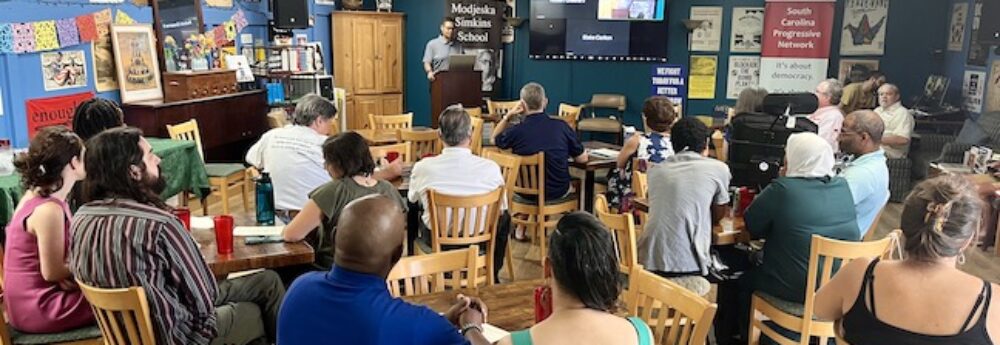
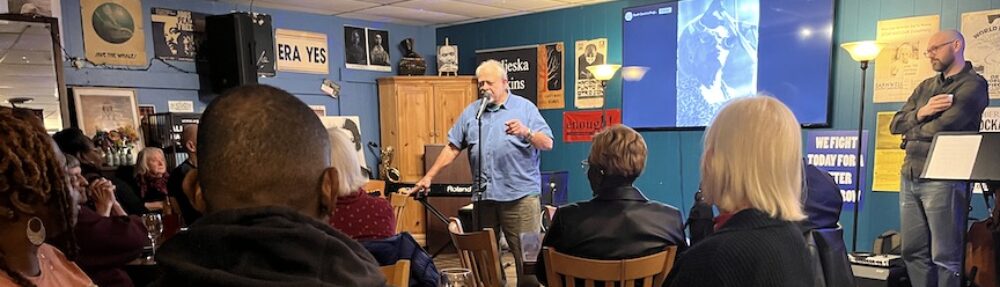
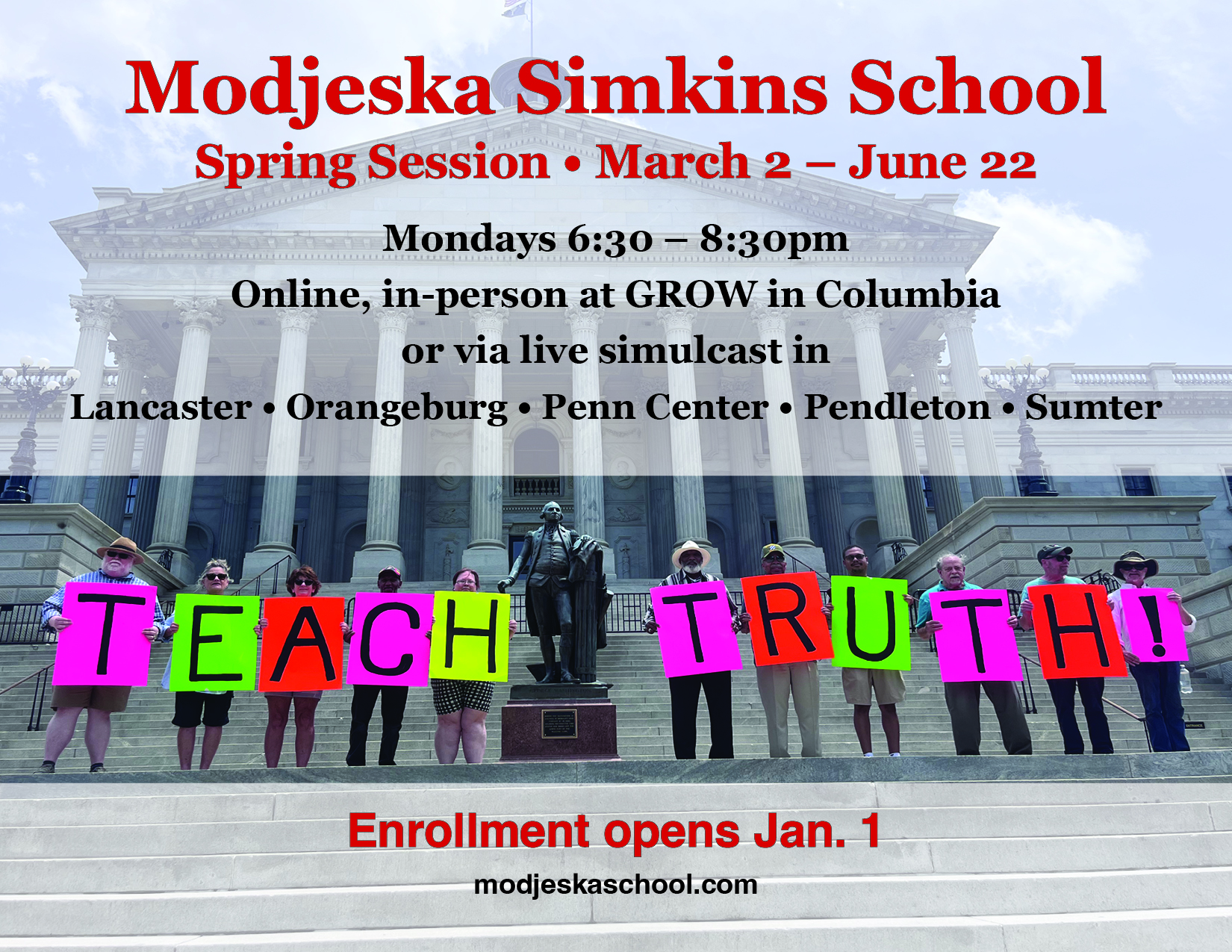
The Modjeska Simkins School is now accepting applications for its spring semester, which runs from March 2 through June 22. Classes meet Monday evenings in Columbia, on Zoom, and via live broadcast at five satellite sites.
Expanding on last year’s success with our partners in Sumter and Penn Center, this year we’ve added remote sites in Lancaster, Orangeburg, and Pendleton. This in-person-option lets more students have the collaborative experience that is central to the program.
“These satellite sites broaden access to the school and help build community outside of our Columbia base,” said Brett Bursey, executive director of the SC Progressive Network, which launched the school in 2015. “You deepen the experience by sharing the experience,” he said. “The course covers challenging subjects, and it is good to have people to help process the material.”
Network staff member James Felder facilitated operations at the Sumter site last semester. “People in Sumter have heard from graduates, and are anxiously awaiting the spring semester,” he said. “People who have been through the program are our best messengers.”
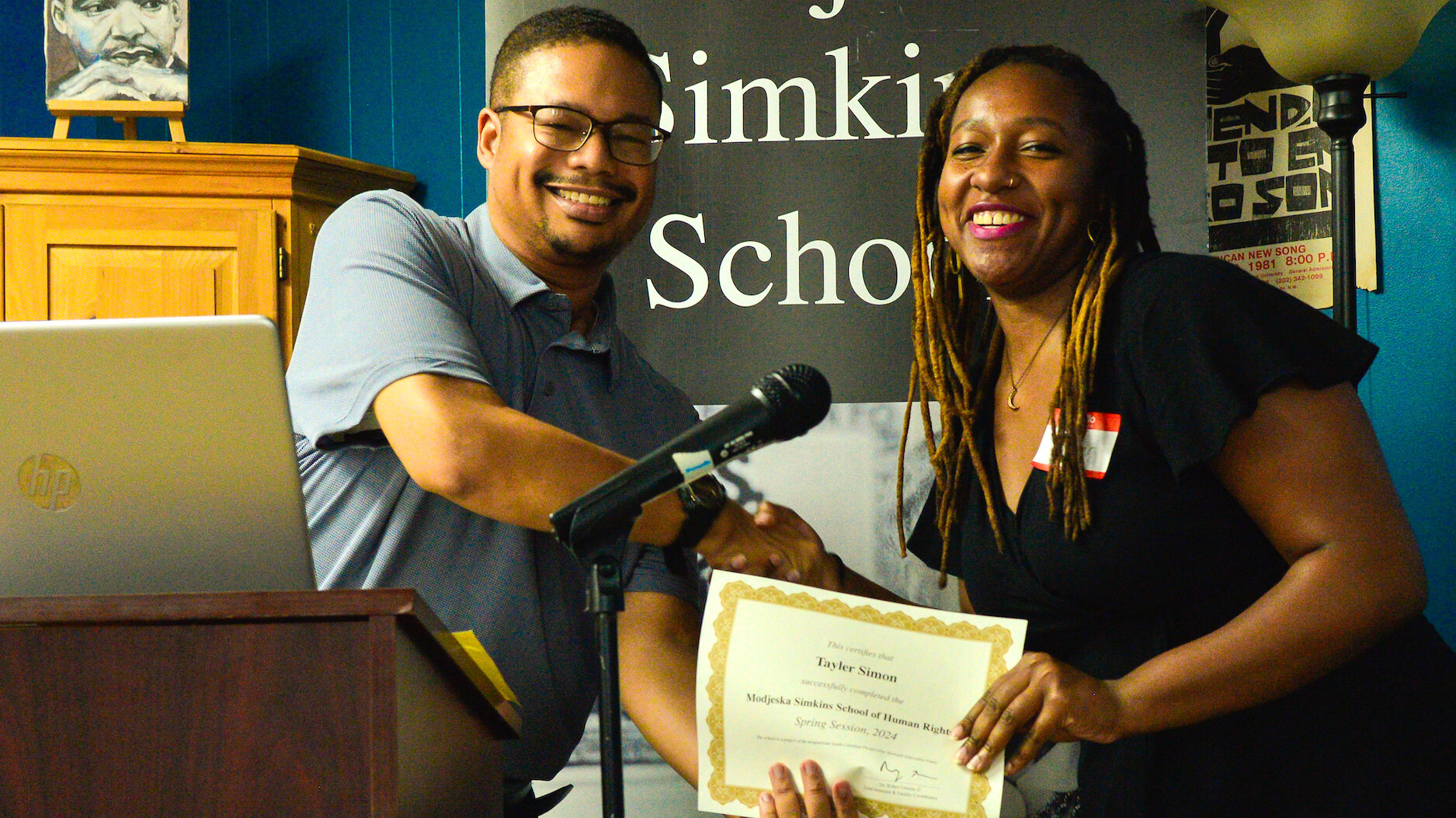
Dr. Robert Greene II, a tenured professor at Claflin University and president of the national African American Intellectual History Society, has served as the Modjeska School’s lead instructor since 2019. “This year’s session of the Modjeska Simkins School comes at a time of both great peril and great promise for our state and our nation,” he said. “Learning the true history of South Carolina’s past can be inspiring and up-lifting.”
Dr. Robert Greene II and Tayler Simon
The curriculum reflects the Network’s nonpartisan strategy, focused intentionally and specifically on South Carolina, which continues to play an over-sized role in our nation’s politics.
This unique and ever-evolving master class is led by guest presenters who are some of the state and nation’s leading writers, historians, professors, and activists. It is a curriculum unlike any in South Carolina. While we welcome students of all backgrounds and ages (our youngest was 14) the course is not for everyone. It covers mature, difficult topics, and requires hours of outside study each week.
If you love history, want to be a more effective grass roots activist, are a retired person wanting to connect with others in your community, or are a transplant who wants to know more about your adopted home state, this course is for you.
The school also offers Deep Dives throughout the semester, Sunday afternoon programs held in Columbia and broadcast on Zoom. They are free and open to the public. To receive notices of the programs, sign up for the Network’s email list or bookmark GROW’s calendar.
For details about the school, see modjeskaschool.com. There you will find a list of instructors, the spring class schedule, and an application.
Full tuition is $500. Payment plans and scholarship assistance is available.
Questions? Call 803-808-3384 or email info@modjeskaschool.com.
Not going to lie; it’s been a rough year. Butif 2025 taught us anything, it’s the importance of connection and community. We offer this short review to remind you that we can thrive even in darkness.
Modjeska Simkins School lead instructor Dr. Robert Greene II
In January, we gathered at the Big Apple in Columbia to mark the 10th year of the Modjeska Simkins School. The gala was a chance to celebrate this important milestone and recommit ourselves to the work of remembering who we are, where we’ve been, and the power of ordinary people to make change.
In March, the Modjeska Simkins School began its spring session, and for the first time offered students the option of participating at satellite sites in Sumter and at historic Penn Center in St. Helena. It was so successful that we are expanding on that model in 2026, adding partner sites in Lancaster, Orangeburg, and Pendleton. We are excited about broadening access to communities outside of Columbia, and working with them after classes end.
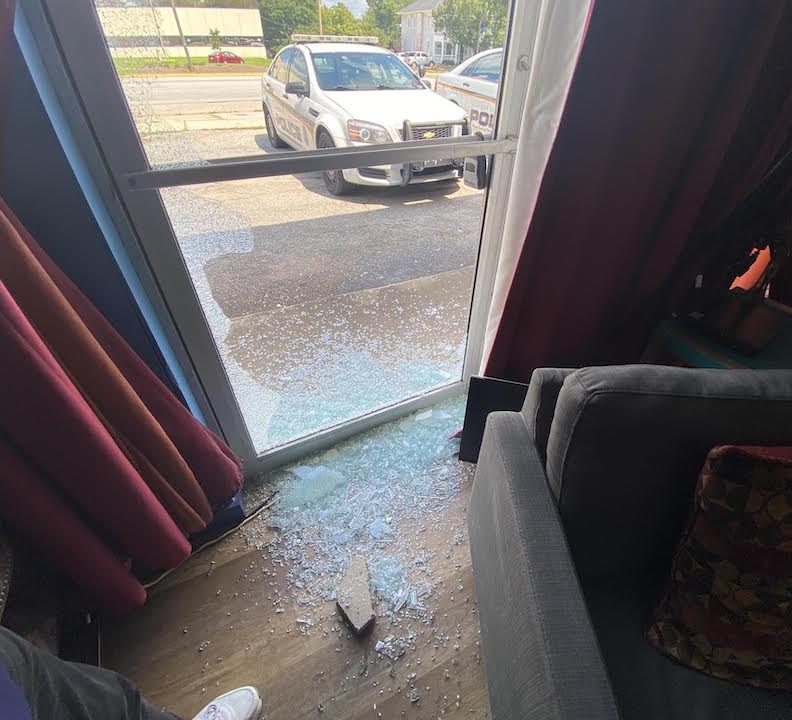
In April, GROW, our HQ, was vandalized for the second time, leaving considerable damage. Our friends rallied to cover the cost of repairs and to upgrade our security system. In 2026, we will make the building even more secure by remodeling the parking area to include barriers. We were moved by the support.
In May, we took a field trip to Orangeburg for a special program on Briggs v Elliott’s role in the landmark Brown v. Board case. The trip included a tour of the SC Civil Rights Museum’s new building, still under construction. Cecil Williams has done a beautiful job overseeing the creation of a first-class facility that will serve generations.
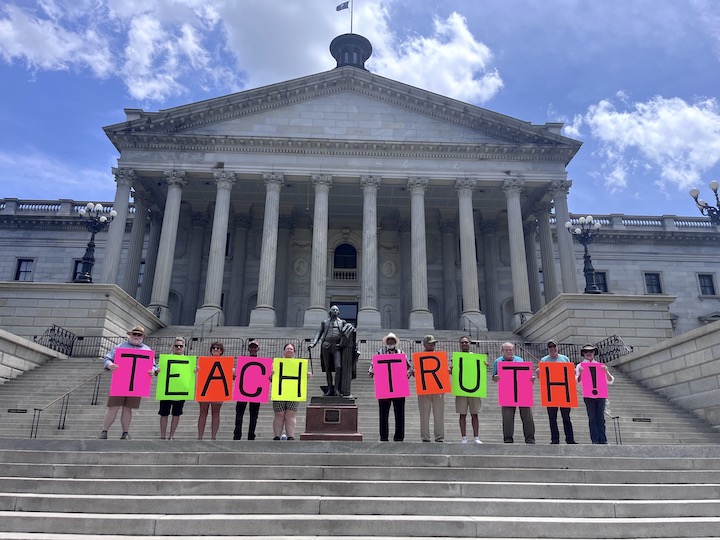
On June 10, friends and alumni of the Modjeska Simkins School marked the Zinn Education Project’s Teach Truth Day with a speak-out at the SC State House. See video clip.
July 31, on what would have been his 100th birthday, we joined friends and family of James E. Campbell at the Avery Research Center in Charleston to mark his extraordinary life with a day of teachings, discussions, and remembrances. Campbell was a longtime member of the SC Progressive Network, and was among the first to receive the organization’s Thunder and Lightning Award, in 1998. He served as a mentor to many and an inspiration to all who had the pleasure to work with him.
On June 28, the Modjeska Simkins School graduated 63 students, the largest class yet.
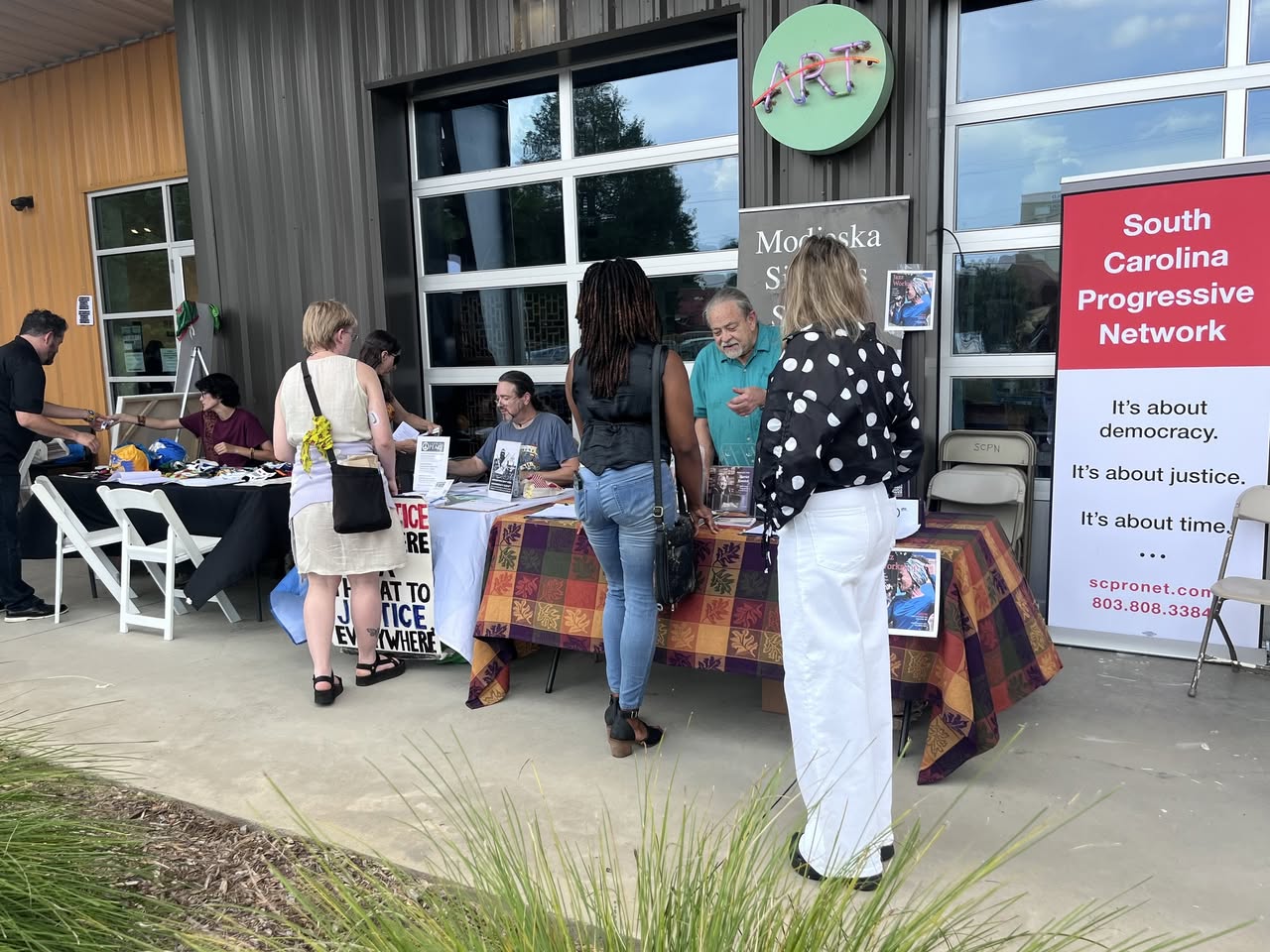
In July, we tabled at the Degenerate Arts Activist Fair at Stormwater Studios in Columbia, a four-day event organized by Jasper Project. Our friends at Jasper included an essay about GROWin their fall magazine, and have invited us to participate in their second Activist Fair, which kicks off Jan. 20.
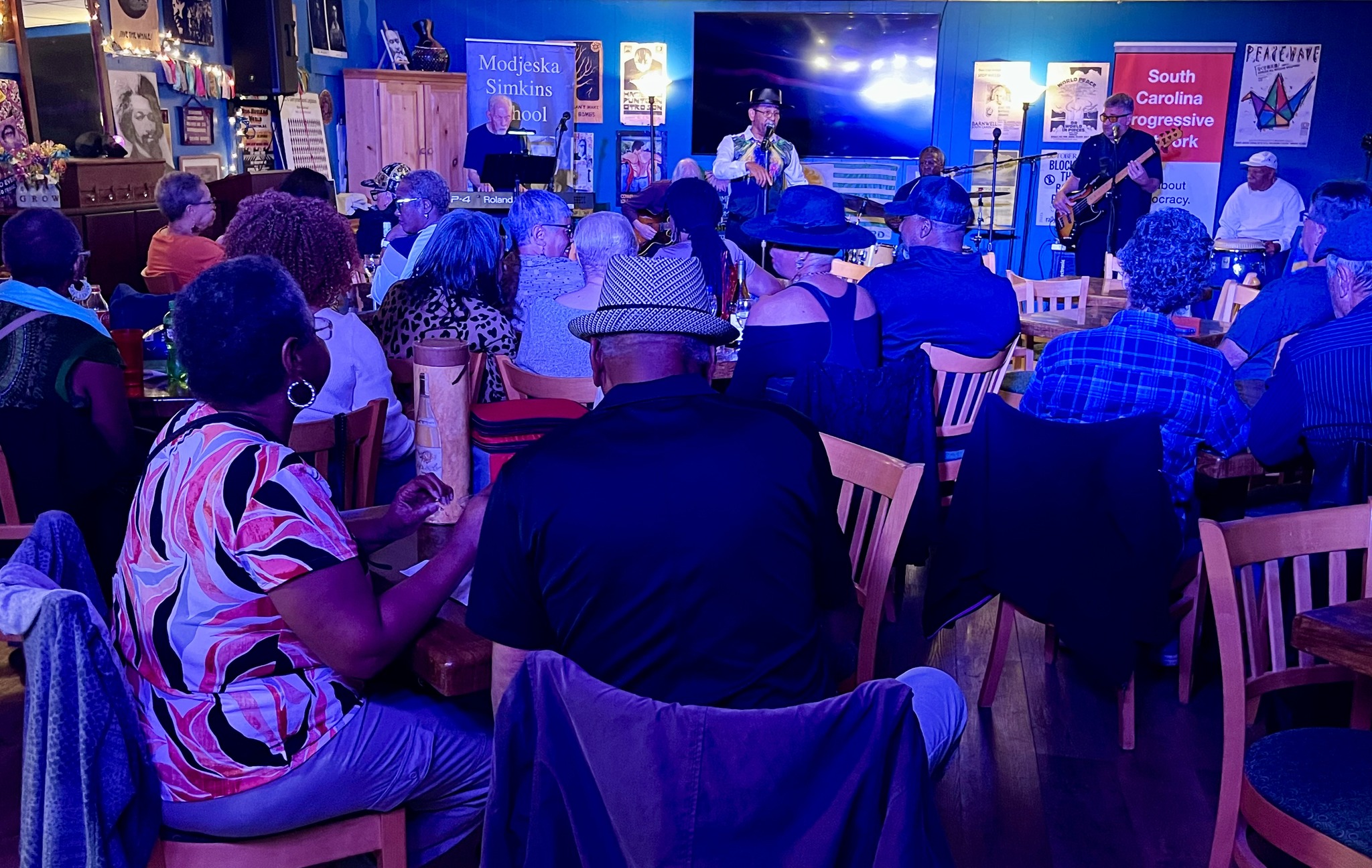
In August, we added blues to the menu at GROW, building on the popularity of the jazz workshops we’ve been hosting since 2023. Led by world-class bluesman Cesar, the blues workshops have brought a whole new vibe to the corner of Elmwood and Marion. Now, every Thursday between 8 and 10 folks can come out to hear some of Columbia’s finest musicians. It’s free — for now. We may move to a GROW membership model in the coming year.
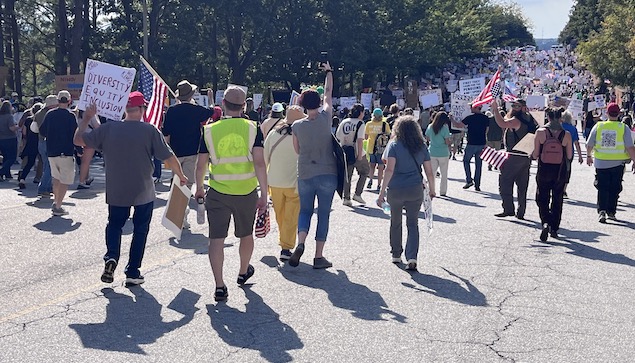
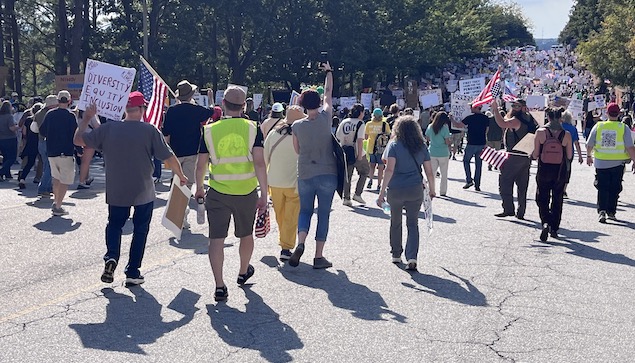
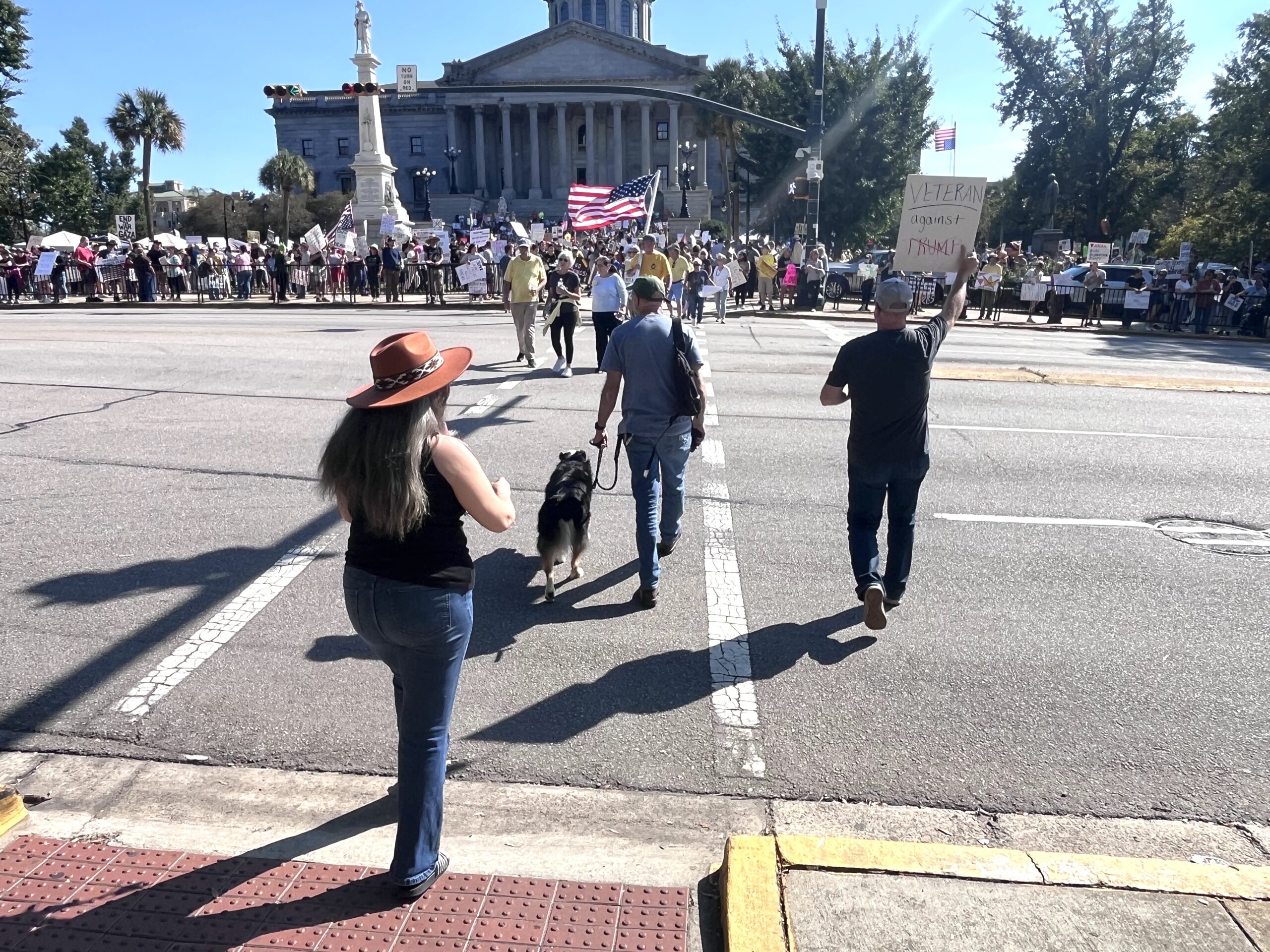
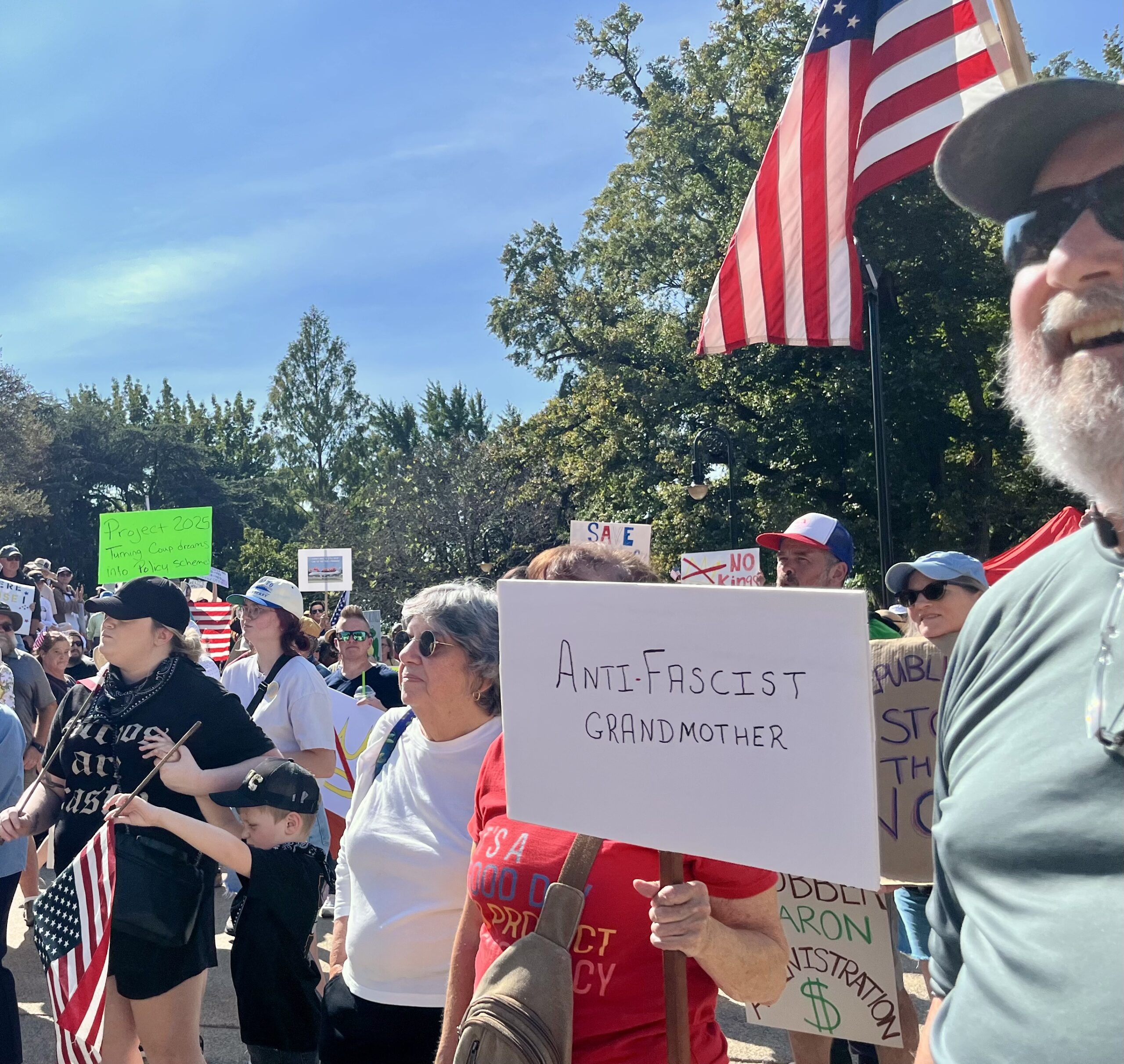
In October, many of our members and allies took part in the No Kings rallies across the state, joining some 7 million Americans in telling the administration we resist and condemn authoritarian rule. Several of our members were invited to speak at earlier rallies in Columbia and in Greenville.
In November, the Modjeska Simkins School was invited to participate in the SC Council of Social Studies conference in Greenville, where Dr. Robert Greene IImade a presentation on the challenge of teaching history in these times. We recruited more than a dozen teachers at the symposium to participate free of charge in the 2026 session of the school. It is our way of investing in education.
The Wednesday before Thanksgiving, GROW held its first Friendsgiving, a casual gathering to mark our country’s tastiest and most complicated holiday. It was great fun, and may become a new tradition.
Armand Derfner (left) and Vernon Burton
Over the spring semester, the school held a number of Deep Dives, Sunday programs on Zoom and at GROW that are open to students and the public. We welcomed such luminaries as nationally renowned civil rights attorney Armand Derfner and historian Dr. Vernon Burton, and authors Fergus Bordewich, Carolyn Click, and Dr. Justene Hill Edwards. We screened the 2014 film Scarred Justice, about the 1968 Orangeburg Massacre, and the labor documentary Uprising of ’34, about the killings of striking workers at Honea Path, SC.
We maintained our quarterly commitment to Columbia’s Adopt-A-Street program by cleaning Marion Street between Elmwood and Taylor. Our thanks to the volunteers who help us keep our promises and make our neighborhood more beautiful.
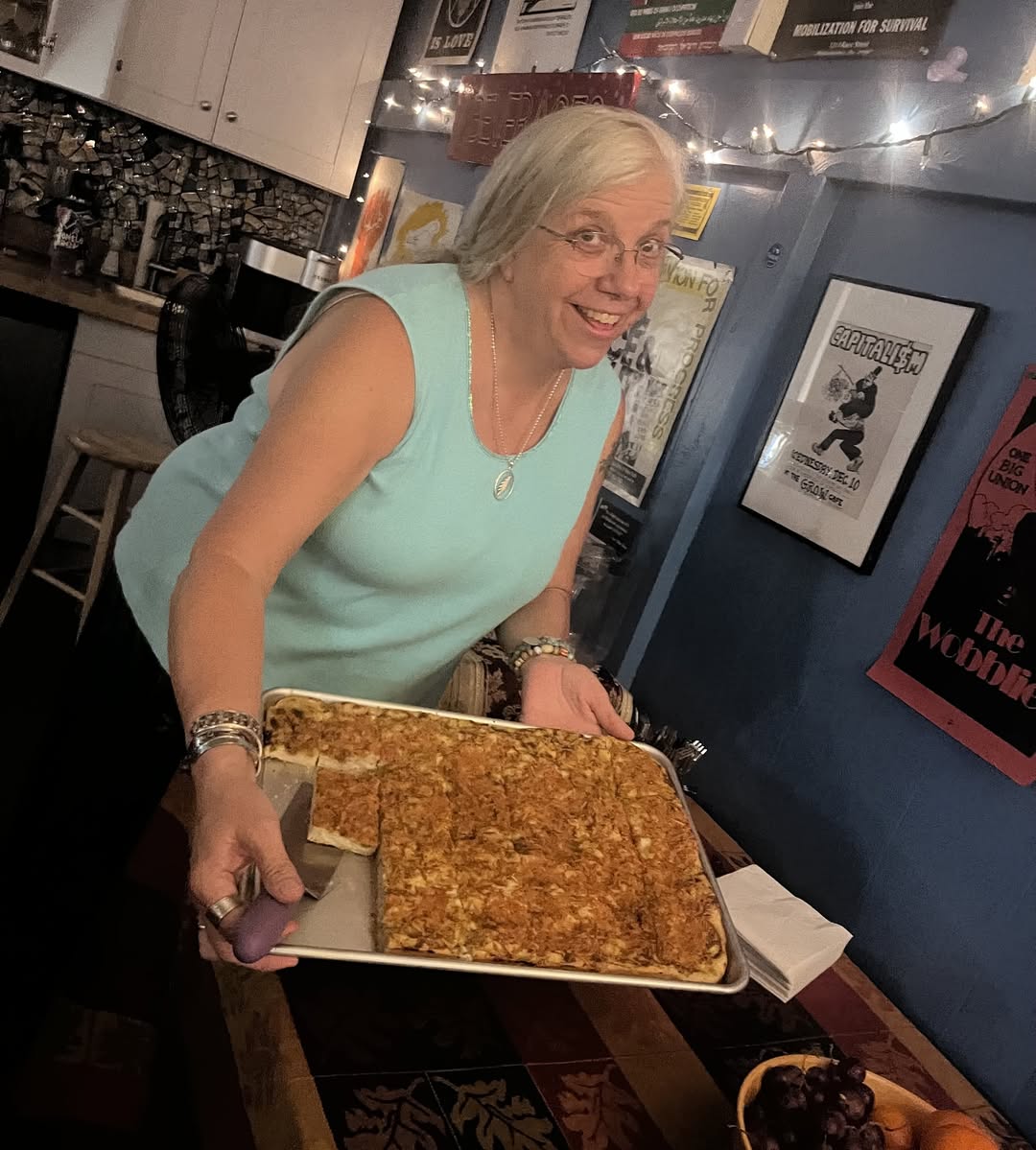
We said goodbye to Gabbi Zurlo, who left just shy of a year on the job. We appreciate her time with us, and wish her well. We welcomed Nilanka Seneviratne to our board and Leisa Marie Greer to the GROW team. She used to sell ads for our newspaper POINT at the original GROW, so it’s a full-circle moment to have her return as our most talented volunteer.
Finally, some gratitude. We are indebted to all the musicians who bring GROW to life every Thursday, and grateful for the people who come to see them. It’s Columbia’s best-kept secret, but word is slowly spreading.
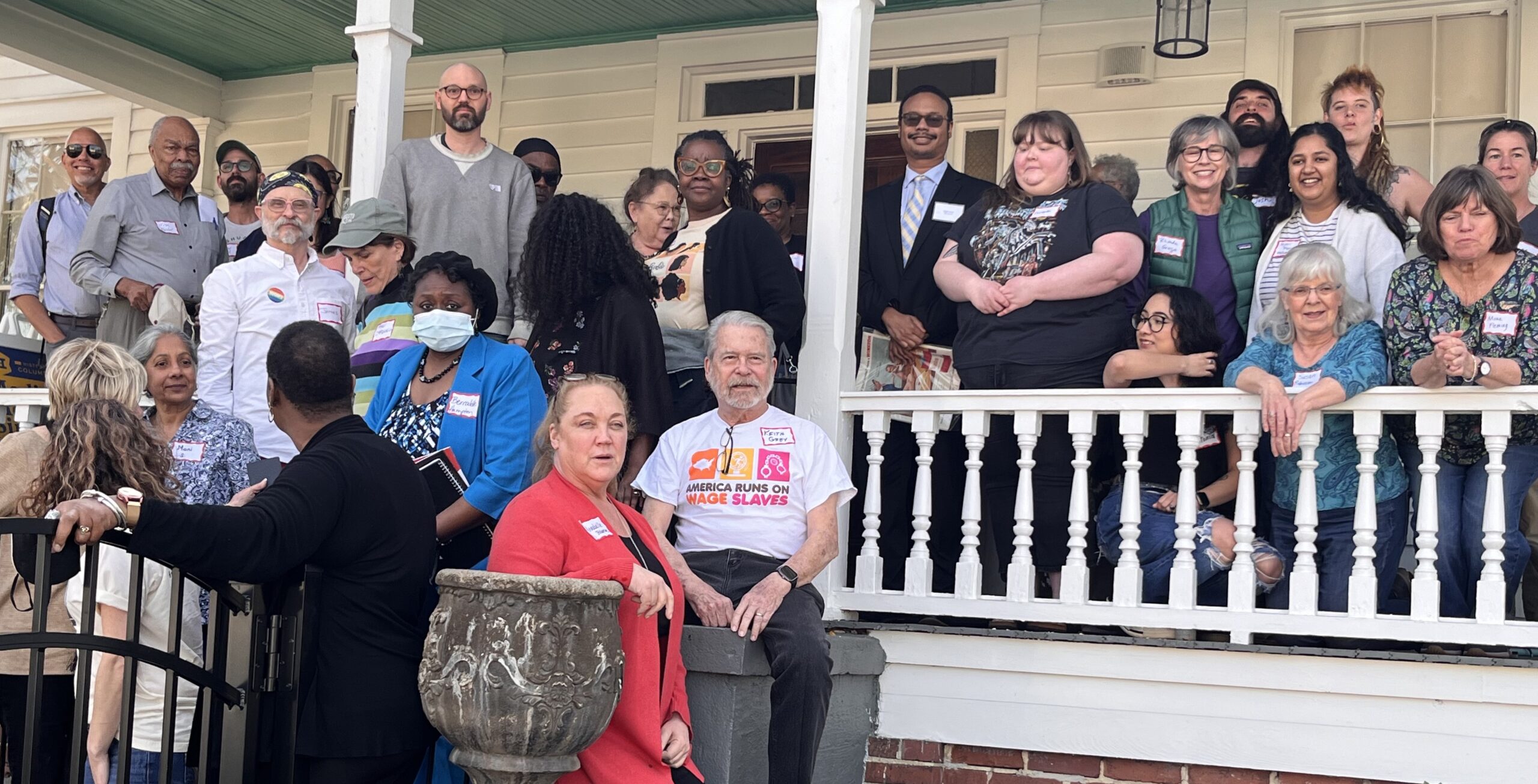
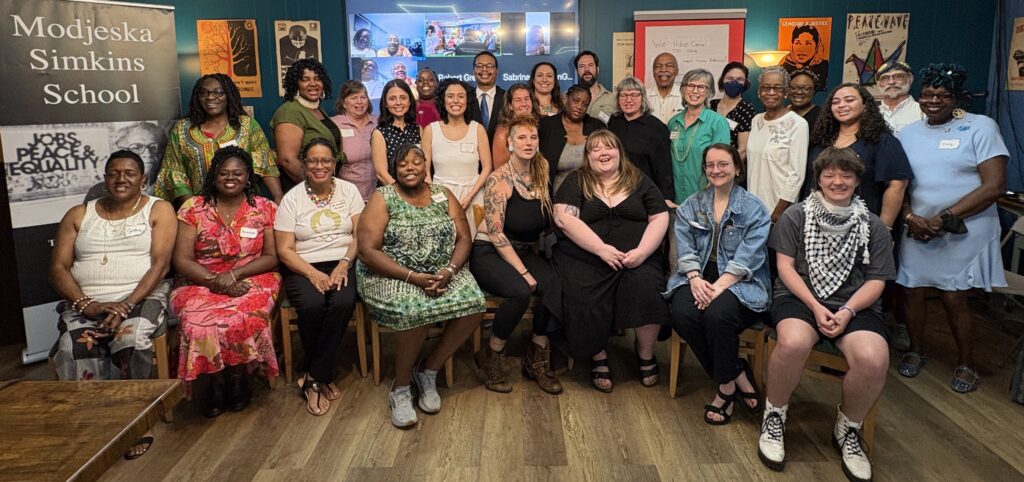
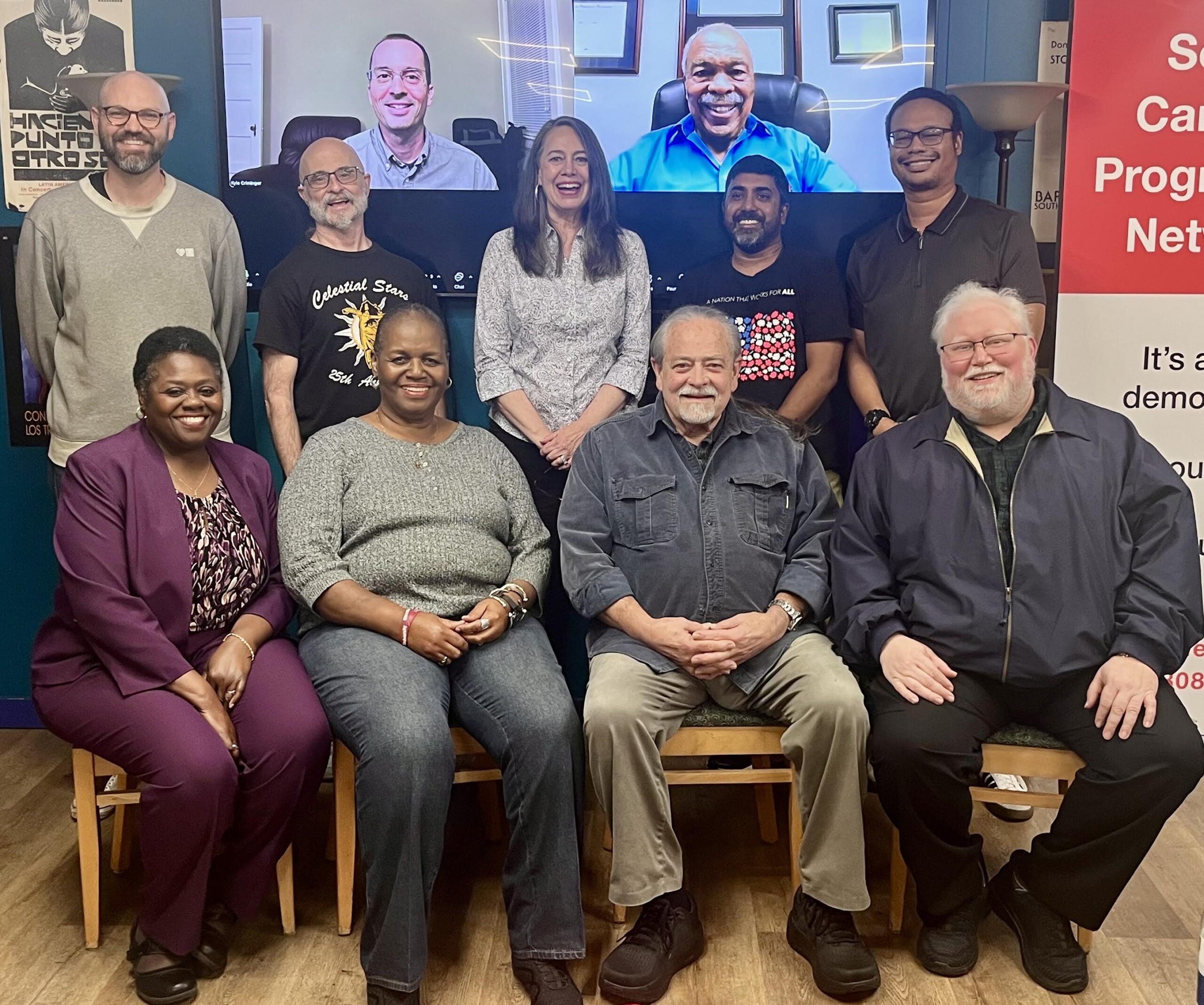
We thank the members of our hard-working board, who keep our books sound and our organization on track — all with good cheer. In photo, they are: (on Zoom) Kyle Criminger, James Felder, (standing) Chris Gardner, James Carpenter, Shannon Sylvester, Nilanka Seneviratne, Dr. Robert Greene II, (seated) Bernadette Hampton, Carol Singletary, Brett Bursey, and Cecil Cahoon.
And we thank the groups that meet at GROW to network and map plans, doing movement building at the grass roots. If you belong to a nonprofit whose values align with ours, keep us in mind as a potential gathering spot. Call 803-808-3384 or email network@scpronet.com for details.
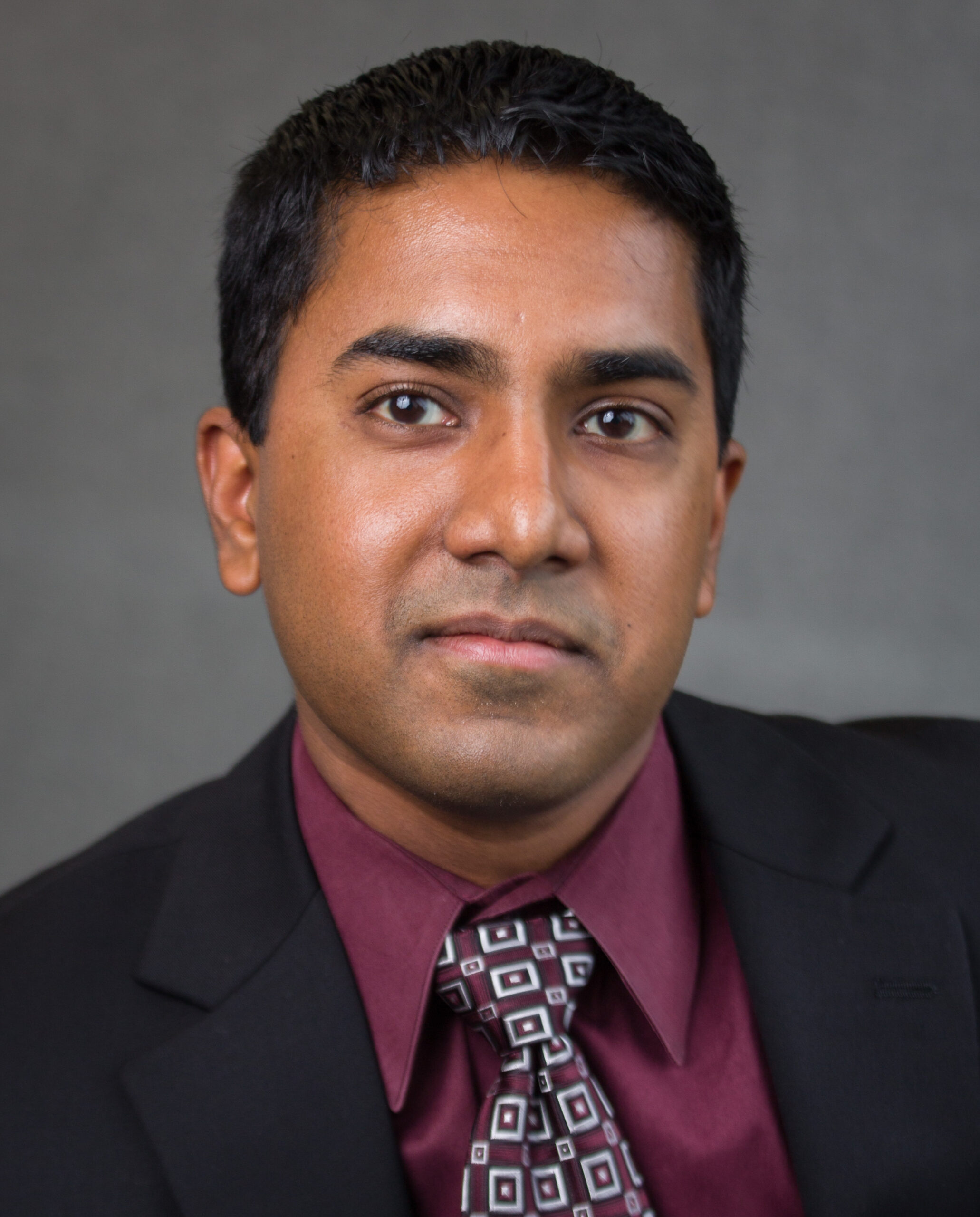
The SC Progressive Network is pleased to announce that Nilanka Seneviratne has accepted our invitation to join the organization’s board of directors.
“Nilanka was a stand-out at the Modjeska School and was well-respected by his peers,” said Network Executive Director Brett Bursey. “I know he will be an asset to our board, as he brings a global perspective, fresh ideas, and valuable skills to the table.”
Nilanka has a Master’s in Public Administration from the George Washington University (with a concentration in budgeting and analysis), and Bachelor’s Degrees in Psychology and International Studies.
He is Director of Operations and Systems at The Horizons Project, which works to connect US social justice, peace building, and democracy communities. He serves as President of the Board for Street Meat Bicycle Club, and is the Social Committee Chair for Earlewood Community Citizens Organization.
He is also a one-day Jeopardy! Champion and avid Learned League Llama. His hobbies? “Music, hiking, riding bikes, reading, beer, and trivia. Especially the combination of the last two.”
As the child of Sri Lankan immigrants who periodically returns to the island, Nilanka said he has “borne witness to the horrific outcomes of a polarized society riven by ethnic violence and a breakdown in the rule of law.”
Nilanka first became aware of GROW when he attended shows at the old building while in high school. In 2005, he joined the SC Progressive Network shortly before moving to DC for grad school.
After he returned to Columbia, he started attending the regular lunches at the new GROW. There, he learned about the Modjeska School, which he completed in 2024.
“Attending the Modjeska School was one of the most transformative experiences of my life,” he said. “I learned about our state’s outsized connections to major historical events, the deep history of those organizing for change in South Carolina, and I made friends and comrades who I work with locally.”
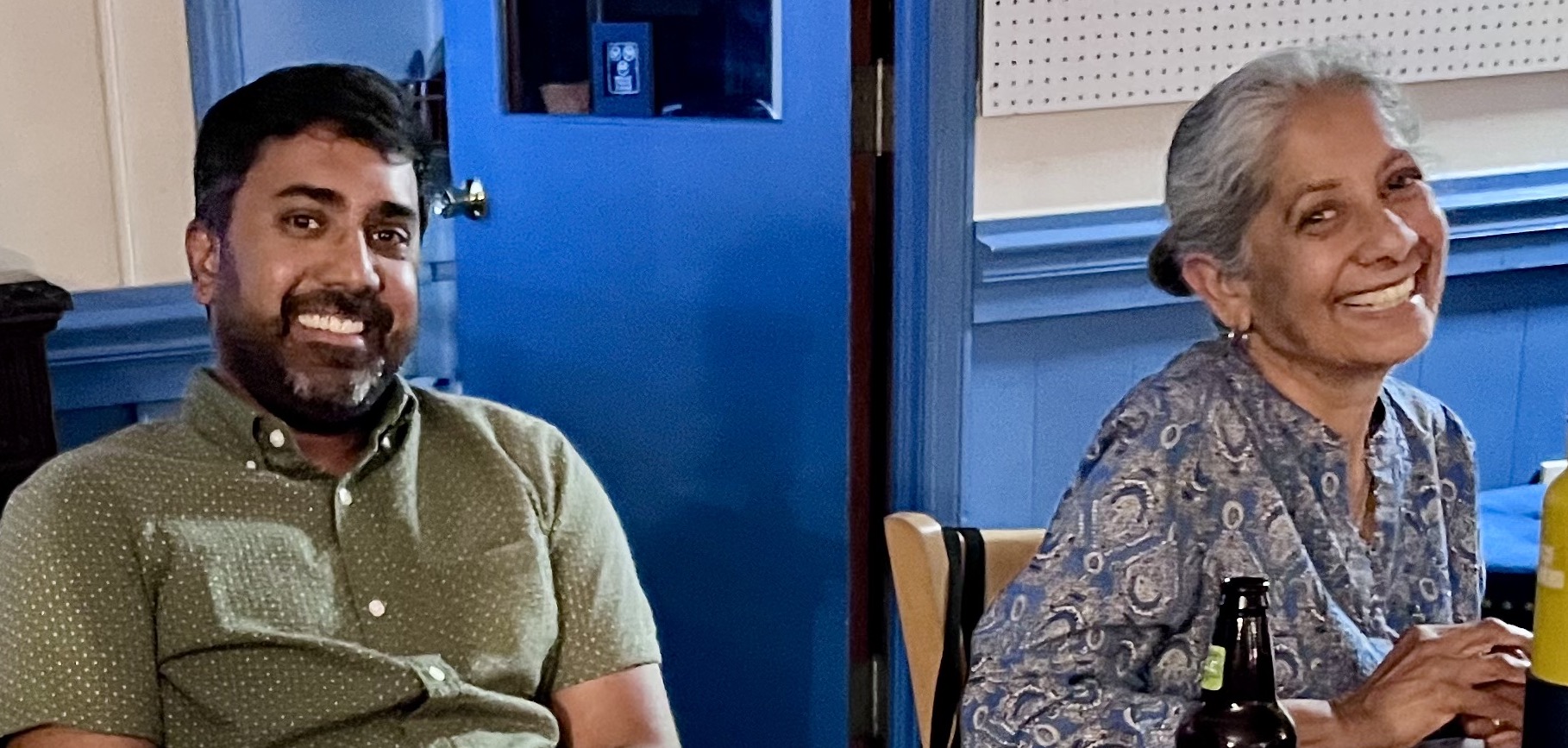
Nilanka was so affected by his experience that he persuaded his mother, Nilmani Seneviratne, to attend the school in 2025. Both have since become champions of the Thursday jazz and blues nights at GROW.
Nilanka and Nilmani Seneviratne at GROW
When approached to join the board, Nilanka said “at this moment, we all need to find how we can chip in, and for me that means building community locally as well as representing South Carolina in the national spaces I participate in and bringing resources back home.
“Given my background in nonprofit management, joining the board of the Progressive Network was a no brainer. I look forward to working with all of you to make South Carolina a better place. There’s much to do, so let’s get started!”
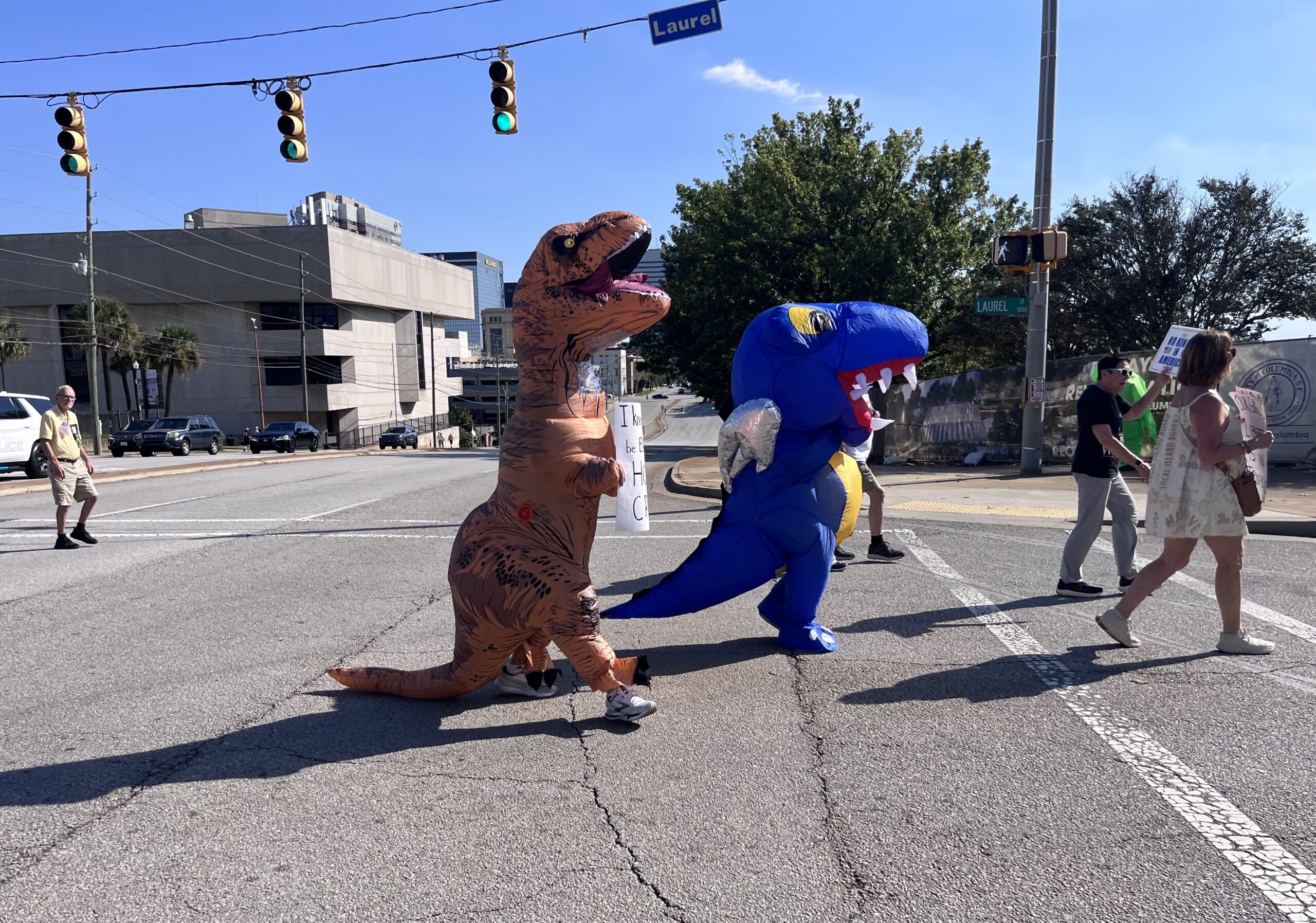
Protesters march down Laurel Street Oct. 18 in downtown Columbia on their way from the SC State House to the Governor’s Mansion.
According to organizers of the No Kings rallies, some 7 million people turned out at large and small events across the country. Even with numbers still coming in, Oct. 18, 2025, marks one of the largest single-day nationwide demonstrations in our history.
There were more than 2,700 protests across all 50 states. South Carolina did its part, with events from the Lowcountry to the Upstate. It was a joyful and peaceful day. The only arrest took place in Myrtle Beach, where a woman brandished a firearm to threaten the crowd.
Columbia turned out in a big way, gathering at the SC State House for a rally, followed by a march to the Governor’s Mansion. Congratulations to everyone who spent their Saturday defending democracy. You looked amazing.
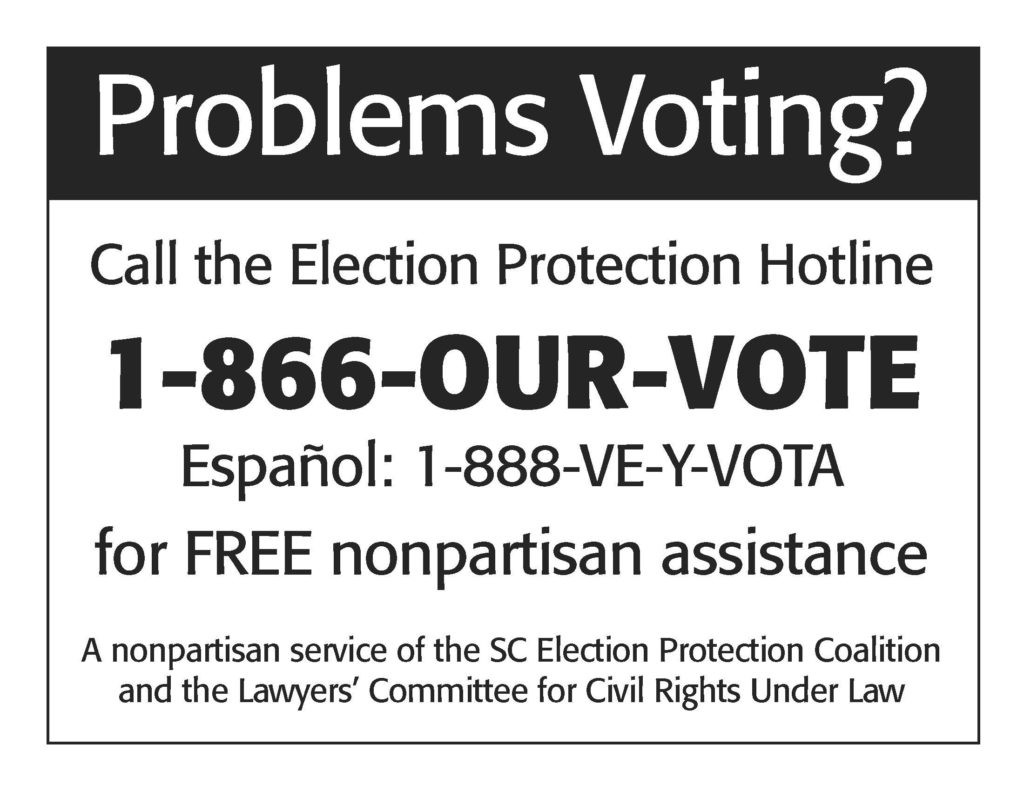
A nonpartisan hotline is now live for voters in South Carolina who have voting-related questions or want to report problems they experience or witness at the polls.
The Election Protection Coalition, in alliance with in-state nonpartisan organizations, is working to ensure that everyone has an equal opportunity to vote in South Carolina. In addition to the 1-866-OUR-VOTE hotline, trained nonpartisan volunteers will be on the ground across the state to provide voters assistance at the polls on Election Day.
“This will be the 12th year that this free, nonpartisan service has helped South Carolina voters with problems at the polls,” said SC Progressive Network Education Fund Director Brett Bursey. “Beyond providing help to voters, reports to the hotline provide the only nonpartisan, real-time, statewide audit of the state’s election system that helps identify problems to address before the next election.”
By calling the hotline, voters can confirm their registration status, find their polling location, and get answers to questions about proper identification at the polls.
Voters who have been required to vote a provisional ballot should call the hotline for advice prior to the certification hearing on their provisional ballot that take place in each county’s election office on Nov. 6.
“Voters must be aware that the state’s photo ID requirements will be enforced for voting in person at all locations” said Susan Dunn, attorney for the ACLU of South Carolina. All voters are required to show a valid ID that includes: driver’s license, DMV-issued ID card, passport, concealed weapons permit, federal military ID, or their photo-voter registration card with them to the polls on Election Day.
Dunn said, “We recommend to voters without one of the accepted IDs to trade their paper voter registration card in at their county elections office for one with a photo on it.”
Given the unique challenges posed by the COVID-19 pandemic, the SC Progressive Network Education Fund has filed suit to extend voter registration beyond the Oct. 6 deadline for mail-in applications in South Carolina.
A hearing before US District Court Judge Mary Geiger Lewis is scheduled for 11am on Tuesday, Oct. 6, in the Mathew Perry Federal Court House in Columbia. The hearing is open to the public with appropriate ID and face coverings.
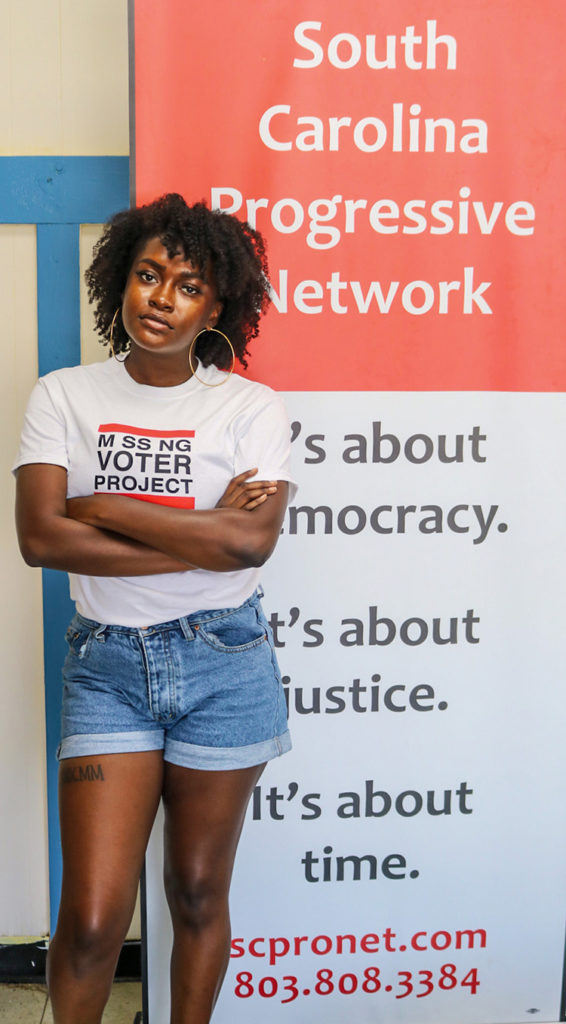
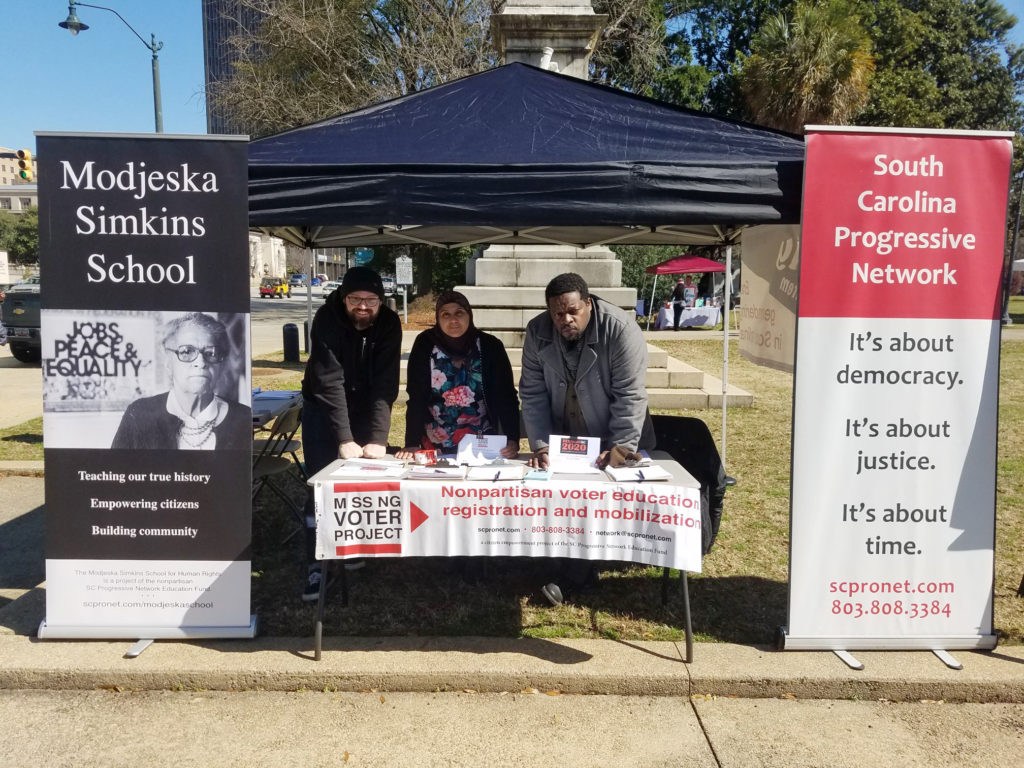
The Columbia-based Network Education Fund, a 25-year-old nonpartisan policy and research institute, has been monitoring the state’s election and campaign systems since its formation in 1996. Since 2004, the Network’s Missing Voter Project (MVP) has been doing voter education and registration in the state’s historically under-represented communities.
Network Director Brett Bursey said, “We are nonpartisan, so we don’t focus on candidates. Our job is to help citizens understand how state and local government policies affect their lives so they can make informed decisions about registering and voting.”
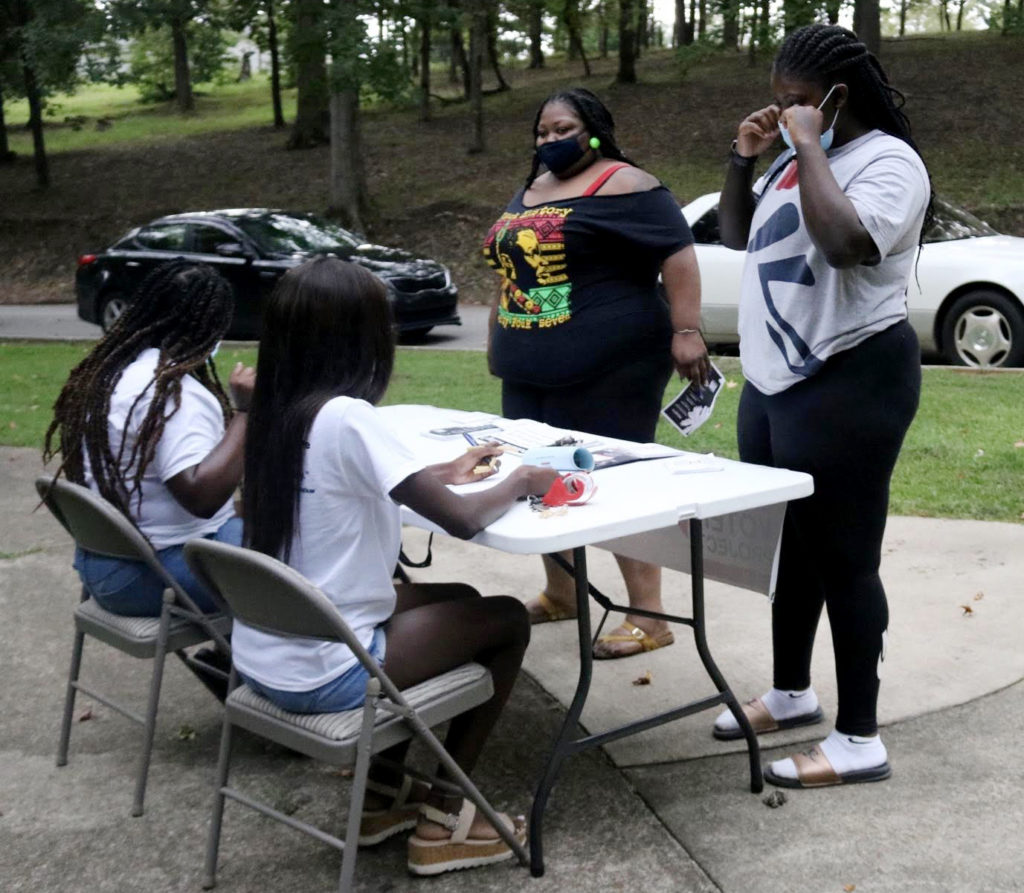
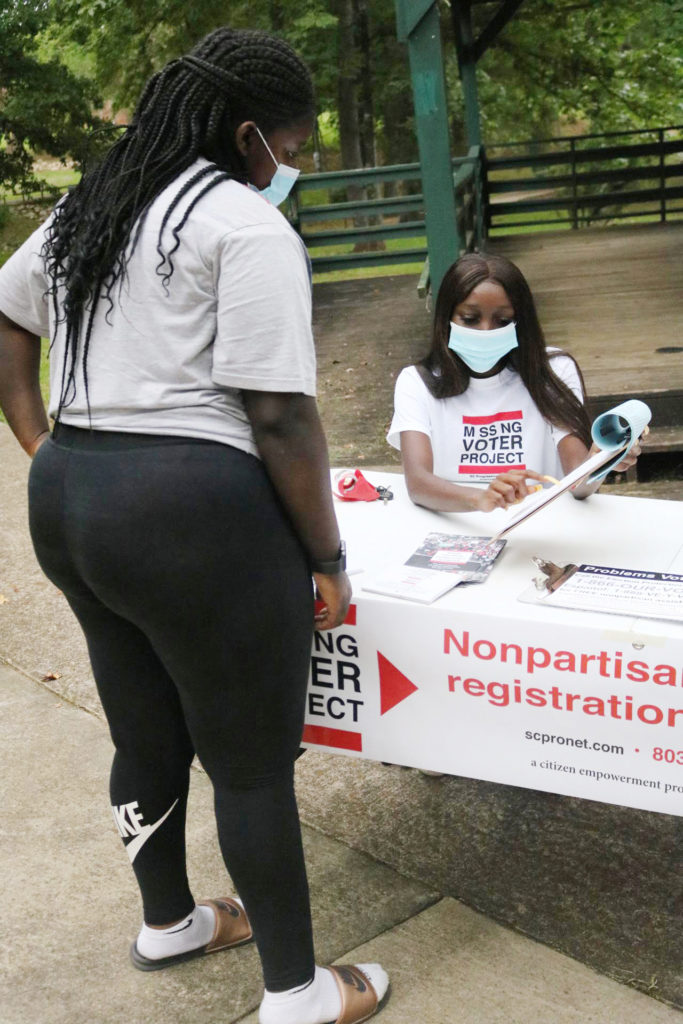
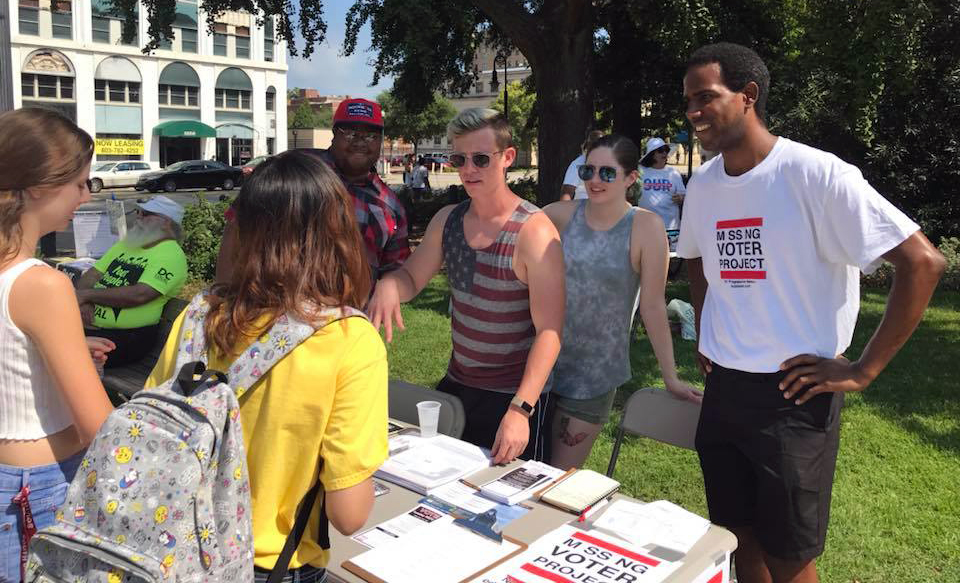
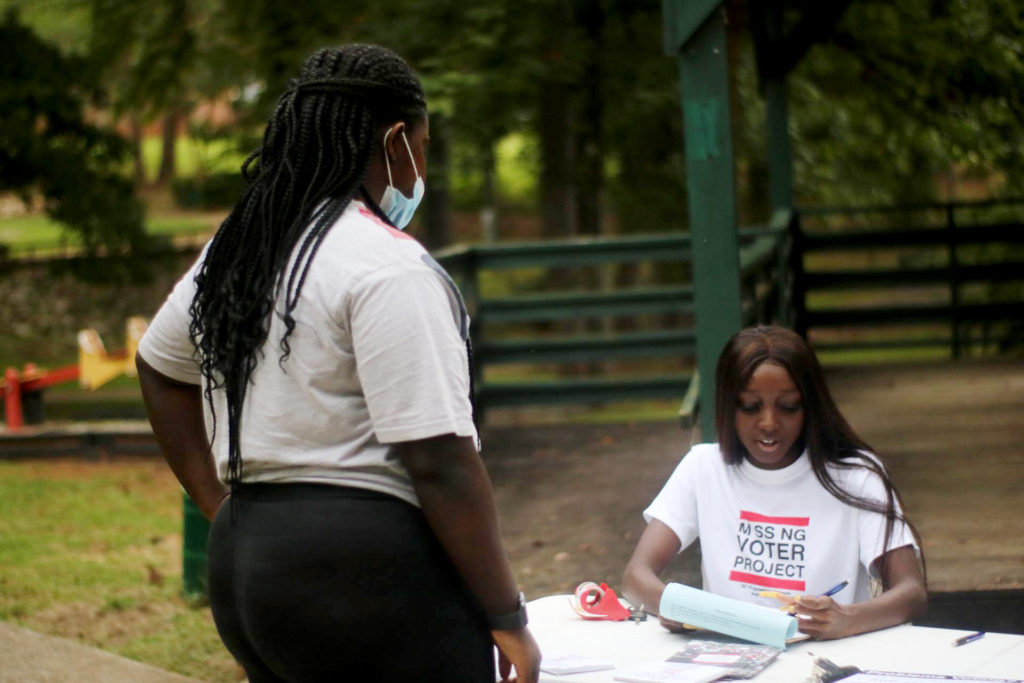
For 16 years, trained MVP volunteers have registered voters at events and locations around the Midlands, several thousand in each presidential election year. This year, the MVP partnered with the SC NAACP State Conference to train young Black members on nonpartisan registration practices in 26 counties. Those grassroots efforts were complicated by the pandemic and our commitment to keep volunteers and the public safe.
“Since March,” Bursey said, “health centers, bus transit stations, food banks, and schools have been shuttered or restricted, and large public gatherings have gone virtual. As a result, we have registered just several hundred citizens.”
According to the National Conference of State Legislatures, South Carolina is one of only six states that close voter registration 30 days before elections. The Network’s complaint, filed on Oct. 2, points out that the current 30-day provision became law in the 1895 State Constitution, which was written specifically to exclude Black citizens from voting. “The 30-day ban was implemented before the age of cars and electronic transmission of voter registration documents,” Bursey said. In 26 states, citizens may register and vote on the same day.
The complaint notes that the State Election Commission in the past has supported moving the registration period closer to the elections, citing extensions the SEC has provided due to hurricanes. “There is no doubt that pandemic safety measures and government restrictions have prevented some citizens from registering and participating in the next election,” Bursey said.
The SC Progressive Network Education Fund is represented in this case by Free Speech For People; Emery Celli Brinckerhoff Abady Ward & Maazel LLP; and Burnette Shutt McDaniel P.A.
Mysia Wynn-Robinson is leading a team of Missing Voter Project activists in Fairfield County.
The Missing Voter Project was launched in 2004 to reach and mobilize new and infrequent voters in South Carolina.
Unlike other voter registration drives, the MVP is nonpartisan, ongoing, and focused on historically under-represented communities.
It was created by the SC Progressive Network to grow an informed electorate with the power to mobilize around public policies critical to young people, working families, and communities of color in South Carolina.
While most voter registration drives start anew each election cycle, the MVP works year-round to inform citizens about local and county matters that impact their lives, and to invite them to become involved in a growing movement for social and political change.
This year, the MVP is using a novel peer-driven approach of asking young, Black voters to reach young, Black non-voters and get them to the polls in November.
Just 15% of South Carolina’s Black voters under age 26 went to the polls in the last general election. Those voters are central to our 2020 MVP campaign.
Over the summer, MVP organizers targeted Saluda and Fairfield, taking advantage of the relationships the Network has built in those counties over the 26 years it has been organizing.
This year, we are raising funds to recruit county-based MVP teams from the 23,087 young Black South Carolinians who voted in the last general election. We challenged them to be the catalyst to turn out record numbers of young, Black voters in 2020. They have the numbers to change history.
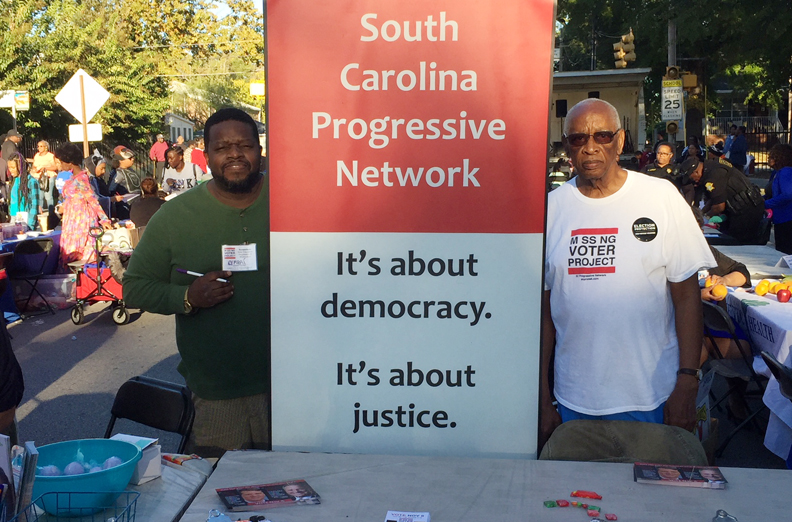
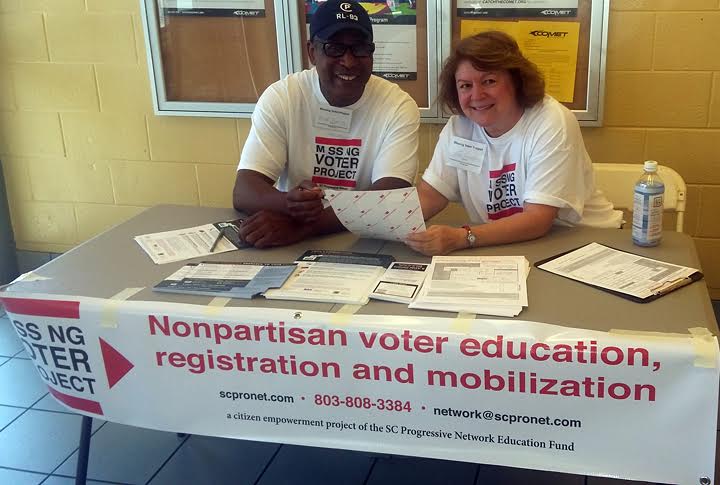
Network Cochair Omari Fox (left) and MVP volunteer Tim Pearson work outreach table at Jubilee Festival in Columbia.
Whether or not the MVP succeeds in that goal this year, we will have laid the groundwork for a multi-year plan to level the imbalance of power codified in the state’s current constitution, created in 1895 specifically to disenfranchise its African-American citizens.
A reckoning is upon us.
These are perilous times, to be sure, but they offer an unprecedented opportunity to challenge, and begin to dismantle, South Carolina’s racially segregated politics.
What we do between now and the election on Nov. 3 can change our lives for many years to come.
While 78% of South Carolina’s nonwhite voting-age population is registered, only half of them regularly vote. An average of 500,000 of the state’s one million registered Blacks (along with 100,000 unregistered citizens), are sitting out the elections. If those “missing voters” were mobilized, it could change everything.
The continuing racial disparities in jobs, housing, health care, poverty, education, and the criminal justice system show that Black lives are devalued in South Carolina. It is not an accident, and it is a problem that won’t fix itself.
Former Fairfield County Councilman Kamau Marcharia (left) was an early MVP volunteer.
Reality check: for decades, incumbent legislators have been allowed to carve political maps to retain their power by packing Black and White voters into racially segregated political districts. This creates safe seats for incumbents but dilutes the effectiveness of Black votes on state policies.
The MVP is working to motivate and sustain Black civic engagement by showing that we can increase the turnout of Black voters by 200,000 in the only political district that cannot be gerrymandered: a statewide race.
The average margin of victory in the last three governor’s races was only 125,877 votes. If our plan works, it would prove to the half-million Black registered nonvoters that if political districts were not racially segregated their vote could change public policy.
By 2022, an energized Black electorate in South Carolina could determine the state’s next governor, attorney general, and superintendent of education.
The 2020 MVP training will prepare activists to organize county-based petitions in 2021 to force a constitutional amendment on the 2022 ballot to end race-based redistricting. It is part of the Network’s Fair Maps campaign to end partisan gerrymandering in South Carolina. See FairMapsSC.com for details.
This year’s MVP campaign is designed to train and sustain county-based teams of activists who understand that to make meaningful change will take commitment and longterm vision.
Training includes a component to involve MVP organizers in the statewide election protection work that the Network has anchored since 2004, when the nation’s first paperless voting system was implemented.
MVP volunteers will meet their county’s election director, become credentialed poll watchers, and have the opportunity to participate in their county’s vote certification process.
Volunteer organizers will be trained to help with Census enumeration. With only 57% of citizens counted, South Carolina ranks 44th among states. Each uncounted resident costs our cash-strapped state $15,000 in federal funds this decade.
Last year, we partnered with the new leadership of the NAACP State Conference to test the 2020 MVP to see whether it could effectively be launched statewide. The Memorandum of Understanding was enthusiastically endorsed by the national NAACP office. The plan set our two-county model in place.
As the pandemic worsened, we adjusted recruiting, training, and mobilization strategies to keep organizers and the public safe.
We mailed a letter to young Black voters in our two targeted counties — Saluda and Fairfield — inviting them to join their county MVP team.
It took until 2018 for majority-Black Fairfield County to elect its first Black state representative since Reconstruction.
Ten years earlier, the MVP conducted its first student training at the only high school in Fairfield County. The team registered three times as many new voters than had previously voted. At almost 25%, the county now has the state’s second-highest youth participation rate.
Saluda County is majority-White, and had just 65 young, Black voters in 2018. For decades, the Network has worked with the Riverside CDC, the only enduring civic engagement organization in the county. It prepared us for this campaign.
The level of capacity in this rural county with poor broadband service is requiring a different organizing model than in Fairfield. The differences between the two inform how we are conducting MVP outreach in other counties.
In Saluda and Fairfield counties, the NAACP Branch has partnered with local Network members to support the MVP teams. With their help, we are soliciting community buy-in to help sustain core teams of local activists beyond 2020. We are paying a stipend to trained organizers. The more money we raise, the more boots we can put on the ground.
In both counties, a vibrant organizing core is taking root. Word is getting out that something is happening.
Each week, MVP volunteers are being trained through Zoom sessions, supplemented with socially distanced and masked in-person meetings.
Training includes a short course on democracy and a brief but critical history lesson that explains how our democracy was made — and how we can remake it to be more equitable for a new generation.
The young organizers are excited about leading such a bold and hopeful plan. They are making their first round of calls to other young voters in their county using the State Voices database and an automated Virtual Phone Bank that trained volunteers can access from their phones.
When that list is finished, they will begin calling the registered voters their age who didn’t vote. The next round of calls will go to unregistered young people. And when they have contacted and cajoled their peers, they will then begin calling the county’s older citizens.
With organizing underway in the model counties, the MVP is focusing on Richland County, which houses the state Capitol as well as two HBCUs.
Chris Gardner, Tayyaba Sadiq, and Omari Fox at SC State House.
Just 4,306 out of 27,397 young, Black residents of Richland County voted in 2018.
We can change that. 2020 offers an unprecedented opportunity to reconsider our shared values and transform the institutions that have failed in South Carolina by creating systems that work for everyone, not the select few.
There are no short cuts when it comes to grassroots organizing. Trust takes time. Our years of developing ties in some of the state’s most neglected counties has laid the groundwork for us to take the MVP into communities where we can make the biggest impact — not just in the next election, but for decades to come.
While 78% of South Carolina’s nonwhite voting-age population is registered, only half of them regularly vote. An average of 500,000 of the state’s one million registered Blacks (along with 100,000 unregistered citizens), are sitting out the elections. If those “missing voters” were mobilized, it could change everything.
The continuing racial disparities in jobs, housing, health care, poverty, education, and the criminal justice system show that Black lives are devalued in South Carolina. It is not an accident, and it is a problem that won’t fix itself.
Reality check: for decades, incumbent legislators have been allowed to carve political maps to retain their power by packing Black and White voters into racially segregated political districts. This creates safe seats for incumbents but dilutes the effectiveness of Black votes on state policies.
The MVP is working to motivate and sustain Black civic engagement by showing that we can increase the turnout of Black voters by 200,000 in the only political district that cannot be gerrymandered: a statewide race.
The average margin of victory in the last three governor’s races was only 125,877 votes. If our plan works, it would prove to the half-million Black registered nonvoters that if political districts were not racially segregated their vote could change public policy.
By 2022, an energized Black electorate in South Carolina could determine the state’s next governor, attorney general, and superintendent of education.
The 2020 MVP training will prepare activists to organize county-based petitions in 2021 to force a constitutional amendment on the 2022 ballot to end race-based redistricting. It is part of the Network’s Fair Maps campaign to end partisan gerrymandering in South Carolina. See FairMapsSC.com for details.
This year’s MVP campaign is designed to train and sustain county-based teams of activists who understand that to make meaningful change will take commitment and longterm vision.
Training includes a component to involve MVP organizers in the statewide election protection work that the Network has anchored since 2004, when the nation’s first paperless voting system was implemented. MVP volunteers will meet their county’s election director, become credentialed poll watchers, and have the opportunity to participate in their county’s vote certification process.
Volunteer organizers will be trained to help with Census enumeration. With only 57% of citizens counted, South Carolina ranks 44th among states. Each uncounted resident costs our cash-strapped state $15,000 in federal funds this decade.
Last year, we partnered with the new leadership of the NAACP State Conference to test the 2020 MVP to see whether it could effectively be launched statewide. The Memorandum of Understanding was enthusiastically endorsed by the national NAACP office. The plan set our two-county model in place.
As the pandemic worsened, we adjusted recruiting, training, and mobilization strategies to keep organizers and the public safe.
We mailed a letter to young Black voters in our two targeted counties — Saluda and Fairfield — inviting them to join their county MVP team.
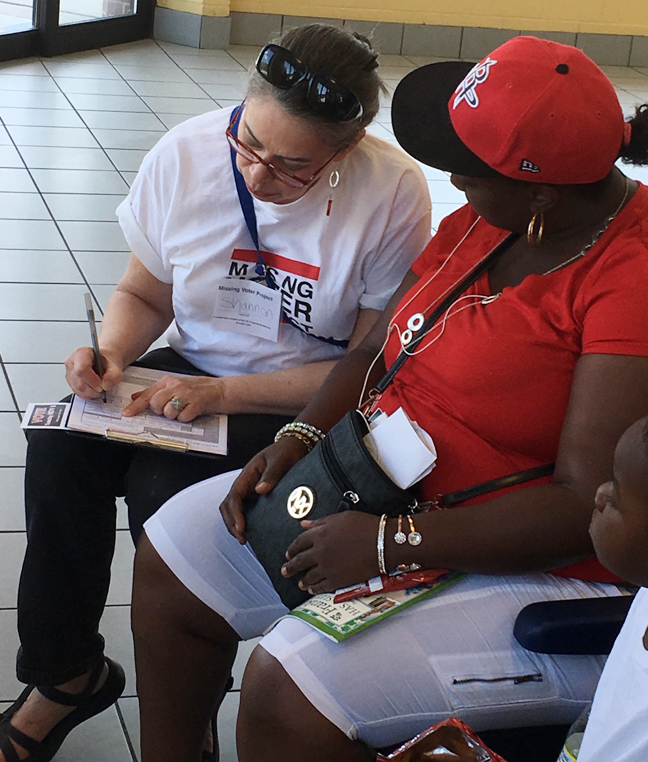
Network Treasurer and MVP volunteer Shannon Herin (left) registers a new voter at the bus station in Columbia.
It wasn’t until 2018 that majority-Black Fairfield County elected its first Black state representative since Reconstruction.
Ten years earlier, the MVP conducted its first student training at the only high school in Fairfield County. The team registered three times as many new voters than had previously voted. At almost 25%, the county now has the state’s second-highest youth participation rate.
Saluda County is majority-White, and had just 65 young, Black voters in 2018. For decades, the Network has worked with the Riverside CDC, the only enduring civic engagement organization in the county. It prepared us for this campaign.
The level of capacity in this rural county with poor broadband service is requiring a different organizing model than in Fairfield. The differences between the two inform how we are conducting MVP outreach in other counties.
In Saluda and Fairfield counties, the NAACP Branch has partnered with local Network members to support the MVP teams. With their help, we are soliciting community buy-in to help sustain core teams of local activists beyond 2020. We are paying a stipend to trained organizers. The more money we raise, the more boots we can put on the ground.
In both counties, a vibrant organizing core is taking root. Word is getting out that something is happening.
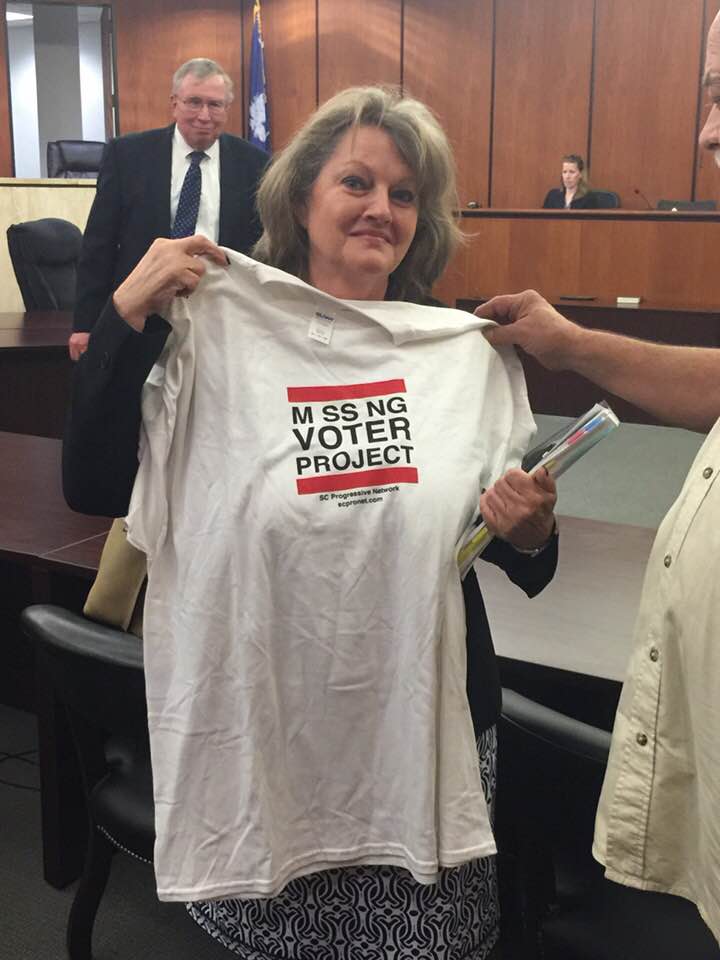
Marci Andino, Executive Director of the SC State Election Commission, accepts an MVP t-shirt, giving the campaign a thumbs-up.
Each week, MVP volunteers are being trained through Zoom sessions, supplemented with socially distanced and masked in-person meetings.
Training includes a short course on democracy and a brief but critical history lesson that explains how our democracy was made — and how we can remake it to be more equitable for a new generation.
The young organizers are excited about leading such a bold and hopeful plan. They are making their calls to other young voters in their county using the State Voices database and an automated Virtual Phone Bank that trained volunteers can access from their phones. When that list is finished, they will begin calling the registered voters their age who didn’t vote. The next round of calls will go to unregistered young people. And when they have contacted and cajoled their peers, they will then begin calling the county’s older citizens.
With organizing underway in the model counties, the MVP is focusing on Richland County, which houses the state capitol as well as two HBCUs.
Just 4,306 out of 27,397 young, Black residents of Richland County voted in 2018.
We can change that. 2020 offers an unprecedented opportunity to reconsider our shared values and transform the institutions that have failed in South Carolina by creating systems that work for everyone, not the select few.
There are no short cuts when it comes to grassroots organizing. Trust takes time. Our years of developing ties in some of the state’s most neglected counties has laid the groundwork for us to take the MVP into communities where we can make the biggest impact — not just in the next election, but for decades to come.
Organizations representing scores of thousands of members across the state sent a letter today to the Board of the SC Dept. of Health and Environmental Control citing DHEC’s authority, and responsibility, to issue and enforce mandatory compliance with the agency’s COVID-19 safety measures. The organizations represent the public at risk, as well as the workers and their families who are being required to work or face being fired for following Gov. Henry McMaster and DHEC’s advice to follow CDC guidelines during the pandemic.
“It is clear that urging citizens and employers to mask up and follow safety guidelines isn’t working,” said Rep. Gilda Cobb-Hunter, Executive Director of CASA Family Systems, an Orangeburg-based shelter for battered women and children. “The virus has become a political issue, and DHEC must stand up for science or we are all going to continue to suffer,” Cobb-Hunter said.
SC NAACP President Brenda Murphy stressed the disproportionate impact of the virus on working people of color. “Those most vulnerable to the disease are the least protected workers,” Murphy said. “They fear getting fired if they challenge unsafe conditions at work.”
The letter to the DHEC Board points out that the governor’s Executive Order declaring a State of Emergency ordered DHEC to “utilize any and all necessary and appropriate emergency powers, as set forth in the Emergency Health Powers Act (Title 44, Chapter 4 of the SC Code of Laws) that regulates your agency: During a state of public health emergency, DHEC must use every available means to prevent the transmission of infectious disease and to ensure that all cases of infectious disease are subject to proper control and treatment.”
SC AFL-CIOCharles Brave Jr. said, “The governor wants to sound like he has no enforceable authority to require that COVID guidelines be followed, but we know that’s not true. His priority of keeping corporate profits up and workers’ rights down is killing people.”
The Charleston Alliance for Fair Employment (CAFE) fights for wage workers in the hospitality and service industries. “Our members don’t have sick leave, and will get fired if they don’t show up for work,” said CAFE President Kerry Taylor. “Many of them are single mothers who are forced to work sick or lose their income if they have to stay home with a sick child.”
“The pandemic underscores how cruel public policies are in South Carolina,” said Brett Bursey, Executive Director of the SC Progressive Network‘s 24-year-old nonpartisan policy institute. The state has a long history of sacrificing workers’ health for corporate profit.”
The Network fought legislation introduced in 2013 to prohibit local governments from establishing sick leave policies to prevent sick workers from spreading diseases. In 2017, Gov. McMaster signed the anti-sick leave legislation into law.
The bill was promoted by the same hospitality corporations that comprised the governor’s accelerateSC task force that contributed over $21,000 to his current campaign account. Members of the House Ways and Means Committee, which passed the Hospitality Task Force’s $2 billion COVID relief budget last month, received over $100,000 in campaign contributions from the same hospitality industry that relies on low-wage service workers with no sick leave. They did this without a public hearing.
Workers and their families threatened by the state’s failure to adequately address the continuing spread of the virus and their potential loss of employment are encouraged to contact the Network at 803-808-3384 or email network@scpronet.com. Fast food workers should address their concerns to CAFE at kerryt33@gmail.com. Workers testimony is needed to develop a legal case seeking to compel state agencies compliance with existing statutes regulating health emergencies.