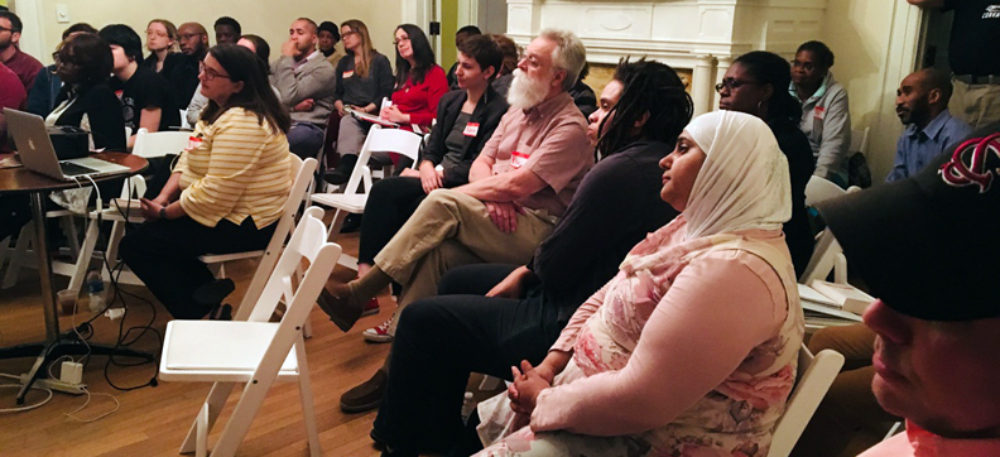
As Senate takes up budget, town hall panel to debate role of special-interest tax breaks

Is South Carolina broke? That’s what the governor and a majority of the state legislature are saying. What if the state isn’t broke, but is leaving billions in revenue out of the budget because of special-interest tax breaks?

That’s the question to be debated at a town hall meeting April 27, 7pm, at the SC State Museum, 301 Gervais St. in Columbia. The forum is free and open to the public.

With the Senate set to begin debate on the budget April 26, it’s important that the public have a say in our funding priorities. The town hall was organized because the Senate is not allowing any opportunity for public comment during its deliberations.

The town hall will debate the argument that the state is broke, and will provide striking details about the $4 billion left out of the budget through special tax breaks.

Dr. Holley Ulbrich, Professor Emerita of Economics at Clemson University, will present the case that there is sufficient revenue to fund a moral budget that reflects our values as a society. “By any measure, our state and local tax system has failed to reflect our shared values of justice, of freedom, of compassion, and of opportunity,” Ulbrich said. “Instead, we have focused on tax cuts and failed to update our antiquated revenue system, standing idly by while our tax base continues to erode.”

Dr. Mike Fanning, who has been working with Chambers of Commerce across the state to promote comprehensive tax reform, will lay out the case to lower taxes and balance the budget. “How can a state claim to be broke?” Fanning asked. “Our legislators choose to collect taxes at twice the rate needed to run government while giving away billions in special interest exemptions.”

Network Director Brett Bursey said, “The Chambers of Commerce and the Progressive Network agree that tax breaks are leaving too much money on the table and that our political leadership refuses to acknowledge that the money exists. When the public understands we’re not broke and forces the politicians to reform the tax code, then we can have a productive fight over how to spend the money.”

The Chambers would use the revenue to reduce state taxes and balance the budget. The Network wants the money to enhance the budget and fund crumbling public services. The legislature and the governor are opposed to raising revenue, and see no alternative to cutting government programs.

After a panel discussion, the public will be invited to ask questions and make comments. This is a 90-minute opportunity for the public to understand that South Carolina is not broke, and that the real debate should be over what to do with the additional revenue.

A 2011 study by the Tax Foundation found that South Carolinians have the lowest state income tax burden in the nation and rank 43rd in combined state and local taxes.

The Organization of Economic Cooperation and Development, with 34 “first world” member nations, ranks the United States 33rd in collection of taxes, compared to the country’s wealth. Only Mexico ranked lower.


Irreparable human deficit looms in wake of budget cuts

By Riane Eisler and Rene Redwood

A financial debt can be paid back. But the debt we’ll owe our children if investments in health, nutrition and education are slashed is irreparable. Investment in human infrastructure – providing the human capacity development for optimal economic productivity and innovation through both government and business investments – is essential for success in the post-industrial economy, and this should be our policymakers’ guiding economic principle.

It’s up to us to ask the hard questions: Why are we being told we can’t raise taxes on the rich, but must cut wages for teachers, nurses, child-care workers and others on whom our future depends? There is no evidence that lower taxes on corporations and millionaires “raise all boats,” or that massive cuts in social services have ever helped people in developing nations rise from poverty. The opposite is true. It is countries like Canada, Sweden, New Zealand and Finland that have made commitments to caring for future generations that have risen from poverty to prosperity. And today nations such as Brazil, South Korea, and other “emerging advanced economies” are heavily investing in their people.

Why are we told that cutting social programs is the road to prosperity, when our past prosperity was the result of the very opposite?

At the beginning of the 20th century, the United States was what we today call a “developing country.” Except for the super-rich, our general living standard was abysmal: child and general mortality rates were extremely high, as was poverty. Then we invested in prenatal and child health care such as vaccines; abolished child labor; mandated not only primary, but also secondary public education; and promoted college education through the GI Bill for returning soldiers. These kinds of government expenditures, along with Social Security, Medicare, Head Start and other government programs to care for and educate our people had a huge return on investment for our people and nation.

Today, largely as a result of retrenching in such public expenditures, the U.S. has higher child mortality, maternal mortality and poverty rates than any other developed nation. According to a 2007 UNICEF study, the U.S. ranked 24th of 25 developed countries with children living below the national poverty level. By comparison, the Netherlands, Sweden, Denmark, Finland and Spain topped the list. The U.S. Census Bureau estimates that poverty afflicts roughly one in six American children—some 13 million youths, a figure that’s expected to rise as poverty trends continue to soar.

In 2009, more than 4.4 million single mothers earned wages below the national poverty level and were barely able to supply their children with basic needs. That number of women had increased 6.7 percent compared to the previous year, according to census figures. The kinds of cuts now proposed—especially cuts to programs to help impoverished families with children—will push us down even further.

By contrast, investing in education, health care, child-care and eldercare drastically reduces unemployment, poverty, public assistance, spending on prisons — and at the same time provides a trained work force and higher tax base. According to a recent NBC/Wall Street Journal poll, 37 percent of Americans believe job creation/economic growth is our nation’s No. 1 issue, and only 22 percent named the deficit/government spending as the top. What’s more, while Americans find some budget cuts acceptable; they adamantly oppose cuts in Medicaid, Medicare, Social Security and K-12 education.

That’s because most of us know that our most important assets are our people. If we don’t invest in human infrastructure, we cannot be economically successful.

We urgently need a realistic long-term perspective on how national and state deficits are calculated. The human capital deficit created by cutting social programs will be irreparable. By contrast, benefits to individuals, families, businesses and society at large from investment in human infrastructure will accrue for generations.

There’s an old saying that an ounce of prevention is worth a pound of cure. Our priorities should be exactly what the “deficit hawks” are putting on the chopping block. Cutting those programs is criminal behavior, not sound policy.

Riane Eisler is president of the Center for Partnership Studies and author of The Real Wealth of Nations and The Chalice & the Blade. Rene Redwood is CEO of Redwood Enterprise in Washington, D.C.

SC businesses slam Senate Finance Committee’s lack of transparency on Amazon deal

The South Carolina Alliance for Main Street Fairness today responded to a last-minute hearing scheduled by the full Senate Finance Committee on Amazon’s special deal, which exempts them from collecting the sales tax. By bypassing subcommittee hearings, senators have cut off a public debate and prohibited South Carolina businesses owners who would be negatively impacted by this special deal from testifying publicly.

“Lawmakers attempting to ram through legislation for Amazon without a public debate sends a message that rewarding an out-of-state company with a special deal is more important than the thousands of other South Carolina employers who play by the rules and are just asking for a level playing field. By bypassing subcommittee hearings, senators are cutting off those who would be most affected by Amazon’s special deal: existing South Carolina employers,” said Brian Flynn, spokesperson for the South Carolina Alliance for Main Street Fairness.

“It certainly appears the Senate Finance Committee is not interested in seeing or hearing from employers who could lose their livelihoods if the state makes a special deal for one company. Passing a special deal that gives an out-of-state company a special advantage over existing South Carolina businesses would be bad enough, but ramming it through and silencing the very businesses owners who would be affected is an insult to every job provider throughout the state.”

BACKGROUND:
“A proposal to give online retail giant Amazon.com a break from collecting South Carolina sales taxes has been put on a fast track for debate.  The full Senate Finance Committee is scheduled to debate the measure Tuesday and bypass subcommittee hearings that would let the public tell senators what they think about the measure.” (“SC Senate Panel To Take Up Amazon Sales Tax Break,” The Associated Press, 4/19/11)

Network to host roundtable on SC budget crisis

TOWN HALL

Is South Carolina broke? Or is our tax system broken?

April 27, 7 – 8:30 pm

SC State Museum, 301 Gervais Street, Columbia

FREE and open to the public!

PANEL
Moderator: Brett Bursey, Director, SC Progressive Network

Dr. Mike Fanning, Reduce Our Awful Tax Rates
Dr. Holley Ulbrich, Professor Emerita of Economics, Clemson University

TALK BACK
After a panel discussion about the state budget crisis and possible alternatives to cuts in critical services, the public will be invited to ask questions and make comments. We need YOU at the table for this important conversation. Come out and speak up!

You are invited to join us for a reception afterward.

For details, call 803-808-3384 or email network@scpronet.com.

State trends: hostility to abortion rights increases

Through March 31, legislators introduced 916 measures related to reproductive health and rights in the 49 state legislatures that had convened their regular session. (Louisiana’s legislature will not convene until late April.)

By the end of March, seven states had enacted 15 new laws on these issues, including provisions that:

  • expand the pre-abortion waiting period requirement in South Dakota to make it the most onerous in the country, by extending the time from 24 hours to 72 hours and requiring women to visit a crisis pregnancy center in the interim;
  • expand the abortion counseling requirement in South Dakota to mandate that counseling be provided in-person by the physician who will perform the abortion and that counseling include information published after 1972 on all the risk factors related to abortion complications, even if the data are scientifically flawed;
  • require the health departments in Utah and Virginia to develop new regulations governing abortion clinics;
  • revise the Utah abortion refusal clause to allow any hospital employee to refuse to participate in any way” in an abortion;
  • limit abortion coverage in all private health plans in Utah, including plans that will be offered in the state’s health exchange; and
  • revise the Mississippi sex education law to require all school districts to provide abstinence-only sex education, while permitting discussion of contraception only with prior approval from the state.

In addition to these laws, more than 120 other bills have been approved by at least one chamber of the legislature, and some interesting trends are emerging.

As a whole, the proposals introduced this year are more hostile to abortion rights than in the past: Fifty-six percent of the bills introduced so far this year seek to restrict abortion access, compared with 38% in 2010. Three topics—insurance coverage of abortion, restriction of abortion after a specific point in gestation and ultrasound requirements—are topping the agenda in several states.

At the same time, legislators are proposing little in the way of proactive initiatives aimed at expanding access to reproductive health-related services. This stands in sharp contrast to recent years, when a range of initiatives to promote comprehensive sex education, permit expedited STI treatment for patients’ partners and ensure insurance coverage of contraception were adopted. For the moment, at least, supporters of reproductive health and rights are almost uniformly playing defense at the state level.

The Guttmacher Institute works to advance sexual and reproductive health in the United States and worldwide through an interrelated program of social science research, policy analysis and public education designed to generate new ideas, encourage enlightened public debate and promote sound policy and program development. Learn more at Guttmacher.org.