Care about seniors?

Get off the couch, and get active with the SC Alliance for Retired Americans!

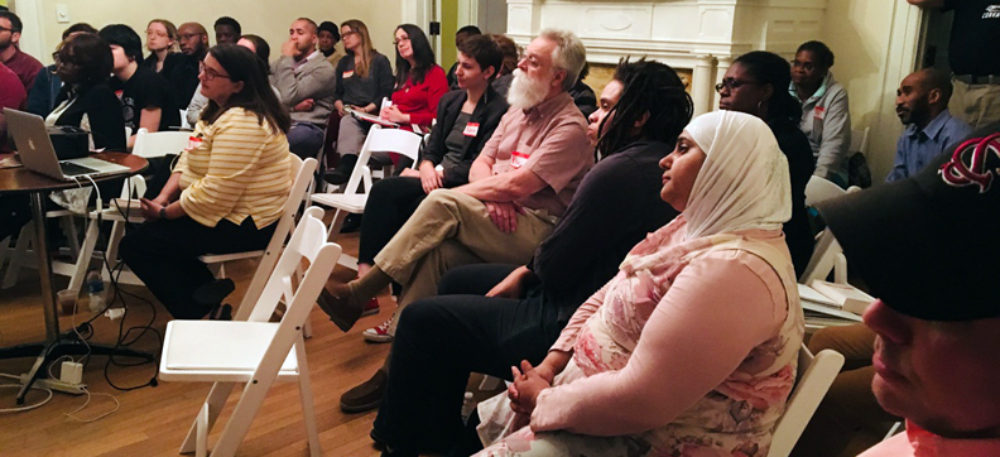
Join us for a casual drop-in May 20, 5–6:30 pm

Modjeska Simkins House  •  2025 Marion St., Columbia

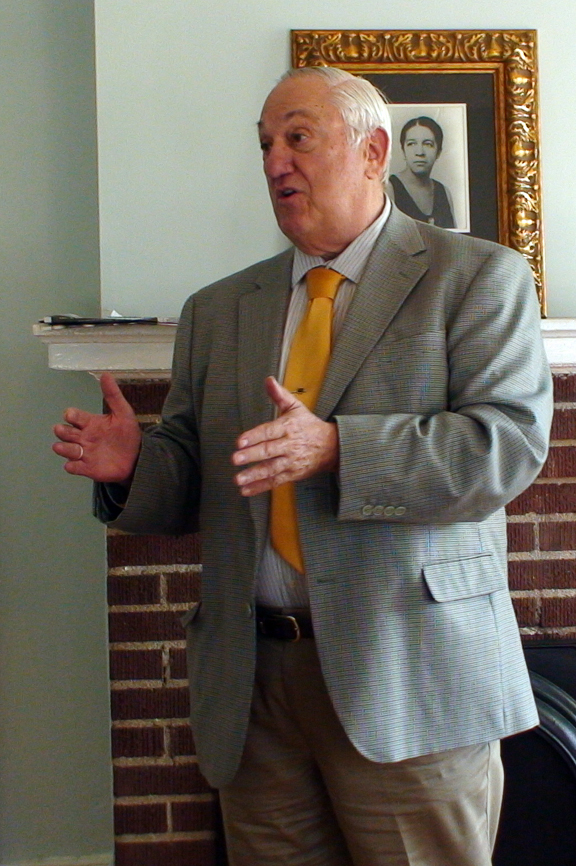
Hear Bob Kearney of the national Alliance for Retired Americans
talk about the most critical issues facing seniors in 2010.

The SC Alliance for Retired Americans needs YOU to help educate, energize and mobilize retirees and seniors in the Palmetto State. Join us, and help protect the health and economic security of South Carolina’s older citizens.

FREE and open to the public! Enjoy snacks, beverages and live music.

For more information, call 803-957-8740 or email becci@scpronet.com.

The new nullification

By Hoyt Wheeler

Is South Carolina once again taking up the old Confederate cause by attempting to nullify national laws? Nullification was the theory of South Carolina’s John C. Calhoun that provided philosophical grounds for our state seceding from the United States a century and a half ago.

In the past year or so, we have seen a number of actions in this direction.

Most visibly, Attorney General Henry McMaster’s response to the new federal health law. He proposes taking legal action against the federal government to block the federal law’s application in South Carolina — to nullify it. He describes this as defending “state sovereignty.” Attorney General (and gubernatorial candidate) McMaster has said that although at one time the Soviet Union was the enemy, now “The enemy is Washington, D.C.”

Like the tea party crowd with whom he sympathizes, he is confused about what part of the S.C. heritage he’s following. It is not the “Don’t Tread on Me” flag of the American Revolution that he is waving. It is the stars and bars of the Confederacy.

Then there is the current attempt to forestall proposed federal labor legislation by amending the state’s constitution to mandate that all matters of employee representation (unions) be decided by secret ballot. It is currently federal law that an employer has the right to demand a secret ballot election if a union requests recognition. Pending in Congress is the Employee Free Choice Act, which would require an employer to recognize a union upon being presented with cards signed by a majority of employees. Although this bill has some merit, there is little chance of this particular provision being adopted.

More importantly, whatever the merits of the federal legislation, this is a matter for the national government, not the individual states, to decide. As our state legislators well know, in an area of law such as this, where the national government has lawfully acted, state action is preempted. This amendment to the state constitution would be patently unconstitutional under the U.S. Constitution.

Nowadays in our Legislature, we hear much about support for the 10th Amendment to the U.S. Constitution, which provides simply that matters not delegated to the federal government are left to the states or the people. In principle this is not controversial. However, a number of actions have been taken under its mantle by South Carolina and other states in the past year to assert state power against the federal government.

Our Legislature has adopted a state sovereignty resolution, or 10th Amendment resolution. State Sovereignty bills considered by some states go one step further and declare that the state must take action against federal laws that the state deems to be unconstitutional. The position of our attorney general on the federal health law is in line with these state sovereignty bills.

At a Tea Party rally in Boiling Springs, at which Attorney General McMaster spoke, a pastor from North Carolina described our president as “a proud young man who appears not to have a clue about America’s godly heritage.” A tea party organizer dressed as Tom Paine said: “I’m not calling people to arms, yet. But that may be what it comes down to at the end of 2010.” We have a congressman who shouts at our president, calling him a liar. This is in a national context where a former vice presidential candidate, Sarah Palin, tells a Southern Republican Leadership conference: “Don’t retreat. Reload.”

I, for one, do not see these extreme statements and actions as reflecting the good sense, patriotism and good will of South Carolinians. We can, and should, raise our voices and speak through the ballot to rid ourselves of those extremist public officials who have made themselves a source of embarrassment to our state.

Hoyt Wheeler is a retired university professor and attorney living in West Columbia. His publications include The Future of the American Labor Movement and Workplace Justice Without Unions.
Ultrasound bill taken up in conference committee

Yesterday, the H.3245 (two-trip ultrasound) Conference Committee started the meeting with a prayer led by Sen. Bryant. In Senator Bryant’s prayer, he asked for guidance, wisdom, and for “a miracle because only a miracle from God will get us out of this conference committee.”

Chairman Kevin Bryant started the conversation with a side by side comparison of the Senate and House versions of the bill. Each side was able to voice their opinion on common ground items which include the effective date, severability clauses and the general concept of a 24-hour waiting period. The more controversial items including where the woman would receive the Woman’s Right to Know information, when the 24-hours clock would start, and an exception for rape and incest victims were debated in length.

Rep. Wendy Nanney expressed her initial intent of enforcing a 24 hour wait for all women even in a trauma. According to Nanney, trauma is the most vulnerable time for women and she is not thinking rationally, therefore a woman needs more time to think about her decisions regardless of rape and incest. Sen. Jake Knotts rebutted her claim by saying he would not be in favor of victimizing a woman for the second time with a governmental regulation.
Rep. Greg Delleney stated the House would not budge on the 24-hour time period starting when an ultrasound was performed.  He also called the meeting a “press conference” for each member. Senators Brad Hutto and Knotts informed the House that if they were not willing to negotiate on the 24 hour trigger than there was no need to continue with the conference committee.

Although Sen. Bryant did set a tentative next meeting for next Wednesday, he is requesting that each member of the Conference Committee work behind the scenes this week to possibly come up with proposals and agreements.

Subcommittee debates discriminatory teen dating violence bill; SC Equality seeks public input

Yesterday, the Senate K-12 Education Sub-Committee held another hearing on H3543, the Teen Dating Violence Bill. SC Equality, its lobbyist, and allied organizations like Sean’s Last Wish (a member of the SC Progressive Network) were present–with four witnesses who were prepared to present expert and personal testimony in opposition to the non-inclusive dating violence bill.

Although we were not given the opportunity to present our testimony, fair-minded members of the Senate–Senators Joel Lourie and Phil Leventis–gave voice to our position. They acknowledged that the current language of the bill is discriminatory and privileges some relationships over others, and they argued that the bill should not move forward in its current form.

As expected, Sen. Mike Fair rejected this argument and would not accept the bill without the amendment excluding same sex partners. Realizing that this one issue of defining a dating partner is the only thing that is holding up moving this otherwise sound bill forward, the Chair asked if there was a compromise position that could be taken that would satisfy both sides. Senators Leventis and Fair agreed to discuss this further outside of the hearing. Thus, no action was taken on the bill today.

SC Equality (a member of the SC Progressive Network) is fully committed to seeing that a non-discriminatory dating violence bill–one that protects all children equally–is passed. We will continue to aggressively monitor the progress of this legislation, and should another hearing be scheduled, we will have witnesses ready.

These witnesses will be your voice at the hearing–so we need to hear from you. Should we have an opportunity to testify or to speak with legislators individually, it would be extremely helpful to be able to share stories from those who have experienced dating violence, particularly from the perspective of gay youth. If you have had experiences that you would be willing to share, please contact us at info@scequality.org. We will respect all confidentiality.

SC Retirees Must Keep Sharp Eye on New Spending Panel

A new federal commission is meeting for the first time today in Washington, and Julie Harbin, president of the South Carolina Alliance for Retired Americans (the newest member of the SC Progressive Network), is encouraging retirees in the Palmetto State to pay close attention in the coming months.

The panel, the National Commission on Fiscal Responsibility and Reform, is a bi-partisan group charged with recommending ways to lower the federal debt. US Congressman John Spratt serves on the Commission, which will offer its recommendations in December.

Harbin fully supports the goals of the Commission, but is deeply concerned that some are urging the panel to recommend changes in Social Security as a way to reduce the federal deficit. “If the commission takes a thorough and honest look at Social Security, it will see one of our nation’s greatest success stories. Social Security has helped generations of retirees stay out of poverty. South Carolina’s retirees want to make sure that Social Security remains strong for our children and grandchildren,” Harbin said. She noted that for over 25 percent of retirees, Social Security is their only source of income. With an average monthly benefit of only $1,164, she said that Social Security is, “a tenuous lifeline for many seniors.”

Harbin said that Social Security did not cause our large deficits. Since 1983, American workers have paid enough Social Security payroll taxes to accumulate a $2.5 trillion surplus in the Social Security Trust Fund. But between 2001 and 2006, Washington gave away $2.48 trillion in tax cuts.

To help retirees better follow the panel’s work, the Alliance for Retired Americans has written the Commission to urge that its work be conducted in open, televised sessions and that it hold field hearings across the country to listen to public testimony.

SC Alliance for Retired Americans President Julie Harbin.

Calling all SC political junkies

Tired of politics as usual?


Don’t miss the SC Progressive Network’s Conference April 10!

Booker T. Washington Cultural Arts Center
2611 Grant St., Columbia SC

FREE and open to the public!

Join us for the SC Progressive Network’s 14th annual spring conference, beginning with non-partisan policy work and ending with political action. This year, we have candidates from our own ranks running for office. Given these politically charged and challenging times, this promises to be a lively day of talking politics. We need YOU at the table!

AGENDA

11 am: Registration and light lunch (RSVP for lunch required by4/8/10. Pay $10 on site. Please let us know of any dietary restrictions.)

Noon-2:30pm: Progressive Network Education Fund meeting. If your organization is part of the Network’s nonpartisan coalition, your organization has a seat on the board and should be represented. Remember: this is YOUR organization. It is only as strong as you make it.

  • Network Co-chairs Rep. Joe Neal and Donna Dewitt will review our policy struggles and lead a discussion on sharpening our strategy and tactics.
  • Network Director Brett Bursey will lead a workshop on “Corporations and Democracy.”
  • “Jobs With Rights” organizer Ken Riley, President of the Charleston longshoreman’s union will present the campaign’s plan to fight SC’s anti-worker laws.

3-5pm: Progressive Voter Coalition meeting. SC ProVote is a political action committee of individual Network members and allies. ProVote supports candidates, regardless of party, that support our values of a just and inclusive democracy.

  • We’ll hear from candidates seeking our endorsement, target races and refine strategies and tactics.
  • We’ll discuss Progressive Caucus plans for the state Democratic Convention April 24.
  • Political consultants Carey Crantford and Wil Brown will lead a session on effective messaging of campaigns.

For more information or to RSVP for lunch, call 803-808-3384 or email network@scpronet.com.

Racial profiling topic of TV program

SC Progressive Network Director Brett Bursey recently appeared on WIS-TV’s Awareness show to talk about the racial profiling study the Network completed in January, as well as the legislation we’ve been advocating for several years. He was joined on the program by Sheriff Leon Lott.

Click below to view.

Part one

Part two

Part three

Labor activists picket Wachovia in Columbia


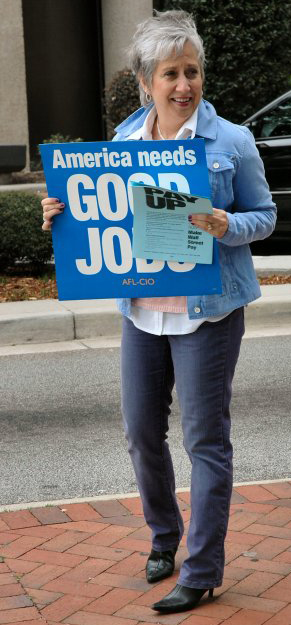
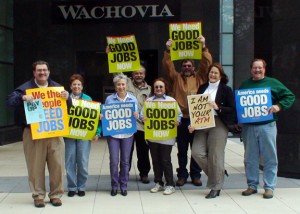
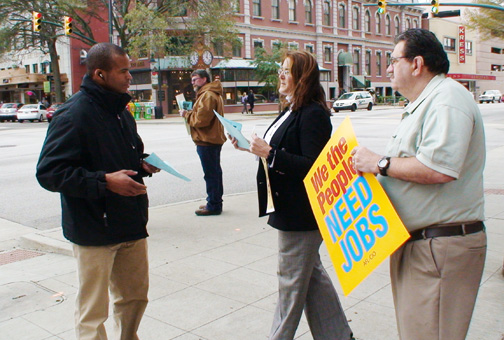
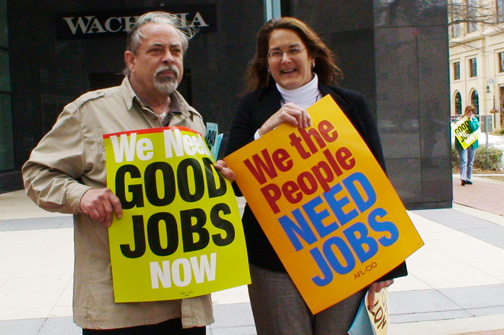
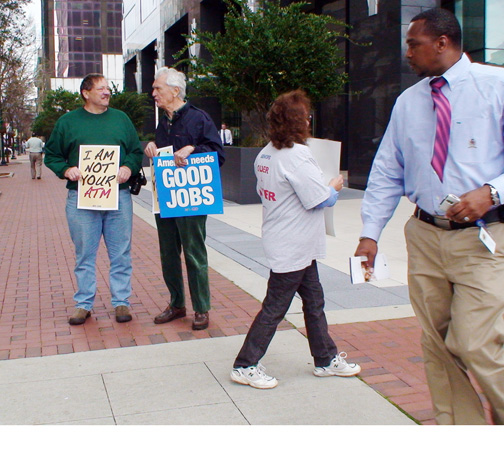
As part of a national effort led by the AFL-CIO, labor supporters held a lunch-time informational picket in front of Wells Fargo/Wachovia’s Columbia headquarters. Members of the SC Progressive Network joined the SC AFL-CIO, SC Alliance for Retired Americans (our newest Network member) and the Central Labor Council in passing out fliers and talking to passersby about the bank’s practices.

“America needs 11 million jobs, and big Wall Street banks should pay to rebuild jobs and the economy they helped destroy,” said Jenny Patterson, President of the Columbia Central Labor Council.

Since the recession began, America has lost nearly nine million jobs when we needed to create more than 2 million just to stay even. While Americans have lost jobs, homes, retirement savings and hope, Wall Street banks took billions in taxpayer bailouts and gave executives some $145 billion in 2009 pay and bonuses. Now they’re spending millions lobbying to kill financial reform.

The AFL-CIO is calling for a major jobs plan to extend unemployment
insurance benefits, food assistance and health benefits; rebuild our crumbling infrastructure; increase aid to state and local governments to save critical services and jobs; increase funding for neglected communities to match people who need jobs with work that needs to be done; and use TARP money to get credit flowing to small businesses for job creation.

What you should know:

* Wells Fargo/Wachovia got a $25 billion taxpayer bailout.

* Wells Fargo/Wachovia paid CEO John Stumpf $21.3 million last year.

* Wells Fargo/Wachovia spent $2.9 million on lobbying last year to kill financial reforms.

SOURCES: Company SEC filings, The New York Times, Center for Responsive Politics

View more photos by clicking here.

Family planning services are wise investment

By Beth Richardson

Columbia attorney with Tell Them, an e-advocacy network supported by the New Morning Foundation, a member of the SC Progressive Network

The Legislature faces the unenviable task of finding ways to reconcile the state’s budget while continuing to provide meaningful services to its citizens. What many lawmakers do not see, however, is the great opportunity to achieve a documented 17:1 return on investment simply by restoring funding for family planning services.

Births to teen mothers in South Carolina cost taxpayers upwards of $156 million annually. (In Richland and Lexington counties alone, that number reaches $15 million.) We have the eighth-highest rate of pregnancies among 15- to 19-year-olds in the nation, and our state’s teen pregnancy rates are on the rise. In some rural counties, the rates can be as high as 200 pregnancies per 1,000 young women ages 18 to 19. Why? They have received virtually no family planning education in school, and due to a series of state budget cuts, they have no access to contraceptive counseling and clinical services in their isolated rural communities.

A state’s money invested in family planning services offers a strong return on investment and represents sound fiscal policy. A cost-benefit analysis conducted by researchers at the University of Iowa and the University of Northern Iowa found that in as little as five years, a state can save $17 for every tax dollar invested in programs and clinics that help prevent unintended pregnancies among 14- to 19-year-olds.

Of course economics are only one part of the equation. Restoring state funding for family planning services will mean fewer unintended pregnancies, so fewer children will be born into situations where they will be at greater risk of child abuse or neglect.

Here is what we know: Children born to mothers age 15 and younger are twice as likely to be abused or neglected in the first five years of their lives than are the children born to mothers ages 20 to 21. They are more likely to grow up in a poor and mother-only family, to live in an impoverished or underprivileged neighborhood and to suffer high risks to both their health status and potential school achievement. Poverty, inadequate social support, mothers’ lack of education, mothers’ cognitive immaturity and greater maternal stress all have been suggested as possible factors contributing to unsatisfactory social and educational outcomes for the children of teen mothers, many of whom never were intended.

One in four children and nearly half of single-mother families are expected to be poor in 2011. Making further progress in reducing teen pregnancy will benefit the national and state economies as well as improve the educational, health and social prospects for this generation of young people and the next.

On March 23, thousands of South Carolinians are taking part in our state’s first-ever virtual march on the State House. They believe, as we do, that one of the most fiscally responsible actions our Legislature can take is to properly fund age-appropriate reproductive health education and access to services for all South Carolinians. By protecting all children and young adults now, we can save millions of dollars in public health care and welfare services in the future.

It’s our responsibility to stand together on behalf of all these young people, so that each of them can have the opportunity for a future that is bright and healthy. We must take a long view, and invest in programs that will make South Carolina a healthier state.