Join us on Sunday, Dec. 6, at 2:30pm for a free screening of Rethink Afghanistan, an 80-minute documentary about the US role in Afghanistan. The screening will be held at the Nickelodeon Theater, 937 Main St., in downtown Columbia. A discussion will follow, led by Dr. Stephen Sheehi of the Department of Arabic Culture at the University of South Carolina. Free and open to the public. For details about the film, see the web site. Sponsored by the SC Progressive Network and Carolina Peace.
Category Archives: Network News/Events
LGBT groups spearhead Charleston anti-discrimination victory
Because of the collaborative effort among LGBT groups — including SC Progressive Network member organizations AFFA and SC Equality — the city of Charleston now has proactive legislation protecting LGBT people in both housing and public accommodations.
Last week, the Charleston City Council passed ordinances expanding the city’s existing policy prohibiting discrimination in housing to include age, sexual orientation and gender identity The council also passed a public accommodations ordinance prohibiting discrimination on the basis of race, color, religion, sex, age, disability, familial status, national origin, sexual orientation or gender identity.
The ordinances were presented to the mayor’s office in August by AFFA, SC Stonewall Democrats, SC Log Cabin Republicans, American Civil Liberties Union and South Carolina Equality–who paved the way by successfully introducing similar ordinaces in Columbia, SC, last year.
Charleston is the second municipality in the state to pass comprehensive human rights ordinances in housing and public accommodations that include sexual orientation and gender identity. Council Member Gary White said, “It’s a step forward in the right direction in making sure that we are not discriminating against anyone.”
Read the ordinances here.
Abortion shouldn’t imperil health care reform
By Sloane Wheelen
S.C. field coordinator for Planned Parenthood Health Systems in Charleston, a member of the SC Progressivve Network
The House vote to establish near-universal health care coverage came at a steep cost to women. That cost, issued as an amendment by Rep. Bart Stupak (D-Mich.), eliminates abortion coverage by private insurance companies even when women are paying for all or most of the premium with their own money.
Stupak’s amendment is a cynical attempt to push an anti-choice agenda that imperils badly needed reform. His amendment undermines the ability of women to purchase private health plans that cover abortion even if they pay for most of the premiums with their own money. This amendment reaches much further than the Hyde Amendment, which has prohibited public funding of abortion in most instances since 1977.
Before its introduction, health care reform measures in both the House and Senate contained agreed-upon language regarding abortion. Public funding would remain prohibited, and women with private health insurance would continue to receive the benefits they already have. Though this language satisfied neither side completely, it enabled health care reform to move forward without being derailed by abortion politics.
In addition to undermining the reform effort, the amendment would impact the more than one in four American women who have at least one abortion during their reproductive years. Tens of millions of women will be required to pay for health care coverage that expressly excludes one of their most commonly requested medical procedures.
The Stupak Amendment, like the Hyde Amendment, allows coverage of abortion only in cases of rape, incest and for medical complications that “place the woman in danger of death unless an abortion is performed.” However, if the woman’s health is in jeopardy – if her pregnancy risks organ failure or infertility but not death – then there is no coverage for care. The woman’s health, no matter how substantial and irremediable, is placed at risk.
Women’s health care should not be sacrificed on the altar of reform. President Obama repeatedly stated that under health care reform, “no one will lose the benefits they currently have.” The House bill now embraces a lesser ideal: No man will lose the benefits he currently has.
Is this sexual discrimination or abortion politics? Frankly, the two are inseparable. The 11th-hour amendment is just the latest example of statutes, regulations, medical standards and corporate policies that have caused women to pay more, suffer more and receive less: Pharmacists refuse to fill prescriptions for birth control pills. The FDA imposed unwarranted and unscientific age limits on over-the-counter access to emergency contraception. Health insurance companies demand higher premiums from women than from men.
Women pay nearly 68 percent more than men – much of it resulting from the uninsured expenses of reproductive health care.
The promise of reform was supposed to remedy all that. Health care reform sought not only to expand coverage but also to reduce gender discrimination.
No longer would women have to pay more than men for the same insurance policy. No longer could pregnancy or womanhood be treated as pre-existing conditions. No longer would women be denied affordable contraceptives. And all women’s health centers finally would be recognized as essential community providers no less than centers that cater to other segments of the population.
Because of Rep. Stupak, the House further entrenched a two-tiered health care system that limits access to care for women.
If Congress is capable of enacting health care reform, it is capable of treating women as equals who don’t have to settle for less. Already, members of the House and Senate pro-choice caucus are pledging to withhold their final votes unless the Stupak Amendment is removed.
Abortion politics should not scuttle health care reform. That is why the Stupak Amendment must be eliminated.
This piece originally ran in The State on Nov. 29, 2009.
SC students rally for the environment
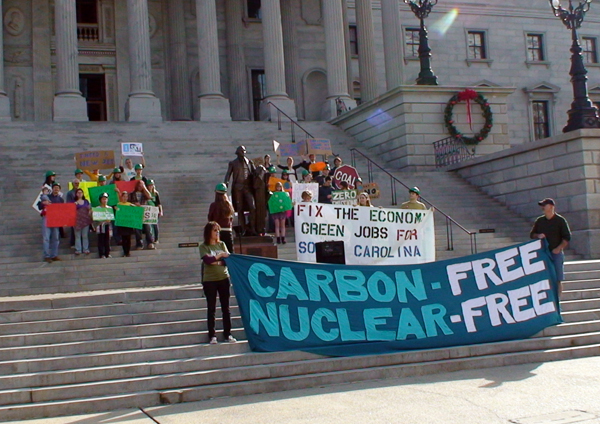
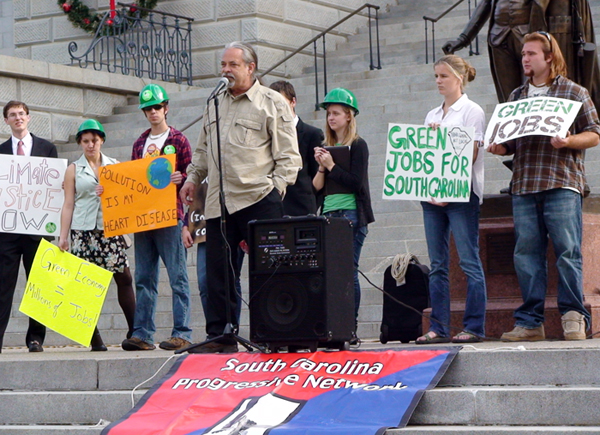
On Nov. 21, the Palmetto Environmental Action Coalition, a statewide student organization, rallied at the SC State House in Columbia. Featured speaker was Brett Bursey, director of the SC Progressive Network.
To view video, click here: Green Rally
When Catholic bishops control health care for all of us
This piece, written by SC Progressive Network member Herb Silverman, ran in The Washington Post.
By Herb Silverman
Founder and President of the Secular Coalition for America and Secular Humanists of the Lowcountry
Q: U.S. Catholic bishops are defending their direct involvement in congressional deliberations over health-care reform, saying that church leaders have a duty to raise moral concerns on any issue, including abortion rights and health care for the poor. Do you agree? What role should religious leaders have — or not have — in government policymaking?
I wouldn’t want to be on a plane with a pilot who had never before flown, nor would I seek sexual guidance from a Catholic bishop who, presumably, had never “flown.” I also think Catholic bishops should have no moral authority when it comes to matters involving sex. The Catholic faithful may choose to live their lives based on pronouncements by priests, bishops, and the pope, and I support their right to do so. But bishops have no right to impose their sectarian beliefs on the rest of us.
Catholic bishops have injected themselves into Congressional deliberations over health-care reform for one primary reason, their updated scarlet A–abortion. And abortion is, after all, first a matter of having sex–which Catholic clergy condemn when it is outside of marriage; when it is within marriage if birth control is used; when it is between homosexuals (whose marriage they would also condemn); and even when it is with oneself (masturbation). Reasons for having abortions vary greatly, and include pregnancy that threatens the mother’s health or life, pregnancy that comes from rape or incest, likelihood of seriously deformed or incurably ill baby, an inconvenient pregnancy, an inability to support and care for a child, a dislike of children. Catholic clergy ignore individual cases with their one-size-fits-all pronouncement about abortion. Americans should be allowed to make up their own minds about the need for and morality of abortion, and should not be denied on the basis of the Catholic theology of sin.
This is not to condemn those from either the left or the right whose faith motivates them to enter the political arena or engage in political issues. However, whatever the motivation, Congress needs to make sure their policies are backed for good secular reasons. That is why we have as law the Three Commandments: don’t steal, murder, or commit perjury. Most of the other seven are sectarian and deal with whom, how, and when to worship. These are properly left for individuals to decide.
Since there are good secular reasons for providing health care for the poor, I see nothing wrong with Catholic bishops and other religious people advocating for reform. Unfortunately, if the bishops don’t get their way on abortion, the signs are that they will try to scuttle health care reform for millions of Americans. The irony is that some women have abortions because they could not afford contraception and cannot afford to provide for a baby because of our inadequate health care system. As far as I can tell, the biblical Jesus said nothing about abortion, but had a lot to say about the poor. Perhaps some Catholic bishops should ask themselves, “What would Jesus do?”
Public financing needed to avoid AG conflicts
This op-ed appeared in The State today. It was written by John Crangle, a longtime member of the SC Progressive Network and advocate for our clean elections initiatives.
By John Crangle
Common Cause of South Carolina
The controversy over Attorney General Henry McMaster’s acceptance and later return of $32,000 of campaign contributions from lawyers he hired to represent the state of South Carolina in a lawsuit against drug companies is yet another episode in a continuing chronicle of attorneys general taking campaign money from lawyers and parties having legal business with the state.
The problem arose when Attorney General Travis Medlock was running for governor, when Attorney General Charlie Condon was running for governor and U.S. Senate and now with McMaster running for governor.
The danger of conflict of interest, favoritism, abuse of office and corruption ia very real for attorneys general, who have in their jurisdiction great discretionary power. The attorney general can decide which lawyers are retained to represent the state in multimillion-dollar lawsuits, which in some cases produce huge attorney fees. Furthermore, the attorney general is in a position to file civil suits and to favorably settle suits benefiting an adverse party. In criminal matters, the attorney general has the power to decide whether to seek an indictment, whether to prosecute, whether to plead a case down or even dismiss.
All of these decisions can have catastrophic or highly beneficial consequences to the lawyers and parties involved. Many lawyers and clients would pay dearly for favored treatment by the attorney general in such cases.
It is all too easy for campaign contributions to influence the decision-making of attorneys general, especially in close cases where great civil or prosecutorial discretion is in play. Given the extensive history of public corruption in South Carolina over the years, it is not far-fetched to envision a future attorney general trading favors for campaign contributions.
Public financing of races for attorney general would be the best cure for the problem of corrupting campaign contributions. As a member of Gov. Jim Hodges’ Commission on Campaign Finance Reform in 2000-01, I argued that the danger of pay-to-play corruption was most acute in the office of attorney general due to the great discretionary power of the office and the enormous stakes involved in major civil and criminal cases. It also seemed that the cost of public financing for the attorney general race would be modest since at the time candidates were spending relatively small sums
The big objection to public financing is always that the taxpayers should not have to pay for the cost of election campaigns. Of course, the taxpayers already pay many costs of elections, including the expense of the S.C Election Commission, the county election commissions and all of the related costs of providing polling places, buying multimillion-dollar voting equipment and hiring poll workers. In case of election appeals and litigation, the taxpayers pay much of these costs too.
My proposal is to have an unprecedented public financing system for attorneys general whereby the ordinary taxpayers pay nothing, but the necessary money would be raised by a tax on campaign contributions to political candidates. As candidates for state and local office raise well over $20 million every four years, a tax of 10 percent would generate enough money to provide candidates for attorney general with public funds sufficient to communicate their positions and qualifications to the voters.
Supreme Court rulings give candidates the right to raise money for their own campaigns, so the state can only offer to give them public financing in exchange for voluntarily not raising money. So public financing alone wouldn’t accomplish our goals. But if we retain the existing laws that limit campaign contributions by source, amount and use, ban contributions from special counsel as suggested in a recent editorial column by Cindi Ross Scoppe and also add my proposal for public financing, we could deter conflicts of interest and abuse of office and inhibit corruption in the position of attorney general.
Finally, an especially and difficult manifestation of the problem is incumbent attorneys general raising funds for another office such as Congress or governor. Although we can’t prohibit an attorney general from raising money, for re-election or election to another office, we can prohibit an incumbent from transferring funds from an attorney general account to a campaign for another office. And we should.
Public financing for the attorney general’s race can serve as a pilot project. If voters and legislators conclude after a trial run that public financing has worked well for attorney general candidates, then public financing could next be tried for another office, such as governor or treasurer.
A Fundraising Fling!
Join us for “An Argentine Affair” without leaving the state or wrecking your marriage. Attendees will enjoy the wines, food and music of Argentina, a tango exhibit by the Durlach-Breedlove Dance team, can bid on a variety of items in a silent auction to benefit the SC Progressive Network, and help honor three SC activists receiving awards for their work.
“An Argentine Affair” will be begin at 7pm on Saturday, Nov. 14, at The Big Apple in downtown Columbia (corner of Hampton and Park).

Local artist Alejandro Garcia‘s original oil painting (50″x30”) will be included in a silent auction. The Spanish caption on the painting reads, “I want to drown my heart with wine, to extinguish a crazy love, that more than love, is pain,” words taken from Nostalgias, a famous tango.
The evening will conclude with an awards ceremony to honor three of South Carolina’s finest grassroots activists with the Network’s annual Thunder and Lightning Awards. This year’s honorees are: the Rev. Dr. Neal Jones of the Columbia Unitarian Universalist Fellowship, Tom Clements of Friends of the Earth, and Ruth Thomas, founder of Environmentalists Inc.
Tom Clements is the Southeastern Nuclear Campaign Coordinator for the US branch of Friends of the Earth, an international environmental organization with affiliates in 70 countries. Based in Columbia, he works on issues related to the state’s seven nuclear reactors, four proposed new reactors, the Savannah River Site, and a low-level waste dump. Tom worked for 13 years as a nuclear campaigner with the Greenpeace International nuclear campaign, and for three years was the director of the Nuclear Control Institute in Washington, DC. In addition to a focus on DOE’s problematic management of 132 million liters of high-level reprocessing waste at SRS and management of surplus weapons plutonium, Tom is leading the fight in his state against four proposed reactors and the DOE’s effort to locate a reprocessing complex at SRS.
Rev. Dr. Neal R. Jones earned a scholarship to Wake Forest University, where he became president of the Baptist Student Union, majored in political science, and graduated summa cum laude. He had planned to go to law school, but the chaplain at Wake Forest introduced Neal to the social gospel, which convinced him that religious faith could be a motivation for social justice rather than an obstacle. So he decided to become a minister and attended Southeastern Baptist Theological Seminary, where he earned a Master of Divinity degree. Neal never served a Baptist church, however, except for a brief stint as the interim minister of his home church — until they fired him for his liberal sermons. He then joined a more progressive denomination, the United Church of Christ, and served as the minister of a UCC congregation in Rockwell, NC, and then of a Moravian church in Winston-Salem. At these churches, too, his liberal sermons and his involvement in causes for social justice put him at odds with his parishioners. Also, his faith was growing beyond the confines of traditional Christianity and becoming more humanistic and universal. So Neal left the church and went back to school to earn a doctorate in psychology at Baylor University. There he discovered the Unitarian Universalist Fellowship of Waco, Texas, and was soon hired as part-time minister. Discovering Unitarian Universalism was a spiritual homecoming for Neal. For the first time, he experienced a religious community that respected the inherent worth and dignity of every person, that encouraged a free and responsible search for truth and meaning, that worked for peace and justice, and that recognized the interdependent web of all existence. He has been a passionate “evangelist” for UU principles ever since. Neal’s psychologist internship brought him to the University of South Carolina in 1999, after which he became the clinical psychologist for the Pastoral Counseling Center of Palmetto Health. Five years ago, Neal was hired by the Unitarian Universalist Fellowship of Columbia. Neal preaches and lives a practical spirituality that seeks personal wholeness, relational respect, social justice, and ecological responsibility. He would like to apply his values to law-making. Neal recently announced his candidacy for South Carolina House District 80.
Ruth Thomas, founder of Environmentalist Inc., will receive the Lifetime Achievement Award for her service. In 1974, Ruth was the lone voice against building a facility in SC to process plutonium into a commercial nuclear fuel. Ruth would show up at state and federal hearings on the issue with a cardboard box of documents and face off a dozen high-paid attorneys. The plant — Allied General Nuclear Services — was the target of demonstrations the Natural Guard (the Network’s founding organization) organized in Barnwell SC in 1979, which turned out 5,000 people. The facility never operated, and the larger question of using plutonium for commercial power was addressed by Jimmy Carter’s presidential executive order banning the use of plutonium. For 30 years, Ruth was often the lone voice in SC Public Service Commission hearings on issues relating to rate payers subsides of nuclear development. Although Ruth moved into a nursing home this fall, she continues her fight against the use of plutonium-based fuel.
Tickets are $25 each; $40 per couple. Reservations appreciated, but not required, by calling 803-808-3384. Proceeds will help sustain the SC Progressive Network’s programs for a more just and equitable South Carolina.
Making the Case for Universal Broadband Access in SC

SC Progressive Network Director Brett Bursey (left) and Sascha Meinrath, Director of New America Foundation’s Open Technology Initiative, speak at a press conference before a recent legislative hearing on the broadband transition.
On Sept. 18, Bursey was a guest on Frank Knapp’s U Need 2 Know radio program to talk about the latest developments in South Carolina’s broadband debate. Listen to the show’s audio stream here
[audio:http://www.scpronet.com/wordpress/wp-content/uploads/2009/09/BrettBursey9-18-09.mp3]Bill Fletcher Talks About Organized Labor on Bill Moyers Journal
Bill Fletcher, Jr., will keynote the SC Progressive Network’s fall retreat Oct. 3-4.
With public support for labor unions at its lowest point in 70 years, Bill Moyers on Sept. 18 talked with experts Bill Fletcher, co-author of SOLIDARITY DIVIDED: THE CRISIS IN ORGANIZED LABOR AND A NEW PATH TOWARD SOCIAL JUSTICE and Michael Zweig, director of the Center for the Study of Working Class Life at SUNY Stony Brook, about the state of organized labor.
Click here to watch.
Bill Fletcher will be the keynote speaker at the SC Progressive Network’s fall retreat at Penn Center Oct. 3-4. See our web site for details. Call 803-808-3384 to register for the retreat, which is open to anyone interested in improving the quality of life in South Carolina.
Register today for the Network’s annual grassroots retreat at historic Penn Center
SC Progressive Network Fall Retreat
Oct. 3 – 4
Historic Penn Center, St. Helena Island (near Beaufort) SC
Get away to the Lowcountry to talk politics, build alliances, sharpen organizing skills and recharge your batteries. Find out what’s happening in South Carolina’s progressive community and how you can help grow a grassroots movement for social equality and political power. Come for a day or for the whole weekend.
Guest speakers include acclaimed labor and civil rights activist Bill Fletcher and SC Rep. Joe Neal, who will offer critical analysis and perspective on our state and nation. The most important component of the weekend will be the participants themselves, who will take a hands-on approach to advancing our issues in the coming year.
On Saturday afternoon, participants will break into caucuses to map strategy on the following issues:
• Workers’ Rights
• Waging Peace
• Racial Justice
• Environmental Protection
• LGBTQ Organizing
• SC Death Penalty
The weekend begins at 10am on Oct. 3 and runs through 2pm on Oct. 4. Full package is $100, and includes conference materials, all meals and overnight accommodations. Day-only registration is $10. Car pools available from Columbia, Greenville and Charleston. Call 803-808-3384 if you can offer or need a ride.
See the weekend’s full agenda by clicking here.
To register, call 803-808-3384 or download the registration form by clicking here.