Category Archives: Network News/Events
Network still fighting privatization of SC ETV broadband
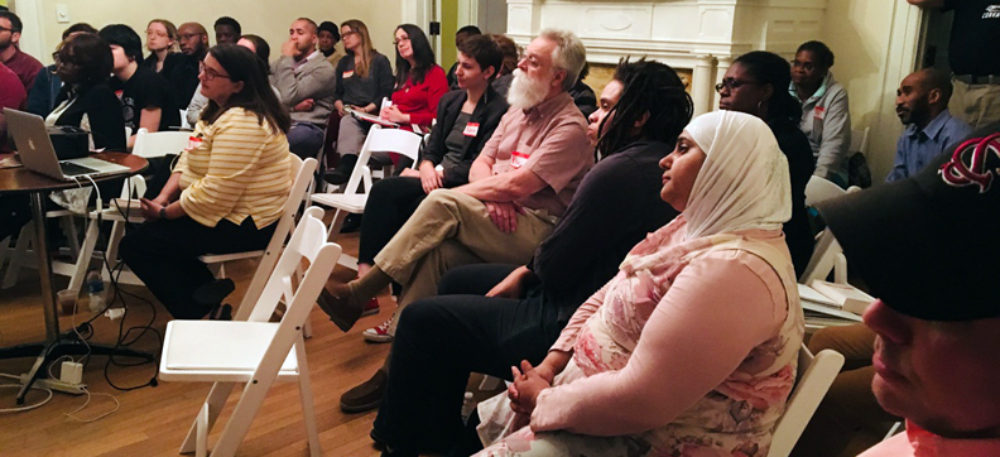
Sascha Meinrath, Director of New America Foundation’s Open Technology Initiative, speaks at a press conference before the hearing.
A three-hour meeting of a legislative subcommittee Aug. 5 gave opponents of privatizing SC ETV’s broadband spectrum their first opportunity to challenge the contract that privatizes the system. The SC Progressive Network presented testimony that the state should retain control of 25% of the spectrum for public use. This “mid band” portion of the spectrum would allow robust wireless Internet statewide.
The contract now under consideration could result in the public losing control of the nation’s only unified, statewide broadband system.
The subcommittee decided that further study of the contract terms were necessary.
The proposed contact leases the statewide educational broadband system to Clearwire and Digital Bridge for 30 years.
Sen. Harvey Peeler and Rep. Gilda Cobb-Hunter, who represent rural counties, were concerned that the contract doesn’t require the companies to provide service in rural and under-served areas.
Sascha Meinrath, Director of New America Foundation’s Open Technology Initiative, testified and responded to questions regarding the practicality of adopting the system for public access. Meinrath’s participation provided the Network with the necessary technical side of issue. Meinrath’s comments on the historical under-valuation of public airwaves was of particular interest to the subcommittee.
Sen. Glen McConnell, chair of the subcommittee, gave all interested parties until Aug. 14 to submit additional information on:
* The value of public retention of 25% of the spectrum. What will it cost to set up and maintain public access WiMax systems and how will it be paid for (by off setting cost of public entities leasing service, etc.). We have to show that giving up $35 million in lease revenue over the 30 years of the lease is a good deal for the state and taxpayers. Can we show that the value of the licensed spectrum will increase?
* The contract calls for the vendors to provide three free, regular subscription broadband services in each area of the 67 licenses. Are there places where Clearwire, or other vendors, provided more free incentives for lucrative contracts?
* The companies are being asked to provide examples of how they provide service to rural areas to address the problem that the contract allows service to be “market driven.”
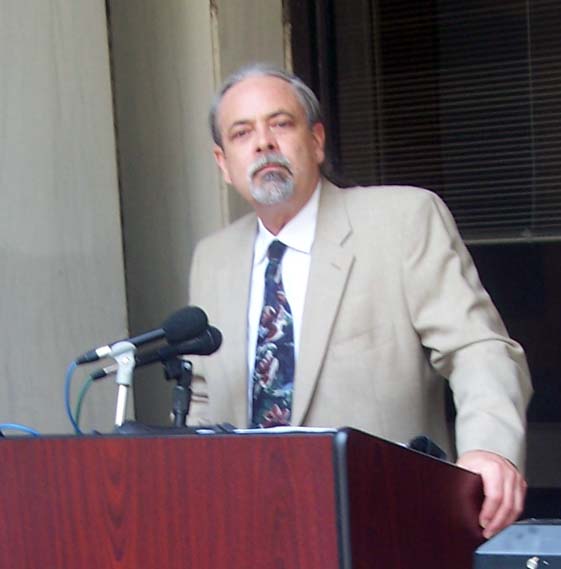
SC Progressive Network Director Brett Bursey addresses the media at a press conference before the subcommittee hearing.
Letters that support public control of 25% of the state’s educational broadband system should include specific cost savings and applications. Address your letters to: Sen. Glenn McConnell, Chairman, Joint Bond Review Subcommittee on the EBS. Send your comments to the Progressive Network at network@scpronet.com or PO Box 8325, Columbia SC 29202.
Leases on table for state’s broadband
A legislative subcommittee took testimony Wednesday about a controversial plan to lease ETV’s excess spectrum to private companies, Clearwire and Digital Bridge Communications.
A plan being considered by the state would lease out all but 5 percent of ETV’s excess capacity. The two companies will pay nearly $143 million to the state over a 30-year lease agreement and build wireless broadband networks that residents and businesses could subscribe to for a fee.
The S.C. Progressive Network and others want the state to retain a larger portion of the spectrum for future educational and governmental needs.
No conclusion was reached by the subcommittee. The State Budget and Control Board will have the final say.
SC’s Broadband Transition Provides Unique Opportunity
By Brett Bursey
Director, SC Progressive Network
South Carolina is on the edge of blowing a unique opportunity to be number one in something good, for a change.
Ours is the only state in the nation that
* owns all the educational broadcasting licenses the FCC has issued to that state;
* has a statewide, unified system; and
* supports its entire educational broadcasting infrastructure with state tax dollars.
When the FCC mandated the switch to digital broadcasting, it opened the door for South Carolina to own — or lease to private companies — the nation’s only public, statewide wireless Internet system.
On Aug. 5, a legislative subcommittee will hear testimony on the terms of a contract to lease all of the state’s educational broadband capacity to two private companies. The SC Progressive Network has been urging the state to retain control of 25% of the spectrum for public use.
“Throughout telecommunications history, policy-makers have routinely under-estimated the utility of the public airwaves,” said Sascha Meinrath, Director of New America Foundation’s Open Technology Initiative, who will testify at the hearing. “South Carolina has a once-in-a-generation opportunity to deploy affordable broadband for all residents. It would be a shame for the State to squander such a valuable spectrum asset for pennies on the dollar. This is an issue of prioritizing long-term progress over short-term gain.”
With a clear plan and the political will, we can use the licenses and infrastructure we already own to address big problems. It’s a relatively small investment that would yield long-term rewards for education, job growth and innovative health care delivery. We are now spending millions of public dollars through hundreds of individual leases with private providers to local governments and public institutions.
Until relatively recently, electricity was considered a luxury. When electricity wasn’t reaching homes in rural South Carolina, co-ops were created as publicly owned utilities to power areas it wasn’t profitable for corporations to serve.
Internet access remains a luxury not available everywhere. Geography and income often determine whether your neighborhood has access. (A 2008 Census report found that only 39% of SC households do.) The current contract only requires the companies to provide minimal service in unserved and under-served areas.
It will take time and money to build our broadband access across the state. But it can be done over time. One WiMAX unit can serve a 10-mile radius with robust broadband for less than $100,000. Richland County is spending $300,000 annually on Internet service, and USC just signed a $840,000 annual contract with AT&T for a campus Wifi system. A public WiMAX/Wifi system for the entire county could be paid for by what USC will spend in several years. The public would own the system and it would cost a fraction to maintain.
If the contract leases out all the available spectrum to private companies for the next 30 years, much of South Carolina will remain in the digital dark, with public institutions across the state paying high rent for decades to come.
Unfortunately, the commission operated mostly in executive session, and the contract is still secret. The Commission was mandated to consider “the costs and benefits, both monetary and societal, that would be borne by or inure to the public at large, as well as the public to be served.” If the contracts are approved as written, it will have failed.
Robert Rini, a DC attorney who specializes in FCC law, was hired by the commission to help draw up the contracts. In November he recommended that the state should retain control of 25% of the spectrum for public use and that this would “not appreciably” reduce the value of the remaining 75%. The commission ignored his advice.
The commission never did a cost-benefit analysis of the public retaining control over 25% of the state-owned spectrum. The $35 million the current leases will bring in over the next 30 years, divided by 46 counties, comes to about $25,000 per county.
Not on the table when the commission crafted its contracts is the $7 billion in federal stimulus grants for broadband development. Experts around the country are mystified that South Carolina didn’t propose a coordinated state plan to apply for a grant to fund a statewide broadband service.
Each state has been assured of at least one grant. For likely much less than the total of all the local grants submitted, we could have had a winning proposal for a statewide public system that would be the envy of 49 other states. It’s not too late. If we retain control of the spectrum the contract intends to lease out, we can use the value of the licenses and spectrum for the 80-20% state matching funds for the next two rounds of stimulus grants.
The Joint Bond Review Board subcommittee — which includes Sen. Glenn McConnell, Sen. Harvey Peeler, Rep. Dan Cooper and Rep. Gilda Cobb-Hunter — now has the chance to order a study on the benefits of public ownership of 25% of the educational broadband spectrum and make an informed decision that takes South Carolina’s long term public interest to heart.
Minimally Adequate? You decide.

Sen. Sessions, race and impartiality
By Sue Sturgis
Facing South
There’s more than a little irony in some of the questioning U.S. Sen. Jefferson Beauregard “Jeff” Sessions III has subjected Supreme Court nominee Sonia Sotomayor to during this week’s confirmation hearings.
The Alabama Republican — the top GOP member of the Senate Judiciary Committee and a former prosecutor and state attorney general — has led the charge for his party, raising concerns about Sotomayor’s impartiality.
In particular, Sessions and other Republicans have expressed worries about Sotomayor’s comment in a 2001 lecture that “a wise Latina woman with the richness of her experience would more often than not reach a better conclusion than a white male who hasn’t lived that life.”
“That’s troubling me,” Sessions said at one point during the hearings. “That’s not impartiality.”
Responding to Sessions, Sotomayor said she made the remark in the context of a speech to young Latino students and lawyers that aimed to make them believe their life experiences were valuable, but that ultimately it was a “rhetorical flourish that fell flat.”
But what of Sessions’ own racial impartiality? After all, his 1986 nomination by President Ronald Reagan for a federal judgeship was killed by the Senate Judiciary Committee over his history of racist actions and comments.
A year before Reagan nominated him, Sessions — who was then serving as U.S. Attorney for the Southern District of Alabama — was involved in a controversial and ultimately unsuccessful voter fraud prosecution of three civil rights workers, including a former aide to Martin Luther King Jr. As writer Sarah Wildman described the case in a 2002 story in The New Republic:
The three had been working in the “Black Belt” counties of Alabama, which, after years of voting white, had begun to swing toward black candidates as voter registration drives brought in more black voters. Sessions’s focus on these counties to the exclusion of others caused an uproar among civil rights leaders, especially after hours of interrogating black absentee voters produced only 14 allegedly tampered ballots out of more than 1.7 million cast in the state in the 1984 election. The activists, known as the Marion Three, were acquitted in four hours and became a cause célèbre. Civil rights groups charged that Sessions had been looking for voter fraud in the black community and overlooking the same violations among whites, at least partly to help reelect his friend Senator Denton.
Other Sessions’ comments that came to light in those hearings, according to TNR:
* He criticized the National Association for the Advancement of Colored People and the American Civil Liberties Union as “un-American” and “Communist-inspired” and said they “forced civil rights down the throats of people.”
* He called a white civil rights attorney a “disgrace to his race” for litigating voting rights cases.
* He once said he used to think Ku Klux Klan members were “OK” until he found out some of them were “pot smokers.”
* He called Thomas Figures — a black former assistant U.S. Attorney in Alabama — “boy” to his face, and after hearing Figures criticize a secretary warned him to “be careful what you say to white folks.”
Even Sessions’ own home state senator, the late Howell Heflin, voted against his nomination.
Despite being rejected for the federal judgeship, Sessions went on to be elected Alabama attorney general in 1994. Two years later he was elected to the U.S. Senate, where he has earned a 7% approval rating from the NAACP.
Curiously, Sessions’ history of racial insensitivity has been overlooked in the mainstream press. On July 14, for example, five major U.S. newspapers reported on Sessions’ opening statement at Sotomayor’s confirmation hearing without any mention of his 1986 rejection by the Senate Judiciary Commission for the racially charged comments, reports Media Matters for America.
SC Peace Activist to Travel to Israel and Palestine
Longtime Carolina Peace Resource Center activist and SC Progressive Network member David Matos will be traveling on an Interfaith Peacebuilder delegation to Israel and Palestine at the end of July. Over two weeks, the delegation will meet with Israelis and Palestinians working for peace and reconciliation, while investigating the facts of the ground; then, upon returning home, the delegates will share their experiences with several American audiences at this crucial time for peace-making. Please support this effort!
How?
1. Make a generous donation to support the expense of this trip. Make your tax-deductible donation payable to “Carolina Peace Resource Center” for “David Matos-IP Trip” and mail to P.O. Box 7933, Columbia, SC 29202. Your donation will be used to help defray the hefty costs of participating in this delegation, not the operations of the Carolina Peace Resource Center. The Carolina Peace Resource Center is a 501(c)3 nonprofit organization.
2. Organize a Speaking Engagement. Upon his return in August, David will be eager to speak to audiences, share his pictures in a slideshow and discuss what we can do for peace. Contact the Carolina Peace Resource Center at 803-446-2772 or info@carolinapeace.org.
For more information about Interfaith Peacebuilders, click here.
PO Box 7933
Columbia, SC 29202
Addressing Crisis by Investing in Women
By Thoraya Ahmed Obaid
None of the crises we face today — whether it is the food crisis, the water crisis, the financial crisis or the crisis of climate change — can be managed unless greater attention is paid to population issues.
World Population Day is the right time to put the issue of population back on the radar screen. And it is not a moment too soon. By 2050 our current global population of 6.8 billion could grow to the United Nation’s median projection of 9 billion, or even soar to 11 billion people.
But what is not widely appreciated is that the projection of 9 billion global population is premised on a substantial reduction in fertility in the least developed countries and this requires a dramatic expansion in access to voluntary family planning.
Recently we heard President Barack Obama, in his address from Cairo, say that denying a woman her education is denying her equality.
I would add another area that is vital for broadening women’s horizons, one to which governments agree, it is improving access to health. The right to sexual and reproductive health is essential for advancing women’s empowerment and equality between women and men.
Some 200 million women today want to plan and space their births but lack access to safe and effective contraception. According to the latest figures, just 1 in 4 married women in the least developed countries are using modern contraception and a further one-quarter of those women had an unmet need for family planning. So there is a high unmet need for family planning, and the need to expand these services is urgent.
It is important to note that investments in women and reproductive health are not only decisive for overcoming poverty, they are also cost-effective. For example, an investment in contraceptive services can be recouped four times over — and sometimes dramatically more over the long-term — by reducing the need for public spending on health, education, housing, sanitation and other social services.
That’s why the International Conference on Population and Development proposed a plan 15 years ago in Cairo to ensure universal access to reproductive health by 2015. This target now appears in the Millennium Development Goals, under MDG5 to improve maternal health, and this is an area where we need to make far greater progress.
The sad and shocking truth is that maternal mortality represents the largest health inequity in the world. And of all the Millennium Development Goals, MDG 5 to improve maternal health is lagging the furthest behind. With the financial crisis and the reduction in budgets for health, solving these problems will be even harder.
Clearly we need to do more to improve women’s health. The health benefits of these investments are well known, well documented and substantial. It is estimated that ensuring access to voluntary family planning could reduce maternal deaths by 25 to 40 percent, and child deaths by as much as 20 percent. The World Bank estimates that ensuring skilled care in delivery and particularly access to emergency obstetric care would reduce maternal deaths by about 74 percent.
Access to reproductive health helps women and girls avoid unwanted or early pregnancy, unsafe abortions and pregnancy-related disabilities. Women stay healthier, are more productive, and have more opportunities for education, training and employment, which in turn, benefits entire families, communities and nations.
In March, the World Bank reported that the current economic crisis could lead to increases in infant and maternal deaths, female school dropout rates, and violence against girls and women. Regardless of this economic crisis, investment in women and girls must continue if not increase.
In war or peace, natural or man-made disaster, prosperous economy or financial crisis, women continue to get pregnant. And when they do, what happens to them is quite limited: give birth safely, abort safely or unsafely, miscarry, or simply die while giving birth. These facts of life cannot be stopped or postponed. But we cannot excuse ourselves when women die while giving birth simply because there is a financial crisis.
Obaid is executive director of the United Nations Population Fund.
This piece was provided by the American Forum, a nonprofit, nonpartisan, educational organization that provides the media with the views of state experts on major public concerns in order to stimulate informed discussion.
Time to Fix Broken Criminal Justice System
By Victoria Middleton
Executive director, ACLU South Carolina national office
We all have a stake in fixing our state’s broken criminal justice system, and this is the time to encourage our representatives to make the streets and schools safer while holding down government growth.
Last weekend, the General Assembly-appointed Sentencing Reform Commission (SRC) held a public retreat in Charleston aimed at coming up with cost-effective strategies for improving public safety. The Pew Center on States has analyzed the fiscal and human cost of the current SC system: one person in 38 is in prison, on probation, or on parole; 6.6 percent of general state funds is allotted to probation; we spend $1 on prisons for every 6 cents spent on probation and parole.
We applaud the SRC’s willingness to listen to outside experts and learn from other states’ best practices. We hope they are open to creative solutions that will increase public safety and make prudent use of taxpayers’ funding.
1) We urge that the SRC become a permanent, standing commission with a broader mandate, one that looks at factors that drive over-population in South Carolina prisons and sends too many non-violent people, including juveniles, to jail.
2) We urge that the funding the State saves by changing our sentencing practices be invested in people – not prisons. Other states have reinvested corrections dollars in communities, especially those where most ex-offenders return, so that these folks can successfully reintegrate into society. These smart investments in people reduce crime and result in more productive, tax-paying citizens.
3) We oppose so-called “truth in sentencing,” which too often means mandatory minimum sentences by another name. Alternatives to incarceration, such as residential drug treatment, intensive community reporting, house arrest, and half-way houses that allow folks to continue working are cheaper and often more effective than time behind bars. They also keep people working and families together so the impact of criminal justice involvement is less grave on the community as a whole.
4) We also oppose any measures like the “three strikes” rule which have taken away flexibility in sentencing and led to unjust sentences for minor crimes. Under “three strikes” provisions, our prisons are now overflowing with individuals convicted of low level offenses, serving longer and longer sentences at greater and greater cost – with very little benefit for public safety.
Doing nothing will not only guarantee an increase in our prison population, it will increase the number of victims in our communities at an escalating cost to the public. We jail too many non-violent drug offenders, rather than treating them and turning them into productive, tax-paying citizens. We are sending too many children to jail rather than supporting them and their families with intervention that will correct behavioral problems early and keep them in school. To stop the cycle of violence requires imagination and courage as well as good policy.
A remarkable woman demonstrated this recently at a forum co-sponsored by the Community Partnership in Charleston. Vanessa Halyard is an advocate for victims and for abused children who, after her only son was murdered, reached out to the killer’s mother. She took a bold step to break the cycle of violence, because she knows that punishment is not enough.
It requires bold leadership to make real change, and it requires the community to support bold initiatives. We hope the SRC will propose real change, but enacting these reforms will only happen if average citizens care enough.
Victoria Middleton is executive director of the ACLU’s South Carolina national office in Charleston.
Charleston Sanitation Workers Fight for Union Recognition
by Kerry Taylor
Labor Notes
Sanitation workers in Charleston are knocking on doors to drum up support for their battle to gain recognition for Local 1199B, part of the National Union of Hospital and Healthcare Employees- AFSCME.
On April 4, the anniversary of Martin Luther King’s assassination during a 1968 sanitation workers’ strike in Memphis, the Charleston workers launched a door-to- door petition drive to raise awareness of their struggle and pressure the City Council to recognize the union.
City officials have offered to meet with any individual worker about their concerns, but maintain that the state’s right-to-work laws prevent them from negotiating with public sector employees. Union supporters counter that no South Carolina law forbids public employees from collectively bargaining.
Workers have complained of abusive supervisors, an ambiguous system of promotions that pits workers against one another, and treacherous working conditions.
One driver was blamed for an incident in which a falling tree branch pinned her in the cab and seriously injured her neck and shoulders. She was rushed back to work, as was a collector whose eyes were burned by chemicals that shot from a paint can as it was being compacted.
Until recently the sanitation workers had hoped to resolve these grievances through discussions with their supervisors. The discussions have provided a few token concessions such as new rain jackets, but little actual relief.
The workers have now concluded that establishing an employees’ organization with democratic rights to negotiate with the city is the only way to win some measure of equality and fairness.
“If you’re a public servant you deserve dignity, respect, and acknowledgment that you’re doing a service for the community,” said Richard Polite, a 12-year sanitation department veteran, who adds that the workers’ demands are not primarily economic but center on basic human rights.
“We’re overworked, underpaid, and disrespected. The people who are in charge of sanitation have got to realize that they’re dealing with human beings.”
While the City Council has the power to grant the union’s request, the decision likely rests with Mayor Joseph P. Riley, who enjoys considerable influence over the Council.
LEARNING FROM THE ‘60s
Since last summer, the workers have been meeting with Mary Moultrie and other leaders of a historic 1969 struggle. Forty years ago, Charleston was the center of a bitter 113-day strike by 400 hospital workers, almost all of them black women.
It drew strong support from Local 1199 and the Southern Christian Leadership Conference, and many civil rights and union activists viewed the strike as an indication of the potential for joining black power with labor militancy.
“There is more openness in Charleston today. It’s a different city,” acknowledges Moultrie. “But what drew me to the sanitation workers is that the day-to-day grievances are exactly the same as the ones we faced 40 years ago. This petition drive has brought those hidden grievances to the attention of the public.”
Area students and members of Longshoremen (ILA) Local 1422 have joined the workers in collecting more than 4,000 signatures.
“Our reciprocal approach to workers who are organizing is a lesson we learned well during our struggle,” said Leonard Riley of Local 1422 [a member of the SC Progressive Network], which was at the center of a nearly two-year international solidarity campaign to resist union-busting and to free five of its members- the Charleston 5-arrested during a picket line protest.
“We know that we have to be there for any group of workers like the sanitation workers who are doing what they do to earn a living and protect themselves on the job,” he said. “No one does it in this political and economic climate on their own.”