To mark National Condom Week, Planned Parenthood has pulled together a few condom-related videos and put them all in one playlist.
This is one of them.
To mark National Condom Week, Planned Parenthood has pulled together a few condom-related videos and put them all in one playlist.
This is one of them.
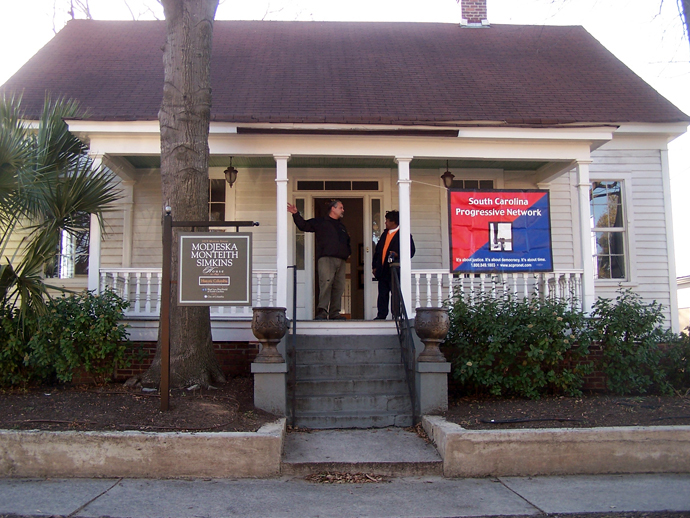
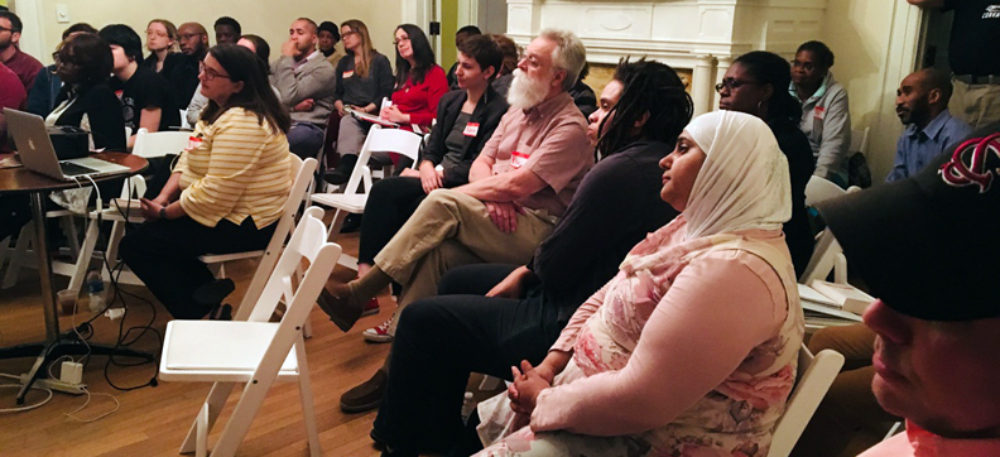
The SC Progressive Network has set up shop in the Modjeska Simkins House in downtown Columbia. We have been using the space for our monthly Midlands meetings over the past year, thanks to Historic Columbia Foundation, which has managed the property since 2007. In February we signed a lease to rent the house, and are now holding regular office hours there.
When Foundation Director Robin Waites handed over the keys, she said, “Modjeska must be smiling right now.”
Ms. Simkins was the matriarch of the state’s civil rights movement. Her work spanned six decades, until her death in 1992. The home where she lived for 60 years sits on a lot at 2025 Marion Street just off Elmwood. It served as office and meeting place, and housed visiting civil rights advocates, including Thurgood Marshall.
“The place has a really good vibe,” said Midlands Co-ordinator John Dawkins. “I’m excited to be moving into a space with so much history.”
Network Director Brett Bursey said, “We haven’t given up on owning our own building, but this is a gracious offer that is a good fit for us right now. Having offices right downtown will allow us to work with interns and volunteers, and will keep us more engaged with what’s happening in the city and in the State House.”
The Simkins House is fully accessible, has two offices, a kitchen, a sun room, a proper front porch and two meeting rooms — which we invite our member groups to use.
One of the first groups to express interest in holding meetings at the Network’s new headquarters is the Greater Columbia Central Labor Council. It has been meeting at the office of the state AFL-CIO, which is in the process of moving outside of Columbia.
“The timing is perfect for us,” said SC AFL-CIO President Donna Dewitt, who serves as Network Co-chair. “We’ll have a place to hold meetings as well as access to office space when we are in Columbia to lobby or attend hearings,” she said. “I think it’s going to be a vibrant place for our Network members to congregate and collaborate.”
Bursey said, “I worked closely with Ms. Simkins for 25 years, and was proud that she called me one of her children. It seems a wonderful opportunity to keep Modjeska’s spirit alive.”
If you are interested in using the House to hold your group’s meetings, call us at 803-808-3384 or email network@scpronet.com.
For more photos of the Simkins House, taken on Moving Day and at our first meeting in our new headquarters, click here.
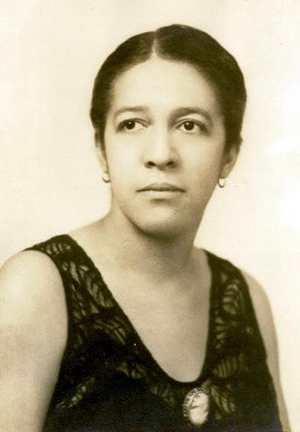
Modjeska Simkins
***************
Join us for a house warming party March 7, 5:30-7pm
Modjeska Simkins House, 2025 Marion St., Columbia
FREE and open to all. Come help us celebrate!
By S.C. Sen. Brad Hutto (D-Orangeburg)
As the nation struggles with its worst economic crisis since the Great Depression some in Washington, D.C., are fighting a rear-guard action to block the President Obama’s stimulus plan.
And among them, U.S. Sen. Jim DeMint, is jockeying to become leader of the heel-dragging pack.
This professional ad man knows the importance of burnishing his brand. He has become a stock fixture on the national media circuit. If you need someone to defend the failed economic policies of former president George Bush, schedule Jim DeMint for your show.
DeMint’s ideas sound good to a dwindling number of true-believers who think tax cuts can solve any problem and that magical forces will repair an economy in disarray without public intervention.
What’s becoming increasingly apparent is that DeMint is not only out of step with Democrats and moderate Republicans, but that he is also out of touch with the real world – the one where South Carolinians live.
DeMint on Tuesday voted against the American Recovery and Reinvestment Act, which fortunately passed the Senate with a 61-37 vote. The stimulus package is designed to get money into the economy quickly through spending projects to save or create 3 million U.S. jobs over the next four years. The version passed by the House Jan. 28 included $3.2 billion for South Carolina’s needs from road repairs to college tuitions.
On ABC’s “This Week with George Stephanopoulos” Feb. 1 DeMint joined a conversation that also included U.S. Rep. Barney Frank, D-Mass., and two chief executives – FedEx’s Fred Smith and Google’s Eric Schmidt.
Google has particular interest for South Carolinians. The company recently opened a computer data center in Berkeley County, and has bought land in Richland County, where it might open another – if demand is there.
But DeMint thought he should lecture the chief executive of one of the most successful American companies about economics, trotting out studies from the conservative Heritage Foundation that favors tax cuts over direct public spending.
Schmidt, a soft-spoken man who measures his words carefully, replied, “I’m worried that tax cuts alone … won’t be sufficient because people are not paying any taxes because they’re not making any money.”
“There are plenty of cases where directed spending does help things to happen more quickly,” Schmidt said. “Most of the [stimulus package] money actually goes to reasonably short-term things in education, state relief, various other things that help people in the very short term. Some combination of all that money has got to get out now to get people going again.”
Schmidt and Smith, the FedEx chief executive, shared one message: Congress needs to act quickly to get the economy moving. “I’m sure this stuff is going to get fixed by you guys, because you’re working very hard on it,” Schmidt said.
“I wouldn’t count on it,” DeMint replied.
This is not the first time DeMint has made such comments.
In a column that ran Jan. 22 in The State he warned Republicans against helping President Obama pass a meaningful stimulus plan. “Should the bill fail to revive the economy, its bipartisan character would inoculate the new president from sole responsibility for what Republicans could otherwise brand “The Obama Recession.”
DeMint is using one of South Carolina’s seats in the U.S. Senate to act like a hedge fund manager – trying to lure citizens and donors to bet that the economic failure his party created will worsen.
South Carolinians can’t afford to be so cynical.
Hutto represents Allendale, Bamberg, Barnwell and Orangeburg counties. He can be reached at CBH@scsenate.org.
The rationale and strategy for universal Internet service
By Brett Bursey
Director, SC Progressive Network
On April 15, South Carolina has to present a plan for the use of the state’s educational broadcasting capability that will be “excess capacity” due to the switch to digital broadcasting.
Because South Carolina is the only state that owns all the educational broadcasting licenses, we have the unique opportunity to be the first state to provide free wireless Internet to all citizens. The 67 licenses owned by SC ETV — and the taxpayer-funded infrastructure — are paid for, so the capability for statewide, free Internet is in hand.
Universal access to the Internet would be the single most significant thing we could do, at no cost to taxpayers, to improve educational, health care and employment opportunities for all South Carolinians; regardless of income or geographic location. Over 250,000 SC school children qualify for free lunches. Many of them also don’t have Internet access, or the skills and tools to take advantage of being online. Many rural communities don’t have Internet access.
The legislature created the Educational Broadband Service Commission to oversee what is referred to as the “educational broadband transition.” The state plans to lease the broadcast spectrum to private telecommunications companies and put the estimated $5 to $8 million annual revenue in the general fund. The actual and future value of the spectrum is unknown.
While we agree with the public/private partnership leases, we submit that the state’s priority concerns may not be reflected in the terms of the leases or the use of the revenue. We call on the Commission, the Joint Bond Review Committee and the Budget and Control Board to use South Carolina’s educational broadcast capabilities to:
• Create a “lifeline broadband service” that would provide a free universal access tier of Internet service for all citizens. This service would be at a level below subscription services and would introduce scores of thousands of new consumers to the Internet. These new users would provide a source of new customers for expanded subscription services to the lease holders.
• Establish a “Citizens Trust” that would use a percentage of the lease revenue to provide tools and training for citizens to access the Internet. Start with the quarter of a million children who can’t afford lunch.
South Carolina, through its already established Educational Broadcast capability, has the unique opportunity to lead the nation in closing the “digital divide.”
The state of Tennessee recently contracted with AT&T for a $600 million upgrade of its broadband network for schools and governments. The investment South Carolina started making in the 1970s puts our state ahead of Tennessee and other states that are now making major expenditures in educational broadband services.
We need to wisely leverage our investment to the benefit of our citizens and our future. For more information on this issue and to find out how you can get involved, call 803-808-3384.
While the SC Progressive Network fights to bring more democracy to this oft-backward state, our Republican-controlled legislature is working to make voting more difficult. Yesterday, the House Judiciary Subcommittee on Election Laws passed out a bill to require all voters to have a state-issued photo ID in order to vote. The argument for the bill is that it will prevent voters from fraudulently pretending to be someone else to cast multiple votes.
Ignoring testimony from the State Election Commission and Network Director Brett Bursey that there are no cases of this happening, and that the current system of requiring either a voter registration card or a state ID is working, the subcommittee passed the bill out to the full committee. Bursey presented the subcommittee with a report by the Brennan Center for Justice that concluded there was a higher chance of being struck by lightning while waiting to vote than someone stealing your identity to vote.
Since House Speaker Bobby Harrell is the prime sponsor of the bill, it is expected to pass the House.
The 2008 legislative elections again saw South Carolina as number one in the nation for the fewest contested races. Only 34 percent of the 170 legislative seats were contested in the general election. The national average is 56 percent.
Out of the 46 SC Senate seats, only 20 were contested. Nine were taken by new members (6 R, 3 D).
Of 124 House seats only 38 were contested. 20 new members (16 R, 4 D).
That’s 83 percent of the 170 seats held onto by incumbents.
The biggest impediment to having a choice in our general elections is the redistricting that was done following the 2000 Census. The Republicans and the Legislative Black Caucus worked out a plan that gave them “safe” districts, that means the winner of the party primary is assured election.
Check out the spread of Wal-Mart.
by Kim Gandy,
President, NOW
The current financial crisis is a feminist issue, and groups like NOW are working to ensure that the revitalization of our economy takes women into account. So, if I sound like I’m taking the successes and setbacks of the economic recovery package personally — well, I am.
In early reports, the recovery package seemed to focus on creating construction and physical infrastructure jobs (which, like it or not, are primarily done by men), even though women’s unemployment rate is nearly as high as men’s. NOW worked with our sister organizations, the Obama transition team, and House and Senate leaders, and–would you look at that!–the American Recovery and Reinvestment Act includes funds for rebuilding our human infrastructure, aimed at helping struggling families and generating jobs in education and health care that women are likely to fill. There are important safety net funds, increases in food stamps and unemployment compensation, tax credits for child care, and much more. Large-scale success for women — I had almost forgotten what that feels like!
By Becci Robbins
Communications Director, SC Progressive Network
SC legislators meet Jan. 28 to discuss a bill that would require women to undergo an ultrasound, be given “certain written materials” and wait 24 hours before obtaining an abortion, a move opponents say poses a prohibitive burden for many poor and working women.
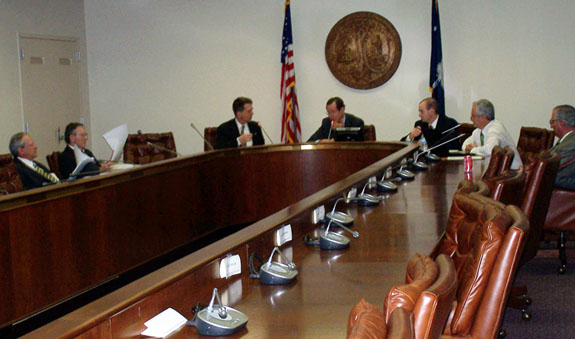
What’s wrong with this picture? I’ll tell you: these gents are debating what goes on in my uterus. Some of them have been doing this for years. Hard to believe, but they somehow feel entitled to making decisions about the most intimate details of my health and welfare. As a grown woman, I find their presumption insulting.
Seriously. Imagine a group of women discussing how long men should wait before being allowed to have a vasectomy, or whether they should be given Viagra, and under what circumstances. Now stop laughing and imagine that these women had the power to make these choices for men.
Fat chance.
Hi to all my friends,
As you know, we donated Sean‘s organs and he saved the life of five people. I just signed up, and ask you to please join me to give the gift of life. It only takes a few minutes and it is considered a legal document, like a will, so your last wishes be carried out.
Remember, it is a hard decision for your loved ones to make and this way they will know for sure what your last wish is. Please join me and many others to be an organ donor, go to www.every11minutes.org and sign up.
Love,
Elke
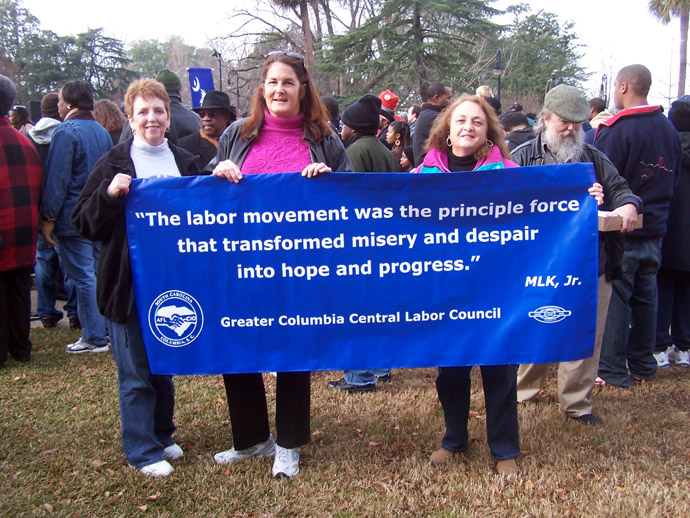
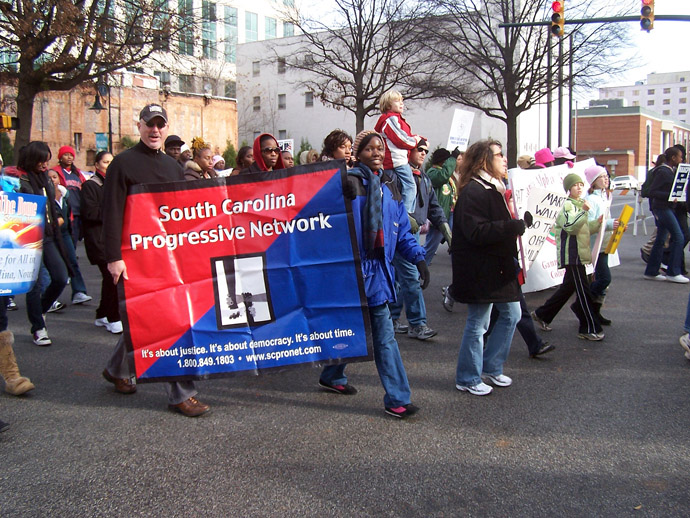
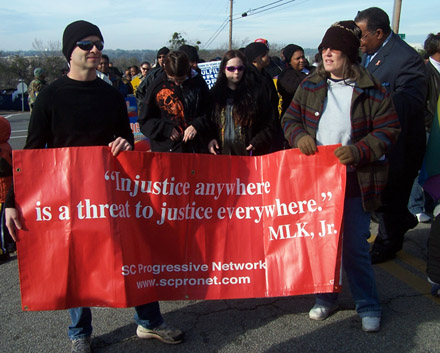
The SC Progressive Network helped boost the numbers at this year’s King Day at the Dome, which attracted fewer people than in years past. We can assume that many of the folks that filled the State House grounds last year are in DC to witness an historic inauguration.
Even here, we share the feeling of expectation and celebration. Braving the winter chill, these Network groups were in the crowd at the State House to remember the life of Martin Luther King, Jr.: Charleston CLC, Columbia CLC, AFL-CIO, SC Equality, Sean’s Last Wish, SC Pride, PFLAG, Carolina Peace Resource Center, Grimke Sisters and Columbia’s Unitarian Universalist Fellowship.
Thanks to everyone who turned out.
Network Treasurer James Carpenter
Cindy Rickards, Jenny Sample and Donna Dewitt

The Rev. Dr. Neal Jones, Unitarian Universalist Fellowship
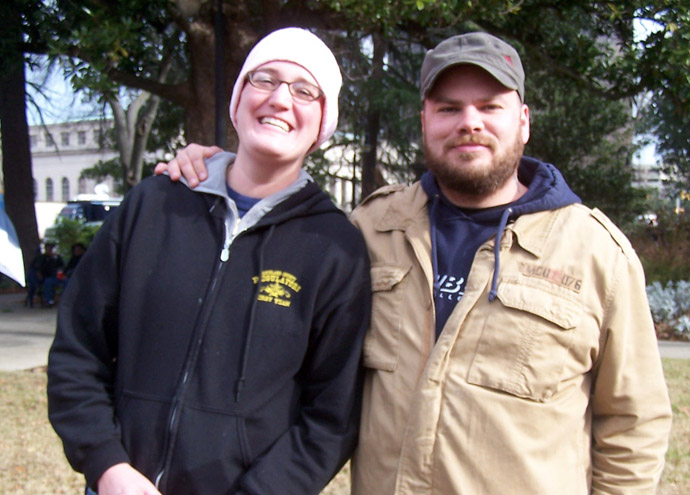
Network Midlands Co-ordinator John Dawkins
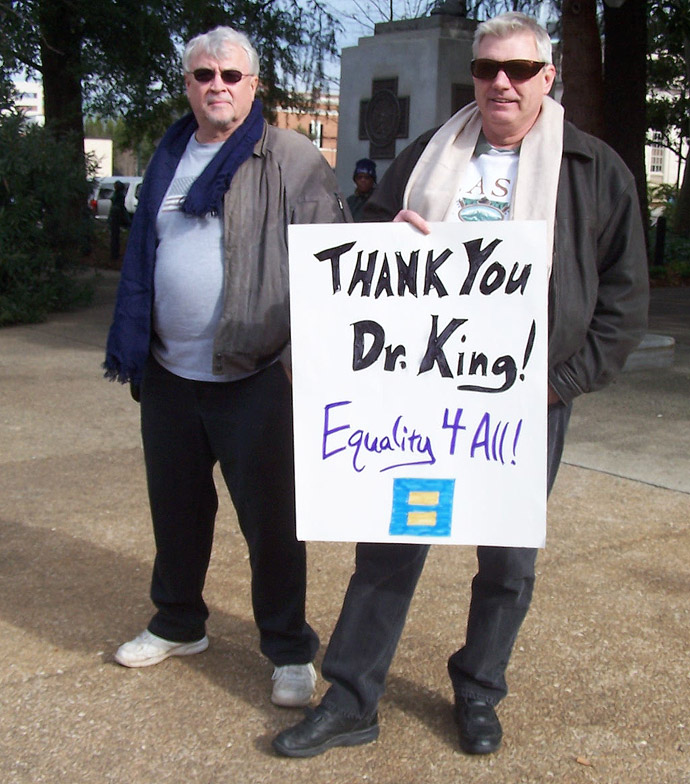
John Converse and Michael Vandiver
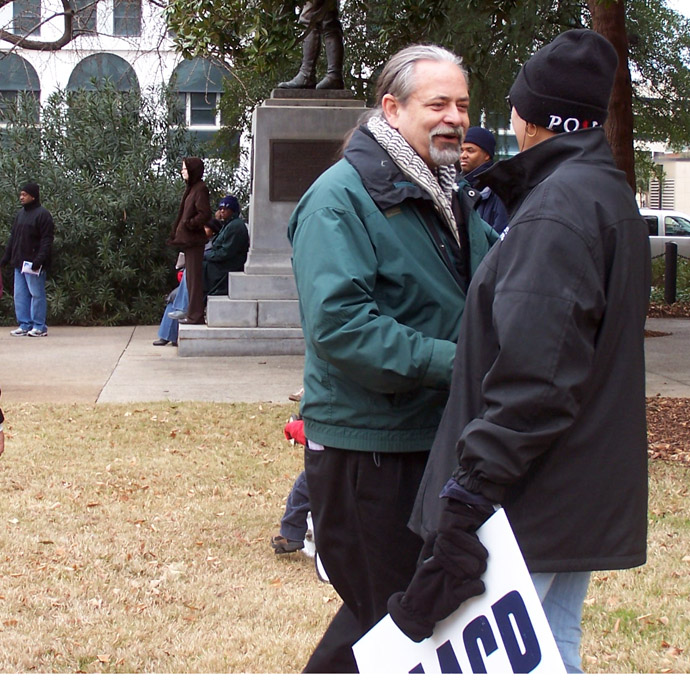
Network Director Brett Bursey
For more photos, click here.