Coal is never “clean”

INSTITUTE INDEX
Compiled by the Institute for Southern Studies

• Size of the coal ash sludge pond that broke at TVA’s Kingston power plant on Dec. 22: 40 acres

• Estimated amount of coal ash sludge that spilled from the pond: 1.1 billion gallons

• Rank of the incident among U.S. environmental disasters in terms of waste spilled: 1

• Land covered by the sludge: 300 acres

• Depth of the sludge at its highest point: 6 feet

• Number of properties damaged: 42

• Factor by which arsenic levels found in samples taken two miles downstream from the spill exceeded safe drinking water limits: 30

• Days it took before authorities issued a notice advising residents not to touch the waste or drink water from affected wells and springs: 7

• Number of breaches in the same ash pond over the past six years: 2

• Tons of coal combustion waste produced each year by US coal plants: 129 million

• Rank of coal combustion waste among top waste streams in the US: 2

• Number of federal regulations governing coal combustion waste: 0

• Year EPA last considered regulating coal combustion waste: 2000

• According to EPA, number of times the risk of getting cancer from coal ash lagoons exceeds safety standards: 10,000

• Number of sites around the country that the EPA says have proven damage from coal ash: 24

• Number of US power plants dumping more coal waste into ponds then the one that failed at Kingston: 22

All sources on file with the Institute for Southern Studies; for more information, e-mail sue@southernstudies.org.


Seeking justice for Sean Kennedy

by Elke Kennedy
Sean’s Last Wish

I was told yesterday that Sean’s murderer, Stephen Andrew Moller, will be eligible for parole as of 12/28/08! He has served less then 7 months. Most likely the parole hearing will be in February 2009. They are currently doing the pre-parole investigation, and now would be the best time to for them to receive as many handwritten letters as possible to ask the parole board to deny his parole, you need to add what happened and why you believe he should not get parole. I will send out call for a letter campaign to all of my supporters to stop this from happening.

You all had always said if there is anything you can do for me to let you know – well this is one thing I need your help – without these letters (hundreds) I think he might just get parole. The juditional system is not fair and has lots of gaps. But let’s make a statement as a community to say enough is enough.

I know you agree that he certainly did not get a high enough sentence and to allow him to get out of jail already is ridiculous. It would be awesome and certainly very much appreciated from me and my family if you could help by taking a few minutes and writing a letter to the Parole board in the next couple of weeks.

Thank you in advance for your time and support to help me keep Sean’s murderer in jail.

Here is the information you will need:

Department of Probation, Pardon and Parole Services
2221 Devine Street, Suite 600,
PO Box 50666
Columbia SC 29250

Please add this information as a reference on your letter as the topic: Parole for Stephen Andrew Moller – SCDC ID # 00328891;
(eligible for parole after 12/28/08).

If you decide to send a letter, please let me know – I would like to know how many letters were sent so I can make sure that it is known (just in case). E-mail me at elke@seanslastwish.org.

Again, I want to thank all of you for your support and caring in these last 19 months.

***********
For background on Sean’s case, read an earlier post here.

Tribute to Harriet McBryde Johnson

Today’s New York Times Magazine ran a piece by Princeton bioethics professor Peter Singer to honor Charleston lawyer Harriet McBryde Johnson, who died in June. Singer, a leader in the animal rights movement, and Johnson, an activist with a national profile in the disability community, sparred over the years in public forums and in private emails, all the while maintaining a mutual respect.

Johnson was a longtime member of the SC Progressive Network, and was honored with the organization’s Thunder and Lightning Award in 2004. To read an earlier post recognizing Johnson’s death, click here.

*****************

By PETER SINGER
New York Times Magazine

I met Harriet McBryde Johnson in the spring of 2001, when I was giving a lecture at the College of Charleston. Her brand of Southern etiquette prescribed that if you’re not prepared to shoot on sight, you have to be prepared to shake hands, so when I held out mine, she reached up from her powered wheelchair and took it with the three working fingers on her right hand. She added that she was attending my lecture as a supporter of Not Dead Yet, the disability rights organization that a year and a half earlier blockaded Princeton University’s Nassau Hall in protest against my appointment as a professor of bioethics. I told her I looked forward to an interesting exchange.

My lecture, “Rethinking Life and Death,” was a defense of the position that had aroused such vehement opposition. I pointed out that physicians routinely withdraw life support from severely disabled newborns, and I argued that this is not very different from allowing parents to decide, in consultation with their doctors, to end the life of a baby when the child has disabilities so serious that the family believes this will be best for the child or for the family as a whole.

When I finished, Johnson, who was born with a muscle-wasting disease, spoke up. I was saying, she pointed out, that her parents should have been permitted to kill her shortly after her birth. But she was now a lawyer, enjoying her life as much as anyone. It is a mistake, she said, to believe that having a disability makes life less worth living.

Our exchange of views continued for a few minutes in the lecture theater, and by e-mail afterward. Years later, when I read her autobiographical book, “Too Late to Die Young,” I wasn’t surprised to see “arguing hard” listed among the pleasures of her life.

Continue reading →

Warren Invocation Causing Rift With Progressives

This piece quotes longtime SC Progressive Network member Rev. Candace Chellew-Hodge, associate pastor at Garden of Grace United Church of Christ in Columbia and author of Bulletproof Faith, A Spiritual Survival Guide for Gay and Lesbian Christians.

*************

By Sam Stein

Huffingtonpost.com

Ever since Barack Obama was elected president, the media has been pining to write a story about liberal dissatisfaction with his transition efforts. By and large, the meme has been blown out of proportion, as the press overestimated how divisive Obama’s cabinet choices were for progressives.

The press may now have its conflict moment. And it comes in the form of the spiritual leader chosen to launch Obama’s inauguration.

On Wednesday, the transition team and Joint Congressional Committee on Inaugural Ceremonies announced that Rick Warren, pastor of the powerful Saddleback Church, would give the invocation on January 20th. The selection may not have been incredibly surprising. Obama and Warren are reportedly close — Obama praised the Megachurch leader in his second book “The Audacity of Hope.” Warren, meanwhile, hosted a values forum between Obama and McCain during the general election. Nevertheless, the announcement is being greeted with deep skepticism in progressive religious and political circles.

“My blood pressure is really high right now,” said Rev. Chuck Currie, minister at Parkrose Community United Church of Christ in Portland, Oregon. “Rick Warren does some really good stuff and there are some areas that I have admired his ability to build bridges between evangelicals and mainline religious and political figures… but he is also very established in the religious right and his position on social issues like gay rights, stem cell research and women’s rights are all out of the mainstream and are very much opposed to the progressive agenda that Obama ran on. I think that he is very much the wrong person to put on the stage with the president that day.”

Continue reading →

The wisdom of pardons

By Kemba Smith

The nomination of Eric Holder as the next U.S. attorney general has renewed concerns about the end-of-term clemencies granted by President Clinton.

High-profile names such as Marc Rich grabbed headlines at the time, but many other people with no political influence benefited from the president’s mercy.

I am one of those people. If I had not received a commutation, my first-time conviction for a non-violent offense would have kept me in prison until 2016 (with good behavior) because of the harsh mandatory sentencing laws for crack cocaine. My 1994 prison sentence grew out of my boyfriend’s trafficking in crack. After he was murdered, the government charged me with conspiracy to distribute the crack that his drug ring distributed. During my court hearings, prosecutors acknowledged that I never sold, handled or used any of the drugs involved in the conspiracy.

Continue reading →

Congratulations, Donna!

On Dec. 6, friends, family and colleagues gathered at ILA Hall in Charleston to honor SC AFL-CIO President Donna Dewitt for her years of service to the labor community in South Carolina. The event was also a fundraiser, with the $30,000 raised going toward a new building, which will be named for Donna. 

Donna is Co-chair of the SC Progressive Network. We couldn’t be more proud of her accomplishments nor more grateful for our long association.

SC Professional Firefighters President Mike Parrotta and SC AFL-CIO President Donna Dewitt. To see more photos of the event, click here.

Women in unions earn more, get better benefits

A new report by the Center for Economic and Policy Research documents a large wage and benefit advantage for women workers in unions relative to their non-union counterparts.

The report found that unionized women workers earned, on average, 11.2 percent more than their non-union peers. In addition, women in unions were much more likely to have health insurance benefits and a pension plan.

“For women, joining a union makes as much sense as going to college,” said John Schmitt, a senior economist at CEPR and the author of the study. “All else equal, joining a union raises a woman’s wage as much as a full-year of college, and a union raises the chances a woman has health insurance by more than earning a four-year college degree.”

Continue reading →

Problems voting?

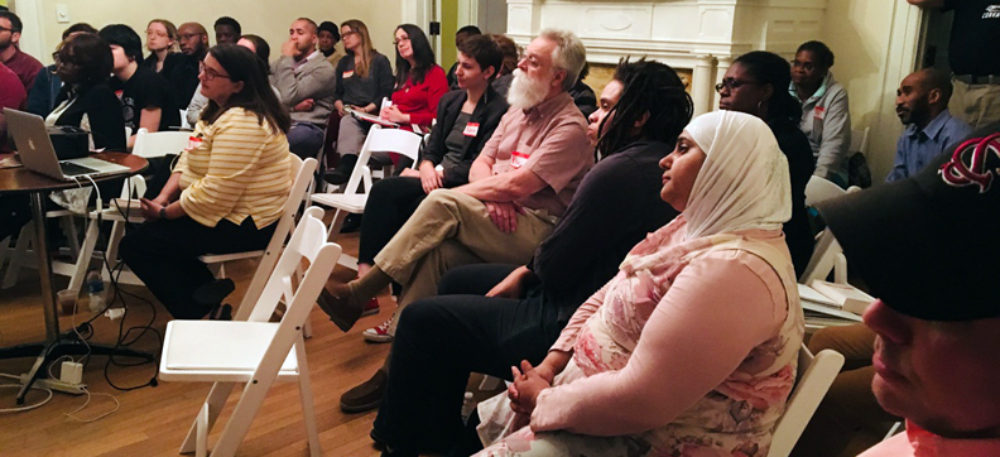
The public is invited to share any problems they encountered while registering or voting in the recent election in front of a panel of county election officials, council members, legislators and voting rights advocates. Data collected at the forums will be used to help shape voting reforms so that future elections will run more smoothly. Speakers will be allotted three minutes each. For more information, call the SC Progressive Network at 803-808-3384 or e-mail network@scpronet.com.

Town Hall Meetings

Columbia: Dec. 4, 5:30-7pm, Council Chambers, 2020 Hampton St.

Charleston: Dec. 9, 5:30-7pm, Charleston City Council Chambers, 4900 LaCross Rd.


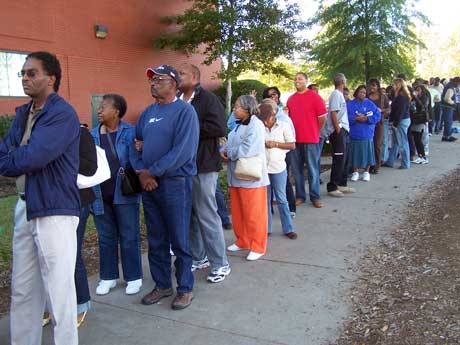
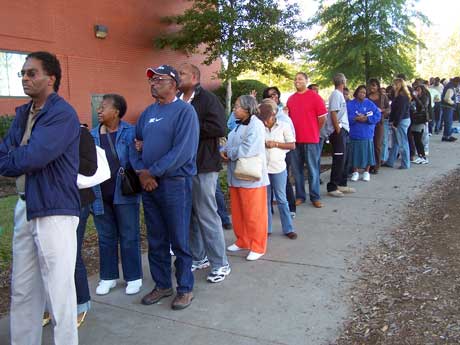
Voters wait up to four hours to vote absentee in Richland County on Oct. 31. For more photos, click here.

DHEC deja vu

By Becci Robbins

Today The State newspaper wrapped up DHEC Under Fire, an “exclusive” series exposing the failure of the state agency charged with protecting South Carolina’s environment. It was oddly familiar. In 1999, the alternative newspaper POINT ran a similar package. I remember it well; I was managing editor and wrote most of the stories. You can read them here.

This was the introduction we ran:

This issue is dedicated to South Carolina’s environment. Seems that while we weren’t looking, this state became the country’s garbage dump. We hope this issue of POINT gives you something to think about and, just maybe, something to fight for.

By way of full disclosure, readers should know that the publisher and editor of POINT have for the past year been working with grassroots groups from across the state on an initiative to restructure DHEC, the state’s environmental agency.

Some will argue that our connection to the project renders us incapable of covering this story without bias. Perhaps.

But we believe our experience lends us a valuable perspective that we could not have as a member of the “straight” media. For many months, we have been meeting with lawyers, legislators, community leaders and environmental activists, some of whom go way back with DHEC. We have heard them talk with the freedom they would not if they were “on record.” While we have not used any quotes from those meetings or discussed what went on in them, the discussions deepened our understanding of how DHEC works — and how it doesn’t.

Finally, we invite anyone at DHEC, including those who declined to be interviewed, to respond to our coverage in this issue. We will gladly publish any written responses in the next POINT.

While it’s good to see The State finally give DHEC the sort of scrutiny it deserves, it’s too bad it took them so long to do it. Frankly, it’s no surprise. The State, ironically, has a long history of doing what it now accuses DHEC of doing: coddling industry and putting the interests of big business above the public interest.

The paper has been unable, or unwilling, to connect the dots that draw the clear picture of systemic problems that allowed DHEC to operate so irresponsibly and with such devastating consequences. There is no excuse. We sent the newspaper the same press releases we sent the rest of the media informing them about our grassroots campaign and legislation designed to reform the environmental agency. They ignored us. No telling how much pollution went unchecked as a result.

The State’s reporters said they interviewed 200 people to write their recent DHEC series. Not one of them was from the SC Progressive Network, the organization that initiated the move to reform the agency and called the first meeting of legislators and activists to explore the issue. That’s shoddy reporting, at best. At worst, it reveals a pettiness unbecoming of the state’s main newspaper.

POINT cover, Winter 1999

Employee Free Choice Act

AFL-CIO:

In this economic crisis, working families are struggling. CEOs are raking in hundreds of times more than their employees earn and then giving the boot to workers who try to exercise their freedom to form unions. CEOs wouldn’t work a minute without a contract — but they do whatever it takes to keep their workers from gaining contracts. Three minutes of your time today could help restore the balance to our economy.

Watch this video, then click here to sign our petition.