Volunteer to enter voter registration data

The Richland County Voter Registration office needs volunteers on Saturday, Oct. 18, to help enter registration information at its office at 2020 Hampton St. in downtown Columbia. The great work that everyone has done in Richland has left the election office swamped. We can’t start our Get Out The Vote drive until we have all the folks entered in the system.

Volunteers are needed from 9am until 5pm. Call the Missing Voter Project‘s John Dawkins at 803-467-1981 if you can help, even if it’s just for an hour or two.

Legislators ask attorney general to issue opinion on emergency ballots

At the urging of the SC Progressive Network, state legislators have requested that SC Attorney General Henry McMaster issue an opinion on the state statute regulating emergency ballots at polling places.

“After the failure of many of the voting computers in Horry County during the January Republican presidential primary, where many voters were turned away from the polls, we found that no law requires precincts to have emergency paper ballots,” said Network Director Brett Bursey. Horry County election official Lisa Bourcier reported that “80-90 percent” of the county’s more than 300 machines malfunctioned. Voters in many of the county’s 118 precincts were told to come back later, on a cold and rainy day, because emergency paper ballots ran out shortly after the polls opened and the machines failed to operate.

Rep. Tracy Edge, a McCain campaign official, reported that his mother-in-law was only the 12th person to vote in her precinct, and that she was given a blank piece of paper because they didn’t have emergency ballots. State Election Commission spokesperson Chris Whitmire was widely quoted as telling people to vote on “paper towels” if necessary.

Section (A) of 7-13-430 of the state law used to read: “There must be provided for each voting place where voting machines are used as many ballots as are equal to ten percent of the registered qualified voters at the voting place.” The statute was amended in 2000 to read: “There must be provided for each voting place where voting machines are used a number of ballots not to exceed ten percent of the registered qualified voters at the voting place.”

Sen. Phil Leventis, along with Rep. Gilda Cobb-Hunter and Rep. James Smith, requested that the Attorney General issue an opinion on the statute. “Our switch to electronic voting statewide in 2004 accentuates the need for a back-up system of paper ballots,” Leventis said. “The current statute has no minimum number of emergency ballots required, and does not protect our right to cast a ballot in the event of machine failure.” Leventis was opposed to the state’s purchase of the touch-screen computers that do not produce a durable, and voter-verifiable, paper ballot that can be used to verify a recount.

Beaufort County’s early voting was stymied on Oct. 6 when its computers failed to come online due to an incorrect password. The problem was detected Oct. 4 and not resolved until the afternoon of the 6th. The county blamed the State Election Commission for providing the wrong password. The SEC said Beaufort County election officials were to blame.

Maryland Attorney General Douglas Gansler recently called for emergency paper ballots to be used in case of long lines to vote on machines. Maryland, one of only three states (Georgia and Delaware) using paperless computer voting machines like those in South Carolina, has decided to dump the computers in 2010 and switch to an optical scan system that uses paper ballots that can be hand marked if the machines malfunction, or the electricity is off.

In Pennsylvania, voting rights advocates are pushing the Secretary of State to change his ruling that emergency ballots will not be used unless all the machines in a precinct fail, urging the paper ballots be distributed if half the machines aren’t working.

After the Horry County machine failure, State Republican Party Chair Kayton Dawson told CNN that he was confident of a “full and fair count” and noted that “there is always a back-up in case of a machine malfunction and a ballot can’t be cast.”

Leventis said, “Actually, there is no mandated back-up in case of machine failures, and that is why we have taken this matter to the Attorney General.”

“This Nov. 4 we expect to see record numbers of voters,” Bursey said. “If machines fail, as they have in the past, we shouldn’t have to rely on paper towels to insure that every vote counts.”

Ten years later, still no hate crime law

By Elke Kennedy
Sean’s Last Wish

This week, Americans are mourning the 10-year observance of the tragic murder of Matthew Shepard. It’s hard for any of us to relive the memories — a promising 21-year-old college student beaten to death and tied to a fence outside of Laramie, Wyo., just because he was gay.

Harder still for me. Watching the coverage of this high-profile case, I could not foresee that a similar tragedy would happen in my own family a few years later.

On May 16, 2007, my son Sean Kennedy was leaving a bar in Greenville. A car with three boys in it was parked outside the door, and one of them called Sean over, asking him for a cigarette. Sean gave him one and was walking away when Stephen Andrew Moeller got out, approached my son and called him anti-gay epithets. He punched him in the face, and Sean fell to the ground.

Sean’s murderer got back into the car and left my son dying there. A little later, he left a message on Sean’s friend’s phone: “You tell your faggot friend that when he wakes up he owes me $500 for my broken hand.” When I got to the hospital, the doctors told me that Sean’s injuries were not survivable because his brain had separated from his brain stem. Sean was pronounced brain dead at 11:20 that evening. He loved music, was happy with who he was and stood up for what he believed in. He wanted to be a Web designer. He was only 20 years old.

As hard as the stories of Matthew and Sean are to hear, they represent only two out of hundreds of violent incidents targeting gay and transgender people across the country.

Sadly, South Carolina’s absence of any hate crimes law makes gay and transgender residents more susceptible targets of such crimes. The FBI’s 2006 reporting found that 16 percent of hate crimes were based on sexual orientation — even more than crimes based on ethnicity or national origin. (South Carolina does not identify or track hate crimes statistics, so they are not included in national statistics.)

It is inexcusable in 2008 that South Carolina remains one of only five states in the country that does not have a hate crimes law. Tragically coincidental is the fact that Wyoming, where Matthew was murdered in 1998, also is among those five.

On June 11, Stephen Andrew Moeller was given a three-year sentence for Sean’s murder. Since he received credit for days served before he was released on bond, he will have to serve only 10 months in prison before he is eligible for parole. This shockingly short sentence sends the message that it is OK to attack and kill people just because you don’t like who they are. Justice was not done for my son.

Sean’s murder was not considered a hate crime because there is no such thing in our state. Every single one of our members of Congress also voted against the national Matthew Shepard Act, claiming that our state could handle these types of cases without federal laws. But this was certainly not so in Sean’s case.

We need a federal law to protect gay and transgender people such as Sean, but South Carolina can’t wait while Congress keeps stalling on an inclusive act and more young people like Sean are murdered. We must act now.

However, just changing our laws is not enough. We must change hearts and minds, and we must work together by embracing diversity, supporting and standing with each other and speaking out.

After Sean’s death, I founded Sean’s Last Wish (www.seanslastwish.com) to work on educating the public about the gaps in the law and the lack of protection. We educate about how bullying, intolerance, hatred and violence lead to these senseless crimes, and we provide information and resources about how everyone can help prevent hate crimes.

It’s time to honor Matthew’s and Sean’s legacies by sending this strong message: Bullying, hatred and violence have no place in our hearts, homes, churches, states and countries. No mother should ever have to bury her child. No mother should ever lose her child to hate and violence. No mother should ever have to fight for justice for her child.

Making change, one voter at a time

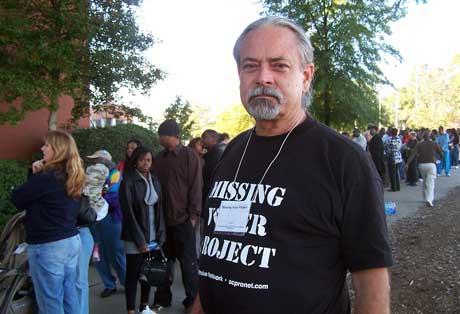
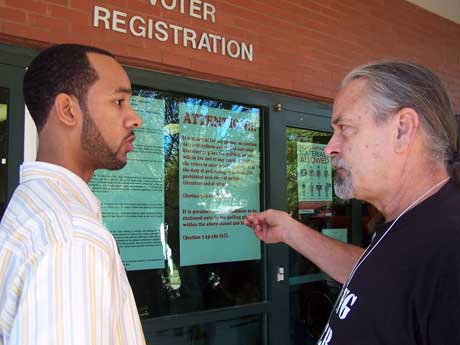
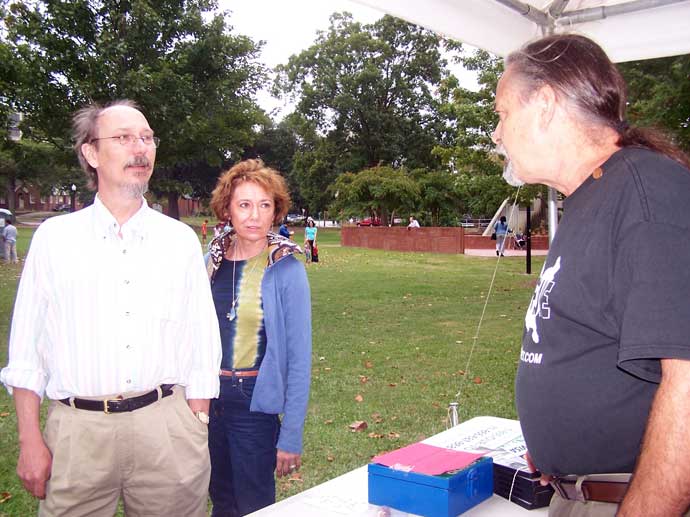
SC Progressive Network Midlands Coordinator John Dawkins oversees the registration drive on North Main St. in Columbia on Oct. 4, the last day to register new voters before the November elections.

Dawkins and a crew of volunteers registered 199 new voters in an afternoon. Similar volunteers across the state have spent months recruiting new voters as part of the Network’s Missing Voter Project.

Why Palin drives feminists crazy

By Becci Robbins

SC Progressive Network

She’s only been on the scene five weeks, and I’m suffering severe Sarah fatigue. You know which Sarah. The one tapped by the McCain camp in a cynical attempt to shore up the crippled wing of his fundamentalist base. The one who has been winking and obfuscating her way through a tightly scripted campaign that is relying on style over substance, sound bites over sound public policy.

As a woman, I want to see Sarah Palin do well, knowing that her performance reflects — fairly or not — on all women and our perceived ability to lead. As a feminist, I want to enroll her in a women’s studies program. If she knew her history, she couldn’t so easily impose her anti-choice ideology, wouldn’t presume to know what’s best for all women.

Palin holds an extreme position on reproductive rights, opposing contraception and access to abortion, even for rape victims. And yet she cried foul when reporters dared mention her unmarried pregnant teenage daughter — never mind that Palin’s abstinence-only agenda makes it a legitimate point of discussion. Our government has spent over $1 billion to fund abstinence-only sex education programs since 1996. That approach has failed countless young women, including, apparently, Palin’s own daughter.

Rather than talk about it, Palin simply said that her children should be off limits. But in the vice-presidential debate she repeatedly mentioned her son in Iraq and her special-needs child. She did not mention her pregnant daughter. Apparently it’s okay to talk about her kids as long as they serve the campaign’s interest.

Yes, Palin proudly touts her pro-life credentials. While she sits in her office on a couch covered with a bear skin, the head still attached. While she shows off photos of her and her four-year-old daughter posing with the caribou she shot. While advocating hunting wild game from the safety of a low-flying aircraft.

When Palin talks about life, she is referring to pre-born human life. Not the lives of grown women. Not the lives of children her running mate would deny health care. Not, certainly, the lives of the animals with whom we share this planet. Not even the life of the planet itself, which will continue to suffer the devastating effect of America’s petroleum addiction, which Palin advocates when she gleefully chants, as she did in the debate, “Drill, baby, drill!”

The debate was little more than cheap theater. The McCain camp had negotiated its terms, in effect dumbing down the debate. The contract limited the candidates’ responses to 90 seconds, discouraged the moderator from asking follow-up questions, and prohibited the candidates from asking each other questions. The format helped ward off the sort of embarrassment an unscripted Palin revealed in recent network television interviews.

Instead of an honest debate, we had Sen. Joe Biden biting his tongue — warned by his handlers to play nice — and Gov. Palin ignoring the moderator’s questions and providing instead well-worn one-liners, off topic and sometimes off the wall. She was like a Chatty Cathy doll programmed with conservative talking points. Pull the string, and she spouts a few sentences.

Fortunately, I’m not the only one underwhelmed by her performance. A number of conservative pundits have grudgingly admitted that Palin is not ready to be a heartbeat away from the presidency. Kathleen Parker’s Sept. 26 editorial, in which she suggested Palin pull herself out of the race, garnered the most attention. “If BS were currency,” Parker wrote, “Palin could bail out Wall Street herself.” If she were a man, she continued, we’d be laughing; but since she’s the first woman on a Republican presidential ticket, we can’t say the painful truth.

In earlier editorials, Parker was Palin’s biggest cheerleader. “Palin is everything liberals have always purported to want for women — freedom to choose, opportunities for both career and family, a shot at the top ranks of American political life,” she wrote. “With five children and an impressive resume, Palin should be Miss July in the go-girl calendar.”

In an editorial she wrote after the Republican convention, she gushed, “No one is going to be embarrassed by John McCain’s maverick pick.”

What a difference a few weeks make.

And in a twist of irony, the pundit who has made a career out of skewering the opposition with barbs aimed, more often than not, at women on the Left, got a taste of her own venom. After her editorial pleading for Palin to pull out of the race, she found herself on the receiving end of her party’s most rabidly partisan element. In her latest piece, she writes about being called an idiot, a traitor, about people writing angry and threatening letters.

Surprised and dismayed, she writes, “Anyone who dares express an opinion that runs counter to the party line will be silenced. That doesn’t sound American to me.”

Sadly, that is the America she helped create.

There are lessons here for us all. May we learn them before it is too late.

SC Election Protection volunteers needed

866-OUR-VOTE Hotline Set Up in South Carolina

The SC Progressive Network is once again organizing nonpartisan election protection work to ensure that all eligible voters’ ballots count in the upcoming election. In the past two general elections, we responded to calls to the 866-OUR-VOTE toll-free hotline set up for voters to call if they had problems at the polls. The hotline received over 500 calls.

While most of the calls were from confused voters, some reported incidents of voter intimidation and efforts at vote suppression. Some calls were referred to SLED or the Justice Department. We were able to deal with most problems by having a volunteer call the voter. With the assistance of volunteer attorneys and informed volunteers, we were able to dispatch someone directly to most of the problem precincts.

We are assembling a directory of attorneys and informed volunteers willing to respond to calls for help in their county on Election Day. While most problems can be resolved by telephone, some require going to the problem precinct.

We need help on Nov. 4 and in the days leading up to the election. Election Protection Volunteers (not necessarily attorneys) are needed to deliver signs to the county election boards for placement in the precincts, to monitor the operation of the voting computers and to report problems at the precincts. A South Carolina Legal Manual prepared by the Election Protection Coalition is available to volunteers that answers a wide range of election-related questions.

This is a nonpartisan effort. Participants can neither support or oppose candidates, and must offer assistance regardless of voters’ party affiliation.

To volunteer, please contact Brett Bursey at 803-808-3384 or network@scpronet.com. We will need your contact information, your hours of availability and services you are offering. Your information will be shared only with coordinators of the Election Protection coalition. There will be a volunteer training by conference call.

For details on the Election Protection coalition click here.

Students and ex-offenders unclear about voting

The State picked up part of the SC Progressive Network‘s recent press release on the confusion over ex-offenders’ voting rights. It’s tacked onto the end of this piece about student voting.

*********************

Student voters face barriers –
Geography, rules complicate process for college youth

By Wayne Washington

They have provided much of the passion in this presidential race. They have put up signs, answered phones, swamped campaign Internet sites and sworn to be there for their candidate on Election Day.

But past elections show college students can be an unreliable voting group. Part of the reason is confusion about whether they can vote in the county where they attend school. Or, others say, it’s the hassle of having to cast an absentee ballot.

“The enthusiasm of the campaign runs into the reality of voting by absentee ballot or even remembering to vote,” said Blease Graham, a political science professor at the University of South Carolina. “There are a lot of potential barriers.”

College students, of course, are not all residents of the place where they attend classes. Typically, large colleges enroll students from across the country.

Elections, however, are local functions, administered by local officials. Different localities have different rules, further complicating things for students.

Chris Whitmire, public information officer for the S.C. State Election Commission, said students have three choices when it comes to how they vote.

If they already are registered to vote in another place, they can contact election officials there to request an absentee ballot.

In addition to voting by absentee ballot, students can return to their hometowns to vote. However, students do have a third option — changing their place of residence so they can vote in the county where they attend college.

But that can be a little tricky, Whitmire said. “You have to know the address of your dorm,” Whitmire said. “They can’t use a post office box. They have to put you in the right district.”

Students who want to change their place of residence and vote in South Carolina have until Saturday to do so. There is no required length of residency.

Whitmire said information on the state Election Commission’s Web site could answer other questions students might have about registering and voting.

OTHERS CONFUSED TOO

Students aren’t the only ones who may be confused about their voting rights. Many with criminal records, especially those who have been incarcerated, often wrongly think they forever forfeit their right to vote.

Felons and those who have broken the state’s elections laws are not eligible to vote until they complete the terms of their legal punishment.

The state Election Commission recently sent county officials a memo outlining how such voters can cast ballots. First, they have to re-register with county voting officials by submitting a registration application. County officials then determine whether the potential voter meets eligibility requirements.

Local election boards can ask for proof that the voter’s legal punishment has been completed, though that proof is not required by law.

In a recent study, the S.C. chapter of the American Civil Liberties Union found 36 S.C. counties require proof that legal punishment has been completed.

“If additional proof is not required by law, the state Election Commission should be advising the counties not to require proof that an offender has completed a sentence,” said Brett Bursey, director of the S.C. Progressive Network, a social and economic advocacy group. “This added requirement burdens the 18,000 citizens a year who have paid their debt to society, and may result in them not voting.”

State Election Commission Complicates Voting Procedures for Ex-offenders

Voting Rights Remain Unclear for SC Citizens Who Have Served Their Sentences

In light of a recent study that revealed confusion among county election directors regarding procedures for ex-offenders’ voting rights, the State Election Commission (SEC) yesterday sent a memorandum to the 46 county election directors advising them that they “may ask the voter for proof of completion of their sentence, but this is not required by law.”

This discretionary additional requirement may depress the vote among ex-offenders, said Brett Bursey, director of the SC Progressive Network. “If additional proof is not required by law, the State Election Commission should be advising the counties not to require proof that an offender has completed a sentence. This added requirement burdens the 18,000 citizens a year who have paid their debt to society, and may result in them not voting.”

South Carolina’s voter registration form includes a “Voter Declaration” that the registrant must sign, and face criminal penalties for falsely taking the oath. No additional proof is required to prove their US citizenship or mental competency. Ten counties accept the oath as proof that the registrant is not serving a criminal sentence.

On Sept. 17, the SC Progressive Network and the SC ACLU held a press conference to release the results of a study that found county election directors around the state had different methods of dealing with ex-offenders who wanted to register to vote. The study concluded that, since there were no laws regulating the procedure, all counties should simply allow ex-offenders to register by signing the registration form.

“We daily encounter citizens who tell us they can’t vote because they are ex-offenders.” Bursey said. “Unfortunately, the citizens don’t know the laws, the county election boards don’t know the laws, and the State Election Commission is unwilling to define the laws.”

While the SEC has recognized that there is no law requiring ex-offenders to provide proof of completion of sentence to register, its officials claim they are unable to direct the independent county election boards not to do so.

When asked if they will issue a press release advising ex-offenders of their right to register, an SEC spokesperson said, “That’s not our job.”

Sept. 24 SC Election Commission memorandum:

Any person who is convicted of a felony or an offense against the election laws is not qualified to register or to vote, unless the disqualification has been removed by service of the sentence, unless sooner pardoned.  Service of sentence includes completion of any prison/jail time, probation, parole, and payment of restitution.

Federal and state courts provide the SEC with lists of persons convicted of felonies or crimes against the election laws. Those persons are removed from the state’s list of active, registered voters. The SEC notifies each voter whose name is deleted from the list. Voters have 20 days from the date the notice is mailed to appeal. Appeals must be made to the SEC.

Once a person who was convicted of a felony or offense against the election laws serves their sentence; they may register or re-register.

The following process should be followed for voters who are re-registering after being made inactive due to a conviction.

• The voter must re-register with the county voter registration board by submitting a voter registration application.
• The board makes the final determination of whether the voter meets the qualifications to register.
• The board may ask the voter for proof of completion of their sentence, but this is not required by law.
• The voter is either added as a new voter or reinstated to the voter registration system
• If the board determines a voter should be reinstated to active status, the board must notify the SEC in writing. Once notification is received, the SEC will reinstate the voter.

Thank you,

Chris Whitmire
Public Information Officer

South Carolina State Election Commission 
Post Office Box 5987
Columbia, S.C. 29250
Tel: 803.734.9070
Fax: 803.734.9366