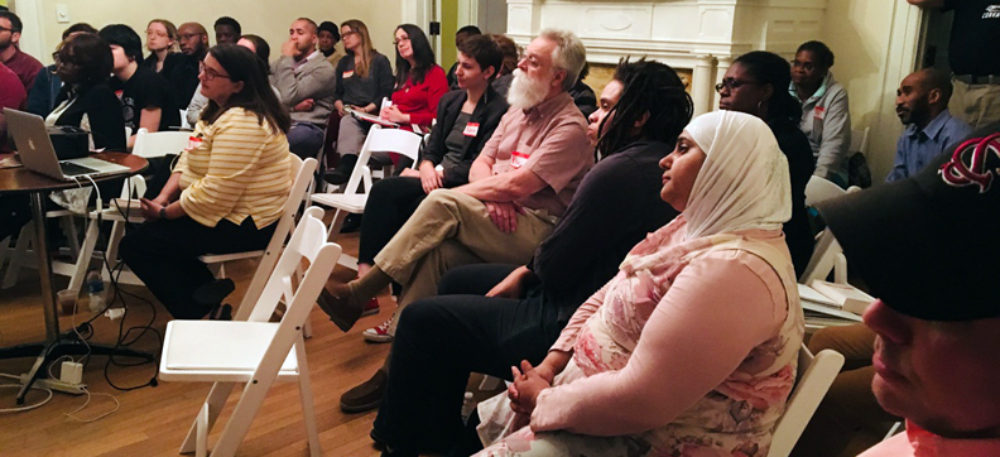
Council Passes Ordinances Prohibiting Discrimination in Housing and Public Accommodations
Today the Columbia City Council voted unanimously to pass ordinances prohibiting discrimination on the basis of sexual orientation or gender identity in housing and public accommodations. South Carolina Equality proposed these ordinances in January and the ordinances passed with little opposition.
C. Ray Drew, Executive Director of South Carolina Equality Coalition, said, “We have passed one of the most comprehensive bills in the country, in one of the most conservative states in the country. South Carolina, and states like ours, represents the front lines of our battle for LGBT civil rights in this country.”
Columbia is the first municipality in the state to pass comprehensive human rights ordinances in housing and public accommodations including sexual orientation and gender identity. Council Members Daniel Rickenmann and Tameika Isaac Devine introduced the legislation and urged the City Council to support the ordinances. Rickenmann and Isaac Devine stated, “When we work together and respect each other, we can make Columbia an even better place to live.”
Columbia joins two other cities in the “Deep South” that have passed comprehensive anti-discrimination ordinances – New Orleans and Atlanta.
Harriet Hancock, longtime activist and Board member of the SC Gay and Lesbian Pride Movement, said, “These ordinances represent the single greatest advance in civil rights for the LGBT community in the history of our state.” Hancock was the architect of the 1991 city ordinances prohibiting discrimination in city employment on the basis of sexual orientation.
Drew added, “Working collaboratively with the SC Gay and Lesbian Pride Movement in passing these historic city ordinances is a perfect example of what our community can accomplish when we work together.”
Ryan Wilson, President of SC Gay and Lesbian Pride Movement, said, “There’s a whole new energy in our state. We’re focused and working together. There’s no end to what we can accomplish.”
Some five years ago, in the days leading up to our invasion of Iraq, a local peace advocate carried a sign outside Greenville’s federal building asking “Are we what we say we are?” as a nation. More recently — about a week ago, in fact — a former U.S. House Speaker implored public radio listeners to carefully consider the relationship between our rhetoric and our actions.
An ongoing debate about the acceptability of torture as an interrogation technique has led to passage of the Intelligence Authorization Act, with a provision that bans torture through its reference to the U.S. Army Field Manual. Regrettably, Sen. Lindsey Graham opposed use of this standard for civilian intelligence gathering; Sen. Jim DeMint voted against the final legislation; and President George Bush threatens to veto it.
While we often boast of being the most democratic and most pious of nations, the rest of the world watches our actions and recognizes the frequent hypocrisy between what we say and what we do. Abu Ghraib is one example. The high civilian casualty count in Iraq is another. Guantanamo is yet another. And now we have representatives of the United States, including the “leader of the free world,” condoning torture — albeit couched in more acceptable language — with the ultimate outcome of the issue being uncertain.
Torture is completely indefensible on moral and ethical grounds. Most faith communities specifically condemn inhumane acts toward others. The New Testament of the Christian Bible quotes Jesus calling on us to love our enemies and to do unto others as we would have them do unto us. The United States has been party to the Geneva Conventions since their inception in 1864. And our “greatest generation” punished enemy soldiers and officers found guilty of torture during World War II.
Sometimes progress is measured by half-court movements. When I was in school, girls played basketball by different rules than the boys. We played on a half-court and could only dribble three times before passing the ball. Girls were regarded as too fragile to run the distance. Now, tell that to the women in the WNBA.
It’s good to measure positive change, like women’s full court professional basketball. Recognizing these changes is what we celebrate in March as Women’s History Month. But I’m done with simply celebrating where we’ve been. Instead, it’s time to look at March as more a celebration of our future: let’s call it “Women Making History Month.”
Old stereotypes still stand in our way. Even today, only two-thirds of adults in this country think a woman could be president, according to a CNN/Opinion Research survey. Meanwhile, state legislatures — the farm teams for future leaders — have only one-quarter representation by women, a pitiful ratio that has remained unchanged for a decade. The U.S. ranks 69th in the world for women’s legislative representation with only 16 percent women in Congress.
We’re missing a lot and it doesn’t have to be this way. The leaders of some countries have realized that it really does matter who makes the decisions. They see what our leaders have not yet recognized: having more women at the top is good business and smart politics. For example, in Norway, women make up 36 percent of the members on corporate boards, while in the U.S. progress seems stalled at not quite 15 percent. How did Norway they do it? In 2003, Norway passed a tough law that requires all public companies to ensure that their boards are 40 percent women. By 2007, 85 percent of their public companies met the mark.
When I asked the 62 young people at Fairfield High school’s Teen Institute what “democracy” was last week, hands shot up. “One person, one vote,” one said. “Rule of the people,” said another. When I asked what country leads the world in democratic participation, a chorus of “USA” broke out.
They were shocked to find that the land of the free and home of the brave doesn’t rank in the top ten. In fact, the USA doesn’t even rank in the top 100.
The voting-age population in 138 other countries turn out at higher numbers than in the United States. In fact, according to the International Institute for Democracy and Electoral Assistance’s “Global Report on Voter Turnout,” the U.S. ranks 139th, between Armenia and Nigeria, with an average of 47 percent of our voting-age population participating in elections.
So, no, the USA is not number one. What’s more, the Census puts South Carolina 34th in state rankings for voting-age participation in elections.
Which brings us back to Fairfield High School and the discussion on democracy. I went there to urge the Teen Institute to sign on to the SC Progressive Network’s “Missing Voter Project” (MVP), which is working to identify and engage South Carolina’s voting age-population (VAP) that isn’t registered or doesn’t regularly vote.
In the 2006 election, about 47 percent of the state’s registered voters cast a ballot – about 37 percent of the VAP. It gets worse. In Fairfield County, only 136 citizens between 18 and 21 – about 10 percent of that age group – voted.
In Fairfield, 79 percent of the county’s children qualify for a free lunch. The per capita income for the county is about $21,000. Twenty percent of the population lives below the poverty line, including 25 percent of those under age 18. Drop-out rates are high, good jobs are scarce. Fairfield County, which is 60 percent black, has not had a black representative in the State House since Reconstruction, some 110 years.
Why people aren’t voting is a complex equation of historic and systematic disenfranchisement that may take generations to overcome. Voter registration in this state was once limited to white, property-owning males, and has historically been used to restrict access to the ballot box, not facilitate it.
To those of you who do not know me very well, my daughters are on their HS debate team. HS Debate is wonderful because it makes students look at both sides (pro/con) of an issue. As a parent who values what debate has to offer including development of critical thinking skills in-lieu of blind faith, I actively support my daughters and the debate team with my participation as a parent/volunteer judge. I usually judge the Lincoln-Douglas (LD) or Public Forum Debates (PFD). This weekend I was judging PFD and the resolution for debate was “Russia is a threat to United States interests”. Two student teams are randomly selected (by coin toss) to argue the PRO or the CON side of the issue. After hearing several rounds (this week and prior debates), I was bothered by a recurring argument for those who argued in favor (PRO) of the resolution. Their argument was:
Russia is a threat to U.S. interests because Russia has threatened to aim their missiles at proposed U.S. missile defense installations in Eastern Europe which will be installed only for defensive purposes.
The name “Missile Defense,” like many of the Bush Administration initiatives (“Patriot Act” and “Clear Skies Initiative”) is an oxymoron for the following reason:
Mutually Assured Destruction (MAD) is the unwritten policy whereby those countries (US, Russia, China) that possess long-range missiles armed with nuclear warheads co-exist in peace. It is very unlikely that a country will initiate a nuclear war with another country that is capable of retaliating with nuclear weapons. In other words, the US won’t launch a nuclear strike against Russia (and visa-versa) because we know that Russia is capable of retaliating with nuclear weapons from remote locations. There is little incentive to wage nuclear war if the likely outcome is mutual/self annihilation. Consequently, the MAD policy apparently works. There have been no nuclear exchanges between countries since the U.S. dropped nuclear bombs on Hiroshima and Nagasaki Japan in 1945.
The Missile “Defense” initiative threatens to change the calculus of the MAD policy. There are many reasons why the Missile “Defense” shield may never work as advertised; however, if it does work to the satisfaction of those who control it, it would enable the United States to launch a first strike against Russia and survive because the Missile “Defense” system would hypothetically protect us against certain nuclear retaliation by Russia. Consequently, the Ronald Reagan/George W. Bush Missile “Defense” initiative accomplishes the following:
1) It disrupts the peaceful equilibrium achieved by the MAD policy;
2) Hypothetically, it would allow the US to launch a nuclear strike against Russia and survive;
3) It resurrects the Cold War between the US and Russia;
4) The response by Russia (Russian missiles aimed at US Missile “Defense” systems in eastern Europe) will foment mistrust between the US and Russia and another layer of irrational fear among an ill-informed and disengaged American electorate; and
5) Most importantly, it provides yet another reason to increase military spending (feed the military-industrial complex that REPUBLICAN President (and Army General) Dwight Eisenhower’s 1961 Farewell address warned us about:
According to NPR, President Bush’s proposed budget freezes domestic spending and increases military spending. If approved, the military budget alone will be $750,000,000,000 ($750 billion) or more than the entire military budgets of every country in the world combined. If you listen to this link to NPR, you will realise that insane military spending is a bipartisan effort. After all, who wants to be accused of being weak on defense? As a former Navy officer, I agree with General Eisenhower: strong defense? ABSOLUTELY!; self-perpetuating, self-serving out of control military-industrial complex? -NO! I predict that the insanity of out of control defense spending will eventually stop but only when the country is literally bankrupt and the real fear of spiraling inflation, unemployment, and Americans living in third world conditions displaces the irrational fear that cuts in defense spending will lead to imminent attacks by Russia, China, Castro, Hugo Chaves, North Korea, and terrorists sneaking across every border.
In a regular e-mail to his constituents, Sen. DeMint seems to be running out of dogs to whip. The Senator – who bills himself as “your conservative voice in the Senate” – introduced legislation to take $2 million in federal funding from the city of Berkeley, California, because the City Council voted for a resolution telling the Marines that its recruiting office isn’t welcome in Berkeley.
DeMint quoted council members as accusing the Marines to be “trained killers,” with a history of “death and destruction” who recruit young people with “false promises of regarding jobs, job training, education and other benefits.”
DeMint, never one to let the truth interfere with a good pander, posted this YouTube link in his newsletter.
Get into a mind warp and come with me down the nuclear rabbit hole on this mad ride…
On Jan. 29, after dealing with legislation allowing alligator hunting, the members of the South Carolina House Agriculture Committee got down to the business at hand of defining nuclear power as renewable energy. While there was some discussion, much of it quite confused and simply the espousal of pro-nuke positions, the bill passed by a vote of 12-5.
Now, the definition of “renewable energy resources” in South Carolina includes “nuclear energy” and the bill moves to the full House. The bill is likely to come up as early as Tuesday, Feb. 5, where it is very likely to pass and be sent to Gov. Sanford for his signature.
While it may strike you as ridiculous or impossible that this is happening, recall that many of these legislators are hard-core “conservatives” who could give a rat’s ass about reason, logic, science, public opinion, or being fiscally conservative. They might well affirm some southern stereotypes that come to mind. They are acting simply to serve the nuclear industry (Duke Energy), which has as many lobbyists down at the legislature as there are alligators down in the swamp, or road-kill possum on a country road.
Here’s the key language of the bill:
“For purposes of this chapter, ‘renewable energy resources’ means solar photovoltaic energy, solar thermal energy, wind power, hydroelectric, geothermal energy, tidal energy, recycling, hydrogen fuel derived from renewable resources, biomass energy, nuclear energy, and landfill gas.”
One thoughtful legislator commented that you could be driving down the road and see two horses in a field and say that one of them was a mule. While you could call one of the horses a mule that doesn’t change reality and make it a mule. But, hey, in South Carolina why not try to define reality as one wants it to be, or better, as Duke Energy wants it to be…? The leadership of President Bush has been a sterling example of this, after all.
The AFL-CIO has launched its largest-ever online survey to capture Americans’ real experiences with our broken health care system. Survey responses will be given to the presidential candidates, every U.S. senator and representative, every candidate for Congress and state and local officials in every state in our country. The AFL-CIO expects many thousands of responses, which will make this survey one the largest data sets available on individuals’ and families’ health care experiences. The survey is available here.
“You don’t have to look far to see how broken and expensive health care in America is,” AFL-CIO President John Sweeney said. “We are doing this survey because we want to be sure every leader in our country understands exactly what’s going on – every elected official from mayor right on up to the top, and every candidate.”
Questions cover such topics as:
* Whether Americans are going into debt because of medical bills;
* Whether they are instead skipping follow-up visits, treatments and prescriptions because they can’t afford to pay for them;
* Whether people are locked in to jobs for fear of losing health insurance;
* What Americans are paying out of pocket each year for health care.
Perhaps most importantly, the survey will invite respondents to tell their own personal stories, in as much detail as they choose.
The survey will run for one month and is open to anyone. Participants can choose to keep their responses anonymous or have them published online with their first name.
In addition to reminding candidates what voters are going through, the results influence the legislative debates about policy reform.
“No doubt, special interests like insurance and pharmaceutical companies will try to scare Americans into accepting the unacceptable system we have now,” Sweeney said. “The results of this survey will keep America on track, reminding everyone of how little there is to lose and how deeply the problems run.”
I just finished reading the only honest book ever written about South Carolina politics. I had avoided it like the plague because I had mistakenly thought since 1998 that the authors were paying homage to an aging Strom Thurmond. Boy was I wrong! Ol’ Strom by Jack Bass and Marilyn Thompson is an unvarnished expose of every politician of any importance in SC since 1876…in a single context…as they related to the life of Strom Thurmond. It is at once shocking, fascinating, embarrassing and laugh-out-loud funny as Bass and Thompson connect all the political dots of South Carolina’s last century.
I actually felt personally cleansed after reading the second half of the book…mostly because at 10:15 PM I realized that I had been sitting in the Jacuzzi for six hours riveted to this book! I highly recommend it to anyone with even a passing interest in South Carolina history or politics. It’s a great read.