Sign petition urging GOP to support clean elections

By David Donnelly
Director, Campaign Money Watch

Last night as I was watching President Bush’s final State of the Union address I was struck by his unwillingness to recognize the need for change in this country. War profiteering, global warming, poor health care—nothing’s changed. He promoted a weak version of earmark reform, but it’s too little, too late, and doesn’t address the real problem.

Last week 5,000 people signed a petition asking the Republican presidential candidates to support full public financing of elections like the three leading Democratic candidates.

Will you join us? Sign our petition today!

Once we collect signatures for this petition, we’ll fax the Republican presidential candidates a letter the day before Super Tuesday, February 5th, to urge them to support full public financing of elections.

From big campaign contributions to the influence of bundlers and lobbyists, the role of campaign cash in our electoral process has gotten worse. The Republicans are pretending the problem doesn’t exist. They need to hear from people like you that you demand real change in Washington.

Let’s tell the Republican presidential candidates that Washington needs full public financing of elections.

We need to end the status quo in Washington. Thanks for your help.
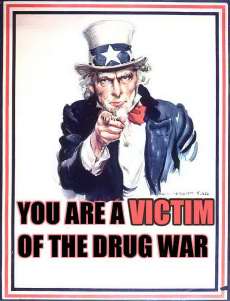
War on the war on drugs loses warrior

war-on-drugs.jpg

South Carolina reform organization closes shop
By Skip Johnson

President of South Carolinians for Drug Law Reform

Norm Stamper, retired chief of police in Seattle, says America’s so-called war on drugs “has arguably been the single most devastating, dysfunctional social policy since slavery.” His words are being heard. All over America – the main exceptions being South Carolina and other Southeastern states – people are making concrete progress in changing that policy. For example:

Twelve states have enacted medical marijuana bills; California alone has more than 1,000 shops selling marijuana today to sick and dying people who have prescriptions from their doctors.

Delaware, New Jersey and D.C., among others, have new needle exchange programs in operation that are cutting back on the spread of AIDS, Hepatitis-C and other wasting diseases. Needle exchanges, illegal in most states, are also protecting police officers and medical personnel from being accidentally stuck.

Local governments in Colorado and several other states have ordered their police departments to put marijuana arrests on the bottom of their list of priorities, thus freeing up police to go after real criminals and easing pressure on the courts and prisons.

Nationally, only recently did the U.S. Sentencing Commission toss out guidelines that dictated penalties involving crack cocaine be 100 times harsher than penalties involving powdered cocaine, realizing that the two are just two versions of the same thing. (As is true with most drug laws, the crack/powder discrepancy was a racist thing: White people prefer powdered cocaine; blacks prefer crack. So black people were getting punished 100 times harsher than white people for the doing the same thing.) The commission found the difference so abhorrent that it made its decision retroactive, meaning some 19,500 inmates, most of them black, can seek reductions in their sentences.

In each case change came only after grassroots efforts forced it. In South Carolina, however, because too few people are willing to work for change, South Carolinians for Drug Law Reform is folding.

I’m sad about that because we are the only organization in South Carolina that is devoted exclusively to reforming our cruel, racist, counterproductive drug laws.

Continue reading →

Get your emergency ballot here!

To address concerns that precincts around the state may run out of emergency ballots if voting machines fail during this Saturday’s Democratic primary, the SC Progressive Network is providing voters with their own emergency ballot that they can print and take with them to the polls.

IMPORTANT: Please note that if your precinct runs out of state supplied ballots, you can vote on any scrap of paper. Do not leave a poll where the machines are not working without casting a paper ballot. Do NOT try and vote on paper if the machines are working. If you insist on voting on paper when the machines are working, your ballot will go in with the contested ballots that will not be counted until the Thursday after the polls close – if at all.

You can print your own emergency ballot by downloading this file:
emergencyballot.pdf

If you encounter problems at the polls, please call the Network’s office to lodge a report by calling 1-803-808-3384. If warranted, the reports will be compiled and circulated to election officials and lawmakers as a resource to help guide us through the uncharted waters created by South Carolina’s new touch-screen voting machines.

The lie that won’t die

Obama as “radical muslim”
By Ed Madden, Columbia

I ran into a friend in the grocery store, and we started talking about politics.

“I hope you’re not planning to vote for that Obama,” he said.

Why? “You know he’s a Muslim.”

Living in South Carolina, you get used to hearing the national news talk about the nasty politics of our state. We are the land of push polls and Lee Atwater—the state that famously spread false rumors about McCain’s child in the last election, the state that saw religious prejudice alive and well in fake Christmas cards sent out last month to attack Romney. It’s become the standard intro to national stories about the Republican primary here—as predictable as the inevitable Confederate flag question at the debates.

But here I was, talking with a friend in Kroger—a friend whose opinion I valued—hearing that Barak Obama was a radical Muslim who refused to put his hand on the Bible when he was sworn in. “He won’t put his hand on the Bible,” he repeated.

Continue reading →

Preparing for voting machine problems in SC’s upcoming Democratic primary

votehere1.jpg

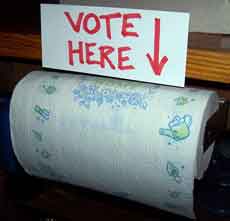
A paper towel may be used as a valid ballot if the voting machine fails you when you’re at the polls, advises SC State Election Commission spokesperson Chris Whitmire.

******************************

The South Carolina Progressive Network held a press conference yesterday to address voting irregularities in last weekend’s Republican presidential primary here. Problems were reported in Horry and Florence counties with voting machines that were not prepped properly. As a result, the touch-screen computers were not working when voters showed up at over 300 precincts in Horry County. Machines in both counties were programmed with the wrong date, and wouldn’t close at the end of the day. Hard numbers are unavailable, but reports indicate that at least some early voters were turned away in several precincts.

The problems at the polls were further exacerbated by election workers’ failure to have the requisite number of emergency ballots on hand.

The Network held the press conference on Jan. 23 to alert the public to potential problems in this Saturday’s Democratic primary, and to urge those going to the polls to be prepared, if the machines malfunction, to vote on paper. Any paper will do, including “paper towels,” according to the state Election Commission’s Chris Whitmire.

Also, if voters encounter problems at the polls they are urged to call the Network at 800-849-1803 or 803-808-3384 to seek help and to lodge a report.

Here are some clips from yesterday’s press conference. Speakers are Network Director Brett Bursey (left) and state Sen. Phil Leventis (D-Sumter). In the background are (on left) Donna Dewitt, Network Co-chair and SC AFL-CIO president, and Liz Deas of the SC Voter Education Project.

Below are links to news stories published after the press event.

Columbia’s Fox News

The State

Associated Press

Network to hold press conference to air concerns about voting problems in South Carolina

Legislators and civic groups to call for adequate paper ballots for Democratic Primary

Legislators and civic organizations will hold a press conference on Wednesday, Jan. 23, at 1pm in the State House lobby to urge all county election commissions to have adequate emergency paper ballots for Saturday’s Democratic presidential primary.

Sen. Phil Leventis (D-Sumter), in a Jan. 7 press release, urged the use of paper ballots in the presidential primaries. “The problems with the Horry County electronic voting machines last Saturday illustrate why we need a paper-based voting system,” Leventis said. “Our state’s reliance on computer-based voting, with no adequate paper backup, is undermining our citizens’ confidence in our elections.”

According to the Myrtle Beach Sun News, “As many as 90 percent of the electronic voting machines in Horry County did not work correctly when polls opened in Saturday morning’s Republican primary. Most were up and running by noon,” county spokeswoman Lisa Bourcier said, “and the last were fixed by 5:30 PM”

“The problems with the electronic voting machines aside, the supposed safety net of emergency paper ballots failed,” said said SC Progressive Network Director Brett Bursey.

State law requires that each precinct have emergency paper ballots for 10 percent of its registered voters. In Horry County’s Republican presidential primary, emergency paper ballots were distributed prior to the polls opening, but County Election Director Sandy Martin said that they gave only 50 ballots to the smaller precincts and 100 to the larger ones, retaining the balance in the office. Fifty-one precincts required more than 100 emergency ballots to meet the law’s requirements, with 10 precincts needing more than 200 and two precincts requiring more than 300.

Voters were turned away from many precincts that had run out of emergency paper ballots. “Under no circumstances should an eligible voter be turner away from a voting place without being given the opportunity to vote,” said Chris Whitmire, spokesperson for the State Election Commission. Any piece of paper can be used in an emergency, said Whitmire, “even paper towels.”

The rush for gold: race, gender and the 2008 Oppression Olympics

Below the Belt: a biweekly column by NOW President Kim Gandy

With Super Tuesday only a few weeks away, it’s hard to have a conversation that doesn’t work its way around to the 2008 elections. The Bush administration, thankfully, is in its final days. Voting registration and involvement among young people is on the rise. And the two most electable candidates for the Democratic nomination are panning out to be a woman and an African American.

With all this excitement, why is it that we seem unable to move beyond the obvious – for those of you who haven’t noticed, Barack Obama is black and Hillary Clinton is female.

As the leader of an organization that champions gender equality, promoting diversity, and ending racism among our top priority issues, in a sense, I am grateful we are finally talking openly about gender and race – topics we generally skirt, so to speak. Something about equality issues makes men and majority populations feel threatened, so what about the rest of the issues at stake?

Continue reading →

Grimke sisters, then and now

As one of the midwives who helped birth the South Carolina feminist organization the Grimke Sisters in 2002, it was a kick to stumble on this funky little video celebrating these exceptional women – Sarah and Angelina Grimke – homegirls from Charleston who made history by thinking big and living large.

The women who so inspired us that we named our group for them deserve a monument on our State House lawn, littered as it is with statuary dedicated to our state’s historical figures (sadly, without regard to their humanitarian records). That’s not bloody likely, but we can remember the Grimke sisters here.

And if you want to join the Grimke Sisters group online, you can subscribe to the listserv by sending e-mail to GrimkeSisters-subscribe@yahoogroups.com.

Becci Robbins

Can we hear the call for change?

By the Rev. Dr. Bennie Colclough
Co-Chair of the SC Progressive Network

The African-American community should pay close attention to what Sen. Barack Obama has said about equality for gay and lesbian Americans and the correlation of religion-based bigotry and discrimination against African-Americans.

The struggle for justice, equality, and dignity for gay and lesbian Americans continues and Sen. Obama and other leaders have engaged the African-American faith community on this issue.

Are we listening?

As an African-American minister, I many years ago heard the call for change on this issue and it is still my resolve today to be a missionary for justice and equality, to be courageous, true to my faith, and challenge the African-American faith community, to love God with our whole heart and our neighbors as ourselves.

The African-American faith community must defend the human dignity of all people as distinguished leaders in our community are calling us to this task.

Continue reading →