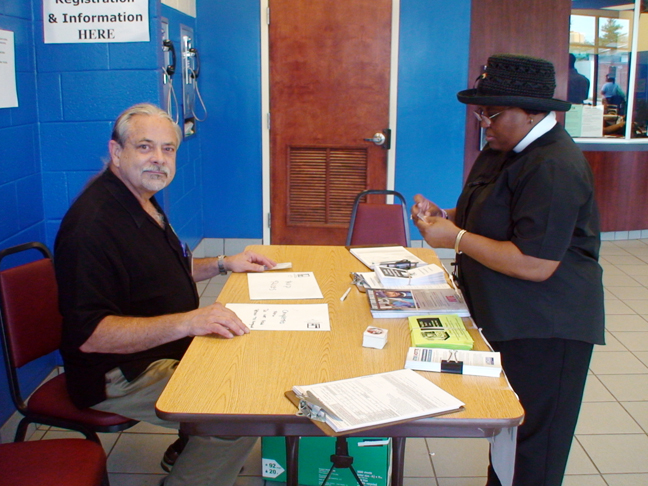
Network needs volunteers to help voters on Election Day

The SC Progressive Network is working with the Election Protection Coalition to help voters with election-related problems between now and Nov. 6.

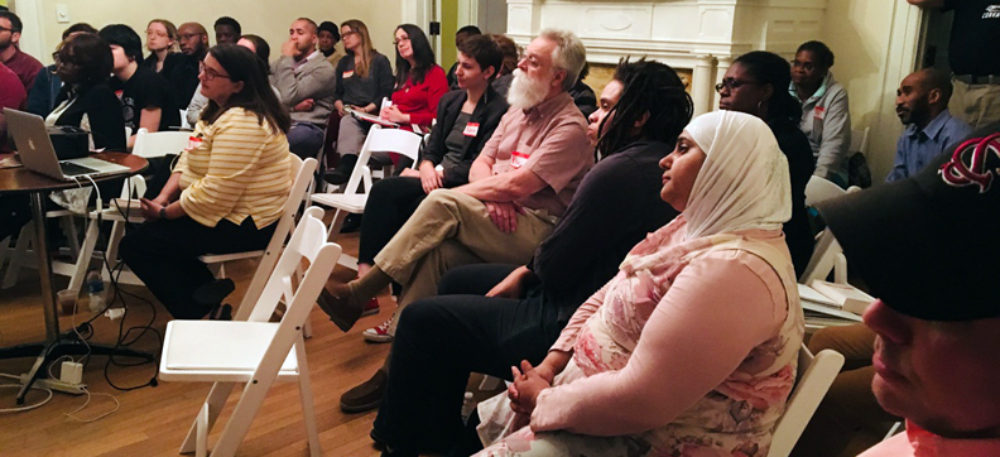
We are training volunteers from across the state to respond to requests for assistance from voters on Election Day.

The Election Protection Coalition is supported nationally by most major nonpartisan organizations and is managed by the Lawyers Committee on Civil Rights Under the Law. Our state partners are the Protection and Advocacy for People with Disabilities, Inc., League of Women Voters of South Carolina, and the ACLU of South Carolina.

The National Hotline number is 866-OUR-VOTE, and in Spanish: 888-VE-Y-VOTA. Signs with this number have been made available to all of South Carolina’s 2,183 precincts.

In 2008, we fielded nearly 1,400 calls on Election Day from South Carolina voters. Most of the calls were from confused voters, and the problems were easy to fix. Other calls required on-the-ground follow-up at precincts or county election offices.

Columbia training: Oct. 30, 5:30pm, Room 138, USC Law School
Charleston training: Nov. 2, noon-2pm, Room 333, (3rd floor) Charleston School of Law, 385 Meeting. St.

To RSVP for training, or to arrange to be trained at another time, call the Network at 803-808-3384.

Download the Election Protection Hotline sign here.

Network holds rally to support DART riders and urge voters to pass penny tax

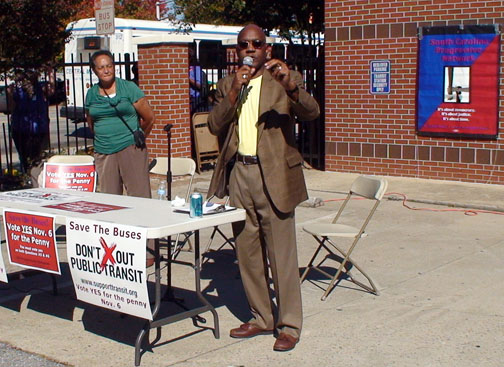
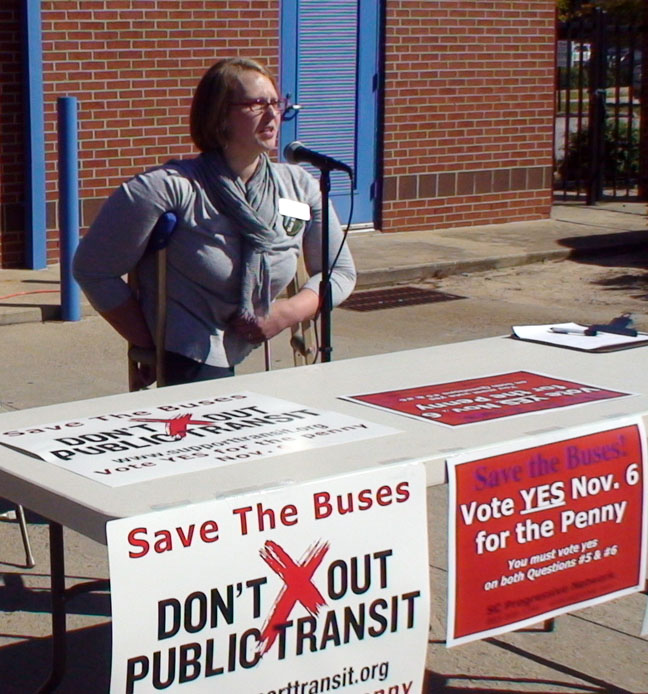
Those who stand to lose the most if the penny sales tax to fund public transit isn’t passed are the DART riders, who have already suffered 40% cuts to services. At a press conference Oct. 24 hosted by the SC Progressive Network, Dori Tempio from the Disability Action Center asked voters to weigh in on this critical issue Nov. 6. For more information, see scpronet.com or call 803-808-3384.

See more photos from the rally here.

Read about it in The State.

SC Equality welcomes new ED

South Carolina Equality, the state’s gay, lesbian, bisexual and transgender political advocacy and civil rights organization – and longtime member of the SC Progressive Network – has announced that Ryan Wilson of Columbia has been appointed Executive Director.

Ryan comes to SC Equality after having served as the President of both South Carolina Pride and the Harriet Hancock LGBT Center. He served five years on the board of South Carolina Pride, with two years as President. During his time at SC Pride the attendance grew from 5,000 to over 8,000, along with increased sponsorship and grant funding. Most recently, Ryan has served as the President of the Harriet Hancock LGBT Center in Columbia, where he has doubled its operational budget in just one year through new grants, as well as increasing its programming for glbt South Carolinians.

Originally from Baltimore, Ryan moved to South Carolina in 2001 to attend Clemson University. While a student, he served as Co-President of the Clemson Gay-Straight Alliance. In 2005, Ryan moved to Columbia as a graduate student at the University of South Carolina. During this time, he also was the University’s Safe Zone Ally Coordinator.

Upon graduation with a Masters of Education in Higher Education and Student Affairs, he was employed at USC as the Sexual Health Program Coordinator, overseeing Student Health Services, supervising the Safe Zone Ally program, and providing programming for LGBTQ students. For the past two years, he has served as Training Coordinator for the South Carolina Campaign to Prevent Teen Pregnancy, a statewide non-profit that supports organizations serving our state’s youth, where he has managed several grant funded projects.

Jeff Ayers, Chair of the SC Equality Board, said “Ryan’s strong qualifications and familiarity with the needs of the glbt community in South Carolina make him ready to assume this position. Our Board is excited about working with him because of his commitment and enthusiasm for the work of securing equal civil and human rights for all lesbian, gay, bisexual and transgender South Carolinians and their families.”

Wilson remarked that “I’m looking forward to being able to advance SC Equality’s important legislative and advocacy work. We have the opportunity help more communities pass non-discrimination ordinances and to see a strong anti-bullying bill enacted by the General Assembly. I am committed to a South Carolina where equal means everyone.”

Network pushes penny tax to save Midlands buses

What’s wrong with our public transportation? Richland County’s bus and DART (Dial-A-Ride-Transit for the disabled) service has been reduced 40% in the past two years. Waits on some routes are up to an hour, and other routes have been cut completely. Buses stop running at 6:30pm, and there is no Sunday or holiday service.

There is no long-term source of funding for buses or DART, and the system will run out of funds June 30, 2013. The system is so bad that people don’t want to use it. Sadly, some people have no choice.

Progressive Network Director Brett Bursey and Bishop Shirley Raiford work Columbia’s downtown bus station educating riders about the penny sales tax.

What can fix our transit problems? On Nov. 6, Richland County will vote on increasing the sales tax by one penny to fund public transit, road improvements and pedestrian pathways. The tax, which will last for 22 years, will raise over $300 million for public transit.

The money will:

  • allow fixed routes to be restored and expanded.
  • reduce wait times to 15-30 minutes
  • extend hours of service
  • restore Sunday service
  • expand DART service
  • fund the building of new transit station and shelters
  • bring more riders and reduce traffic congestion through Park-and-Ride services

Vote YES TWICE on the ballot for the penny sales tax on Nov. 6. The penny sales tax will appear on pages 5 and 6 on your voting machine as Local Question #1 and Local Question #2. A “YES” vote on # 1 will allow Richland County to collect a penny sales tax for transportation for the next 22 years. Download sample ballot here.

42% of the money is projected to come from people who don’t live in Richland County. Each project gets a set percentage of the money raised that cannot be transferred between projects. Buses will get 29%, that is estimated to yield $301 million.

To volunteer to help Save the Buses, contact the Network at 803-808-3384 or network@scpronet.com. Volunteers are meeting every Wednesday at 2pm at the Network office, 2025 Marion St., to make assignments and hand out educational material. Download a flyer, and post at your business, school or church.

Court rules that SC voter ID law does not, in fact, require photo ID

By Becci Robbins
SC Progressive Network Communications Director

Following the federal court ruling that approved a substantially modified version of South Carolina’s voter ID law, SC Progressive Network Director Brett Bursey called the venture “very expensive theater.”

The ruling begins by noting “South Carolina’s new (photo ID) law…does not require a photo ID to vote.”

While Gov. Nikki Haley crowed, “This is not just a win for South Carolina, this is a win for our country,” and state Attorney General Alan Wilson hailed the ruling as a vindication of Republican state legislators, the law the court approved is not the one that went to Washington.

District Court Judge Bates said in his opinion, “Act 54 as now pre-cleared is not the Act 54 that was enacted in May 2011,” when signed by Gov. Haley.

While the Court acknowledged “an absence of recorded incidents of in-person voter fraud in South Carolina,” it found that “preventing voter fraud and increasing electoral confidence are legitimate” reasons for the law.

“After several years of divisive and racially charged debate on this unnecessary law,” Bursey said, “after $2 million in taxpayer money spent defending it, and several million more dollars to implement it, our photo ID law will not require voters to have a photo ID to vote.”

The original law allowed a voter to claim a “reasonable impediment” to not having a photo ID, and left it to the county board of elections to determine whether the reason was legitimate. Today’s ruling said that the reason for not having a photo ID “is to be determined by the individual voter, not the poll manager or county board. So long as the reason given by the voter is not a lie, an individual voter may express any one of of the many conceivable reasons why he or she has not obtained a photo ID…voters with the non-photo voter registration card…may still vote without a photo ID.”

Judge Baker wrote, “It is understandable that the [Dept. of Justice] and the intervenors [including the SC Progressive Network] in this case, would raise serious concerns about South Carolina’s voter photo ID law as it then stood.”

The governor’s victory dance notwithstanding, Judge Baker concluded, “One cannot doubt the vital function that Section 5 of the Voting Rights Act has played here. Without the review process under the voting Rights Act South Carolina’s voter photo ID law certainly would have been more restrictive.”

Calling it political theater, Bursey said, “The grandstanding on this issue by the governor and the Republican majority of the legislature comes at a very real cost to taxpayers, voters and election workers. It is partisan politics at its worst.”

The law will go into effect in 2013.

Delores Freelon has been jumping through hoops for more than a year trying to obtain a SC photo ID. In August, she testified in front of the three-judge panel in Washington, DC.

Network Director makes case for voter-owned elections

In wake of SC House Speaker Bobby Harrell’s spending of campaign cash, SC Progressive Network invited conservative groups to join in a press conference on Oct. 9, 2012, to ask for an independent investigation of the matter. SC Gov. Nikki Haley just days earlier returned $10,000 in improperly used campaign funds. With public frustration and disgust growing, the time is ripe for real reform in SC politics.

The South faces growing school segregation

By Sue Sturgis
Institute for Southern Studies

Despite declining residential segregation for black families in the United States, school segregation for black students remains very high — and it is increasing most dramatically in the South, which has led the nation in desegregation thanks to the victories of the civil rights movement.

Those are among the findings of research released last week by the Los Angeles-based Civil Rights Project, which found persistent and serious increases in segregation of public-school students by race and poverty. The changes are most dramatic in the South and the West, where youth of color now constitute a majority of public school students.

“These trends threaten the nation’s success as a multiracial society,” says project co-director Gary Orfield.

The project released three separate studies looking at school segregation in the nation overall and in the South and West specifically. Among the key findings for the South:

  • The South is a majority-minority region in terms of school enrollment, second only to the West as the nation’s most diverse, with whites making up 46.9 percent of the South’s students.
  • Latino students account for almost the same share of the South’s school enrollment (23.4 percent) as black students (25.9 percent).
  • In 1980, just 23 percent of black students in the South attended intensely segregated schools, defined as those with 90 to 100 percent minority students. By 2009-2010, that number had risen to 33.4 percent — close to the national figure of 38.1 percent.
  • The share of Latino students attending intensely segregated minority schools has increased steadily over the past four decades, from 33.7 percent in 1968 to 43.1 percent in 2009. Today more than two out of five Latino students in the South attend intensely segregated schools.
  • Black students experience the highest levels of exposure to poverty in nearly every Southern state, while in the rest of the United States Latino students experience higher exposure to poverty.

The report also looks at racial segregation in schools in the South’s metro areas. It found that black students in the Raleigh, N.C. area had the highest exposure to white students, though that exposure is on the decline due to the ending of a longstanding socioeconomic diversity policy by the previous school board’s Republican majority (for more on that, click here). Tampa, Fla. and Memphis, Tenn. have experienced sharp increases in school segregation, while black-white exposure in schools is on the rise in two places where it has historically been lowest: Birmingham, Ala. and New Orleans.

The researchers offer several South-specific recommendations to reverse the troubling trends, including continued or new court oversight of the region’s school districts, the development and enforcement of comprehensive post-unitary plans, and making a strong commitment to pursuing voluntary integration policies.

The Civil Rights Project is also concerned that the issue of school segregation is not getting attention in the current presidential election.

“We are disappointed to have heard nothing in the campaign about this issue from neither President Obama, who is the product of excellent integrated schools and colleges, nor from Governor Romney, whose father gave up his job in the Nixon Cabinet because of his fight for fair housing, which directly impacts school make-up,” Orfield says.

A supporter of the civil rights movement, George Romney was named secretary of the Department of Housing and Urban Development by President Nixon and proposed an ambitious housing program to promote desegregation. But his plan was met with hostile reactions from local communities and a lack of support from Nixon, who pressured Romney to resign.

Richland County can build smart transit system people will want to ride

By William J. Hamilton, III
Coordinator, Hungryneck Straphangers, Charleston

A new approach to smarter transit, beyond the commonly considered issues of vehicles, routes and infrastructure, can bring Richland County a transit system people will want to ride.

Transit ridership has been increasing across the country for several years. Bus transit ridership in the United States rose 4.48% from March 2011 to March 2012, despite reductions in the number of routes operated.

In Charleston, SC, CARTA’s most recent report shows bus ridership in the Holy City increased 12.81%, reaching a record 433,221 Riders in August 2012. The system reached a record low in cost per-passenger in the first quarter as well, before inching up due to rising diesel fuel prices.

Having a transit system people will want to ride isn’t the goal. It is the strategy for success in providing mobility options to riders. If you’re not doing it, you’ll never achieve it.

Fortunately this isn’t an issue where the perfect plan, abstract political philosophy and theory are necessary to deliver results. Bus transit provides constant, measurable ridership feedback on what does and does not work.  Bus routes and stops can be lengthened, shortened, adjusted and improved. Ones which simply don’t move enough riders can be canceled.

CARTA has been pursuing such a strategy for five years. All routes are reviewed for cost per-rider. Routes which don’t meet standards after six months or a year are redesigned, adjusted or canceled. New routes and services are tried. Cycle after cycle the services which move the most people at the least cost are retained and the system increases ridership.

Like any system which implies objective standards and accountability (which everyone loves in theory) it can be very hard when routes you value are under pressure to perform. Even the worst-performing bus route is precious to someone. But it’s also a fact that often, somewhere else, there are more people ready and willing to ride. Most volatility takes place at the edges of the system.

In Charleston, the busy #10 Rivers Ave. Route hasn’t moved significantly in 20 years, moving 99,624 riders in August 2012, 3000 more than a year earlier. Frequency has been increased to meet rising demand. Our #40 Route in rapidly changing East Cooper has had five major changes in seven years, but it’s ridership is up over 70% since 2007.

A new Dorchester Express Route serving a Boeing Plant which didn’t exist five years ago, transported 4,397 riders in its second full month of operation. Changes in the popular downtown DASH buses have pushed ridership there to over 95 thousand per month, increasing over 20% year to year.

While many of us dream of gleaming monorails swishing through stations made of glass, marble and neon, the old-fashioned bus has flexibility and the capacity to adapt on its side. It’s a great tool for building a more mobile community.

However the old-fashioned bus is getting smarter. GPS, cellular networks, the Internet and smartphones utterly change how buses work. In Charleston you can now plan any bus trip on CARTA online. Type your destination into your Android phone and it will return detailed plans for the next four possible trips to your destination, with the fare and savings over driving, working out the walk to the nearest stop and connections between bus routes. Tri County Link, our rural bus service, offers free WI-FI on board now, giving riders more productive ways to use their time on board.

While results-driven management and smart technology can make transit in Richland County work better, community mobility also benefits from neighborly efforts reaching out to schools, non profit groups, churches, businesses and government.

Our Hungryneck Straphanger’s organization divides its time between advocacy and outreach, both trying to get better services and facilities and making sure they get used. Handing out schedules to staff at Hospital ERs and Clinics works. Having the Moultrie Middle School Beta Club promote transit to their peers fills seats. Participating in community festivals like the Blessing of the Fleet raises awareness. Hanging bus schedules on apartment complex doorknobs delivers results.

Since people know their area’s bus service will improve if more people ride and faces changes if they don’t, it’s easier to get the community to engage. Every rider and business becomes an advocate. It takes five seconds to explain it to the Manager of a McDonalds facing the need to regularly hire new staff. It takes longer to explain it to the owner, but after a while the whole community gets it, because everyone benefits directly or indirectly from improved bus service, or suffers if service is reduced.

Organizations like the Hungryneck Straphangers exist in dozens of communities across the US today. With a flexible system, you can adapt smart technology to help riders navigate it, and organizations to connect people and transit within the community. Richland County can build a 21st Century transit system people will want to ride.

William Hamilton
is an attorney, writer and 30-year transit rider. He is the coordinator of the Hungryneck Straphangers.

Missing black voters could change political reality

Imagine how different South Carolina would be today if another 15% of registered black voters had bothered to vote in 2010.

If they had, South Carolina probably wouldn’t be suing the federal government to require voters to have photo IDs, or to allow police to require strangers to show their papers. We might have a Health Exchange that lowered the cost of health insurance. We would be embracing the expansion of Medicaid to 344,000 poor South Carolinians – with the state paying only 5% of the cost – as a terrific deal.

“We’re not losing elections,” said SC Progressive Network Co-chair Virginia Sanders, “we’re forfeiting them.” Sanders is referring to the fact that it would have only taken 15% of the registered black citizens who sat out the 2010 election to have changed the results. Nikki Haley won the race by 59,971 votes. There were 387,559 registered, and 168,734 unregistered, blacks who didn’t vote in 2010.

“We have the names and addresses of these missing voters,” Sanders said, “and we need help to knock on their doors. We can provide lists of infrequent and unregistered black voters in any precinct in the state.” Sanders is the Midlands coordinator of the Missing Voter Project, a nonpartisan voter registration/education effort that has registered and educated SC voters since 2004.

“We don’t tell people who to vote for,” said Network Midlands coordinator Bishop Shirley Raiford,” and we don’t just organize around elections. We educate people about the issues and policies that affect their lives and urge them to get involved in an ongoing movement for social justice. If a few more black citizens realized that we have the power to improve the quality of life in this state we might not have the nation’s poorest funded mental health services, lowest Temporary Aid to Needy Families and the country’s shortest unemployment coverage.”

The MVP data base targets voter engagement efforts down to individual addresses. “We don’t have to set up a table at the shopping center and wait for a missing voter to walk by, we know where they live,” Sanders said. “We need your help talk to all of them.”

Citizens, schools, churches and organizations who want to participate in the nonpartisan Missing Voter Project should contact the Progressive Network at 803-808-3384, or by email at network@scpronet.com.

Photo ID law: the numbers underscore its uselessness

A rough estimate using figures from the recent Carnegie-Knight Foundation’s study of voter fraud indicates that the South Carolina photo voter ID law will prevent one in-person election fraud every 68 years.

10 cases in last 6 election cycles nation wide.
145 million registered US voters
= one fraudster per 85 million possible votes.

If every one of South Carolina’s 2.5 million voters are required to show a photo ID when they vote, over the next 68 years (34 election cycles) we will catch one fraudster impersonating someone at the polls.

According to the National Weather Service, during the time it will take to catch one vote fraudster, 85 South Carolina voters will be struck by lightning.

South Carolina is in the process of spending $1.5 million on private attorneys to overturn the Dept. of Justice ruling that our photo voter ID law violates the Voting Rights Act. The case is scheduled to be heard in DC federal court beginning Aug. 27.

Read the Washington Post story on the report.