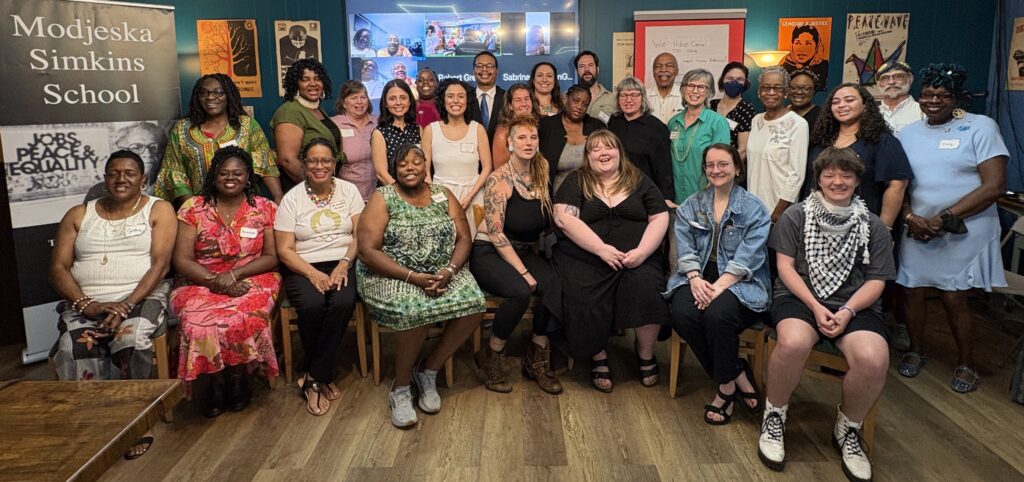
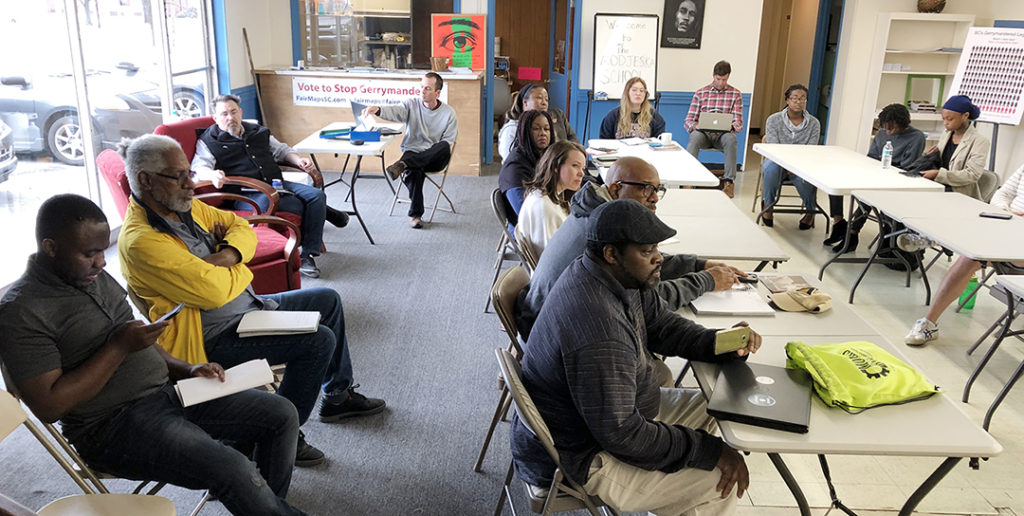
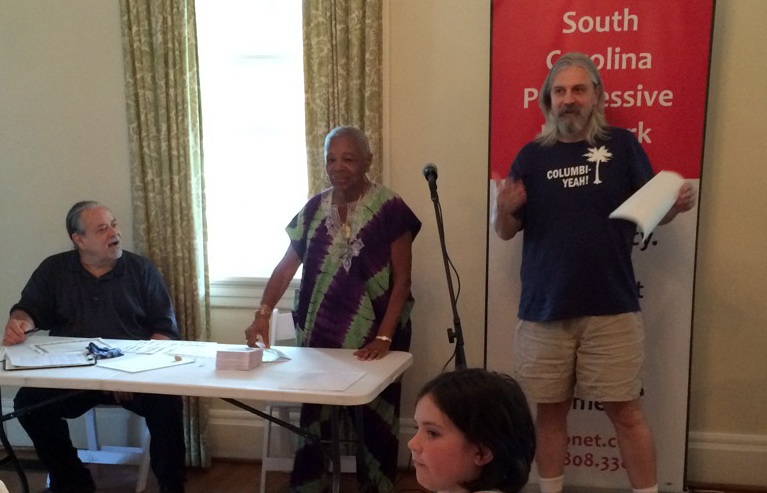
The Modjeska Simkins School is now accepting applications for its spring semester, which runs from March 2 through June 22. Classes meet Monday evenings in Columbia, on Zoom, and via live broadcast at five satellite sites.
Expanding on last year’s success with our partners in Sumter and Penn Center, this year we’ve added remote sites in Lancaster, Orangeburg, and Pendleton. This in-person-option lets more students have the collaborative experience that is central to the program.
“These satellite sites broaden access to the school and help build community outside of our Columbia base,” said Brett Bursey, executive director of the SC Progressive Network, which launched the school in 2015. “You deepen the experience by sharing the experience,” he said. “The course covers challenging subjects, and it is good to have people to help process the material.”
Network staff member James Felder facilitated operations at the Sumter site last semester. “People in Sumter have heard from graduates, and are anxiously awaiting the spring semester,” he said. “People who have been through the program are our best messengers.”
Dr. Robert Greene II, a tenured professor at Claflin University and president of the national African American Intellectual History Society, has served as the Modjeska School’s lead instructor since 2019. “This year’s session of the Modjeska Simkins School comes at a time of both great peril and great promise for our state and our nation,” he said. “Learning the true history of South Carolina’s past can be inspiring and up-lifting.”
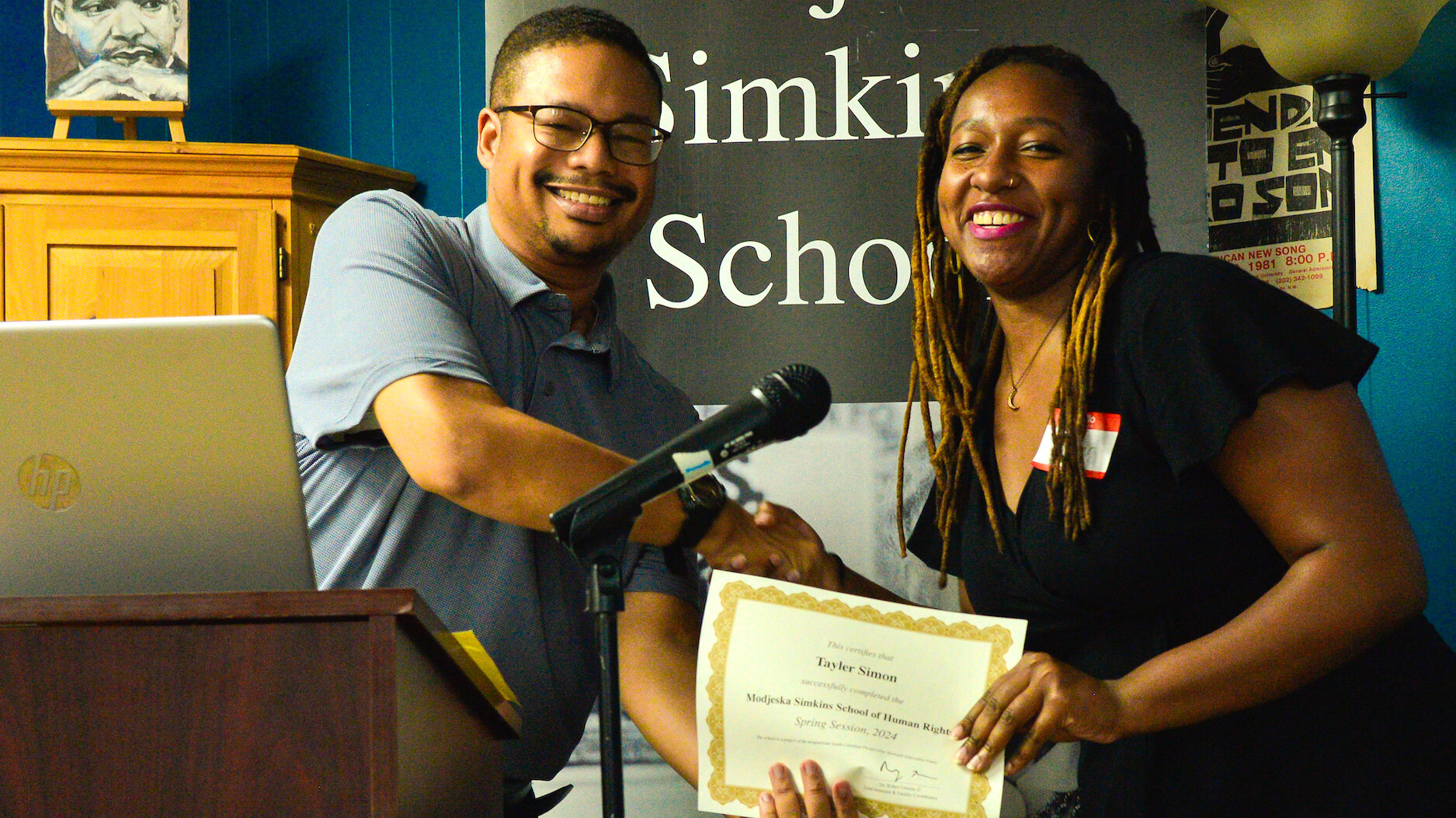
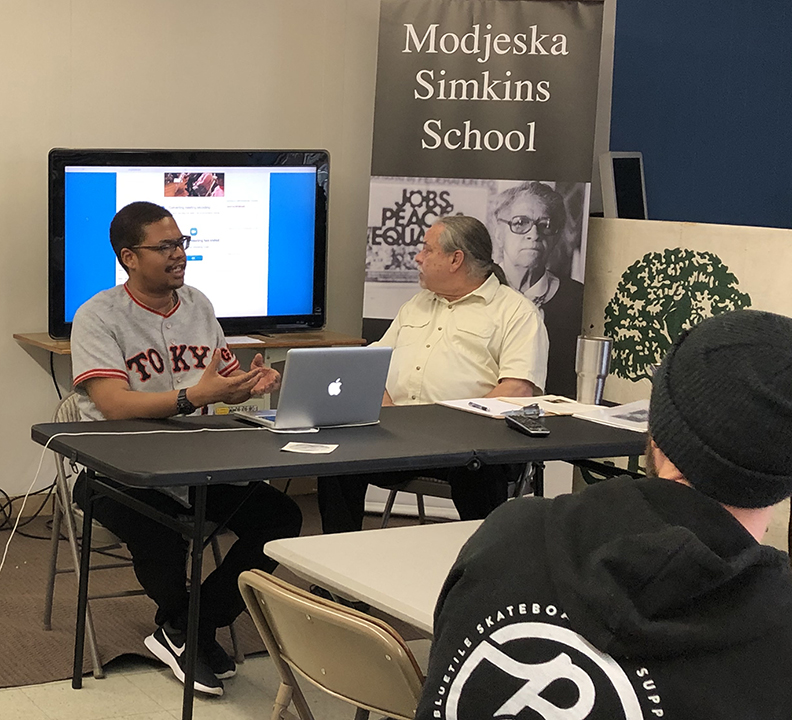
Dr. Robert Greene II and Tayler Simon
The curriculum reflects the Network’s nonpartisan strategy, focused intentionally and specifically on South Carolina, which continues to play an over-sized role in our nation’s politics.
This unique and ever-evolving master class is led by guest presenters who are some of the state and nation’s leading writers, historians, professors, and activists. It is a curriculum unlike any in South Carolina. While we welcome students of all backgrounds and ages (our youngest was 14) the course is not for everyone. It covers mature, difficult topics, and requires hours of outside study each week.
If you love history, want to be a more effective grass roots activist, are a retired person wanting to connect with others in your community, or are a transplant who wants to know more about your adopted home state, this course is for you.
The school also offers Deep Dives throughout the semester, Sunday afternoon programs held in Columbia and broadcast on Zoom. They are free and open to the public. To receive notices of the programs, sign up for the Network’s email list or bookmark GROW’s calendar.
For details about the school, see modjeskaschool.com. There you will find a list of instructors, the spring class schedule, and an application.
Full tuition is $500. Payment plans and scholarship assistance is available.
Questions? Call 803-808-3384 or email info@modjeskaschool.com.
Not going to lie; it’s been a rough year. Butif 2025 taught us anything, it’s the importance of connection and community. We offer this short review to remind you that we can thrive even in darkness.
Modjeska Simkins School lead instructor Dr. Robert Greene II
In January, we gathered at the Big Apple in Columbia to mark the 10th year of the Modjeska Simkins School. The gala was a chance to celebrate this important milestone and recommit ourselves to the work of remembering who we are, where we’ve been, and the power of ordinary people to make change.
In March, the Modjeska Simkins School began its spring session, and for the first time offered students the option of participating at satellite sites in Sumter and at historic Penn Center in St. Helena. It was so successful that we are expanding on that model in 2026, adding partner sites in Lancaster, Orangeburg, and Pendleton. We are excited about broadening access to communities outside of Columbia, and working with them after classes end.
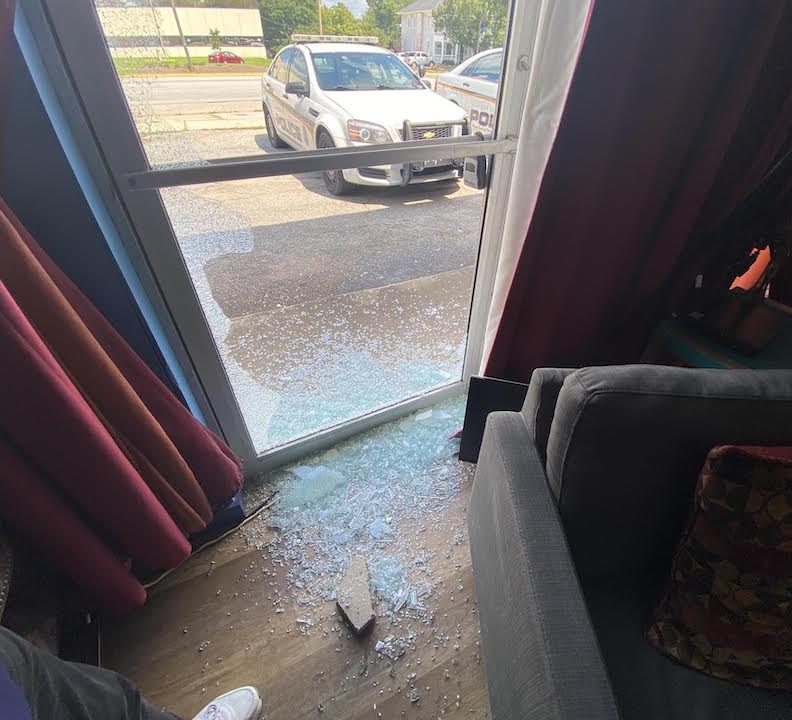
In April, GROW, our HQ, was vandalized for the second time, leaving considerable damage. Our friends rallied to cover the cost of repairs and to upgrade our security system. In 2026, we will make the building even more secure by remodeling the parking area to include barriers. We were moved by the support.
In May, we took a field trip to Orangeburg for a special program on Briggs v Elliott’s role in the landmark Brown v. Board case. The trip included a tour of the SC Civil Rights Museum’s new building, still under construction. Cecil Williams has done a beautiful job overseeing the creation of a first-class facility that will serve generations.
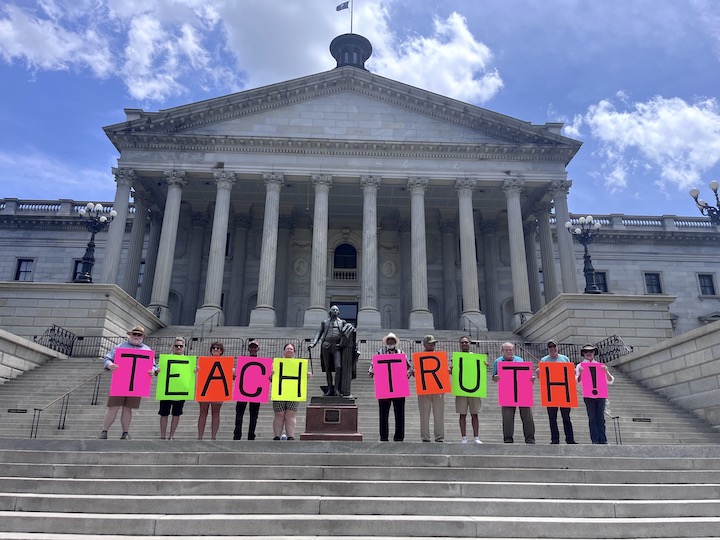
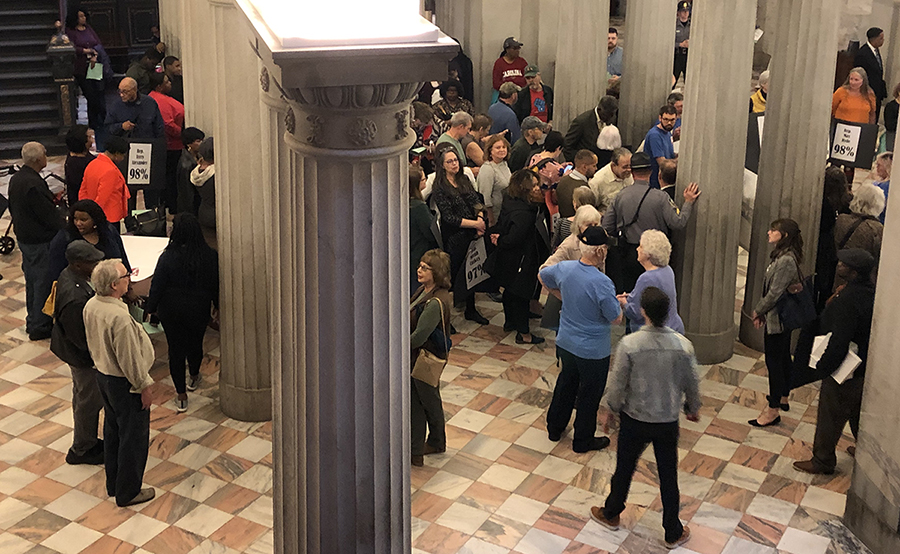
On June 10, friends and alumni of the Modjeska Simkins School marked the Zinn Education Project’s Teach Truth Day with a speak-out at the SC State House. See video clip.
July 31, on what would have been his 100th birthday, we joined friends and family of James E. Campbell at the Avery Research Center in Charleston to mark his extraordinary life with a day of teachings, discussions, and remembrances. Campbell was a longtime member of the SC Progressive Network, and was among the first to receive the organization’s Thunder and Lightning Award, in 1998. He served as a mentor to many and an inspiration to all who had the pleasure to work with him.
On June 28, the Modjeska Simkins School graduated 63 students, the largest class yet.
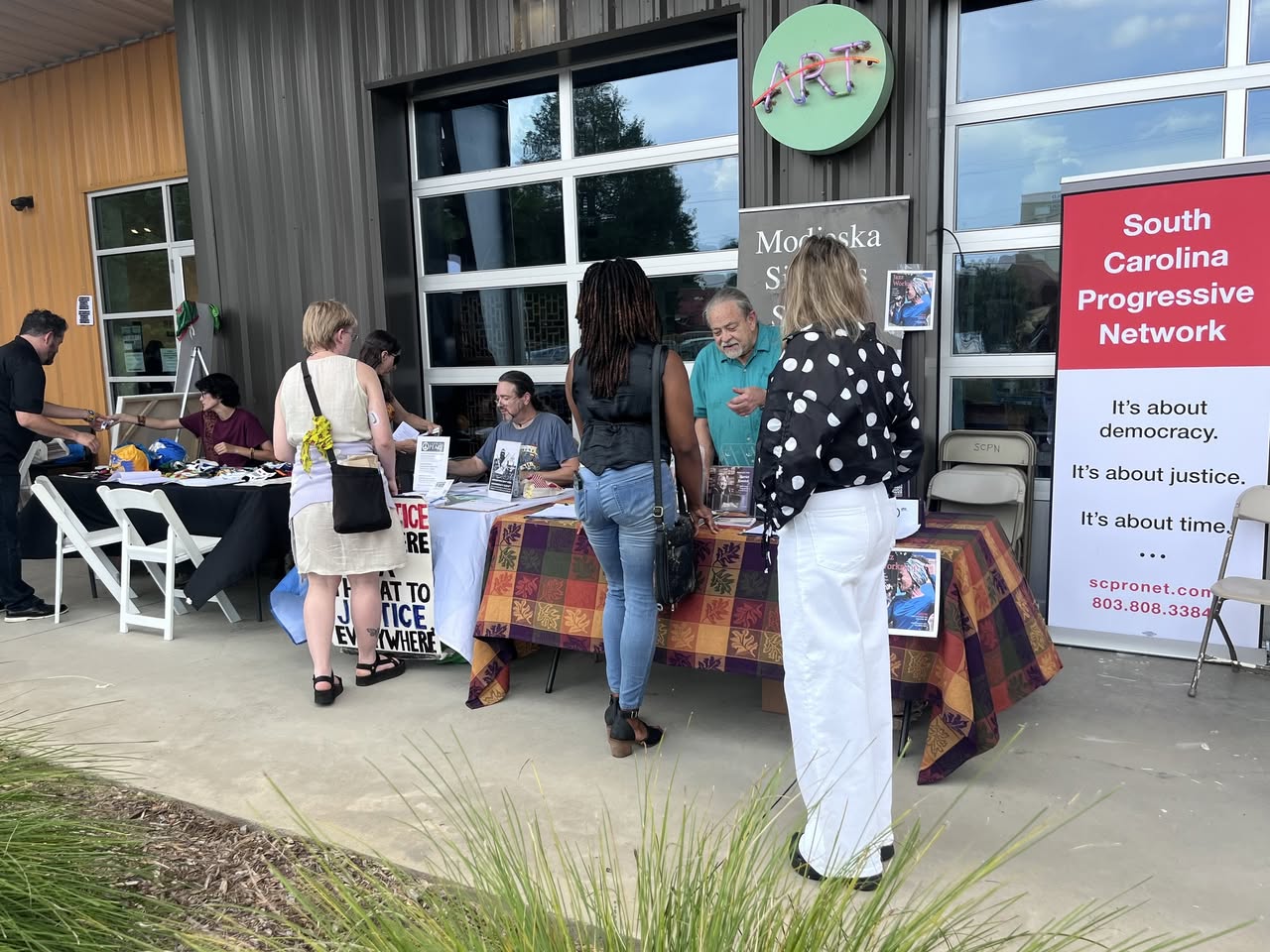
In July, we tabled at the Degenerate Arts Activist Fair at Stormwater Studios in Columbia, a four-day event organized by Jasper Project. Our friends at Jasper included an essay about GROWin their fall magazine, and have invited us to participate in their second Activist Fair, which kicks off Jan. 20.
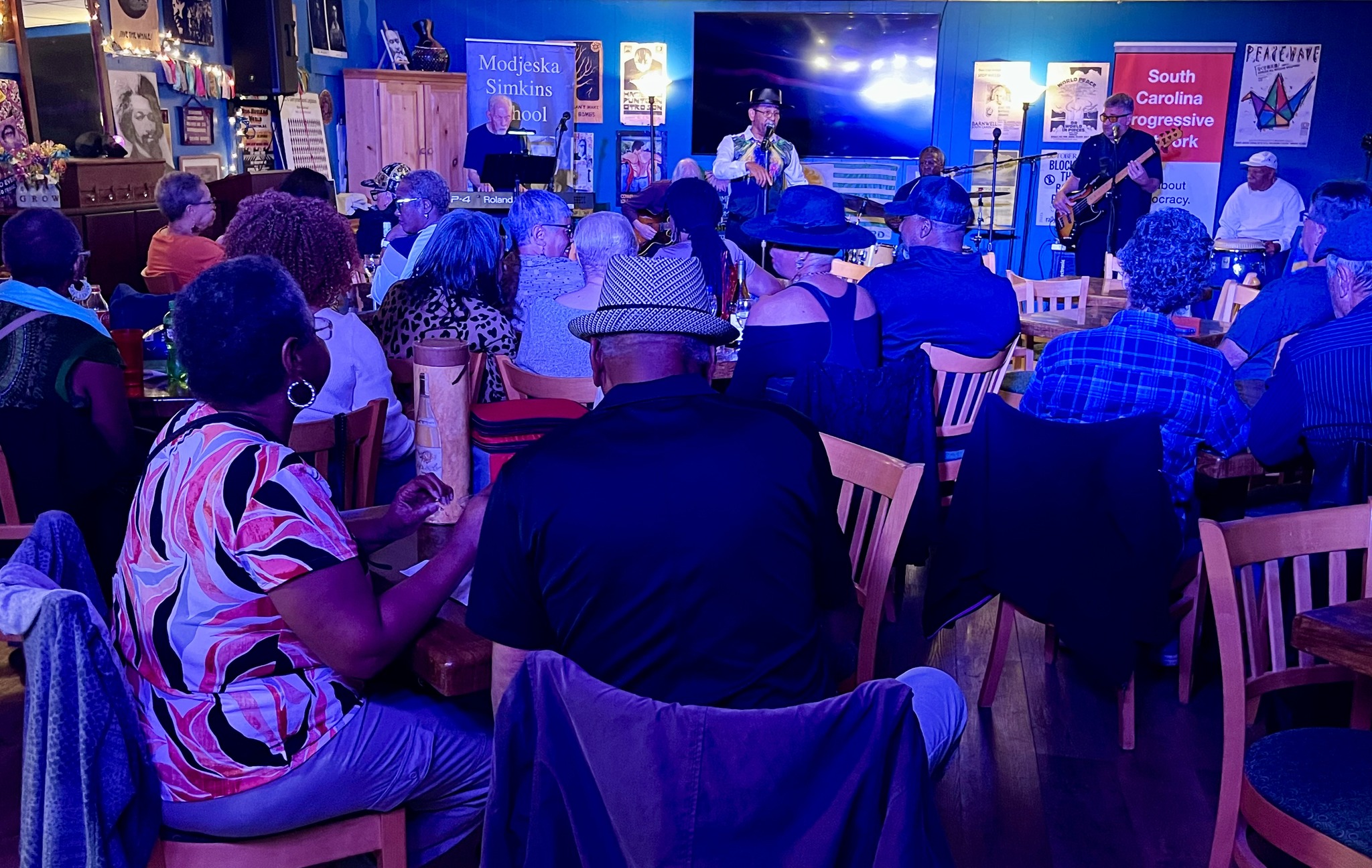
In August, we added blues to the menu at GROW, building on the popularity of the jazz workshops we’ve been hosting since 2023. Led by world-class bluesman Cesar, the blues workshops have brought a whole new vibe to the corner of Elmwood and Marion. Now, every Thursday between 8 and 10 folks can come out to hear some of Columbia’s finest musicians. It’s free — for now. We may move to a GROW membership model in the coming year.
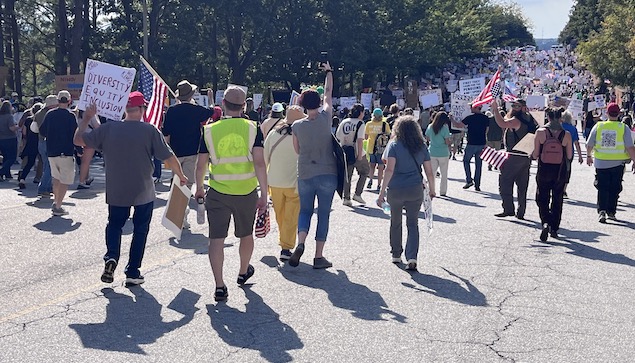
In October, many of our members and allies took part in the No Kings rallies across the state, joining some 7 million Americans in telling the administration we resist and condemn authoritarian rule. Several of our members were invited to speak at earlier rallies in Columbia and in Greenville.
In November, the Modjeska Simkins School was invited to participate in the SC Council of Social Studies conference in Greenville, where Dr. Robert Greene IImade a presentation on the challenge of teaching history in these times. We recruited more than a dozen teachers at the symposium to participate free of charge in the 2026 session of the school. It is our way of investing in education.
The Wednesday before Thanksgiving, GROW held its first Friendsgiving, a casual gathering to mark our country’s tastiest and most complicated holiday. It was great fun, and may become a new tradition.
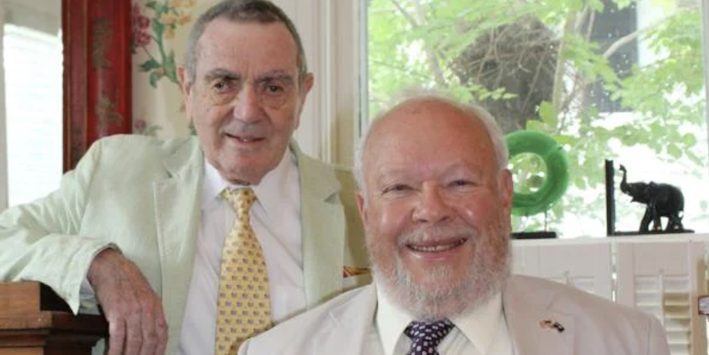
Armand Derfner (left) and Vernon Burton
Over the spring semester, the school held a number of Deep Dives, Sunday programs on Zoom and at GROW that are open to students and the public. We welcomed such luminaries as nationally renowned civil rights attorney Armand Derfner and historian Dr. Vernon Burton, and authors Fergus Bordewich, Carolyn Click, and Dr. Justene Hill Edwards. We screened the 2014 film Scarred Justice, about the 1968 Orangeburg Massacre, and the labor documentary Uprising of ’34, about the killings of striking workers at Honea Path, SC.
We maintained our quarterly commitment to Columbia’s Adopt-A-Street program by cleaning Marion Street between Elmwood and Taylor. Our thanks to the volunteers who help us keep our promises and make our neighborhood more beautiful.
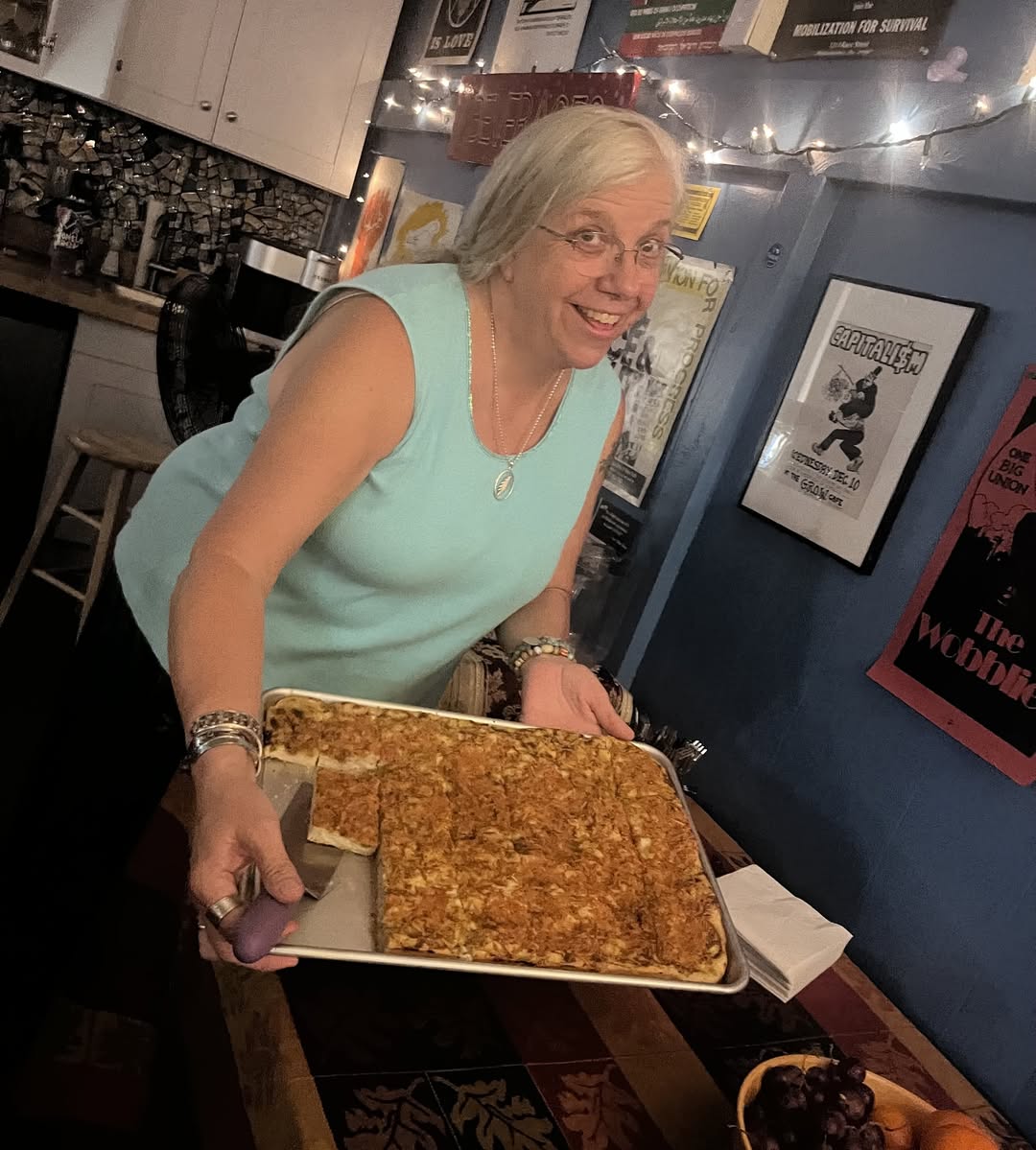
We said goodbye to Gabbi Zurlo, who left just shy of a year on the job. We appreciate her time with us, and wish her well. We welcomed Nilanka Seneviratne to our board and Leisa Marie Greer to the GROW team. She used to sell ads for our newspaper POINT at the original GROW, so it’s a full-circle moment to have her return as our most talented volunteer.
Finally, some gratitude. We are indebted to all the musicians who bring GROW to life every Thursday, and grateful for the people who come to see them. It’s Columbia’s best-kept secret, but word is slowly spreading.
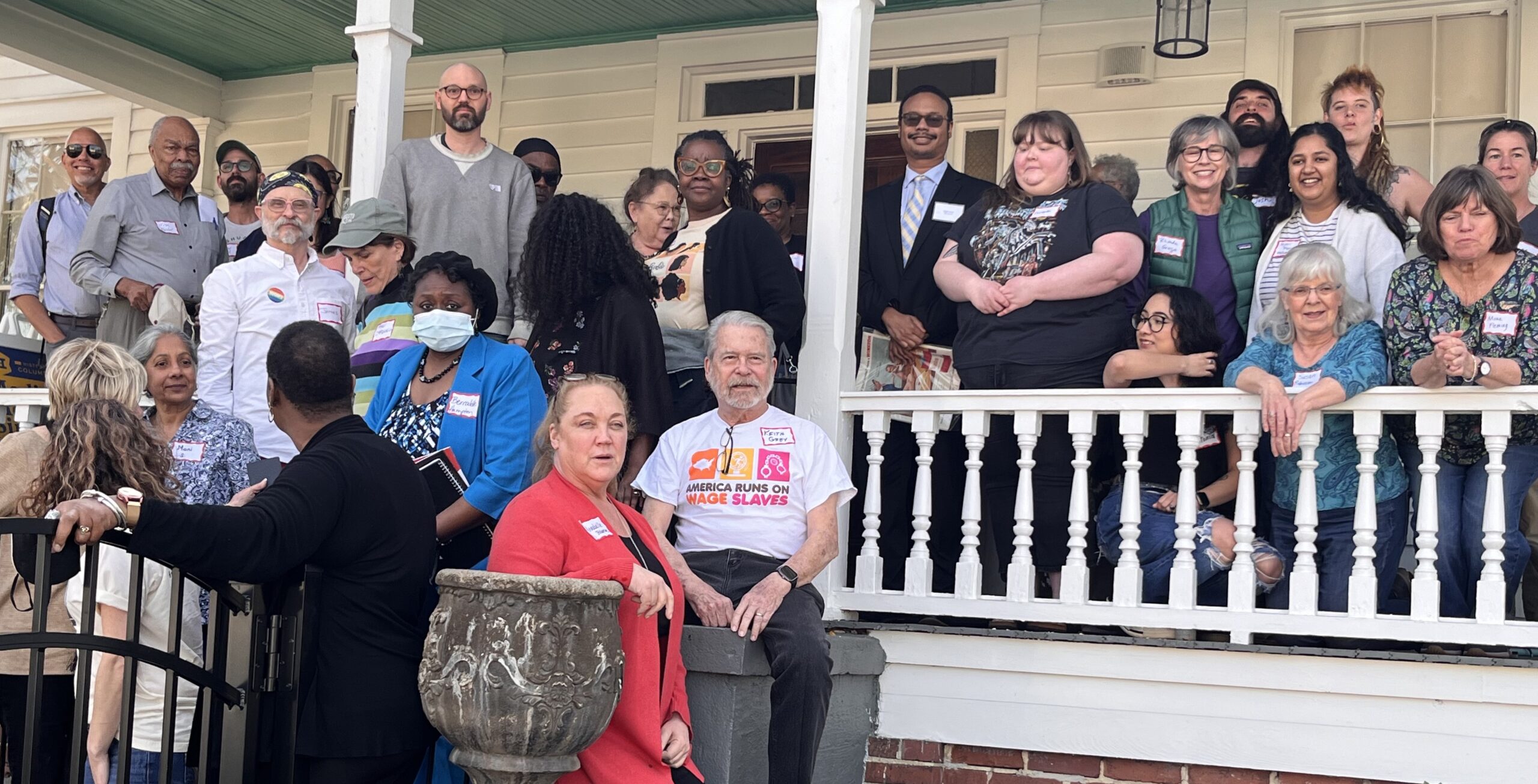
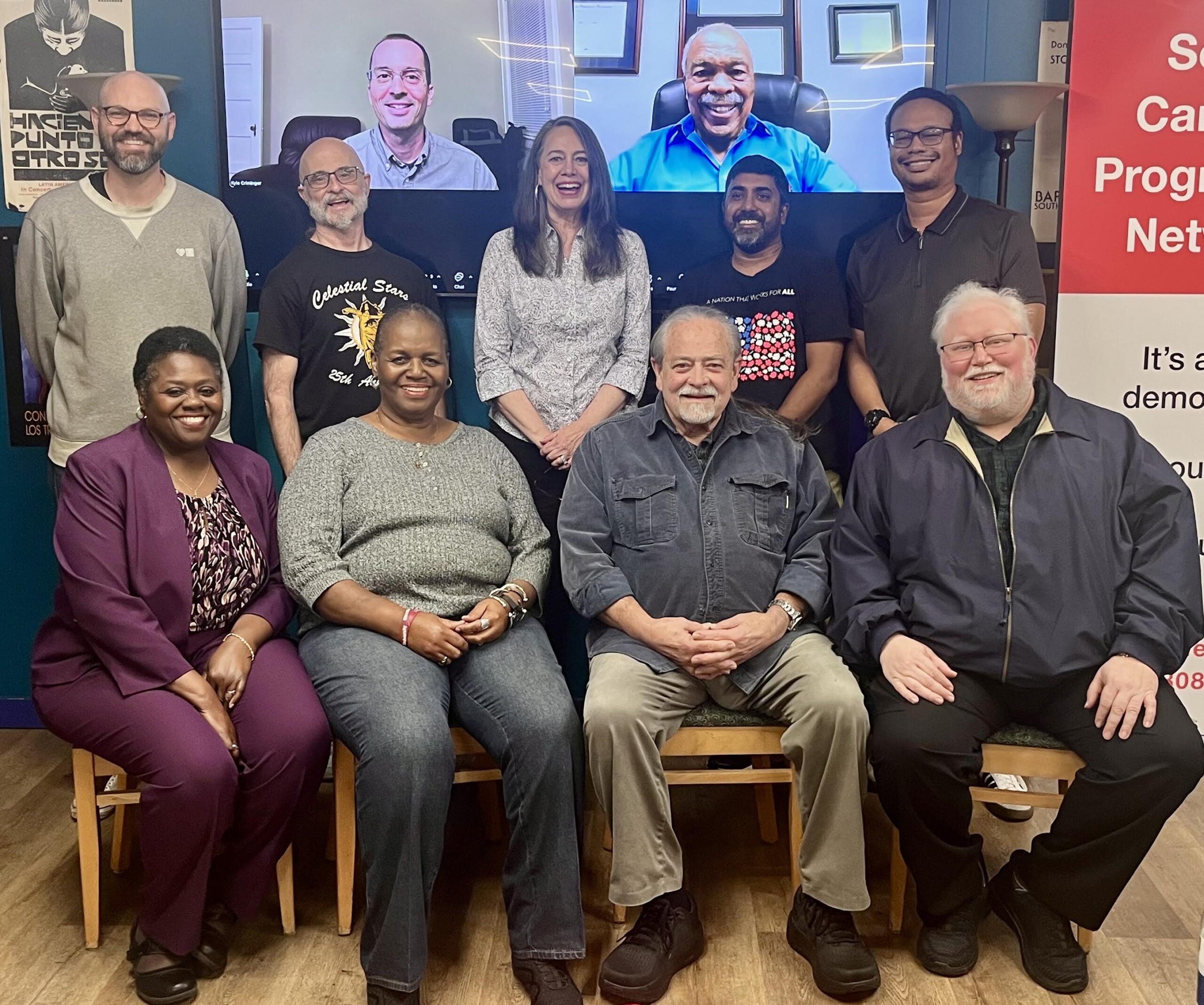
We thank the members of our hard-working board, who keep our books sound and our organization on track — all with good cheer. In photo, they are: (on Zoom) Kyle Criminger, James Felder, (standing) Chris Gardner, James Carpenter, Shannon Sylvester, Nilanka Seneviratne, Dr. Robert Greene II, (seated) Bernadette Hampton, Carol Singletary, Brett Bursey, and Cecil Cahoon.
And we thank the groups that meet at GROW to network and map plans, doing movement building at the grass roots. If you belong to a nonprofit whose values align with ours, keep us in mind as a potential gathering spot. Call 803-808-3384 or email network@scpronet.com for details.
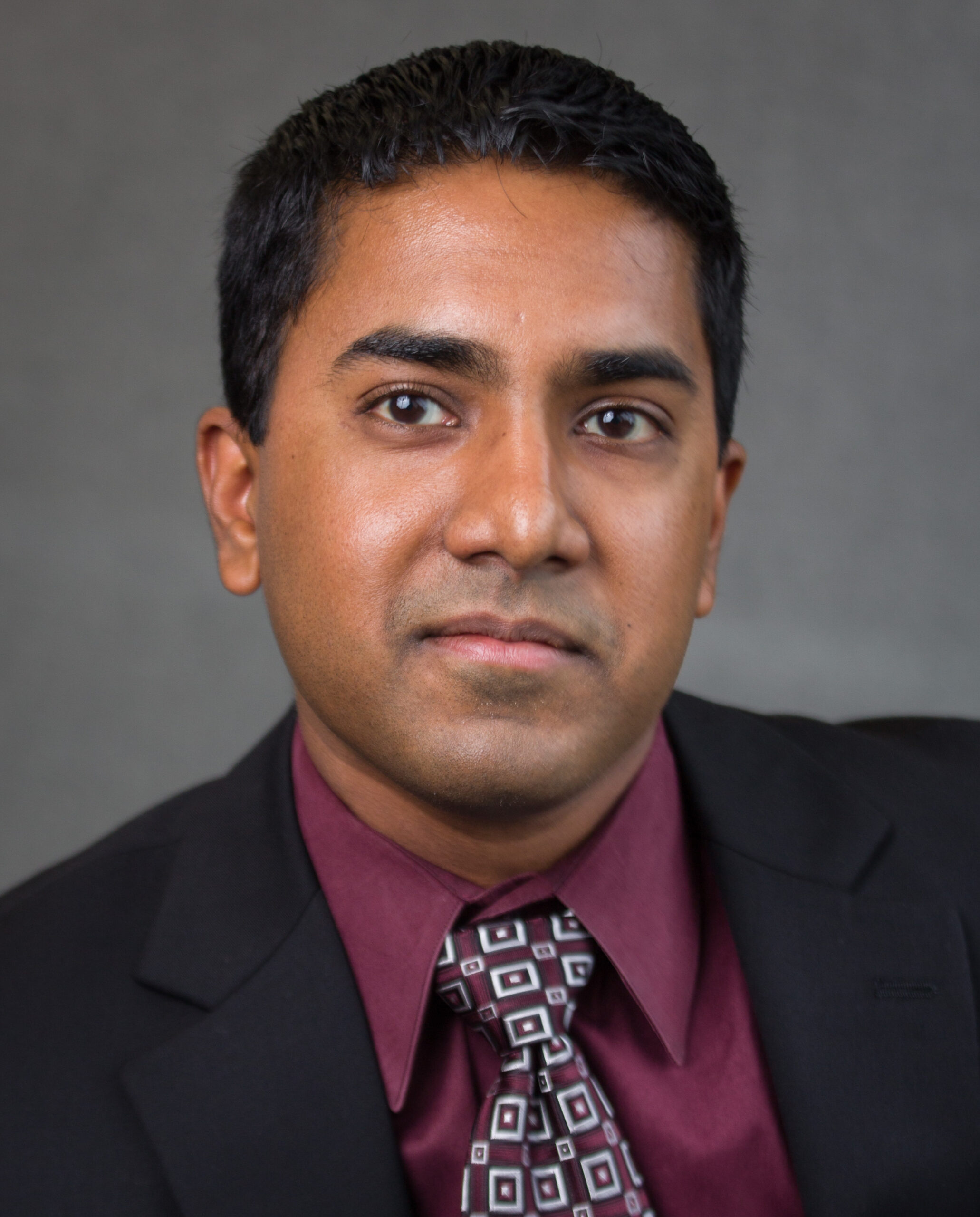
The SC Progressive Network is pleased to announce that Nilanka Seneviratne has accepted our invitation to join the organization’s board of directors.
“Nilanka was a stand-out at the Modjeska School and was well-respected by his peers,” said Network Executive Director Brett Bursey. “I know he will be an asset to our board, as he brings a global perspective, fresh ideas, and valuable skills to the table.”
Nilanka has a Master’s in Public Administration from the George Washington University (with a concentration in budgeting and analysis), and Bachelor’s Degrees in Psychology and International Studies.
He is Director of Operations and Systems at The Horizons Project, which works to connect US social justice, peace building, and democracy communities. He serves as President of the Board for Street Meat Bicycle Club, and is the Social Committee Chair for Earlewood Community Citizens Organization.
He is also a one-day Jeopardy! Champion and avid Learned League Llama. His hobbies? “Music, hiking, riding bikes, reading, beer, and trivia. Especially the combination of the last two.”
As the child of Sri Lankan immigrants who periodically returns to the island, Nilanka said he has “borne witness to the horrific outcomes of a polarized society riven by ethnic violence and a breakdown in the rule of law.”
Nilanka first became aware of GROW when he attended shows at the old building while in high school. In 2005, he joined the SC Progressive Network shortly before moving to DC for grad school.
After he returned to Columbia, he started attending the regular lunches at the new GROW. There, he learned about the Modjeska School, which he completed in 2024.
“Attending the Modjeska School was one of the most transformative experiences of my life,” he said. “I learned about our state’s outsized connections to major historical events, the deep history of those organizing for change in South Carolina, and I made friends and comrades who I work with locally.”
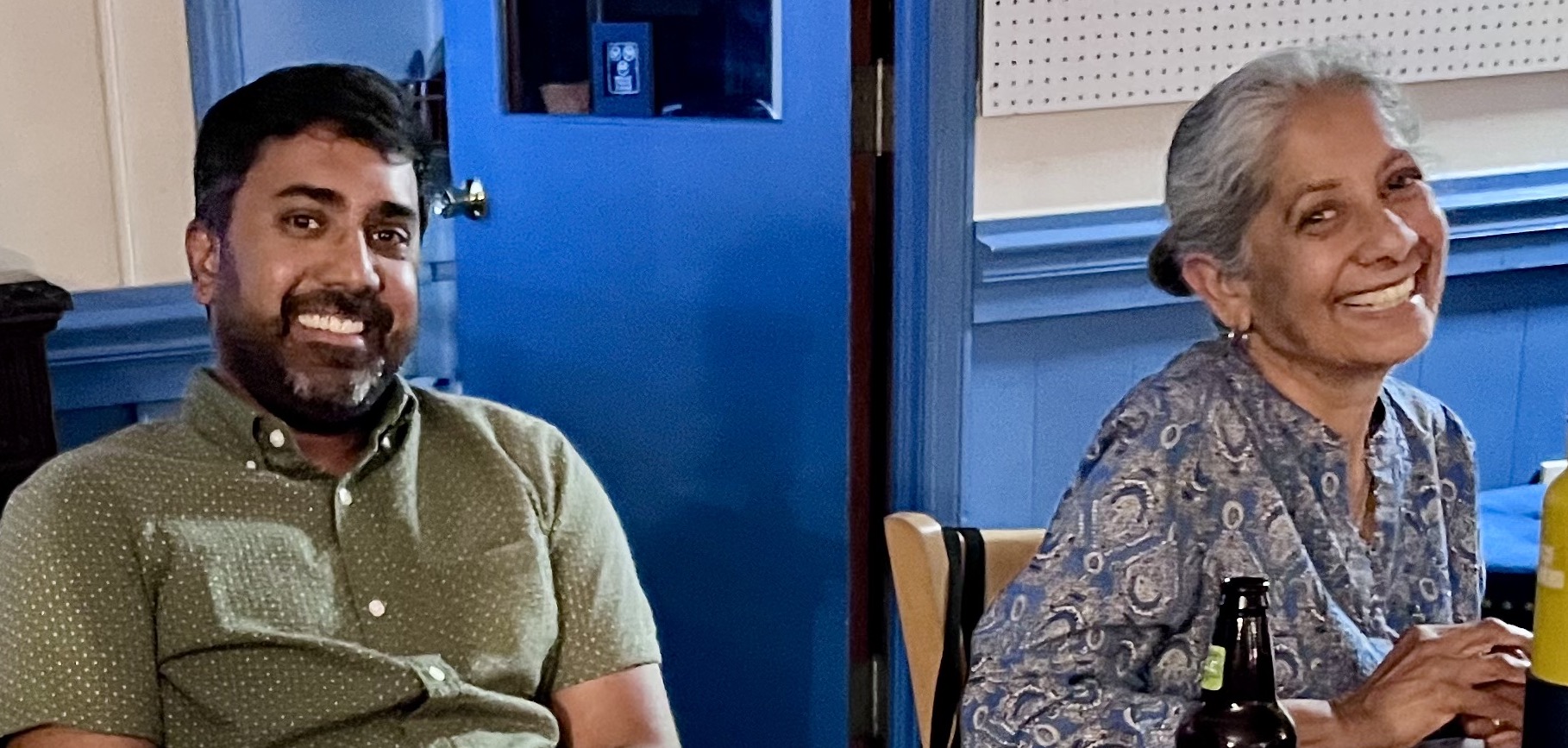
Nilanka was so affected by his experience that he persuaded his mother, Nilmani Seneviratne, to attend the school in 2025. Both have since become champions of the Thursday jazz and blues nights at GROW.
Nilanka and Nilmani Seneviratne at GROW
When approached to join the board, Nilanka said “at this moment, we all need to find how we can chip in, and for me that means building community locally as well as representing South Carolina in the national spaces I participate in and bringing resources back home.
“Given my background in nonprofit management, joining the board of the Progressive Network was a no brainer. I look forward to working with all of you to make South Carolina a better place. There’s much to do, so let’s get started!”
The spring session of the Modjeska Simkins School has not gone as planned. Turns out, the student orientation on March 15 was the first and last time the group would meet in person. The extent of the threat posed by the coronavirus in South Carolina was just becoming clear.
The crisis forced our classes online. While the format is not ideal, it does have its benefits, one being that classes are recorded so students can see material they missed or want to revisit. We are offering access to the course readings and class recordings as a gift to our friends and allies, hoping they may educate and inspire in these tough times.
The school’s faculty co-ordinator, Dr. Robert Greene, a professor at Claflin University, said, “The COVID-19 pandemic has forced many people around the world to take refuge in their homes. The hope of ‘flattening the curve,’ the attempt to get the virus to a manageable level for health care systems around the world, is now underway. With so many people at home, numerous universities and libraries across the world have opened their online archives to everyone who is hungry for knowledge.
“In that same vein, the SC Progressive Network’s Modjeska Simkins School is also opening its virtual doors. Our study guides and filmed lectures offer a rich vein of information about South Carolina’s long history of oppression and hope. Despite the darkness of the pandemic dimming the dreams of many, we hope that you will find our resources valuable to preparing to build a better world after the pandemic has run its course. After all, Modjeska Simkins herself believed both in knowing one’s history, and in making public health among disadvantaged communities an important priority.”
Robert Greene greets students during orientation session March 15.
It has not been the experience students signed up for, but they have adjusted without complaint to meeting on Zoom. In years past, students often stayed after class to talk with the professors and classmates. To make up for that lack of personal interaction, the school added extra sessions for students to ask questions, offer suggestions, and comment on the course so far.
Jacob Twitty said, “I have thoroughly enjoyed it and have learned so much. A lot of the history didn’t come as a surprise — the details — but the Reconstruction era just fascinates me. The more I learn about that, the more I wonder how South Carolina as a state would be different if we had continued in that regard. It’s amazing to see how we far we have gone the other way in spite of the rich history that we have here.”
Lewis Pitts, a reformed NC lawyer who has been a guest speaker at the school since its first session in 2015, is able to attend the entire program this time because he can join on Zoom. “What struck me about the Reconstruction period is that when we actually expanded democracy to include more people, particularly African-American freed slaves, we had a much more progressive agenda. Public education, there are many things white Americans should be thanking that period for. The more we pull the blanket of democracy down to cover all the feet in the bed, the more warmth and the more progress is shown for all of our society.”
“I am really enjoying the course,” Dr. Bernie Gallman said in an email. The scholar of African roots and the pre-colonial advanced culture added, “The course syllabus for all the classes are outstanding.”
The history portion of the session ended on May 18. The remaining classes will be about political theory, and conclude with student presentations of projects they will commit to upon graduation.
• Click here for class schedule and links to course material. • Click here to access class recordings, updated each week.
The Modjeska Simkins School is a project of the SC Progressive Network. The next session is tentatively scheduled for this fall.
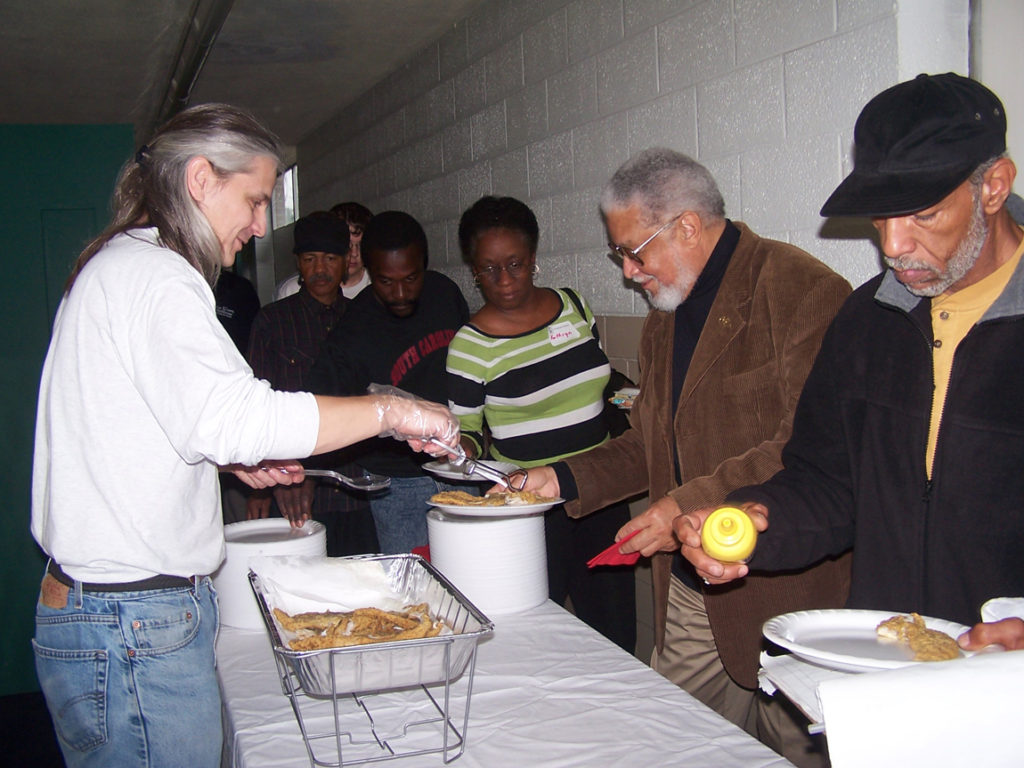
Tim Liszewski serves lunch at a Progressive Network conference in 2007.
We were heartbroken to learn that our friend and colleague Tim Liszewski died at his home in Columbia on March 28 of coronavirus, which he likely contracted at an Indivisible conference in Wisconsin. He was 60 years old, and leaves behind two children, Aaron and Rebecca Liszewski.
Tim was to be married in May to his longtime partner, Maris Burton. Instead, she is planning his memorial, which will be held when it is safe to gather. Meanwhile, Maris herself is recovering at the home she shares with her sister, Barb.
After feeling sick for a week and suspecting that it might be coronovirus, Tim was tested on March 21. He was told they would get results in 2-5 days, but it wasn’t until four days after his death that the coroner’s office confirmed that he had tested positive. Maris is frustrated that they did not know sooner so they could warn others with whom they’d been in contact.
Their story lays bare the state’s slow response to the pandemic and lack of transparency in testing and tracking of Covid-19 cases in South Carolina. The governor has yet to issue a stay-at-home order, making ours one of just 12 states without one. Tim, who worked as one of the Network’s ACA Navigators in 2013-2014, would be angered by the way the pandemic is playing out here and in other states that refused to expand Medicaid, as detailed in this story.
We got to know Tim when he moved to Columbia in 2005 from his native Cleveland, Ohio, to serve as director for the Carolina Peace Resource Center, a longtime Network member. He would go on to work for various political campaigns, in South Carolina and out of state, but stayed in touch. The last time we saw him was at our Fair Maps event at the State House on the first day of session to press lawmakers to end gerrymandering in South Carolina.
Tim was mild mannered and big hearted. He lived his values. Alongside Maris, he helped feed homeless people in Columbia through Food Not Bombs, and volunteered regularly at Nickelodeon Theater. In a story in The State about his work helping people access health care, Tim said, “This is not a job, it’s a lifestyle.”
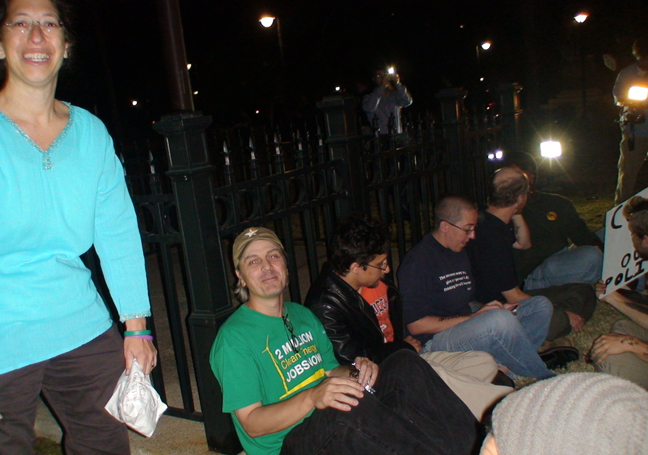
Tim was one of 19 Occupy Columbia protesters arrested in November 2010 after refusing to bow to Gov. Nikki Haley’s order to evacuate the State House grounds. Charges were later dropped, and Occupiers were each awarded a $10,000 settlement for violation of their First Amendment rights.
Tim graduated from the Modjeska Simkins School in 2017. In a blog post about the session he said, “Knowing there are people younger than I am who are actually taking up the cause gives me hope and makes me less angry. Let’s make some change that lasts.”
Network Cochair Kyle Criminger had this to say about our colleague. “A creative, civilly disobedient Occupier of Columbia, a first-rate ‘commandant’ (his word) of the Progressive Network’s efforts with the ACA Health Insurance Marketplace, and a senior regional leader of the Indivisible Project, Tim was an astute community organizer, laser-sharp with his words and with purposeful quips. He always studied and adapted in order to be effective where his feet hit the ground beside his fellow progressives. The social justice movement will miss him.”
The Network sends our collective love to Maris, and to her and Tim’s families.
Maris shared this message: Tim’s family, my sister Barb and myself are overwhelmed at the amazing outpouring of love, respect and kindness you are sharing about Tim (and me). He would be embarrassed at the fuss and then say, “is it true? Do they really mean that?” Yes Tim, you are loved by me and so many more. So thank you all for your words and your “Service in Action” that Tim practiced daily. Our lawn looks amazing, we are being fed, groceries supplied, laundry done! and a continuing offer for other services we will be needing. We feel the love. I am working on getting rid of my virus symptom of “the cough and fatigue” and being well enough to tackle household tasks. Be kind, do good deeds, wash hands and take this seriously. It kills.
At a hearing during the Occupy Columbia saga, which played out for months, Tim spoke on behalf of those arrested. “There are lobbyists and people with money who are occupying inside the State House. This was our symbolic representation of us taking back the State House grounds for all of the citizens, not just the citizens with influence and with money.”
Maris Burton, left, and Tim under the Confederate Flag at the State House just before he is arrested along with 18 others.
Tim graduated from the Modjeska Simkins School in 2017. In a blog post about the session he said, “Knowing there are people younger than I am who are actually taking up the cause gives me hope and makes me less angry. Let’s make some change that lasts.”
Network Cochair Kyle Criminger had this to say about our colleague. “A creative, civilly disobedient Occupier of Columbia, a first-rate ‘commandant’ (his word) of the Progressive Network’s efforts with the ACA Health Insurance Marketplace, and a senior regional leader of the Indivisible Project, Tim was an astute community organizer, laser-sharp with his words and with purposeful quips. He always studied and adapted in order to be effective where his feet hit the ground beside his fellow progressives. The social justice movement will miss him.”
The Network sends our collective love to Maris, and to her and Tim’s families.
Maris shared this message: Tim’s family, my sister Barb and myself are overwhelmed at the amazing outpouring of love, respect and kindness you are sharing about Tim (and me). He would be embarrassed at the fuss and then say, “is it true? Do they really mean that?” Yes Tim, you are loved by me and so many more. So thank you all for your words and your “Service in Action” that Tim practiced daily. Our lawn looks amazing, we are being fed, groceries supplied, laundry done! and a continuing offer for other services we will be needing. We feel the love. I am working on getting rid of my virus symptom of “the cough and fatigue” and being well enough to tackle household tasks. Be kind, do good deeds, wash hands and take this seriously. It kills.
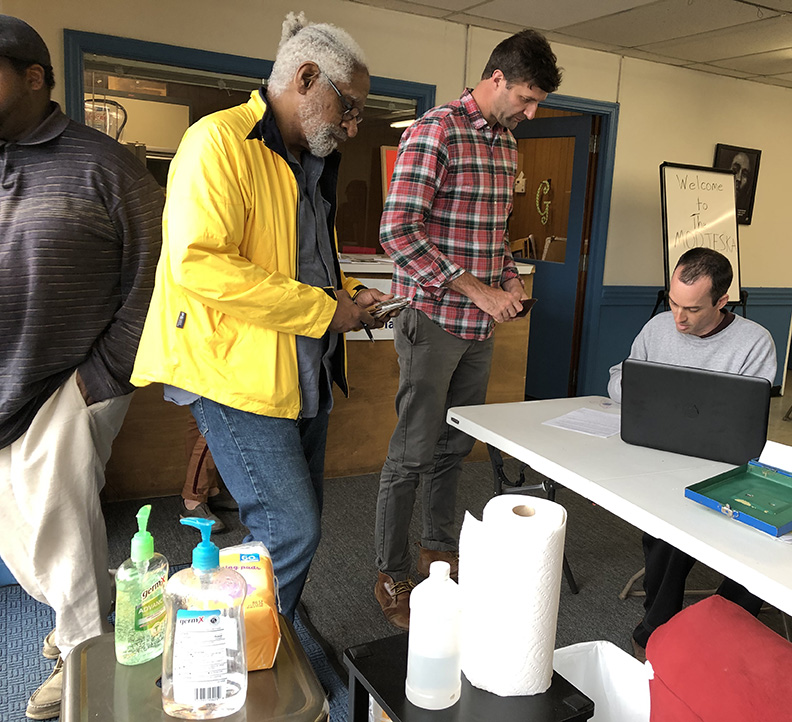
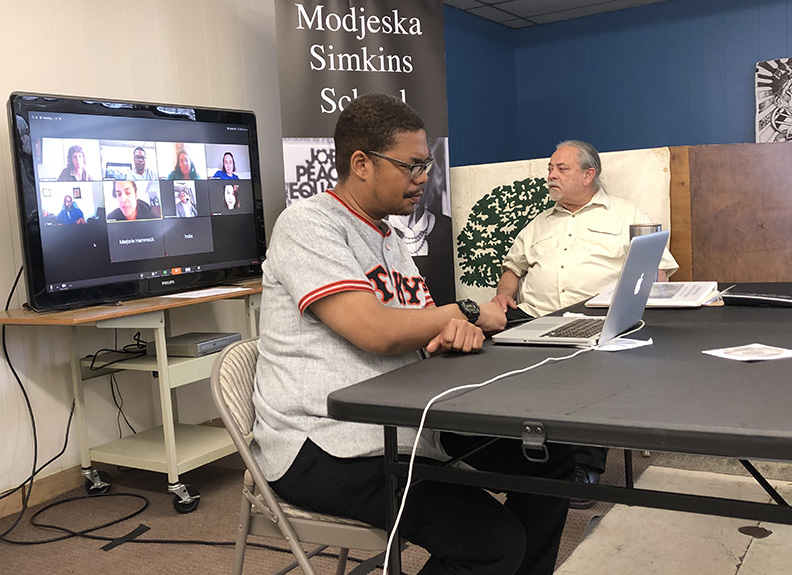
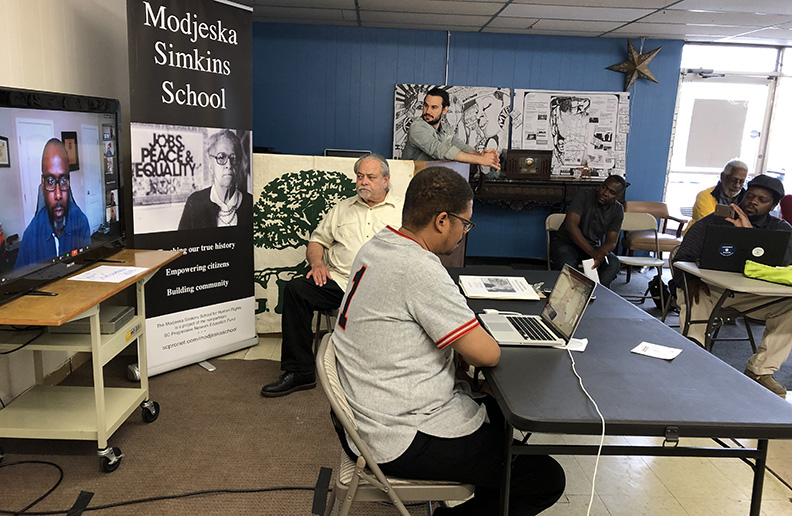
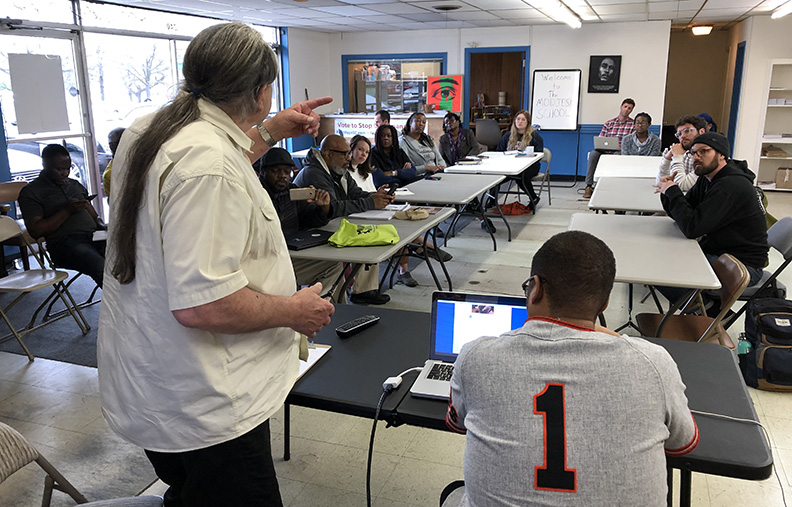
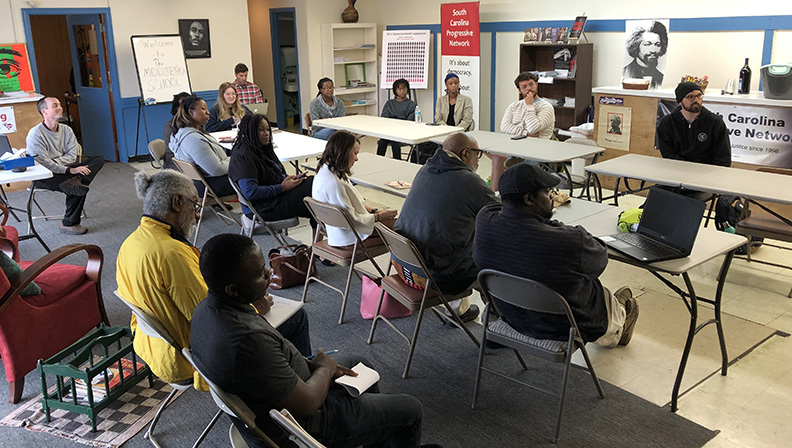
Instead of hugs and handshakes, students gathering for the first day of the spring session of the Modjeska Simkins School were greeted at the door with hand sanitizer and cleansing wipes. As the Palmetto State comes to terms with the growing coronavirus threat, some students opted to join through video conferencing. It is a sign of the times.
Today, after wide criticism for his slow response to the crisis, Gov. Henry McMaster cancelled classes in the state’s public schools for the rest of the month. Colleges across South Carolina have extended their spring breaks and are preparing to move their classes online.
The Modjeska Simkins School has decided to delay its next class for two weeks, and to live stream the rest of the session. “Being online will be a challenge,” said SC Progressive Network Director Brett Bursey, “but we are looking forward to learning new ways of doing things that will help us expand our distance learning capacity. Eventually, we’d like to make the school available to anyone, anywhere. This will help move us in that direction.”
Dr. Robert Greene (left) and Brett Bursey
The session will be led by Dr. Robert Greene (Claflin University). Joining him will be Dr. Todd Shaw (USC political science and African American studies), Dr. Jon Hale (USC education history), Dr. Alison McCletchie (USC sociology and anthropology), activist Kevin Gray, and special guests. Classes will be held on alternate Monday evenings through mid-July.
The class of 28 is made up of students with varied interests and backgrounds. The youngest is in 10th grade; the eldest is in her 80s. “We are impressed with this class,” Bursey said. “It will be a different experience for these students than those in years past, but we are confident it will be no less powerful.”
For more about the school, see the web site. Follow on Facebook.
As part of the Modjeska Simkins School‘s Sunday Social series, the public is invited to hear recovering attorney Lewis Pitts on June 2 at the temporary HQ of the SC Progressive Network, 2015 Marion St., downtown Columbia 4-6pm. Pitts is a dynamic speaker with an impressive resume and a trove of stories from the trenches. He will be joined by his former client and longtime friend Brett Bursey. The event is free and open to all.
• • •
Lewis Pitts was so dismayed by the legal profession that, after 43 years of practice, he asked the NC State Bar to allow him to resign. He was disturbed by the growing tendency of attorneys and law firms to put profit before the people they were supposed to serve.
“My resignation is because I see an overall breach by the Bar as a whole of the most basic of professional conduct and ethics such that I do not want be be associated with the Bar,” Pitts wrote in a 2014 letter to the Bar. “I do not mean to be mean or flippant. The ministry of law has been a powerful force in my life and I have had the pleasure of working with many terrific people in pursuit of justice — lawyers and non-lawyers. I want these parting words to stir your minds and hearts into reflection, boldness, and transformational action.”
The case went to the state Supreme Court, where Pitts was granted the exit he sought.
A South Carolina native, Pitts graduated from Wofford College and USC’s law school. He practiced in DC and spent nearly 20 years at Legal Aid of North Carolina, where he founded the statewide children’s unit and fought the schools-to-prison pipeline.
Pitts was Network Director Brett Bursey’s lawyer after he was arrested for threatening President George Bush with a “No War for Oil” sign. (Read about the case in this blog post.)
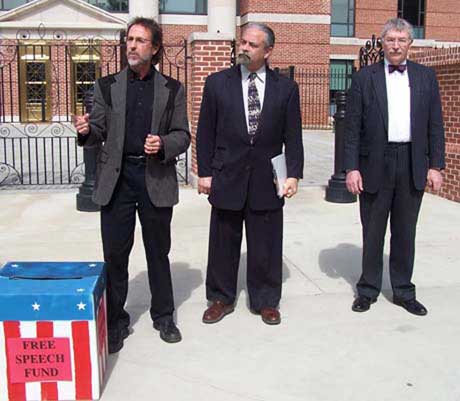
Lewis Pitts (from left), Network Director Brett Bursey, and attorney Jay Bender outside the federal court house in Columbia, where they led a “free speech pay-in” to help cover court costs in Bursey’s trial.
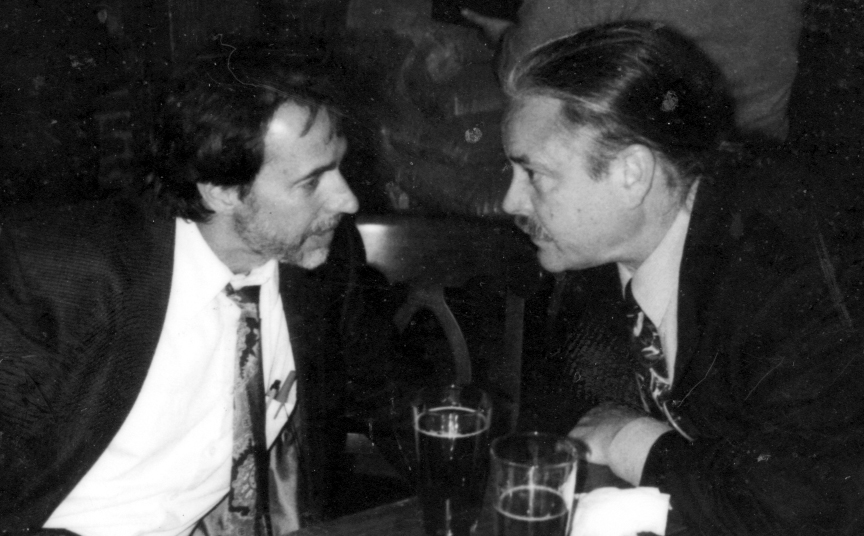
Bursey and Lewis go way back. Pitts represented the Natural Guard protesters at the Bomb Plant (Savannah River Site), and decided to go to jail with them. He was an attorney in Karen Silkwood’s wrongful death suit, took part in civil disobedient arrests at nuclear facilities around the country, and was lead attorney in the successful civil suit against the Klan and Nazis for the murder of five Greensboro activists in 1979. (Watch “88 Seconds in Greensboro” on Vimeo.)
“From my earliest days as a lawyer, I have been concerned that the role of our profession has been to serve and protect the political and business establishment and not to uphold rule of law,” Pitts wrote in his resignation letter. (Read the letter here.)
He told a Greensboro reporter that there was no single incident that made him want to step away. “It was like the hypocrisy was eating me physically and psychologically.” He called his appeal “a desperate plea” in “some explosive times when the rule of law really needs to mean something. I guess it’s time for our profession to undergo a moral checkup.”
Lewis is in Columbia to teach a class of the Modjeska Simkins School. See excerpt from his 2017 class lecture on the evolution of corporations in the United States on our YouTube channel.
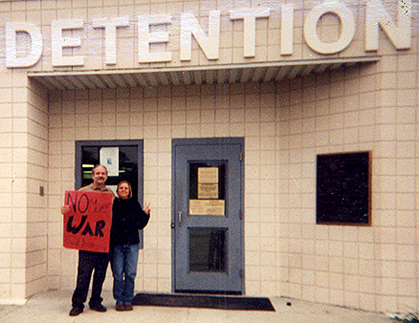
Brett Bursey and Becci Robbins at the Lexington County detention center Oct. 3, 2002, upon his release after being arrested for protesting President George Bush.
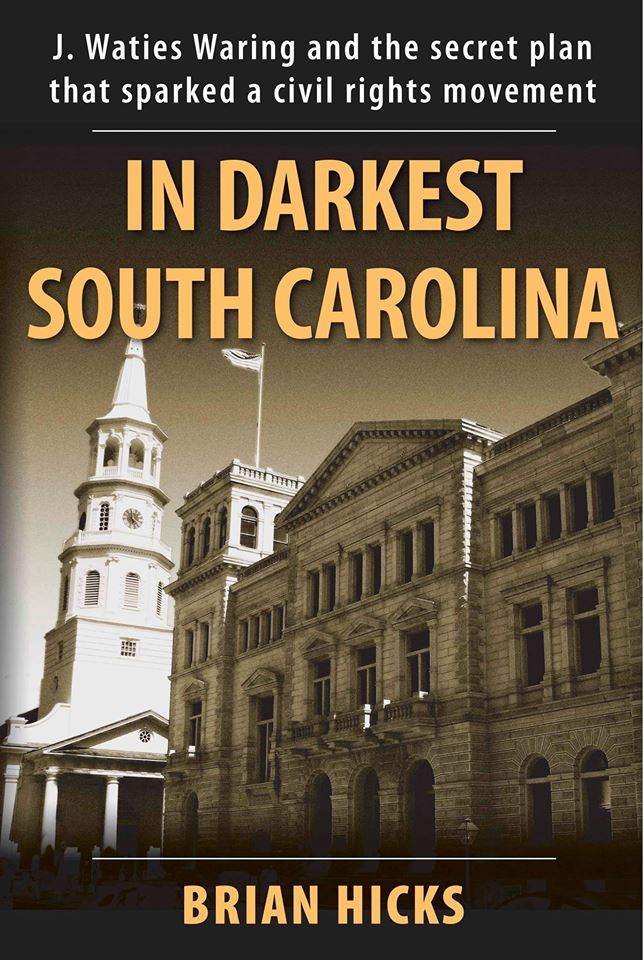
As part of the Modjeska Simkins School’s Sunday Social series, on April 28, 4-6pm at 2015 Marion St. Post & Courier columnist Brian Hicks will talk about his latest book,In Darkest South Carolina: J. Waties Waring and the secret plan that sparked a civil rights movement. His remarks will be followed by a group discussion led by Robert Greene, a Claflin history professor and guest lecturer at the Modjeska School.
The talk is free and open to all. Questions? Call 803-808-3384.
Four years before the landmark US Supreme Court decision Brown v. Board of Education, a federal judge in Charleston hatched his secret plan to end segregation in America.
Julius Waties Waring was perhaps the most unlikely civil rights hero in history. An eighth-generation Charlestonian, the son of a Confederate veteran and scion of a family of slave owners, Waring was appointed to the federal bench in the early days of World War II. He had coveted a judgeship his entire life, but circumstance and fate denied him until he was 61. When Waring finally donned the robe, it changed everything he’d ever known.
Faced with a growing demand for equal rights from black South Carolinians, and a determined and savvy NAACP attorney named Thurgood Marshall, Waring did what he thought was right: He followed the law, and the United States Constitution. Shaken by the bigotry and backlash that followed each of his rulings, Waring soon had a moral awakening – and decided to set the world right.
In the midst of rebelling against home and heritage, Waring crossed two lines from which there was no return: He abandoned his wife of 30 years and married an intellectual Yankee divorcee, which led to his ostracism from Charleston’s South of Broad society. Then Waring ordered the South Carolina Democratic Party to allow African Americans to vote in its primary – and the entire state damned his soul.
The Ku Klux Klan bombarded Waring with threatening calls, letters and burning crosses. The Charleston newspapers declared war. Demagogue politicians promised to run the judge from the bench – and out of South Carolina. Waring’s ruling against discrimination in voting booths even inspired Gov. Strom Thurmond’s infamous Dixiecrat presidential bid. But the judge wasn’t finished. By 1950, Waring believed he’d found a way to destroy all Jim Crow laws, so long as he could carry out his scheme before he was impeached … or killed.
This is the story of 20th century America, where Harry Truman and Strom Thurmond carried on battles begun by Teddy Roosevelt and Ben Tillman, where a Clarendon County preacher risked his life for equality, and a gentle Charleston teacher showed thousands how to claim their civil rights. This is the story of Judge J. Waties Waring, his incredible life and the country he changed. And it all began in darkest South Carolina.
• • •
From In Darkest South Carolina: An early winter storm devastated Charleston the last weekend of November. Tat Saturday, three people died of exposure as temperatures dropped into the teens — colder than it had been along the South Carolina coast in seven years. Pipes burst across the city, leaving many residents without water. One woman was found frozen on the waterfront near the Battery and the Fort Sumter Hotel, where the Southern governors were holding their annual convention.
The next day, 125 people set out from Morris Street Baptist church for a nearly two-mile march to 61 Meeting Street. The walk was not unbearable; the temperature ultimately rose to 48, 10 degrees above the forecast. These people — 100 of them black, 25 white — were led by Modejska Simkins, the Columbia activist and state chairman for the Southern Conference Education Fund. The “pilgrimage” had been her idea to honor Judge Waring and his wife for their dedication to civil rights.
The group walked uncluttered sidewalks along King and Meeting streets for nearly an hour before arriving at the judge’s home. There they found an atypical South of Broad scene: a government car parked beneath a palm tree. An armed marshal casually leaning against the house. It looked like a fortified compound in enemy territory. But the Warings stood outside, near their front door, shaking hands with every one of the pilgrims.
It was a simple ceremony. With the group fanning out on the sidewalk and spilling into Meeting Street, Simkins read a citation that praised Waring for his “wise, just and courageous” work, his understanding of democracy, as well as his dedication to protecting the rights of suffrage and the freedom and equality of men.
“Yet it has been seen that many another, in your place, has found it possible, before obdurate prejudices and customs, to avoid the guidance of the noblest guarantees of our constitution,” Simkins said. “Your own faithfulness in this field, despite environmental discouragements others have bowed to, has been exemplary and heartwarming.”
The judge was moved by this tribute more than any other he’d ever received.
• • •
Hicks’ journalism has appeared in national and international publications since 1986, and he has written about Southern history and politics for 30 years. He has been featured on CBS Sunday Morning, National Public Radio, the Discovery Channel, the National Geographic Channel and in Smithsonian Magazine. His column has won three Green Eyeshade Awards for best commentary in the Southeast from the Society of Professional Journalists, and Hicks is a former South Carolina Press Association Journalist of the Year.
His previous books include Ghost Ship, When the Dancing Stopped and The Mayor. His Toward the Setting Sun and Raising the Hunley were selections of the Book-of-the-Mouth Club, as well as the History and Military Book Clubs.
A native of Tennessee, Hicks has lived in Charleston for more than 20 years.?
The SC New Legacy Project, the youth organizing body of the SC Progressive Network, has started a podcast to engage, educate, and mobilize young people in the Palmetto State. To date, they have taped three episodes, although the latest, on the group’s Monument Tour, has not yet been posted.
Although she is quick to share credit, the force behind the podcast is Vikki Perry, a Pamplico, SC, native and graduate of the Modjeska Simkins School of Human Rights, another Network project. She is rightfully excited about the podcast, and shared with us a little about how it came to be and where she hopes it willl go. [Note: for a primer on the New Legacy Project, listen to the last 45 minutes of this episode.]
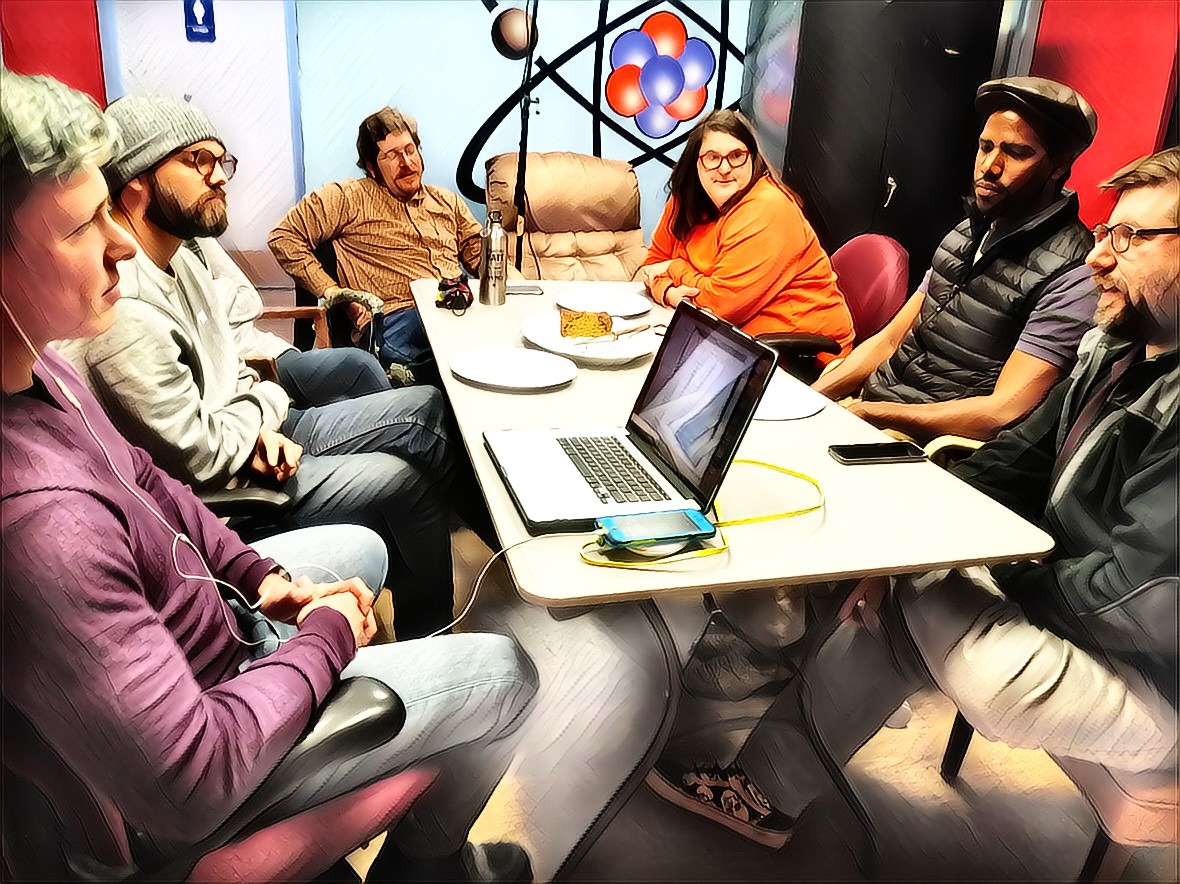
Chris McLauchlin, Chris Gardner, Dale Joyal, Vikki Perry, Wayne Borders, and Curt Shumate tape an episode of the South Carolina New Legacy Podcast. Photo by Danielle Dandridge.
• • • • •
First, the Network is impressed with the podcast, and we can’t wait to follow your progress. What was the genesis for it?
While the idea of a podcast has been around for a long time in NLP, we decided to start it right now for a few reasons.
There is a lot of expertise and experience in the room at the SC Progressive Network/NLP. A podcast is a good way of sharing that information around our community. By virtue of location, our group is pretty Columbia-based. We want people outside the Columbia metro to know what is going on, too.
In the last few years, local news coverage has dwindled to a trickle. National companies are buying local news outlets and there is a dearth of coverage of local issues. Everything is national, and in the age of Fox News and Sinclair Media, there is an agenda to a lot of that media coverage. We have an agenda, too, but we’re up front about it and we try to support it with facts and real stories about the people in our community.
We want to build an apparatus for communication that fits into the 21st Century model. Podcasts are an easy entry point and add a sense of community. But maybe someday, we’ll move into videos or some other integrative format to add that same sense of community.
As for who is responsible for this, it is a collective effort. I remember sitting at the Modjeska House [where the group met before it was closed recently for renovation] and saying, “Guys, if you want to do a podcast, stay after the meeting for a little bit.” No one at the table moved. I was like “Okay, this is going to be a thing now.” So we’ve all worked together over the last several months to decide on a format and some topics. I’m really excited about where we’re going to go with this.
Briefly describe the podcast.
The South Carolina New Legacy Project is a South Carolina-focused political podcast that aims to educate, agitate, and organize in our local communities. It is a show that will feature deep dives into policy, local stories, and interviews with people who are making a difference on either a national stage or a local stage or both.
We plan to regularly feature a segment that we’ll call “Corrupting the Youth.” These will be intergenerational interviews where younger activists interview a more seasoned activist about their lives, their work, and how they see what is happening around the state and nation.
What audience are you hoping to reach?
Young progressives or young-at-heart progressives who want to be politically active in South Carolina and don’t know where to start. When you’re a progressive in South Carolina, you can feel isolated and somewhat powerless. For me, finding the progressive network has given me a sense of community and some of that power back. I want us to help foster that same sense of community and give people who can’t come to our meetings because they live in Myrtle Beach or Easley or somewhere else in the state.
We get lost in the cacophony of liberal groups in this state who maybe aren’t doing the same kind of work we’re doing on a local level. The podcast is a very literal way to be heard over the noise.
How often do you plan to record?
Currently, we plan to release an episode every two weeks, but ultimately, we’d like to do something on a weekly basis.
Who are your key collaborators on the project?
I have taken the role of cat herder, organizer, and learning to produce the podcast as I go. Chris Gardner has taken the role of our sound guy, and has composed the theme music that we’re going to use. Wayne Borders loves doing the intergenerational interviews so you’ll probably be hearing a lot of him.
But we have a large collective, and we’ll all be contributing as we go on depending on the topic. Curt, Janessa, Chris, Danielle (our photographer), Daniel, Omari, Dale, and we will pull in people from the broader collective of the Progressive Network as we need their expertise like Sarah Keeling and Kyle Criminger.
What can listeners look forward to in the coming sessions?
For some time now, the New Legacy Project has been working on something called The State of the Youth. We’ve been researching several main areas where the youth of South Carolina are impacted including health care, criminal justice, economics, education, and voting rights. You can definitely look forward to hearing more about that. Education will be coming up in the next few weeks.
But we have some fun topics that we’ll discuss as well like history, barbecue, movies set in South Carolina, colleges, and more.
Our next episode is going feature the Monuments Project and how it came out of the Modjeska School for Human Rights. Curt and I may also talk a little bit about one of the people who are memorialized on the State House lawn. You’ll need to listen to find out who!
Anything you want to add?
First, you can find us HERE and wherever you listen to your podcasts including iTunes, Spotify, Stitcher, and Soundcloud. Search for us under South Carolina New Legacy Podcast.
Second, we take suggestions for topics and stories. If you’ve got anything you want to hear about, we’ve probably got people who can discuss it. Tell us. You can find us on Facebook, Twitter, and Instagram. Our email address is scnewlegacyproject@gmail.com.