On Social Security’s 75th birthday, let’s party with US Congressman John Spratt

To celebrate Social Security’s 75th birthday and honor US Congressman John Spratt for his long service to the Palmetto State, the SC Alliance for Retired Americans invites the public to a party on Friday, Aug. 13, in Rock Hill.

Spratt serves on the President’s Fiscal Reform Commission, which will offer its recommendations to Congress in December that likely will affect programs critical to seniors. Given the make-up of the Commission, the Alliance fears it may vote to cut Social Security benefits or raise the retirement age to reduce the deficit.

Spratt and other guests will talk about the history and current threats to Social Security, and will remind us that the program did not create the deficit and should not be cut to solve it. Social Security has enough money to cover full benefits for nearly 30 years, and has not added a penny to the nation’s budget crisis. In fact, the program is one of America’s greatest success stories, but misinformation has twisted the public debate.

With a $2.6 trillion dollar surplus, Social Security is not bankrupt. The federal government has borrowed most of that to pay for bailouts, two wars, and tax cuts for the wealthy. The government must pay back the loan, as that money belongs to American workers.

Part of Friday’s program will be the release of a new study detailing how much Social Security benefits residents of South Carolina.

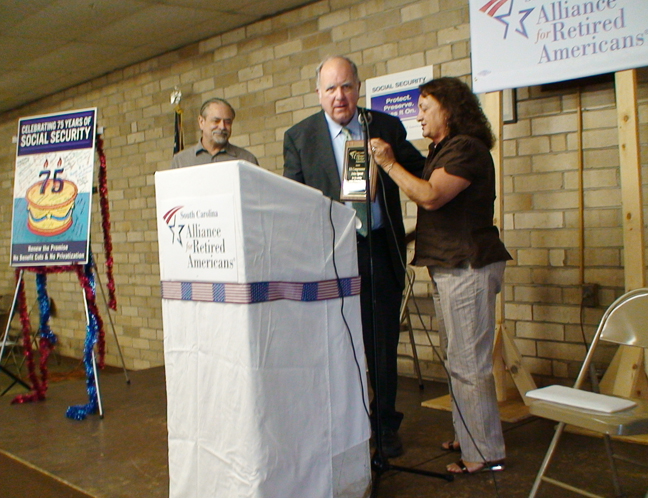
The party kicks off at 5:30pm with music by the TransGenerational Jazz Band and free refreshments. Congressman Spratt will speak shortly after 6pm. He will receive a giant card signed by constituents asking him to protect and preserve Social Security and a plaque from the Alliance thanking him for his service.

Someone will get whacking rights to a large “Fat Cat” piñata.

The SC Alliance for Retired Americans thanks our event cosponsors: SC AFL-CIO, SC New Democrats, SC Progressive Network, Rock Hill NAACP, Catawba Central Labor Council, Greater Columbia Central Labor Council.

For details about the event or the SC Alliance for Retired Americans, email scalliance@mindspring.com or call 803-808-3384. Or join us on Facebook.

On 75th anniversary of Social Security, where does Wilson stand?

This weekend on Meet the Press, Republican Leader John Boehner reiterated his support for making deep cuts in Social Security.  South Carolina Democrats met the assertions with criticism, calling on Second District Congressman Joe Wilson to denounce Boehner’s plan to take away the benefits seniors have earned.  Wilson’s silence on this issue and refusal to protest the GOP plan to raise the retirement age to 70 shows just how out of touch with South Carolina he is.

“It’s time for Joe Wilson to show that he’s willing to fight for South Carolina’s seniors,” said South Carolina Democratic Party Chair Carol Fowler.  “He’s made a career out of voting the way his party leadership tells him to, but cutting the benefits that people have worked a lifetime to earn is taking partisanship too far.  It’s time for Joe to stand up for his constituents, not Wall Street Banks and the GOP’s privatization schemes.”

BACKGROUND

Wilson votes with GOP 96.7% of the time. [Washington Post Votes Database, Accessed 8/9/10]

Meet the Press exchange between host David Gregory and Republican Leader John Boehner:

GREGORY: All right. One of the ways you talk about getting your arms around spending was something you suggested back in June. That is that social security, the retirement age, ought to be raised to the age of 70. Is that something that the GOP will campaign on in the fall?

BOEHNER: David, I think it’s time for the American people to have an adult conversation about the problems that we face. These entitlement programs serve tens of millions of Americans and are critically important. We know that these programs are unsustainable in their current form, and I really do think it’s time we sit down and talk to the American people together about how we solve this. I think we need to bring Democrats and Republicans together in order to solve this problem.

GREGORY: You favor raising the retirement age?

BOEHNER: David, there are a lot of options about how you solve these, but I don’t want to get the cart before the horse. I think it’s important to have this conversation. It’s going to be a difficult conversation, but it’s time to have it and come up with solutions done in a bipartisan way to address the problems. [Meet the Press, 8/8/10]

Boehner Said he’d favor raising the Social Security retirement age to 70. Earlier this summer, Boehner outlined his support for raising the Social Security retirement age to 70, tying cost-of-living increases to the consumer price index rather than wage inflation, and limiting payments to those who need them. [Pittsburgh Tribune Review, 6/29/10]

Described support for existing Social Security system as “nostalgia.” Boehner said, “We need the courage to strengthen Social Security for our children and grandchildren. We can’t be blinded by nostalgia for a broken system or casual about the problems it’ll cause our families down the road…” [US Fed News, Boehner Answers Community’s Questions, 4/29/05]

Boehner promised agenda of privatizing Social Security if he took Ccarge. In 2006, Boehner said he’d push to privatize Social Security if he was in charge. “If I’m around in a leadership role come January, we’re going to get serious about it.” [Washington Times, 7/31/06]

Ethics Act: Misplaced Trust

By Candy Waites and John Crangle
Common Cause of South Carolina (a member of the SC Progressive Network)

Twenty years after we learned the details of Operation Lost Trust, a federal sting operation that caught legislators, lobbyists and state employees in a net of bribery and drugs, we have a new scandal: Operation Misplaced Trust.

The intense media attention and public outrage that grew out of Lost Trust led to the passage of the State Ethics Act, which banned lobbyists’ gifts to public officials, limited campaign contributions by amount, sources and uses, and attempted to prevent the use of public office for personal gain. Both of us worked hard to pass the act and, as advocates for governmental reform, regarded it as an important accomplishment.

We knew even then that the reforms fell far short of what was needed, but we did not foresee the many nefarious schemes that big-money interests and political opportunists would concoct — or how lax enforcement and lenient interpretations of the act would render it less effective.

Though it was a first step in the critical need for reform, the act was fundamentally flawed. The contribution limits were too high — $1,000 per donor for non-statewide and $3,500 for statewide offices. Corporations were allowed to donate (a practice banned for federal candidates since 1907). Political action committees were allowed to contribute, and the number of PACs was unlimited. Enforcement of the act concerning legislators was left in the hands of the Legislature rather than the State Ethics Commission. Disclosure requirements contained loopholes. Even with restrictions, campaign funds were allowed to be used for non-campaign purposes. Finally, no plan for public financing of elections was considered.

In short, the Ethics Act has created a false confidence in officials and enforcement — a Misplaced Trust.

After 20 years, big corporations and PACs remain the dominant source of campaign money. In fact, some candidates get almost all of their money from big business — telecommunications, banks, insurance, trade associations, real estate, auditors, drug companies, hospitals, doctors and lawyers. PACs have proliferated; even the speaker of the House has a PAC, pumping hundreds of thousands from big donors to receptive legislators. Some candidates for governor receive millions from special interests, much of it from outside the state where dozens of companies all owned by the same person deliver large sums of money to candidates.

Disclosure provisions of the act are dodged. Money is often sent to candidates a few hours before or even after the election to prevent voters from knowing the sources, amounts and uses. Legislative caucuses take in millions but don’t disclose who gave the money or how it was used. Independent expenditures by out-of-state interests buy campaign ads backing candidates without disclosing where the money is coming from.

And of course, enforcement has been lenient and ineffective. The House and Senate Ethics committees have never publicly disciplined a member for violation of the act since it took effect in 1992. The State Ethics Commission determined that Gov. Mark Sanford could use more than $500,000 of his campaign funds to pay his legal costs in fighting ethics charges and impeachment, even allowing him to spend nearly $150,000 to settle some three dozen charges with the commission. All this under a clause in the act that says it is OK to use campaign funds for “ordinary and necessary” expenses relating to office.

In the good ol’ days of Operation Lost Trust, lobbyists and big-money interests could ply legislators and executives with unlimited free liquor, drugs, food, golf trips and cash. Campaign money could be used for any purpose and, in fact, was often pocketed. Bribes were handed out in cash, sometimes $100 to a small-time legislative flunky, sometimes as much as $75,000 to a big-time fixer.

The days of do-it-yourself, every-person-for-himself bribery and extortion are gone forever, free-lancing corruption a thing of the past. Since Lost Trust, our politicians have institutionalized the ways in which big money buys legislation. In place of the pay-off to legislators and individuals, we now have lump-sum payments to leadership PACs and caucuses, which in turn pay the money down from legislative bosses to those who do the voting on command.

And worst of all, today big money often determines who runs for office, who gets elected and what officials do when they take office. We know that change is constant, and if we are to have ethical and financial accountability, it is time for the Legislature to overhaul the Ethics Act of 1991.

Waites was a member of the House-Senate conference committee that drafted the final version of the Ethics Act in 1991. Crangle, executive director of Common Cause/South Carolina since 1986, was the only lobbyist who lobbied for the act.
Remembering Dr. Betty Glad

By Becci Robbins
SC Progressive Network Communications Director

It was with real sadness that I learned this morning that Dr. Betty Glad has died. She was, to flip the aphorism, a woman’s woman. Although I didn’t know her well, I knew well the work she did and admired her moxie. Her obituary tracks a distinguished career that included breaking many gender barriers in academia.

The last time I saw Betty was at a House subcommittee hearing last session at which legislators heard testimony regarding a bill that would require women to view an ultrasound before receiving an abortion. The packed room was thick with tension. When the committee chairman began calling people to the microphone, it became clear that he was giving preference to anti-choice activists, allowing them to go first.

While pro-choice activists shifted in our chairs and exchanged exasperated glances, Betty stood — with her oxygen tank at her side — to say what the rest of us were thinking. She protested the process, demanding that both sides be given equal time. The chairman relented, and called her to the microphone. For the rest of the hearing, the speakers alternated between the two sides.

It was a small victory, but an example of how one woman can make a difference. And she did.

Thank you, Dr. Glad.

Dr. Betty Glad

COLUMBIA – Dr. Betty Glad, 82, died August 2, 2010. She enjoyed a truly distinguished career as a scholar of American politics and foreign policy. She was the Olin D. Johnston Professor of Political Science and Distinguished Professor Emerita at the University of South Carolina. She was an exemplary scholar, an expert on the American Presidency, United States foreign policy, and political psychology. She was the author of Jimmy Carter: In Search of the Great White House; Charles Evans Hughes and the Illusions of Innocence; Key Pittman: The Tragedy of a Senate Insider, and most recently, An Outsider in the White House: Jimmy Carter, His Advisors, and the Making of American Foreign Policy (Cornell University Press, 2009). She was editor or co-editor of The Psychological Dimensions of War; The Russian Transformation, and other books. In addition, she published dozens of articles, book chapters and commentary. Her first book Charles Evans Hughes was nominated for the Pulitzer Prize. Dr. Glad received a distinguished alumna award from the University of Utah in 2009.

She earned her B.S. degree magna cum laude, and Phi Beta Kappa, from the University of Utah. She received her doctorate from the University of Chicago in 1962. She taught at Mt. Holyoke College, and Brooklyn College, then taught for many years at the University of Illinois “”” Urbana – Champaign. She was also a visiting professor at New York University, 1986-1988. She was one of the first women to earn a Ph.D. in Political Science and then teach at a Ph.D. granting institution. She served as the first woman chair of the University of Illinois Department of Political Science. Dr. Glad joined the University of South Carolina in 1989. She was a dedicated teacher and exemplary mentor to untold numbers of graduate students whose careers were enhanced with her care and guidance. As a pioneer and role model for women throughout the Political Science profession, she also was one of the first women to challenge prevailing conventions and gender discrimination in the discipline, and one of the first to attain national and international stature. As a result, she won many awards for both scholarship and leadership throughout her long career, including the Frank D. Goodnow Award from the American Political Science Association for a lifetime of contributions and service to the discipline, and the Harold Lasswell Award from the International Society for Political Psychology for a lifetime of outstanding contributions to political psychology. She served as President of the International Society for Political Psychology, President of the Presidency Research Section of the American Political Science Association, and Vice-President of the American Political Science Association.

She was preceded in death by her parents, Harluf Glad Anderson and Edna Jeannette Geersten Glad and her niece, Cheryl Jensen, of Salt Lake City, Utah. She is survived by her brother and sister-in-law, Jay and Edris Glad and by her great-nephew and niece, Christine and Jason Stout.

Dr. Glad enjoyed music, ballroom dancing, reading, and good conversation. Among the many virtues contributing to Betty’s success were courage, strength and tenaciousness. She was a democrat and a Democrat (both little and big D) and loved justice.

Dr. Glad will be buried next to her parents in Salt Lake City, Utah. A memorial service will be held in The Rutledge College Chapel on the historic Horseshoe of the University of South Carolina, Columbia, on Sunday, August 8, 2010, at 2 p.m. Dunbar Funeral Home, Devine Street Chapel, is assisting. In lieu of flowers, tax deductable memorials may be sent to: The Betty Glad Legal Defense Fund of the Women’s Caucus for Political Science, c/o Dr. Laura R. Woliver, 425 Dean Hall Lane, Columbia, SC 29209.

Federal voting machine case clears first hurdle

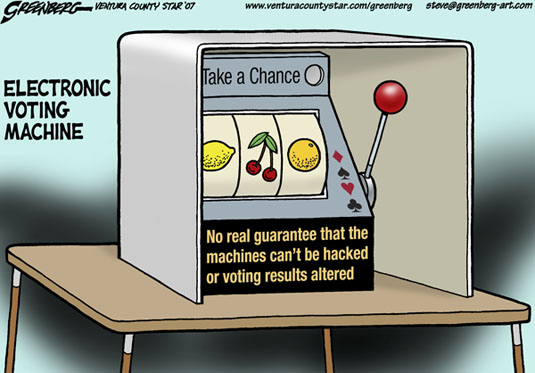
On July 28, Federal Judge Cameron Currie ruled that the SC Election Commission had until Aug. 20 to defend itself against a complaint that the voting machines in South Carolina do not meet federal requirements for record keeping. (For background on the case, see earlier post.)

SC Progressive Network Director Brett Bursey filed the complaint June 17, and the judge gave the parties a month to try and resolve the matter. On July 19, Bursey filed a report that concluded there could be no agreement between the parties regarding an independent audit of the entire voting system.

“I believe that the Election Commission doesn’t want a full system audit for fear that it would conclude — like a recent audit in Iowa did — that these machines should be scrapped.” Bursey said. “We warned the SCEC in 2004 not to buy these machines, and their continued defense of a voting system that cannot reliably tell us who won an election is regrettable.”

Only six states now use a statewide, paper-less system like we have in South Carolina. (Maryland outlawed the paper-less machines last year, but have not funded a replacement.) According to the Verified Voting Foundation, ballots in 38 states are cast on “voter verifiable paper records.”

Email network@scpronet.com to receive regular updates on the lawsuit.

Please consider making a secure donation now to help cover court costs. Indicate in the gift information “verified voting.” Or make a check to SC Progressive Network and mail to PO Box 8325, Columbia SC 29202. We appreciate your support.

NOW Participates in Launch of Campaign to Protect and Strengthen Social Security

By Terry O’Neill
National Organization for Women President

The National Organization for Women is glad to be a part of this large and diverse coalition to strengthen our country’s most important and successful social insurance program–Social Security. Speaking on behalf of NOW’s 500,000 members and contributing supporters, my message is simple: Social Security is especially vital to women, who would be disproportionately harmed by cuts in benefits.

The “three-legged stool of retirement” is meant to consist of a pension, personal savings, and Social Security. But all too often, women have neither a pension nor savings. In fact, fewer than one in three women has income from a pension. Moreover, after a lifetime of wage discrimination, women are far more likely than men to have little in the way of personal savings. The situation for women of color is particularly dire. According to a recent report by the Insight Center, women of color often have no personal savings, or even negative net worth, as they head into retirement.

As a result, Social Security is the mainstay for millions of older women. Every year, a major share of the nearly 24 million women age 62 and older who receive benefits are kept out of poverty because of Social Security. Often that monthly Social Security check is their only income.

We call upon the members of the National Commission on Fiscal Responsibility and Reform to act responsibly and reject any effort to reduce entitlement program benefits — now or in the future. Raising the retirement age to 70 would be an especially cruel benefit cut, forcing a hardship on millions of women (and men) who have physically demanding jobs, as our sister organization the Older Women’s League (OWL) has found.

If anything, Social Security benefits should be improved — especially for elderly women, because many exhaust their savings as they grow older, and for disabled, divorced and never-married women who have had modest incomes and have been unable to save and invest for retirement. Reducing benefits for these women would be calamitous.

Rather than cutting Social Security and putting millions of women’s financial security at risk, the Fiscal Commission should address the real causes of the deficit — unfunded wars, irresponsible tax breaks for the wealthiest, and an economic crisis caused by financial regulatory failures. Women are watching the commissioners, but will we be invisible to them?

*******
If you live in South Carolina, find out how you can help protect Social Security by contacting the SC Alliance for Retired Americans at scalliance@mindspring.com.

Top 5 Social Security Myths

#1: Social Security is going broke.

Reality: There is no Social Security crisis. By 2023, Social Security will have a $4.6 trillion surplus (yes, trillion with a ‘T’). It can pay out all scheduled benefits for the next quarter-century with no changes whatsoever. After 2037, it’ll still be able to pay out 75% of scheduled benefits—and again, that’s without any changes. The program started preparing for the Baby Boomers’ retirement decades ago. Anyone who insists Social Security is broke probably wants to break it themselves.

#2: We have to raise the retirement age because people are living longer.

Reality: This is a red-herring to trick you into agreeing to benefit cuts. Retirees are living about the same amount of time as they were in the 1930s. The reason average life expectancy is higher is mostly because many fewer people die as children than they did 70 years ago. What’s more, what gains there have been are distributed very unevenly—since 1972, life expectancy increased by 6.5 years for workers in the top half of the income brackets, but by less than 2 years for those in the bottom half. But those intent on cutting Social Security love this argument because raising the retirement age is the same as an across-the-board benefit cut.

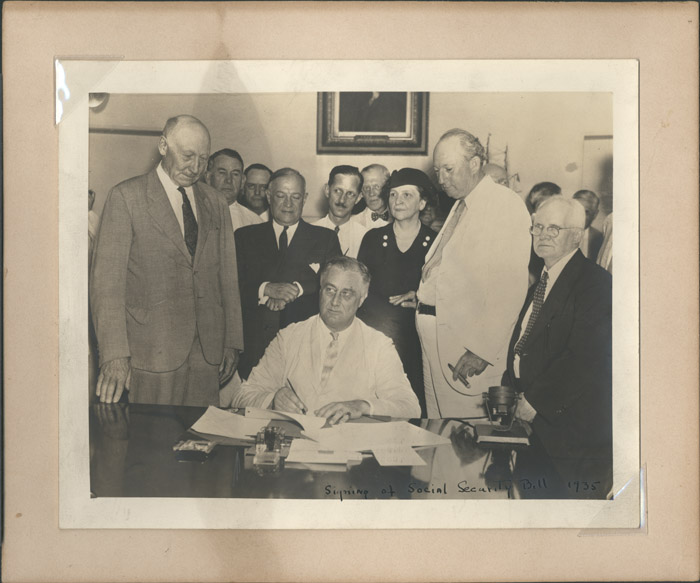
FDR signs Social Security Act

#3: Benefit cuts are the only way to fix Social Security.

Reality: Social Security doesn’t need to be fixed. But if we want to strengthen it, here’s a better way: Make the rich pay their fair share.  If the very rich paid taxes on all of their income, Social Security would be sustainable for decades to come. Right now, high earners only pay Social Security taxes on the first $106,000 of their income. But conservatives insist benefit cuts are the only way because they want to protect the super-rich from paying their fair share.

#4: The Social Security Trust Fund has been raided and is full of IOUs

Reality: Not even close to true. The Social Security Trust Fund isn’t full of IOUs, it’s full of U.S. Treasury Bonds. And those bonds are backed by the full faith and credit of the United States. The reason Social Security holds only treasury bonds is the same reason many Americans do: The federal government has never missed a single interest payment on its debts. President Bush wanted to put Social Security funds in the stock market—which would have been disastrous—but luckily, he failed. So the trillions of dollars in the Social Security Trust Fund, which are separate from the regular budget, are as safe as can be.

#5: Social Security adds to the deficit

Reality: It’s not just wrong—it’s impossible!  By law, Social Security’s funds are separate from the budget, and it must pay its own way. That means that Social Security can’t add one penny to the deficit.

Find out how you can help protect Social Security by contacting the SC Alliance for Retired Americans at scalliance@mindspring.com.

Activists urge senators to vote on jobs bill

On June 30, union and community leaders gathered in front of US Sen. Jim Demint’s office in Charleston. They were among thousands of others across the nation sending a message to their Republican Senators: “Vote on the Jobs Bill Now!”

“On Thursday, June 23, the Senate again failed to get cloture on the Jobs Bill even after Democrats agreed to reduce the overall cost of the bill.” said Leonard Riley, ILA member and president of Carolina Alliance for Fair Employment (CAFE).

Riley was joined by leaders of the Charleston and Columbia Central Labor Councils(CLC), SC Alliance for Retired Americans (ARA), SC Progressive Network, ILA Local 1422, AFSCME Local 1199 and the SC AFL-CIO.

Jenny Patterson, president of the Columbia CLC, said, “We are tired of Senator Demint pulling the rug out from under unemployed workers in our state and our public health and safety just to score political points. His refusal to vote for funding to keep teachers, police officers and other workers on the job and to protect elderly residents from being tossed out of nursing homes is outrageous.”

Vic Rawl, former Democratic candidate for US Senate, was among those attending the action. Rawl was endorsed by the SC AFL-CIO.

It’s time to refocus abortion debate

Cory Manning
S.C. Coalition for Healthy Families

On June 16, the Legislature passed the so-called 24-hour waiting period bill. Previous versions of the bill required women to make two trips to an abortion provider: one to get the materials and one to have the procedure. The bill that was finally passed allows women to review the materials on-line, eliminating the two-trip requirement. This was a victory for S.C. women and others concerned about reproductive rights.

Unfortunately, this was yet another example of the misguided discussion regarding abortion.

The participants in the abortion debate often seek legislative endorsement of moral positions that leave little room for compromise. Instead of seeking to score points or curry favor with constituent groups, they should focus on addressing the problem: unintended or unwanted pregnancies.

Both sides of this debate, if they are being realistic and want solutions, would support measures that reduce unintended or unwanted pregnancies. For example, educating teenagers with age-appropriate information about sexual activity, including contraception and abstinence, and supporting low-income women in economically rational ways that give them real choices regarding the decision to have a child will reduce the number of unintended and unwanted pregnancies (and hence the number of abortions) in South Carolina. If both sides focused on this common ground, we could see genuine improvement in the quality of life for women, children and all citizens of South Carolina.

Help us now to protect your vote in November!

SC Progressive Network Director Brett Bursey filed a complaint in federal court on June 17 to require the state to preserve voting records in federal elections. Since then, the Network has worked to arrange an audit of the entire June 8 South Carolina primary vote.

As you know, the results of two federal elections — US Senate and Congressional District 1 — were, in the words of numerous well-credentialed experts, “anomalous.”

The Verified Voting Foundation released a statement on the South Carolina primary results that concluded, “Whether specific reports of irregularities in this election are confirmed, the most important fact about South Carolina’s voting system is that most ballots cannot be effectively audited or recounted. Serious concerns about the integrity of the primary (and of other elections conducted using the same technology) are inevitable, and legitimate.” For the full statement go to Verified Voting.org.

Since a “recount” of the voting machine tallies we use in South Carolina can only produce the same number, over and over, an audit of the internal memories on the machines is the only way to discover anomalies — and even this won’t reveal the intent of the voter beyond what is recorded by the software.

South Carolina is one of only eight states that uses paper-less, touch-screen devices that are not routinely audited. Thirty-four states now require a “voter verified paper ballot” that can be referred to in the event of a recount or audit.

“We are not questioning the results of the June 8 primary,” said Bursey. “We are questioning whether the machines we use can be audited to insure that the results reflect the voters’ true choices, and if the preserved records satisfy federal requirements.”

Yesterday, we gave up on trying to get the SC Election Commission to agree to a third-party audit of the entire system. The executive director of the SCEC, as well as the board chair, both had roles in the purchase of these machines in 2004. They maintain that the system works fine and no audit is necessary.

We are now focusing on the federal complaint we have filed that questions whether the intent of the federal records preservation statute can be met using the counties’ current systems and software. Our lawsuit is the only thing standing between us and another election in November with unverifiable results.

We have filed a request for all the compact discs that each county was supposed to have used to record the flash memory of each voting machine.

The state Election Commission does not know if all counties followed this procedure, or whether this procedure adequately preserved the records, or whether what is preserved is sufficient to reliably determine the voters’ intent. The state Election Commission is arguing that it is not its job to keep these records, nor to gather them for us.

We need immediate financial help to make our case. We need to raise $3,000 to cover filing fees and expert assistance. If you can help, please do.

We hope that this case, and the growing public awareness of the inherent shortcomings of our voting system, will lead to a voter-verifiable, recountable, paper record of the most critical part of our democracy — our vote.

Please make a secure donation now and indicate in the gift information “verified voting.”

Thank you for your support.