Medicaid expansion would benefit SC’s small businesses

By Frank Knapp
President, S.C. Small Business Chamber of Commerce

The debate is underway over whether to expand the federal-state health insurance program, Medicaid, to more uninsured low-income South Carolinians.

Opponents of expansion, made possible by the Affordable Care Act, or Obamacare, are led by Gov. Nikki Haley’s director of Health and Human Services, Tony Keck, who runs the state’s Medicaid program. Mr. Keck’s public position is that the issue is not about cost but about making more of our citizens healthy. He argues that expanding Medicaid is an inefficient way of achieving that goal.

In December, I attended a forum where Mr. Keck explained that having health insurance was not a good predictor of health outcomes. Therefore the state would do better in promoting health by concentrating on education and jobs while encouraging our citizens to make better personal choices about their behavior.

But in response to a question I posed, Mr. Keck admitted that a low-income person’s health would be better if he had Medicaid than if he did not. “But at what cost?” he quickly added.

Mr. Keck’s almost reflexive response reveals that the tactic of arguing that Medicaid isn’t the best way to improve health is really an effort to misdirect the debate away from the real issue — cost.

If we remove the partisanship over Obamacare and admit that improving the level of education, size of paychecks and behavioral decisions of the state’s low-income citizens is an admirable but daunting goal that will take decades to achieve, the primary objection to expanding Medicaid to improve health today is cost.

Opponents of expansion say that the state can’t afford its eventual 10 percent share of the Medicaid expansion. Mr. Keck’s actuary projects that the cost to the state could be up to $1 billion by 2020.

Proponents of expansion point to a study that projects that economic activity in the state will increase by $3.3 billion and 44,000 jobs will be created from expanding Medicaid. This increase in economic impact would result in the state actually taking in more revenue than it would spend on the expansion through 2020, contradicting Mr. Keck’s analysis. After 2020 the state’s budget would experience a small net loss due to expansion.

Unfortunately, this cost debate has largely overlooked an important factor associated with not expanding Medicaid — the cost to our small businesses.

Many low-income employees work for our state’s small businesses, and expanding Medicaid will result in reduced costs to these employers.

First, there is a significant cost to a small business when workers are not on the job because they are sick or have to care for family members who are ill. Even employees who don’t miss work when they are sick are less effective. Workers with health insurance for themselves and their families miss less work due to illness and are more productive. Clearly expanding Medicaid to cover low-income workers will economically benefit their small-business employers.

Second, small businesses that want to offer health insurance to employees will find it more affordable under a Medicaid expansion. Small employers with Medicaid-eligible workers will have fewer employees to cover on a private group health plan and thus have less in premiums to pay. In addition, with expansion the cost of the employee’s private insurance will drop due to a reduction in the hidden tax on every health insurance policy, which pays for the uncompensated care for the uninsured. Based on projections by Milliman, the actuarial firm used by Mr. Keck for his cost projections, the reduced premiums could be up to $1,000 per year for family coverage.

The third benefit of a Medicaid expansion involves the requirement of the Affordable Care Act that businesses with 50 or more employees either offer health insurance or pay a penalty. Workers on Medicaid are not counted toward the total number of employees, so the Medicaid expansion would mean that even many small businesses with 50 or more employees could avoid paying a penalty for not offering health insurance.

While our state officials continue to debate the cost of expanding Medicaid, that debate must include the cost to small businesses for not doing so.
Activists from across SC to meet for Network’s organizing conference Feb. 23

Progressive Organizing Conference

Growing the grassroots in South Carolina

Feb. 23, 10am – 4:30pm
Brookland Baptist Conference Center
1066 Sunset Blvd., West Columbia

network_spring_2011

See photos from last year’s conference here.

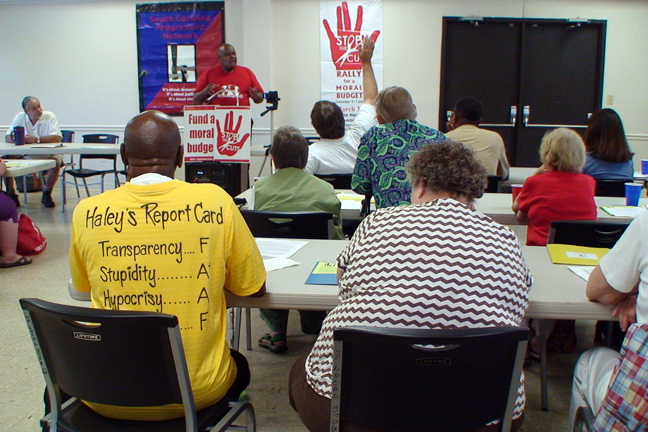
The SC Progressive Network and the SC Legislative Black Caucus are offering a day-long activist training conference Feb. 23 in West Columbia. Participants will focus on significant policy issues being considered by the legislature, with an emphasis on building a progressive movement.

“We must do more than lift up just and rational social and economic policies,” said Rep. Harold Mitchell, chair of the Legislative Black Caucus. “We have to build a popular movement with the power to make the necessary changes.”

The conference will address the challenges and opportunities posed by the increasingly conservative leadership in South Carolina that believes government is the problem.

Member organizations will offer brief reports on recent victories and current projects. This is an opportunity to share and inspire fellow activists with the good work going on across the Palmetto State.

RSVP for lunch ($10) required by calling 803-808-3384 or emailing network@scpronet.com. You can also RSVP or share on Facebook.

Medicaid Organizing Packet with Power Point presentation: $10 (optional).

PROGRAM

10am – Registration

10:30 – Brief reports from member groups and discussion led by community activists:

Reproductive rights: Will Bigger, Planned Parenthood
Ethics reform: John Crangle, Director, Common Cause SC
Environment: Bob Guild, environmental lawyer and Sierra Club activist
Labor: George Hopkins, labor historian and SC Progressive Network’s Lowcountry representative
Immigration: Ivan Segura, Council of Mexicans in the Carolinas
Education: Roger Smith, Executive Director, SC Education Association
Voting reform: Brett Bursey, Director SC Progressive Network
LGBT rights: Ann Wilbrand, SC Equality

12:30 – Lunch catered by Tio’s (optional). $10 RSVP at 803-808-3384

1 – Keynote speaker Rep. Gilda Cobb-Hunter

1:30 – Health Care and Medicaid Expansion: Former Columbia Mayor and Medicaid lobbyist Bob Coble, SC AIDS Task Force Director Dr. Bambi Gaddist, and health care economist Lynn Bailey will facilitate the discussion. The governor’s refusal to accept our federal tax dollars back in the form of a 90 percent match for expanding health care coverage to over 300,000 low-income South Carolinians provides a great opportunity to illustrate the cost of free-market ideology as social policy. Participants will get an organizing packet that will help them organize educational forums on this issue in their communities.

2:30 – Medicaid expansion strategy discussion. Rep. Gilda Cobb-Hunter will facilitate.

3 – Politics and power in the Palmetto State. A discussion about how political parties, elections and grassroots activism figure in to building an effective progressive movement. Former State Superintendent of Education Dr. Jim Rex will join the discussion. He helped launch the new Free Citizens Party. Should be a spirited session.

4 – Network business meeting. Nonmembers welcome.

Jim DeMint, why should taxpayers fund special election?

Dear Mr. DeMint,

We are writing to ask you to help pay for the election to replace you in the Senate. The South Carolina Election Commission estimates that the special election required by your resignation will cost South Carolina taxpayers about $1 million.

According to the Federal Election Commission, your Senatorial political action committee has $800,409 “cash on hand” and no outstanding debts (Team DeMint FEC ID S4SC00083, most recent filing 9/30/2012).

In 2010, your PAC gave a total of $1,150,000 to Republican parties in eight states other than South Carolina. That year you made a total of $7,500 in contributions to 19 South Carolina county Republican parties.

In 2012, you generously donated $700,000 to the Club for Growth and $5,000 to the SC Republican Party.

Your new million-dollar-a-year job at the Heritage Foundation affords you the opportunity to donate the remaining $800,409 in your campaign account to the SC Election Commission, removing that burden from South Carolina taxpayers.

According to FEC staff, your check to the SC Election Commission to pay for an election you necessitated would qualify as a “public purpose” as required by statute.

Your resignation from the Senate, and Congressman Tim Scott’s resulting appointment to your seat, will cost South Carolina taxpayers $1 million to pay for a special election.

We hope that you agree that paying for this election with campaign money you no longer need would honor both your constituents and your conservative values.

Regards,

Brett Bursey
Director, SC Progressive Network

History repeats itself

By Hoyt Wheeler
SC Progressive Network Co-chair

As the famous philosopher Yogi Berra once said, “It’s déjà vu all over again.” We are experiencing once again deep challenges to the survival of the American republic that bear a close resemblance to challenges that we have faced before. Our present fix looks a great deal like the rocks upon which our country foundered in the 19th Century.

In the 19th Century, the War Between the States (or the War of Northern Aggression as it is known in South Carolina), in the words of Abraham Lincoln, tested whether the American government “of the people, by the people and for the people” could survive. This was settled only by a massive slaughter in which the Southern states were conquered by the Northern ones. The root cause of this war was an employment system in which human beings were used as mere resources by their owners – human slaves. To protect this system, the Southern states attempted to nullify national laws and, ultimately, to secede from their Union with the other states.

In recent years, under the banner of honoring the 10th Amendment, which reserves to the States those powers not given by the Constitution to the Federal government, legislatures in a number of states have once more attempted to nullify Federal laws.

With South Carolina once again in the forefront, several states have enacted provisions in their state constitutions to enact their own version of labor laws that conflict with Federal law. When challenged, their attorneys general have responded that these laws, which have to do with employee representation by unions, are not contrary to national legislation, although this is patently not the case. Also, in response to the much hated Federal “Obamacare,” some states are attempting to remove themselves from its requirements by state legislation.

The rhetoric used in attacking the national government has reached extraordinary heights. One of the more moderate candidates for the Republican nomination in the last election for South Carolina’s governor told a Tea Party rally that, where the enemy used to be the Soviet Union, it was now Washington. An application of Federal labor laws has resulted in the National Labor Relations Board being accused of being a “rogue agency” by South Carolina’s governor.

To resolve any doubt as to the extremes to which some citizens would take their resistance to the national government, in several states thousands of signatures have been collected in favor of actual secession from the United States. One would think that, in states such as South Carolina that are characterized by extraordinary expressions of patriotism, this should not be taken seriously.

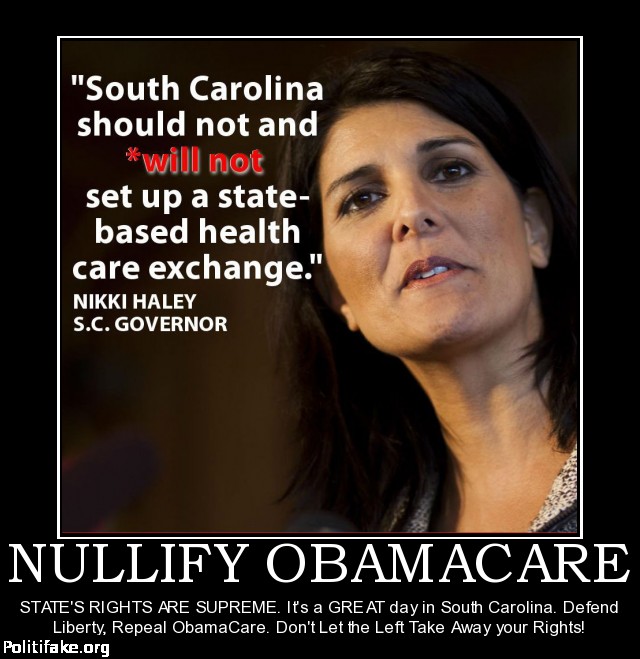
However, it takes place in the context of the extreme libertarianism of many public officials. At least in South Carolina, it is clear that powerful politicians are simply opposed to any government – national or local. Appointments to head state agencies have been accompanied by statements by the governor that the task of the agencies’ leaders is to weaken, not enforce, state laws. Being business friendly, not the welfare of citizens, is seen as the ultimate test of state policy. Gov. Nikki Haley is opposed to cooperating with the Federal government, even refusing millions of dollars of Federal money for expanding Medicaid to benefit health care for the state’s poor.

American government, whether big or small, is in fact a government of, by and for the people. It is not a despotism that justifies rebellion. Although not perfect, it is superior to any alternative. It is a democracy worth defending and supporting.

New Year’s Memo to Members and Allies

Brett Bursey
SC Progressive Network Director

Over the past many months, right-wing leadership has lost its credibility and momentum, posing opportunities for progressives to make headway organizing on critical issues. Three policy areas that are especially ripe:

Medicaid expansion: We have discussed a primary legislative focus being on the expansion of Medicaid. It is a major battle in the war over the role and size of government. That said, it seems that major players (everybody to the left of the Tea Party) are taking up the call to accept Medicaid expansion. Gov. Nikki Haley will probably lose this fight, but we need to mobilize our members to ensure this happens.

Voting reforms: The Network has promoted a package of voting reforms for the past decade to make voting easier and verifiable. After the long lines to vote in November – which inconvenienced and disenfranchised even some Republicans – the idea of Early Voting Centers (which we championed in 2006) now has bipartisan support. The voting machines we use (and which the Network opposed the purchase of in 2003) are reaching the end of their life span. We have an opportunity to again push for an new voting system that is publicly owned, paper-based, simpler, cheaper and more reliable. The Network has been a major player in South Carolina’s voting business, and we need to focus on this.

Ethics reforms: The bipartisan clamor for ethics reform has been driven by indictments and investigations of leading politicians. I have testified before the four different ethics reform committees holding hearings. My main point has been that just because something is legal doesn’t make it ethical. Take House Speaker Bobby Harrell’s leadership PAC which legally circumvents campaign donation limits.

The other elephant in the room is that money is not speech and corporations are not people. The best these committees may come up with is “transparancy” that lets us know who is buying our elections. It is timely to again raise the concept of publicly financed elections for those who don’t want to be bought or sold. Common Cause is joining our call for a pilot program to elect the state Attorney General as a publicly financed candidate. Why should the state’s top cop have to take money from the corporations they may be called on to investigate?

Other work in progress:

A Midlands Public Transit Riders Association that we are helping to organize is coming along nicely. We are meeting every Wednesday at 2pm. Leadership from riders has emerged to run the group. After winning the fight for the penny tax in Richland County for transportation, we need a transit riders group to lobby for just and necessary changes. It shouldn’t be left up to the Chamber of Commerce to shape public transit.

The Workers’ Rights Project
did a nice job with the Longshoremen Dec. 20 in shutting down the Charleston port for two hours to protest a shipment of garments from Bangladesh destined for WalMarts. Some of the clothing came from the factory where 112 workers lost their lives in a fire last Nov. This is the price of always low wages. We will continue to ponder new opportunities for community-based labor organizing.

Immigrant Rights advocates will meet with Sen. Graham’s staff in Columbia Jan 11 and Charleston Jan 10 to thank the Senator for his leadership on establishing a path to citizenship. There is a caravan of “Dreamers,” young people raised in the US but without documentation, passing through SC on the way to DC. Sen. Graham is the major Republican player necessary to get immigration reform. The Network set up the meetings and is seeking community support for other activities. See the Network’s calendar for details.

Last year was one of the Network’s most successful. We won the fight over SC voters having to show photo ID to vote. We helped prevent critical budget cuts that hurt South Carolina’s most vulnerable. We worked to help pass the penny sales tax to fund public transit in the Midlands. We steadily improved the Network’s visibility in the community and online. We did it all on a shoestring budget with the help of a talented board and gang of dedicated volunteers.

Let’s work together to make 2013 even more productive. And fun.

Remembering Modjeska Simkins

On Dec. 4, 2012, the SC Progressive Network honored human rights matriarch Modjeska Simkins on what would have been her 113th birthday. Friends gathered for an evening of fellowship and remembrance at her home, which now serves as the Network’s headquarters.

James Felder read from his recently released book, Civil Rights in South Carolina, from Peaceful Protest to Groundbreaking Rulings, the following passage:

On April 25, 1995, Modjeska Monteith Simkins’ portrait was unveiled at the statehouse. In my capacity as executive director of the NAACP at that time, I delivered a tribute to Ms. Simkins on that occasion.

It is only fitting and proper that a portrait of Mary Modjeska Monteith Smikins be unveiled here today in this statehouse in remembrance of her. I remember Modjeska for being one of the founding members of the SC Conference of Branches NAACP.

I remember Modjeska for serving as the first field secretary of the SC NAACP and receiving no pay for her work.

I remember Modjeska for discovering that white teachers were earning more than black teachers in 1943, and she pushed for litigation that led to Thompson v. Gibbes and the equalization fo teachers’ pay in South Carolina in 1945.

I remember Modjeska giving civil rights seminars to students from Allen University and Benedict College from behind the teller cage at Victory Savings Bank on Harden Street.

I remember Modjeska, who would drive alone to Clarendon County for a mass meeting and then would have the last word in the debate after the meeting in Billy Flemming’s house at his bar.

I remember Modjeska, who cranked out more press releases and letters to the editor than all of the civil rights groups in South Carolina combined.

I remember Modjeska, who had a great sense of humor and was quite a crowd pleaser, but she was a fierce warrior for preserving freedom for all of us.

I remember Modjeska, who was just at ease registering winos to vote on Read Street as she was entertaining Thurgood Marshall at her home on Marion Street.

And I will remember Modjeska as a legend in her own time. She was our Harriett Tubman and our Sojourner Truth. She was a woman who woke up every morning with freedom on her mind.

So after today, when you happen to be passing the statehouse one evening and the lights are flashing and the building is shaking, do not be alarmed, for that will just be Modjeska debating with Edgar Brown, Sol Blatt, Marion Gressette and Ben Tillman, and she will be winning the argument.

See more photos of the birthday party here.

Is Bomb Plant top threat in US?

At a 1978 SC State House press conference organized by the Natural Guard (the SC Progressive Network’s predecessor), Dr. John Goffman, a nuclear scientist credited with the discovery of plutonium, stated that the Savannah River Bomb Plant was the nation’s greatest national security threat. In the ensuing 34 years, the threat has increased.

The Bomb Plant: America’s Three A.M. Nightmare

November 14, 2012

National Security News Service

Aiken, S.C. – Tons of weapons grade plutonium and other nuclear materials, a target for terrorists, are not being properly protected by the National Nuclear Security Administration at the Department of Energy’s sprawling Savannah River Site, according to security consultants and U.S. counterintelligence officials.

A secret security review underway at DOE and other government agencies after an elderly nun last summer breached a NNSA bomb-grade-uranium facility at the Oak Ridge Tennessee Y12 area reveals “harrowing problems in site management and control at other DOE sites,” said a Homeland Security official who requested anonymity. The official said that the Savannah River Site was of concern because “SRS does not have the staffing or the facilities to protect the huge amounts of plutonium that have been brought to SRS in recent years.”

Read more here.

Droning On and On

By Mary Sullivan
Hilton Head, SC

Now that we are all worshiping at the “Cathedral of St. Drone,” we actually no longer need the institution of war. We have been praying for peace and it is actually on our doorstep! War has most certainly now become a totally outmoded institution.

This new state is thanks to our growing arsenal of unmanned armed aerial vehicles known as “killer drones” (now more numerous than other types of military aircraft) and to a president, comfortable with weekly review of his “kill list” for ordering “targeted assassinations” of people in countries with which we are not at war. Even though we don’t know their names, “signature assassinations” of people who just look like they could become a problem are OK too.

Drone assassinations are now THE weapon of choice and the industry is growing mightily. Hurry up and buy stock in the weapons manufacturers. We shouldn’t miss the opportunity to cash in. It’s good on so many levels — jobs, profits and it’s just plain neater. All those deaths are “over there” and our boys remain OK.

Why maybe we can even close the over 700 US military bases in over 150 countries (not our own Parris Island, of course). Finally the planet will be rid of the scourge of war. Any killing needed by the government can be done with a press of a button from a computer terminal right here. And our kids are already trained to skillfully use the button with games like God of War 4, Modern Warfare 3, Battlefield 3, etc. Stock in XBOX 360 and Playstation should also soar.

Now that at least 30 police departments have been equipped with drones, I am also looking toward the day when we can cut our state and local police budgets, thus rescuing these financially ailing entities. What a wonderful world we have to look forward to! I imagine we will eventually get used to the constant buzzing over head and to the insect sized drones listening at our windows.

But I really cannot understand why have we not been celebrating the end of war and this new, cleaner, more sanitized means of just getting rid of anyone who might remotely be of some challenge to our empire–and their families and friends who are surely guilty by sheer association?

I just don’t understand it. Shouldn’t there be ticker tape parades down 5th Avenue in New York City and along the Magnificent Mile in Chicago and maybe along 278 on Hilton Head and in towns and cities across the country? What could possibly account for the fact that we are not celebrating this momentous change in the way we humans deal with conflict? Surely not because most citizens (polls say 62%% or more approve) or media pundits have any moral compunction about assassination as the new strategy.

So whatever could it be?

SC Election Day meltdown: a cautionary tale

By Brett Bursey
Director, SC Progressive Network

The Election Protection hotline started ringing shortly after the polls opened at 7. It didn’t stop all day. Ninety percent of the touch-screen voting machines in the county’s 118 precincts wouldn’t boot up. Some precincts didn’t have working machines until 5:30pm.

One campaign tried to get the court to extend voting hours, but failed. The SC Republican Party Chairman said, “There is always a backup in case there is an election machine malfunction.” But unfortunately for thousands of voters, there was no such backup.

This wasn’t Richland County on Nov. 6, 2012. It was in Horry County’s 2008 Republican presidential primary.

At the time, I thought this was the train wreck we needed to get out from under these unreliable voting machines and get our emergency ballot statute fixed. I was wrong.

Four years later, it was thousands of voters in Richland County standing in line for up to seven hours because there weren’t enough working machines and no emergency ballots.

These are the same machines that failed in Horry County in 2008. The same machines that gave the 2010 Democratic nomination for US Senate to the virtually unknown Alvin Green, a result deemed statistically impossible by the nation’s top computer voting experts. The same machines South Carolina bought between 2004 and 2006 – against our organization’s recommendation to the Election Commission. After studying the issue extensively and watching what was working in other states, we advocated simpler, paper-based voting devices.

This Election Day, machine failures didn’t happen in Richland County alone, but in at least seven other counties, according to reports to the Election Protection hotline. Callers from Spartanburg, Greenville, Charleston, Horry, Berkeley, Kershaw and Sumter counties all reported machine failures causing long lines.

In the 2008 Horry machine failure, State Election Commission spokesman Gary Baum said all precincts must have emergency paper ballots on hand, calling them “part of the election.”

SEC spokesman Chris Whitmire said voters could use almost anything – “a napkin, a paper towel” – to vote.

That afternoon, Whitmire called and said, “Brett, let’s read that statute together, out loud.” He was referring to State Code 7-13-430 that used to require each precinct to have enough paper emergency ballots on hand “as are equal to ten percent of the registered qualified voters at such voting place.”

We discovered that, in 2000, the emergency ballot statute was amended to require “a number of ballots not to exceed ten percent of the registered qualified voters at the voting place.” The math we had learned in our minimally adequate schools allowed us to calculate that zero does not exceed 10 percent. So, while precincts are required to provide emergency ballots, they are not required to have any until after the emergency.

Sen. Phil Leventis requested an opinion from Attorney General Henry McMaster prior to the 2008 general election on the contradictory nature of the redrawn statute. McMaster agreed that while precincts were not required to have emergency ballots on hand, they are required to be available “without undue delay.”

In the 2008, deputy sheriffs waited for the county election office to print the various versions of ballots required by local races, and then drove paper ballots to the precincts. At 2pm, deputies were still delivering the first shipments of paper to some precincts.

Whether you consider it “undue delay” might depend on whether you were one of the thousands of Horry County voters who braved freezing rain only to be told to come back later.

In Richland County, with countywide reports of machine shortages and failures, only a few precincts considered offering emergency ballots. Our Election Protection Coalition provided emergency ballots for one precinct. Other precincts that requested them were told by county election officials they couldn’t use emergency ballots.

Richland County Election Board Chair Liz Crum said they were prohibited by law from using emergency ballots. It says “if no machine is available,” paper shall be provided. Most precincts had some machines working.

Clearly, the statute needs to be fixed to require an on-hand supply of paper ballots and specify the wait times at which point they may be used.

The requirement for emergency paper ballots to be on hand at precincts was written out of the law in 2000 at the insistence of the Association of Counties. At the time, counties were using lever machines, punch cards and mechanical devices that never failed county-wide. The counties argued that emergency paper ballots were an unnecessary expense.

In 2002, in the wake of the Florida “hanging chad” debacle, Congress passed the Help America Vote Act, which provided funding for states to update their voting systems. South Carolina was the first state to spend the money, and one of seven states not to seek an extension of the funding deadline pending the establishment of federal guidelines for the new generation of touch-screen voting computers.

The SC Progressive Network presented expert testimony to the state Election Commission about the devices’ shortcomings before the state spent $38 million to buy the iVotronic machines we still use. The “iVo’s” don’t produce a paper record that can be verified by the voter, or used to recount the vote, and have been de-certified in a number of states because they are unreliable.

Switching to a statewide, computer-based, paperless voting system should have caused the legislature to restore the requirement for emergency paper ballots at every precinct. The potential for county-wide machine failures is a proven liability of this kind of system.

While blame for the failure in Richland County is falling largely on election officials, ignoring the history of failed machines in this and other elections implies that only human ineptitude or malfeasance can cause such problems.

As these delicate and complicated devices reach the end of their lifespan, we should be concerned about future elections and our next generation of machines. Replacing the people that run the machines will not solve the core problem. We must learn from our past mistakes and acquire a more a reliable, rnon-proprietary, paper-based voting system.

Brett Bursey is SC Progressive Network Director and SC Election Protection Field Coordinator.

Speaker Harrell’s PAC donated $30,000 to members of House Republican Ethics Committee

The SC Progressive Network submitted these written comments to the Republican Caucus Ethics Committee, which met this morning.

Money — rather than good ideas — fuels South Carolina’s politics. Ninety percent of the candidates who spend the most money win. An incumbent who spends the most money has a 98 percent chance of being elected. While state ethics laws limit campaign contributions to House races at $1000, a proliferation of political action committees (PACs) allow deep-pocket donors to get around the limit.

Webster’s defines ethics as “the principles of conduct governing an individual or a group.” We urge this committee to consider that while the House rules of conduct, when followed, may be legal, they are not necessarily ethical.

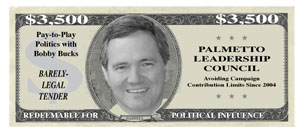
For example, the Palmetto Leadership Council is a PAC headed by the SC House Speaker Bobby Harrell. Membership in his Leadership PAC cost $3,500. Harrell says on the PAC’s web site, “We are building a unique coalition between leaders in the private sector and those of us engaged in public service.”

While Harrell, or a corporation like AT&T, can only make a $1000 donation to a House candidate, AT&T can make a $3,500 donation to Harrell’s Leadership PAC, which can then make another $1,000 donation to the same candidate.

Harrell’s PAC has raised nearly $1 million since its founding in 2004, with 98.7 percent going to Republican candidates (79 percent incumbents). More than 89 percent of the candidates backed by Harrell’s PAC won election.

Harrell’s largest donations were $100,000 checks written to the state Republican Party. The party can then make a $5,000 contribution to the same candidate that received the $1,000 maximum from Harrell’s PAC.

It’s a way around campaign finance laws. It’s legal but ethically suspect. We urge the Committee to follow the Senate’s lead and eliminate leadership PAC’s that allow the “bundling” of campaign donations that violate the spirit of campaign finance laws.

Donations from Palmetto Leadership Council to members of the Republican Caucus Ethics Committee:

Chairman Murrell Smith, R-Sumter
(803) 734-3042 MurrellSmith@schouse.gov
$5000 (2004-2012)

Rep. Rita Allison, R-Lyman
(803) 212-6788 RitaAllison@schouse.gov
$3000 (2008-2012)

Rep. Derham Cole, R-Spartanburg
(803) 212-6790 DerhamCole@schouse.gov
$3000 (2008-2012)

Rep. Joe Daning, R-Goose Creek
(803) 734-2951 JoeDaning@schouse.gov
$3000 (2008-2012)

Rep. Phyllis Henderson, R-Greer
(803) 212-6883 PhyllisHenderson@schouse.gov
$1000 (2012)

Rep. Jenny Horne, R-Dorchester
(803) 212-6871 JennyHorne@schouse.gov
$3000 (2008-2012)

Rep. Andy Patrick, R-Hilton Head
(803) 212-6928 AndyPatrick@schouse.gov
$2000 (2010-2012)

Rep. Tommy Pope, R-York
(803) 212-6895 TommyPope@schouse.gov
$2000 (2010-2012)

Rep. Rick Quinn, R-Lexington
(803) 212-6897 RickQuinn@schouse.gov
$3000 (2004-2012)

Rep. Roland Smith, R-Warrenville
(803) 734-3114 RolandSmith@schouse.gov
$5000 (2004-2012)

TOTAL: $30,000