
Sex and Silliness in South Carolina

By Tom Turnipseed
Columbia, SC

In the most stunning upset in South Carolina’s sordid political history, Alvin Greene, unknown and  unemployed, defeated Vic Rawl, former judge, legislator, and county council member, by a 59 to 41 percent margin to win the Democratic nomination for US Senate. The mysterious Greene will face Republican incumbent Jim DeMint, an ultraconservative tea-bagger, in November.  The state Democratic Party has asked Greene to withdraw from the race because he faces a felony obscenity charge. Greene was recently charged with disseminating, procuring or promoting obscenity. Police say he showed obscene photos to a University of South Carolina student. He has been appointed a public defender which requires proof of being an indigent.  The 32-year-old unemployed veteran haltingly insisted he was a democrat and would not withdraw as he discussed his curious campaign with Keith Olbermann, but had “no comment” on the criminal charge.

The mysterious Mr. Greene told reporters he was the “real deal” and would “make a difference.”

Greene recently got out of the Army, and lives at his dad’s home in rural Clarendon County. He presented a $10,400 personal check to the Democratic Party headquarters for his filing fee but was told it had to come from a campaign account.  He left and came back soon with a check that was accepted. Greene said he got the money by saving it up in the service.

He had no campaign signs, website, or media ads and didn’t attend the South Carolina Democratic Party convention in April.

SC Congressman Jim Clyburn said it was “shenanigans” and that Greene must have been “planted” and financed by those who opposed Rawl and supported DeMint. Former Democratic Chairperson Dick Harpootlian told NPR that the alphabetical placement of Greene above Rawl on the ballot could be the reason for the unbelievable upset and also mentioned the extremely low quality of life of poor and working class people in South Carolina.

In the South Carolina Republican Gubernatorial primary contest a week before the June 8 vote,sState Sen. Jake Knotts of Lexington County called Representative. Nikki Haley, an Indian-American candidate, a “raghead”   Knotts said Haley was hiding her true religion from voters. “She’s a f…king raghead,” Knotts said. He later clarified his statement, saying he did not mean to use the F word. Haley led the ticket in the Republican Primary, 49% to 23% for Congressman Gresham Barrett the 2nd place finisher. Haley and Barrett are competing in a June 28 runoff.

Knotts is a likable former cop.  He’s a friendly caricature of a Southern Sheriff like Rod Steiger’s portrayal of Sheriff Gillespie in The Heat of the Night. Knotts told Corey Hutchins of Free Times of Columbia that Haley was set up to run for governor by a network of Sikhs and outside influences in foreign countries.  Knotts said Haley is ashamed of her religion and is hiding behind being a Methodist.  “South Carolina is a religious community.  We need a good Christian to be our governor,” he said. “She’s hiding her religion. She ought to be proud of it. I’m proud of my god.”

Knotts says he believes Haley’s father has sent letters to India saying that Haley is the first Sikh running for high office in America. He says her father walks around Lexington, SC wearing a turban. “We’re at war over there,” Knotts said.  He said he did not mean the United States was at war with India, but was at war with “foreign countries.  “We got a raghead in Washington; we don’t need one in South Carolina,” he said, referring to President Obama, whose father was a Muslim from Africa. Knotts has rejected the Republican Executive Committee of Lexington County’s request that he resign, saying that libertarians were taking over the party.

Recently, political blogger Will Folks said he’d had an intimate relationship with Haley in early 2007.  Folks is a former campaign staffer for Governor Mark Sanford, who is a Haley supporter.  On June 2, Larry Marchant, a prominent lobbyist said he had sex with Haley while they were both married.  Haley has denied any sexual infidelity, and volunteered to resign if the charges were proven to be true after she becomes Governor.

Political nuttiness is nothing new in South Carolina:  In 1858, US Congressman Preston Brooks  “caned” abolitionist US Senator Charles Sumner of Massachusetts, crippling him for life; when South Carolina seceded from the Union in 1860, James L. Petigru famously remarked, “South Carolina is too small for a republic and too large for an insane asylum”; Strom Thurmond impregnated his family’s 15 year old black maid and sent his daughter up north to hide her away;  in 2009, Congressman Joe Wilson shouted, “you lie” at President Obama who was addressing a joint session of the US Congress; and in 2009, Governor Mark Sanford told us he was hiking the Appalachian Trail while he was in Argentina shacking up with his “soul mate”.

Sex and silliness, mystery and meanness, South Carolina politics is a never-ending mess.

Tom Turnipseed is an attorney, writer and peace activist in Columbia, SC. His blog is at http://tomandjudyonablog.blogspot.com.

Seniors first to benefit from new health law with $250 rebate checks

Last year, about 61,000 Medicare beneficiaries in South Carolina hit the “donut hole” — the gap in prescription drug coverage in Medicare Part D — and as a result received no help with the cost of their medications.

That’s what happened to 72-year-old Mary Edna Crider of St. Matthews, SC. And it wasn’t the first time.

Crider, who has diabetes and suffers from a heart condition, said last year she hit the donut hole in early summer. “This year we were into it by April,” she said.

“I take a good bit of medication,” she said, and estimates they cost between $700-$800 a month. “My husband gets a good retirement check, but we have other expenses and the money doesn’t go that far. We get by.”

Crider will be among Medicare beneficiaries who, beginning this week, will receive a $250 rebate check in the mail from the government as part of the new health care law. “I think it’s good,” she said. “I’ll put it up to buy medicine.”

Medicare enrollees pay 25 percent of their prescription drug costs until the total reaches $2,830 for the year. Then they fall into the coverage gap known as the “donut hole” and have to pay a total of $4,550 in out-of-pocket prescription drug expenses before the plan resumes paying nearly 100 percent of drug costs. Some 4 million seniors will be in the donut hole this year, and will become eligible to receive rebate checks.

The rebate checks are the first of several provisions of the new law that will affect seniors. Throughout the rest of the year, seniors across the country will receive checks as they enter the coverage gap.  The law will close the gap over the next 10 years, cutting the donut hole in half by 2011 and eliminating it entirely in 2020.

“The new health care law offers lots of benefits for seniors,” said Julie Harbin, President of the South Carolina Alliance for Retired Americans. “It stops overpayments to private Medicare Advantage insurance companies that have made huge profits while causing millions of Americans to pay higher monthly premiums for their Medicare coverage.”

The law also protects nursing home residents against elder abuse and neglect, and it prevents discrimination against early retirees by health insurance companies.

Crider hopes the health care reforms help the people she sees at the drug store. “Bless their hearts, some of them don’t have enough money to buy a full prescription, but the pharmacy won’t let them buy half. I’d go out of business working there. I’d be giving people what they need.”

While Crider has not had to go without her medications, she isn’t above asking her doctor for free samples. As she says, every little bit helps.

For more about the South Carolina Alliance for Retired Americans, call 803-957-8740 or email scalliance@mindspring.com.

President Obama to speak via televised town hall on how the new health care law affects seniors

On June 8, 11:15am – 12:45pm, the Alliance for Retired Americans will take part in a one-time, national “tele-town hall” broadcast on C-SPAN and on-line via web streaming at www.healthreform.gov. In South Carolina, Alliance members and allies are invited to watch the event together at the Modjeska Simkins House, 2025 Marion St., downtown Columbia. Free snacks and beverages provided, or bring your own bag lunch. There is a deli across the street.

President Obama will field questions regarding the new health care law and how it benefits seniors. Topics to be covered include the $250 checks for seniors caught in the Medicare prescription drug “doughnut hole” coverage gap, and efforts to combat scams associated with those checks. The CSPAN and phone portion of the town hall will start at 11:15 with Sec. Sebelius.The President will come on at approximately 11:40, and will speak until about 12:45.

For details, call 803-808-3384 or email scalliance@mindspring.com.

Immigrants R Us

By Tom Turnipseed
Columbia, SC

The South Carolina Legislature is considering an anti-immigrant bill much like Arizona’s draconian law. It requires police to check a person’s residency status when stopped or detained for any reason and makes it a crime for illegal immigrants to solicit work.  Opponents of the bill say it would lead to racial profiling, marginalize the state’s Hispanic community and polarize the state.  On May 28, people who oppose the bill dominated public comment before a Senate Judiciary subcommittee claiming it was un-American and racist.

Bill Bunch, a small-business owner said “It smacks of racism and it smacks of pandering. You’re using these people as pawns for your own political gain.”

I serve on the Board of the S.C. Hispanic Leadership Council. Our Board President, Lad Santiago, told the legislators, “It polarizes our community by allowing for overt distinction of physical attributes and a law that allows this is an affront to all that is fair and just in America.”

Exactly what is fair and just in this land of immigrants? Discrimination and injustices against the “shanty Irish” or the Chinese “yellow peril” because of their race and ethnicity was certainly not fair or just. Over 400 years ago people from Europe migrated to what is now the United States and since then immigrants have come here from every country and region of the world. From the dawn of human history, people have constantly migrated all over the world.  But as Hegel said, “We learn from history that we do not learn from history.”

A consensus of historians agree that indigenous people, also known as Native Americans or Indians, were in the Americas at least 10,000 years before the European Christopher Columbus “discovered” America in 1492. Many Native Americans are descendants of people who lived in the southwest and far western region of what is now the United States. Their forebears were there thousands of years before white Europeans came to this continent. They are now called “illegal immigrants” by race-baiting politicians.

When the Spanish arrived in the Americas, Europe was ravaged by war, oppression, religious fanaticism, disease and starvation.  Native Americans were generally healthy, and mostly peaceable. Columbus sold his sponsors on the idea he would find a passage to China and the riches of the Orient, but “discovered” the Americas instead, so he decided to pay for his voyage in a commodity he found in ample supply—human lives.  He seized 1,200 Tiano Indians from the island of Hispaniola (now Haiti and the Dominican Republic), crammed them onto his ships, and sent them to Spain, where they were paraded naked through the streets of Seville and sold as slaves in 1495.  Because Columbus captured more Indian slaves than he could transport to Spain in his small ships, he put them to work as slaves for his family and followers throughout the Caribbean.

It was cheaper to work Indians to death and replace them than keep them alive.  In California the native people were forced to work in the fields on a starvation diet. They died from overwork, starvation and disease and were continually replaced, wiping out the indigenous populations.

As a descendant of Choctaw Indians I despise the nationalistic and historically blind rhetoric we hear about immigration.

European conquest of Mexican Native Americans exemplifies such blindness. European Americans under the flag of the United States took the land from these indigenous Americans in the Mexican Wars. Mexico won independence from Spain in 1821, and the new Mexican republic included present-day Mexico and the territory that today constitutes five southwestern states and more territory further north.

In 1835 United States settlers in Texas revolted against Mexico, fought at the Alamo in 1836, and formed their own republic. In the years that followed, the United States pushed farther westward. The imperial doctrine of Manifest Destiny, the belief that God had destined the United States to be bordered on the east and west by the Atlantic and the Pacific Oceans, was used to justify the United States’ encroachment upon Mexican territories. It finally provoked a war in 1846 that enabled the United States to take almost half of Mexico’s territory.

Hard-working Mexicans in the United States had ancestors who lived in the Southwestern part of what is now the United States for thousands of years before there was a United States. Their ancestors were forcibly removed by the United States.  Should they be treated as undocumented criminals?

The best solution to the immigration question is comprehensive immigration reform legislation at the federal level that will:

  • Provide a path to permanent resident status and citizenship for all members of our communities;
  • Reunite families and reduce immigration backlogs;
  • Secure the border in a humane way;
  • Punish unscrupulous employers who drive down wages and make it hard for honest employers to compete in today’s economy;
  • And provide rights to all workers in the United States.

Such Comprehensive Immigration Reform legislation must also be enforced primarily by the federal government.  The Arizona and proposed South Carolina laws, in  practice, will take even more resources away from state and local law enforcement who need to focus on apprehending real criminals who steal and commit violent crimes rather than on poor and peaceful working people who harvest our crops, construct our homes and do service work for our travel and hospitality industry.

A fair and just America must live the promise we make to the world.
“Give me your tired, your poor,
Your huddled masses yearning to breathe free.”
[Emma Lazarus]

Tom Turnipseed is an attorney, writer and peace activist in Columbia, SC. Read his blog here.

Activists rally to restore HIV funding in state budget bill


Rep. Joe Neal, who also serves as the SC Progressive Network’s Co-chair, speaks at the rally May 25.

Advocates working on behalf of South Carolinians with HIV/AIDS rallied at the State House yesterday morning to pressure the legislature to restore the funding for critical services that the House proposed to cut in its budget bill. Reps. Joe Neal and Bakari Sellers addressed the crowd, praising them for staying vigilant and standing for the state’s most vulnerable citizens.

The rally was organized by the SC Campaign to End AIDS, a member of the SC Progressive Network.

The House cuts would end all state funding for HIV/AIDS prevention and drug assistance, would limit prescription drugs for Medicaid patients and cap enrollment in the state’s Children’s Health Insurance Program.

Later in the day, the Senate rejected the cuts to health care. The bill now goes to conference committee. (See story in The State.) The Senate has named Sens. John Land, D-Clarendon, Hugh Leatherman, R-Florence, and Mike Fair, R-Greenville, to the committee. The House has named Reps. Kenny Bingham, R-Lexington, Bill Clyburn, D-Aiken, and Dan Cooper, R-Anderson, to the committee.

Those committee members need to hear from us.

To see more photos from the rally, click here.

Speak up before budget cuts kill critical programs

Last week the S.C. House of Representatives adopted amendments to the state budget bill that eviscerated health and human services for low-income South Carolinians in order to plug a $20 million hole in the judiciary’s budget.

Instead of considering other logical revenue sources, they balanced the budget at the hard expense of the working poor and children. They gutted programs to come up with $24.3 million for the judiciary and $22.5 million for the Department of Public Safety.

This amendment includes:

  • Capping enrollment in the Children’s Health Insurance Program (CHIP), leaving 70,000 to 100,000 eligible children without health insurance;
  • Cutting funds to the Department of Social Services that assist low-income households with children;
  • Limiting Medicaid patients to 3 drug prescriptions per month, down from at least 4 and up to 10 prescriptions, forcing the seriously ill to make potentially life-threatening medical decisions where they must treat one ailment at the expense of others;
  • Cutting prevention programs for kidney disease, HIV, breast, cervical, and colorectal cancer, and funding for AIDS treatment programs; and
  • Cutting grants to rural hospitals and funding to trauma centers.

Please contact your Senator today and ask him to vote to non-concur with the House amendments.  (You can locate your Senator by going here.)

While cutting these life-saving programs, the House found $240,000 to fund beach re-nourishment and $3 million, the exact amount cut from CHIP, to add to the House of Representatives operations budget.

One obvious and just way to raise revenue would be to increase the sales tax on luxury vehicles. At present, a person purchasing a yacht, a jet, or a luxury car in South Carolina pays the same $300 sales tax as the person buying the cheapest car on the lot so that he or she can get to work and support a family. Such a tax could bring South Carolina more than $100 million per year to fund basic services.

It is past time for our legislators to consider other revenue options, rather than continuing to cut essential programs for our state’s most vulnerable population.  There is no reason we should have to choose between public safety, a strong judiciary and caring for our neighbors in times of need.

This report was compiled by SC Appleseed.

SC Alliance for Retired Americans talk shop

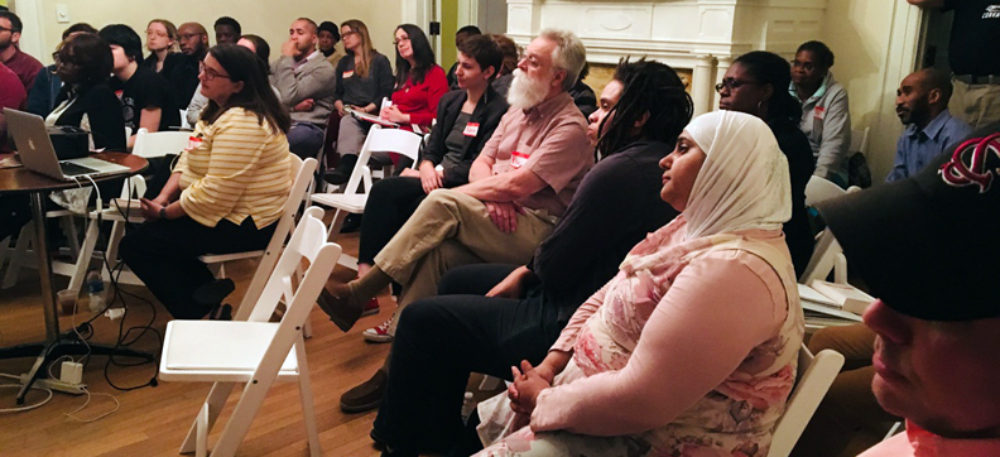
The SC Alliance for Retired Americans held an informational drop-in on May 20 at the Modjeska Simkins House in Columbia. The national Alliance’s Bob Kearney and regional director Bill Cea outlined some of the more pressing issues facing seniors and retirees in 2010, including the new health care law, the Fiscal Commission and efforts to privatize Social Security.

SC ARA is one of 30 Alliance chapters in the country. To find out more or to get involved, email scalliance@mindspring.com or call 803-957-8740.


Bill Cea


Bob Kearney

Click here to see more photos from the drop-in.

Rally to restore HIV funding May 25 at State House

Bambi Gaddist, SCHACCTF Chair
Gwen Bampfield, SCHACCTF Co-Chair

We have been informed by Rep. Joe Neal that once more, health care will sustain another blow. We thought most HIV/AIDS providers were aware that the House have retaliated for losing support of a veto for $20 million in new fees to support the states court system. However, after conversations with several in AIDS leadership we realized that our assumptions are incorrect. This may explain why we haven’t received communications from AIDS leadership expressing concern or proposing strategies to combat what could be interpreted as benign neglect from some of our states leadership.

The State newspaper on Thursday morning spelled it out to the world– so we assumed everyone knew that ALL ADAP and HIV prevention has been eliminated from the House amended budget presented Wednesday. Other cuts include loss of support for state health insurance programs for low-income children, new restrictions on medications funded by Medicaid, and elimination of cancer screenings and kidney disease prevention round out this reality.

We know that the Senate takes up the new House proposal on Tuesday, May 25. Rep. Neal noted that this moment is where the “rubber meets the road.” Either we are prepared to sacrifice today or as I was told, “we can’t come crying later.” Rep. Neal made it crystal clear that we either “show up and show out” or in my words-be prepared to deal with the realities if the House budget amendment passes. I appeal to the Task Force, college students, community citizens to come out on Tuesday, May 25, 9am to noon outside the State House.

We have been told to gather our own constituents once more. We must plead for sacrifices to be made to attend on Tuesday.

We call on all AIDS Directors, Task Force members, faith leaders, health officials, physicians, and community citizens to make the ultimate sacrifice to attend Tuesday morning.

As of yesterday, DHEC says our count is 112 individuals on the SC Wait List. All should be breaking down the doors of the House and Senate.  We hear frequently about advocates and PWA’s in northern and western states who stage rallies in support of HIV/AIDS. We ask that we all make every effort to bring our voice on Tuesday as we proud southerners demonstrate our ability to make a difference in our own lives.

SC prisoners with HIV segregated

According to Sentenced to Stigma, a joint report of the ACLU and Human Rights Watch released last month, prisoners in designated HIV units in South Carolina and Alabama face stigma, harassment and systemic discrimination that amount to inhuman and degrading treatment.

Only South Carolina and Alabama continue the policy and practice, despite all public health, human rights, and practical arguments against it.

In South Carolina, HIV inmates are forced to wear armbands or other indicators of their HIV status, are forced to eat and worship separately, and are denied equal participation in prison jobs, programs and re-entry opportunities that facilitate their successful transition back into society.

There is no medical justification for segregation, which in fact causes harm that extends well beyond a person’s prison term, and only serves to inflame prejudices against people with HIV. The World Health Organization, the National Commission on Correctional Health Care and other experts agree there is no medical basis for segregating prisoners with HIV within correctional facilities or for limiting access to jobs, education or vocational programs available to others.

South Carolina is also the only state in the union to prohibit prisoners with HIV from participating in work release programs, and the ACLU has called for a halt to these policies.

Care about seniors?

Get off the couch, and get active with the SC Alliance for Retired Americans!

Join us for a casual drop-in May 20, 5–6:30 pm

Modjeska Simkins House  •  2025 Marion St., Columbia

Hear Bob Kearney of the national Alliance for Retired Americans
talk about the most critical issues facing seniors in 2010.

The SC Alliance for Retired Americans needs YOU to help educate, energize and mobilize retirees and seniors in the Palmetto State. Join us, and help protect the health and economic security of South Carolina’s older citizens.

FREE and open to the public! Enjoy snacks, beverages and live music.

For more information, call 803-957-8740 or email becci@scpronet.com.