Trigger-Happy Thanksgiving, y’all

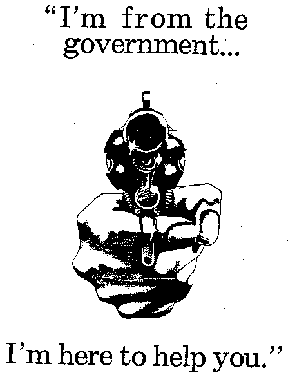
The South Carolina legislators who passed the measure call it the “Second Amendment Sales Tax Holiday.” Thinking people would call it pandering of the worst kind.

Just today The Greenville News reported that, according to the FBI, South Carolina is the most violent state in the nation.

Instead of a tax break for food, or gas, or products to help protect the environment, we get a tax break on guns. Seriously. Beginning at midnight Nov. 28 and ending at midnight Nov. 30, South Carolinians can save money while they beef up their arsenals.

It’s not like they needed the incentive. There has been a run on guns since Barack Obama was elected president, amid fears that he and a Democrat-controlled Congress will pass stricter gun laws.

Apparently, you can take the cowboy out of the White House, but not out of the American household.

Becci Robbins

Network member’s guest column featured in Washington Post

This essay appeared in today’s Washington Post. It was written by Herb Silverman, founder of SC Progressive Network member group Secular Humanists of the Lowcountry.

*************

For Secular Americans, Lip Service Beats No Service
By Herb Silverman

About a month before this recent election, some local progressives in South Carolina asked if I would help Democrat Linda Ketner in her Congressional campaign against conservative incumbent Republican Henry Brown. At first they thought I was joking when I said I didn’t even plan to vote for her, and would leave blank that portion of my ballot. They ticked off a number of issues on which Ketner was better than her opponent. I agreed, even adding a couple of my own. My problem with Ketner was a 30-second TV ad in which she proclaimed her love of God three times.

I have gradually begun withdrawing support from otherwise acceptable candidates who make personal religious beliefs a focal point of their campaigns. In taking a longer view, I described how the Religious Right moved beyond merely saving souls to becoming a formidable political force. My friends discounted this reasoning. The Religious Right may have been thrown a few crumbs by politicians, they said, but mainly all they have received in return for their support is lip service. When my companions asked if I, an atheist, would settle for so little, I replied without hesitation: “YES! We’ll take lip service!”

Continue reading

Election Protection hotline logs over 1,000 calls in South Carolina

Calls to the SC Election Protection hotline from voters reporting problems came in at nearly one a minute on Election Day.

“We logged a total of 1,034 calls by 8pm,” said SC Election Protection field manager Brett Bursey. “That’s more that double the number made in the 2004 and 2006 election combined.” More than half the calls came in on Election Day. Charleston County led the state with 131 problems reported. Greenville and Richland counties each logged 83 calls, and Spartanburg had 56.

Spartanburg County Election Commission Director Henry Laye was the hardest to reach of the county directors. Laye allowed a Republican poll watcher to challenge black voters’ reasons for voting absentee, which made long lines even longer. On Nov. 4, Spartanburg had some of the longest lines, with voters waiting up to five hours. Two precincts reported people in line three hours after the polls closed.

The National Election Protection Coalition of nonpartisan advocacy groups staffed call centers around the country that logged 43,207 calls. Calls were posted by state on the organization’s web site, and volunteer legal advisors in South Carolina followed up with phone calls to voters to help them resolve problems.

Nearly 200 calls were from voters who were not listed on the poll books. Most were newly registered and never received their cards. Many of these people were turned away and not given the opportunity – as required by law – to vote a provisional ballot.

It was clear from the calls that counties are not consistent in interpreting the election laws. “Counties make their own rules, and laws are what the poll workers think they are,” said one frustrated legal volunteer.

The SC Progressive Network will be holding town meeting across the state to gather citizens’ input on their experiences voting in an effort to our work to pass legislation next session to improve voting procedures and practices in South Carolina. The Network introduced legislation in 2006 for Early Voting Centers and other reforms that would have reduced both the lines and the stress on poll workers. For details on these bills, click here

If you have a story to tell about problems voting, please email it to network@scpronet.com. Be sure to include your name, contact information, location of problem and whether it was resolved.

The long road to the White House

The 2008 campaign for president was exhausting. But what an ending!

I saw Barack Obama speak twice in Columbia, once at the Convention Center and again at Williams Brice Stadium, when Oprah was stumping for him. Last night, I was in the Stadium again, this time with friends at a party watching the election returns. The mood was electric.

Here’s a look back. And forward.

Becci Robbins

It’s Election Day…

Surprise!

By Becci Robbins

The phones have been ringing steadily in the SC Progressive Network‘s office today. We’ve been working with the national Election Protection Coalition, which is staffing a hotline to provide free legal assistance to voters with problems at the polls. As of 5:30pm, the hotline has logged 36,513 reports, 480 in South Carolina. We will provide details about the reports once we’ve had time to review them and complete follow-up phone calls. For now, suffice it to say that election workers were not prepared to handle the unprecedented turnout.

It’s not like they didn’t know Election Day was coming. The large number of new voters was no surprise, either. So it’s been frustrating to watch the process over the last couple of weeks. The Get Out The Vote work we’d intended to do was delayed because election offices were so backed up that new registrations hadn’t been entered into the database. And the long lines of people trying to vote absentee bordered on abusive, with some waiting more than four hours to cast a ballot.

When I voted yesterday, in Lexington County, the wait was over two hours. The gentleman in front of me was using a cane and, worried that he wouldn’t be able to handle standing for such a long time, I went to see if he could use the curbside machines set aside for folks with physical disabilities. I was told that the person who brought him would have to wait in line, and then the machine would be brought out. He drove himself, I told them, so what was he to do? They said he could take advantage of a wheelchair parked by the front door.

It’s hard to understand why the county was so ill-prepared to deal with the needs of such voters – especially since among the reasons people can vote absentee in South Carolina is if they are disabled or over 65. The problems in Lexington were not isolated, as I watched people drive up for curbside voting in Columbia and, when nobody came out to help them, they drove off without voting. I also watched seniors stack up by the door to the election office, where there were chairs, with nobody coming out to advise them.

Clearly, we can do better. The Network is working to make sure that we do. We plan to revisit legislation we introduced last session to make it easier to vote. (For details on those bills, click here.) And we are going to hold town hall meetings in the coming weeks so South Carolinians can tell their stories and share ideas about how to improve election process in the Palmetto State.

In the meantime, if you had a problem at the polls, please make a report to the Election Protection hotline: 1-866-OUR-VOTE. That data will be used to inform legislative and procedural remedies for future elections.

Finally, thanks to everyone who volunteered today and in the days leading up to the election. Thanks, too, to all the voters who braved long lines to vote. Let’s hope that sort of faith in democracy is contagious.

Volunteers needed Election Day

Volunteers with the SC Progressive Network‘s Missing Voter Project have been helping election officials in the county offices process new voter registrations and at the polls as people wait in long lines to vote absentee. We can use all the help we can get today and on Election Day. If you can lend even a couple of hours to volunteer, call the Network’s office at 803-808-3384 or John Dawkins at 803-467-1981. We need volunteers to help seniors and the disabled, to monitor the polls and to post flyers at precincts with the hotline number voters can call for free legal advice should they encounter any problems. That number is 1-866-OUR-VOTE.

Network Director Brett Busey helps answer voters’ questions as they wait in line to vote absentee in Columbia on Oct. 31. Some people waited for four hours to vote. Click here to see more photos.

Free speech not dead yet

Brett Bursey’s court hearing on Oct. 27 at the federal courthouse in Charleston went well. Judge Bristow Marchant did not throw the case out, and allowed the introduction of the White House Advance Manual that Bursey’s legal team believes shows a pattern and practice of suppressing free speech.

Judge Marchant’s options are: rule against Bursey, grant the writ and overturn the conviction, or order a new trial.

Attorney Michael Tigar posed the option of a new trial as only fair, since the judge agreed that the suppressed manual was relevant to the case.

The judge will issue a ruling in the coming weeks. We will post details here as they become available.

For background on the case, click here.

Duke Law professor Michael Tigar speaks at a reception Oct. 26 in Charleston on the eve of the hearing. For more photos of the reception, click here.

Vote today!

With a half-million new voters added to the rolls in South Carolina since the last presidential election, election officials are predicting record numbers turning out to vote on Nov. 4. Help cut congestion at the polls by taking advantage of South Carolina’s provision for “in-person absentee” voting.

To vote in-person absentee, you must be a registered voter and meet one of the following criteria:
• Students, their spouses and dependents residing with them
• Members of the Armed Forces, Merchant Marines, Red Cross, USO, government employees, their spouses and dependents residing with them
• For reasons of employment will not be able to vote on election day
• Physically disabled persons
• Persons on vacation
• Persons age 65 or older
• Persons admitted to the hospital as emergency patients on day of election or at least four days prior to the election
• Electors with a death or funeral in the family within 3 days before the election
• Persons attending sick or physically disabled persons
• Persons serving as jurors in a state or federal court on election day
• Certified poll watchers and poll managers

You may vote in-person absentee at your county voter registration office until 5pm on Nov. 3. For more details on voting, or to find your registration office, visit the SC Election Commission’s web site.

If you encounter problems while voting, please call the toll-free hotline for assistance: 1-866-OUR-VOTE. You will be provided free legal assistance, and your report will help provide a record to help election workers address weaknesses in the system and avoid problems in the future.

Free speech on trial

Rev. Dr. Neal Jones

Unitarian Universalist Fellowship of Columbia

Today as I write this (Monday, Oct. 27), a friend of mine and of many within our congregation, Brett Bursey, Director of the SC Progressive Network (of which our Fellowship is a member), is appearing in Federal Court in Charleston for a hearing on a Writ of Coram Nobis.  We pay lawyers to translate these legal Latin phrases for us.  This one translates as “the error before us.”  The error in question is an error that occurred in Brett’s original trial in 2003, in which he was convicted of threatening the President under a federal statute that governs “Presidential Assassination, Kidnapping, and Assault.”  What on earth did the otherwise peace-loving Brett Bursey do to the President?, you may be wondering.  

Well, at a political rally at the Columbia airport, at which President Bush was promoting local Republican candidates in the 2002 election, Brett was carrying a sign that read, “No More Wars for Oil.”  When Brett was ordered to move to a designated “free speech zone” a half-mile away, he refused.  Like many of us, Brett probably thought that the United States of America is a free speech zone.  He was wrong, and for this he was arrested.

Continue reading

Free speech vs. George Bush: the final showdown

Can the White House restrict the First Amendment based on political considerations? This will be the central question at a Federal Court hearing in Charleston, SC, at 10am on Oct. 27.

The hearing on a Writ of Coram Nobis, translated as “the error before us,” filed by Brett Bursey, will examine evidence suppressed at his trial in November 2003. A coram nobis petition applies to persons who have already been convicted and have served their sentence. Such motions cannot be used to address issues of law previously ruled upon by the court, but only to address errors of fact that were not known at trial or were knowingly withheld from judges and defendants by prosecutors that might have altered the verdict were they presented at trial. The writ argues that the government withheld evidence of White House involvement in segregating peaceful protestors from supporters of President Bush at presidential rallies. Bursey was arrested at a Bush rally in Columbia in October 2002 for refusing to be segregated from the general public.

Bursey, Director of the SC Progressive Network, is the only person ever convicted under a federal statute that allows the Secret Service to create a secure zone around presidential events. Bursey was arrested on state charges of trespass at an appearance of President Bush when he refused to go to an obscure “free speech zone” a half-mile away from the event. Four months after the arrest, state charges were found unconstitutional and dismissed. Federal charges were then brought by US Attorney Strom Thurmond Jr. under the statute that governs “Presidential Assassination, Kidnapping and Assault” (Title 18, United States Code, Section 1751(a)(1)(ii)).

“I argued at my trial that the Secret Service was being used as an armed political advance team by the president to keep protesters out of sight of the venue and the media,” Bursey said. He filed discovery motions and subpoenas during his trial for any White House directives to the Secret Service, but the government successfully moved to deny his efforts, calling them a “fishing expedition.”

Bursey has since discovered the White House Advance Manual that instructs the Secret Service to do what he alleged the agents had done. “There are several ways the advance person can prepare a site to minimize demonstrators,” the manual reads. “First, as always, work with the Secret Service and have them ask the local police department to designate a protest area where demonstrators can be placed, preferable not in view of the event site or the motorcade route” (pg. 32, Presidential Advance Manual).

Bursey was convicted of standing on the side of the road, 200 yards from the event, with a sign that read: No More Wars For Oil. His attorneys will argue that the White House and the Secret Service worked in concert with local police to deny the First Amendment rights of those opposed to the Bush Administration’s policies.

Bursey’s lead attorney, Michael Tigar, will be assisted by trial attorneys Lewis Pitts and Rauch Wise, Bursey’s trial counsel, and Columbia attorney Joyce Cheeks.

A member of the Duke University Law School faculty, Tigar is one of America’s leading constitutional lawyers. Justice William J. Brennan has written that Tigar’s “tireless striving for justice stretches his arms towards perfection.” In 1999, the California Attorneys for Criminal Justice held a ballot for “Lawyer of the Century.” Tigar was ranked third, behind Clarence Darrow and Thurgood Marshall.

Tigar is author or editor of more than a dozen books. He has also written three plays and dozens of law review articles. Tigar has represented The Washington Post, John Connally, Sen. Kay Bailey Hutchison, Scott McClellan, Rep. Ronald Dellums, Mobil Oil, Fernando Chavez, Lynne Stewart, Angela Davis and Terry Lynn Nichols. He has tried cases in many courts across the country, and argued seven cases in the U.S. Supreme Court, as well as dozens of federal appeals.

Attorney Lewis Pitts, left, and Brett Bursey.

•••••••

To hear an audio recording of Bursey’s statements during sentencing in 2003, click here.