Burroughs and Chapin builds on history of bigotry

By Charlie Smith
Charleston

Saturday’s headline in the Post and Courier’s Business section heralding the planned expansion of The Burroughs and Chapin Company into the South Carolina Lowcountry would seem on the surface to be good news for the Charleston real estate market. The reality is actually just the opposite. The reason being is that for 113 years this Myrtle Beach-based real estate company has made discrimination a central theme of its business operation. The Horry County Court House is filled with deeds dating from the early days of what is now The Burroughs and Chapin Company that contain such language as:

The property hereby conveyed shall not be sold, devised, mortgaged or donated to any person of the negro race nor to any corporation whose stock is controlled by members of said race, nor shall any members of said race be permitted to rent, lease or reside on said property without the joint consent of the grantor and a majority of the bona fide adult residents of Myrtle Beach and upon such terms as may be by them jointly agreed.

Later deeds excluded Jews, Asians and all other non-Caucasian races with language such as:

“Neither this property nor any part thereof, nor any interest therein shall ever be sold, leased or conveyed to anyone other than a person of the Caucasian race, or to a corporation owned and conducted by persons of the Caucasian race.”

Burroughs and Chapin continued this practice until a U.S. Supreme Court ruling forced them to change their policy on racial and religious discrimination. But the company was back at it again in the late 1990s, this time targeting the gay and lesbian citizens of Myrtle Beach. When then-Myrtle Beach Mayor Mark McBride called Gay and Lesbian citizens of the city “garbage” The Burroughs and Chapin Company was the first to jump on the bigotry bandwagon leading the charge to disrupt the 1998 Gay and Lesbian Pride events in Myrtle Beach. The company prohibited the 1970s-era musical group The Village People from performing on the grounds of a local night club during the event asserting their rights as the owner of the land on which the club had been built.

They also banned any events associated with the festival from being held at any of its other properties such as the Broadway at the Beach shopping and entertainment complex. The media battle that ensued over their bigotry lasted for more than six months and resulted in a tremendous loss of credibility for the company and a huge black eye for Myrtle Beach tourism. It also resulted in the largest Gay and lesbian Pride event South Carolina has ever witnessed.

Most of the churches in the Myrtle Beach area sit on land that was given to them by the Burroughs and Chapin Company. Representatives of the company are often allowed by these churches to make annual presentations to the congregations during which the company reps tell the church folks all about their plans for expanding their business in Myrtle Beach over the coming year. The great PR they achieve through these efforts tends to pay off handsomely at the ballot box for the candidates endorsed by Burroughs and Chapin for public office in Myrtle Beach and Horry County…candidates such as former Mayor Mark McBride.

The long and the short of it is that Charleston does not need the bigotry and political manipulation of The Burroughs and Chapin Company. What we need are companies that understand and appreciate the diversity of the people who have created this beautiful city in which we live and are willing to be good corporate citizens. The Burroughs and Chapin Company has a 113-year history of doing just the opposite.

What would Jesus do?

torture.jpg

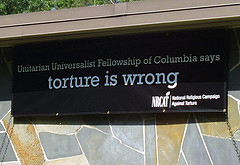
The Unitarian Universalist Fellowship of Columbia is one of more than 300 congregations around the country displaying a banner outside their building that says “Torture is wrong.” It is a national campaign sponsored by the National Religious Coalition Against Torture. The UUFC is one of only two congregations in SC participating. The other is a Friends congregation in Conway.

Your church can get a banner to display by clicking here.

It was oil, all along

By Bill Moyers and Michael Winship

Oh, no, they told us, Iraq isn’t a war about oil. That’s cynical and simplistic, they said. It’s about terror and al Qaeda and toppling a dictator and spreading democracy and protecting ourselves from weapons of mass destruction.

But one by one, these concocted rationales went up in smoke, fire and ashes. And now the bottom line turns out to be….the bottom line. It is about oil.

Alan Greenspan said so last fall. The former chairman of the Federal Reserve, safely out of office, confessed in his memoir, “…Everyone knows: the Iraq war is largely about oil.”

He elaborated in an interview with the Washington Post‘s Bob Woodward, “If Saddam Hussein had been head of Iraq and there was no oil under those sands, our response to him would not have been as strong as it was in the first Gulf War.”

Remember, also, that soon after the invasion, Donald Rumsfeld’s deputy, Paul Wolfowitz, told the press that war was our only strategic choice.

“We had virtually no economic options with Iraq,” he explained, “because the country floats on a sea of oil.”

Shades of Daniel Plainview, the monstrous petroleum tycoon in the movie “There Will Be Blood.” Half-mad, he exclaims, “There’s a whole ocean of oil under our feet!” then adds, “No one can get at it except for me!”

No wonder American troops only guarded the Ministries of Oil and the Interior in Baghdad, even as looters pillaged museums of their priceless antiquities. They were making sure no one could get at the oil except… guess who?

Here’s a recent headline in The New York Times: “Deals with Iraq Are Set to Bring Oil Giants Back.”

Continue reading

Big Media cuts show independent news still essential

Last week newspaper publisher McClatchy Co., which owns five South Carolina newspapers, announced it is cutting 10 percent of its workforce. Columbia’s The State said cuts would affect about a dozen newsroom positions. The Sun News of Myrtle Beach said it would shed nine jobs, or about 3.6 percent of its staff. The Herald of Rock Hill said it would not eliminate any positions. The Beaufort Gazette and The Island Packet of Hilton Head have not said whether they will cut jobs.

What does this mean for readers? Chris Kromm, editor of Facing South, published by the Institute for Southern Studies, offers this analysis.

******

Reports that newspaper publisher McClatchy Co. is slashing 1,400 jobs this month — 10 percent of its national workforce — sent shockwaves through the media industry and served as a grim reminder of the precarious state of newspapers.

But McClatchy’s massive bloodletting raised a bigger question: When newspapers don’t have reporters, who’s keeping the public informed and shedding light on the state of democracy?

The cuts will be especially hard in the South, where McClatchy owns 15 newspapers. And although McClatchy insists cuts in news reporting will be less than seen at Gannett and other chains, newsrooms will definitely feel the knife.

A survey of the carnage: The Charlotte Observer will cut 123 jobs, or 11 percent of its workforce. The Miami Herald plans 250 job cuts, 17 percent of workers there. The Herald-Leader in Lexington, Ky. is dropping 17 positions. In Raleigh, N.C., the News & Observer is cutting a total of 70 jobs, 16 of them in the newsroom.

But not all will suffer equally. As the Lexington Newspaper Guild pointedly observed, McClatchy gave CEO Gary Pruitt an $800,000 bonus last year and just hired a new corporate vice president, even as the company’s stock was spiraling downward:

The Guild does not believe it is humane when employees who have put in a lifetime of service to McClatchy and KnightRidder are thrown to the curb, while McClatchy’s excessive corporate bureaucracy remains untouched.

McClatchy’s corporate mindset — so common in today’s Big Media — offers clues to the real problems facing newspapers. It’s not necessarily readership: As McClatchy admits, online readership grew 41 percent in the first quarter of 2008. The problem is an economic mismatch between declining ad revenues and shareholder demands for high profit margins on one hand, and the money needed for in-depth reporting on the other.

Continue reading

Why two elections when one can do?

Turnout decreases and extra expense in SC’s runoff elections make case for instant runoff voting

South Carolina voters – or at least handfuls of them – went to the polls on June 24 for runoff elections in 11 state legislative elections two weeks after the June 10 initial round. In the district number 4 democratic runoff for State House of Representatives, Paul Corden won a majority with fewer than 7,800 votes after falling short of a majority in early June with 14,968 votes. Overall, turnout declined by more than 48% in his runoff, and declined by at least 20% in nine other runoffs for state office held by Republicans and Democrats. South Carolina taxpayers likely spent hundreds of thousands of dollars on these runoffs; North Carolina’s statewide runoff the same day (one drawing turnout of less than 2% of registered voters) cost $5 million.

FairVote‘s executive director Rob Richie said, “Ensuring winners of party nominations are not opposed by a majority of primary voters is a laudable goal. But the delayed, two-round runoff used in South Carolina isn’t working. It’s time to follow the suggestion of Senators John McCain and Barack Obama and adopt instant runoff voting in South Carolina.”

With instant runoff voting, voters have the option to rank candidates in order of preference rather than select only one choice. If no candidate receives a first choice majority, the two candidates with the most votes advance to the runoff. Ballots cast for eliminated candidates are added to the totals of the runoff candidates according to which candidate is ranked next on each ballot.

Instant runoff ballots have already been used by overseas and military voters during traditional runoffs in South Carolina since 2006. FairVote’s analysis of the 2006 elections shows high comprehension of the new system. In the eight counties where both Democratic and Republican voters had runoff elections, the valid ballot rate in the runoff was fully 100% — with all of these voters returning an instant runoff ballot casting valid ballots.

More than a dozen American cities have passed instant runoff voting or stated to use it. Sen. Barack Obama was the prime sponsor of Illinois legislation in 2002 to establish it for primaries, while Sen. John McCain that year recorded a phone announcement to support instant runoff voting in Alaska. Its advantages over delayed runoffs include: 1) less money spent on running elections; 2) fewer demands for candidates on raising money; 3) higher turnout in one election.

VOTER TURNOUT IN SOUTH CAROLINA RUNOFFS, JUNE 24, 2008 *

Runoff  Winner  Percent Decline in Turnout
State Senate District 10 – REP Dee Compton 23%
State Senate District 12 – REP Lee Bright 20%
State Senate District 13 – REP Shane Martin 16%
State Senate District 23 – REP Jake Knotts -9%
State House District 79 – REP David Herndon 34%
State Senate District 81 – REP Tom Young -3%
State House District 04 – DEM Paul Corden 48%
State Senate District 17 – DEM Creighton B Coleman 25%
State House District 101 – DEM Kenneth Ken Kennedy 41%
State House District 111 – DEM Wendell G Gilliard 33%
State House District 122 – DEM Curtis Brantley 20%

*Data for runoffs is preliminary, but reflects 100% of precincts reporting.

Challenging “minimally adequate” education

Today the state Supreme Court will hear oral arguments in the appeal of the school funding lawsuit. See details in The State.

Here is the trailer for “Corridor of Shame.” If you haven’t yet seen the documentary, you can read background on the film and buy a copy here. Watch it, then share it with folks at your school, church or community organization.

Click here to sign the petition for a constitutional amendment to insert “high quality education” into our state constitution, replacing the current South Carolina standard of a “minimally adequate education.”

Bias in cocaine sentencing remains

By Kara Gotsch

Willie Mays Aikens was not a drug kingpin, but he received a kingpin-sized sentence for selling crack cocaine. A former Kansas City Royal and 1980 World Series record holder, Aikens received a 21-year sentence for selling 63 grams of crack. At the end of his baseball career he had become addicted to powder cocaine but had no previous record for drug distribution when an undercover officer asked him to sell the drugs that led to his lengthy incarceration in 1994. This month Aikens received a sentence reduction after 14 years in prison — authorized due to the U.S. Sentencing Commission’s determination that penalties for crack cocaine offenses are unnecessarily harsh. He returned to his major league hometown, Kansas City, to enter a halfway house, and hopes to soon reunite with his daughters, who live in Mexico with their mother.

Aikens’s release coincides this month with the 22-year anniversary of the death of Len Bias, another prominent sports figure who played basketball at the University of Maryland. His legendary cocaine overdose on the night he was drafted by the Boston Celtics launched the punitive legislative reaction by Congress that would later subject Aikens to a stiff mandatory sentence for selling crack cocaine.

The federal law that Bias’s death inspired, the Anti-Drug Abuse Act of 1986, established a five-year mandatory sentence for offenses involving as little as five grams of crack cocaine, the weight of two sugar packets. Offenses for powder cocaine, a similar yet more expensive substance, only receive that penalty for 100 times the amount of the drug. The harm caused by the excessive crack cocaine sentences prescribed under the law has been decried by judges, civil rights groups, faith-based organizations and many others.

At the time Len Bias died it was assumed that his killer was crack cocaine. When the truth later emerged that his drug of choice was in fact powder cocaine the legislative damage had already been done. Policymakers’ rush to make ill-considered reforms to the laws during the 1980s did not end the war on drugs or stop crack cocaine addiction. Indeed, the harsh penalties are responsible for breaking up many families and wasting the lives of many youths who did not require a decade in prison to learn that their crime was wrong. The penalties also created an assumption among communities of color that equal justice does not apply to them.

Continue reading