Archive for August, 2010
Geography of a recession
Tuesday, August 24th, 2010Nikki Haley’s 10 Dirty Words
Wednesday, August 18th, 2010By Phil Noble
President, SC New Democrats
Charleston, SC
SC Rep. Nikki Haley just released her jobs plan. These 10 words do not appear in it:
1. Agriculture – our largest industry.
2. Tourism – our second largest industry.
3. Technology – the largest driver of economic growth in the past 20 years.
4. Computer (or Internet) – nifty little thing that is used for most every phase of economic activity.
5. Capital – as in venture capital that’s needed for start-ups, the creator of small business jobs.
6. Global – everything and everyone else in the world.
7. Exports – the stuff we sell in the global marketplace to make money.
8. International – as in international business, the way we make the money from the world.
9. Green – as in green jobs, 21st century jobs that save money and can’t be shipped overseas.
10. Rural – as in rural development, what 1 million of us (23.4 percent of South Carolinians) desperately need.
It’s a great 19th century jobs plan.
Ethics Act: Misplaced Trust
Sunday, August 8th, 2010By Candy Waites and John Crangle
Common Cause of South Carolina (a member of the SC Progressive Network)
Twenty years after we learned the details of Operation Lost Trust, a federal sting operation that caught legislators, lobbyists and state employees in a net of bribery and drugs, we have a new scandal: Operation Misplaced Trust.
The intense media attention and public outrage that grew out of Lost Trust led to the passage of the State Ethics Act, which banned lobbyists’ gifts to public officials, limited campaign contributions by amount, sources and uses, and attempted to prevent the use of public office for personal gain. Both of us worked hard to pass the act and, as advocates for governmental reform, regarded it as an important accomplishment.
We knew even then that the reforms fell far short of what was needed, but we did not foresee the many nefarious schemes that big-money interests and political opportunists would concoct — or how lax enforcement and lenient interpretations of the act would render it less effective.
Though it was a first step in the critical need for reform, the act was fundamentally flawed. The contribution limits were too high — $1,000 per donor for non-statewide and $3,500 for statewide offices. Corporations were allowed to donate (a practice banned for federal candidates since 1907). Political action committees were allowed to contribute, and the number of PACs was unlimited. Enforcement of the act concerning legislators was left in the hands of the Legislature rather than the State Ethics Commission. Disclosure requirements contained loopholes. Even with restrictions, campaign funds were allowed to be used for non-campaign purposes. Finally, no plan for public financing of elections was considered.
In short, the Ethics Act has created a false confidence in officials and enforcement — a Misplaced Trust.
After 20 years, big corporations and PACs remain the dominant source of campaign money. In fact, some candidates get almost all of their money from big business — telecommunications, banks, insurance, trade associations, real estate, auditors, drug companies, hospitals, doctors and lawyers. PACs have proliferated; even the speaker of the House has a PAC, pumping hundreds of thousands from big donors to receptive legislators. Some candidates for governor receive millions from special interests, much of it from outside the state where dozens of companies all owned by the same person deliver large sums of money to candidates.
Disclosure provisions of the act are dodged. Money is often sent to candidates a few hours before or even after the election to prevent voters from knowing the sources, amounts and uses. Legislative caucuses take in millions but don’t disclose who gave the money or how it was used. Independent expenditures by out-of-state interests buy campaign ads backing candidates without disclosing where the money is coming from.
And of course, enforcement has been lenient and ineffective. The House and Senate Ethics committees have never publicly disciplined a member for violation of the act since it took effect in 1992. The State Ethics Commission determined that Gov. Mark Sanford could use more than $500,000 of his campaign funds to pay his legal costs in fighting ethics charges and impeachment, even allowing him to spend nearly $150,000 to settle some three dozen charges with the commission. All this under a clause in the act that says it is OK to use campaign funds for “ordinary and necessary” expenses relating to office.
In the good ol’ days of Operation Lost Trust, lobbyists and big-money interests could ply legislators and executives with unlimited free liquor, drugs, food, golf trips and cash. Campaign money could be used for any purpose and, in fact, was often pocketed. Bribes were handed out in cash, sometimes $100 to a small-time legislative flunky, sometimes as much as $75,000 to a big-time fixer.
The days of do-it-yourself, every-person-for-himself bribery and extortion are gone forever, free-lancing corruption a thing of the past. Since Lost Trust, our politicians have institutionalized the ways in which big money buys legislation. In place of the pay-off to legislators and individuals, we now have lump-sum payments to leadership PACs and caucuses, which in turn pay the money down from legislative bosses to those who do the voting on command.
And worst of all, today big money often determines who runs for office, who gets elected and what officials do when they take office. We know that change is constant, and if we are to have ethical and financial accountability, it is time for the Legislature to overhaul the Ethics Act of 1991.
Waites was a member of the House-Senate conference committee that drafted the final version of the Ethics Act in 1991. Crangle, executive director of Common Cause/South Carolina since 1986, was the only lobbyist who lobbied for the act.
Remembering Dr. Betty Glad
Friday, August 6th, 2010By Becci Robbins
SC Progressive Network Communications Director
It was with real sadness that I learned this morning that Dr. Betty Glad has died. She was, to flip the aphorism, a woman’s woman. Although I didn’t know her well, I knew well the work she did and admired her moxie. Her obituary tracks a distinguished career that included breaking many gender barriers in academia.
The last time I saw Betty was at a House subcommittee hearing last session at which legislators heard testimony regarding a bill that would require women to view an ultrasound before receiving an abortion. The packed room was thick with tension. When the committee chairman began calling people to the microphone, it became clear that he was giving preference to anti-choice activists, allowing them to go first.
While pro-choice activists shifted in our chairs and exchanged exasperated glances, Betty stood — with her oxygen tank at her side — to say what the rest of us were thinking. She protested the process, demanding that both sides be given equal time. The chairman relented, and called her to the microphone. For the rest of the hearing, the speakers alternated between the two sides.
It was a small victory, but an example of how one woman can make a difference. And she did.
Thank you, Dr. Glad.
Dr. Betty Glad
COLUMBIA – Dr. Betty Glad, 82, died August 2, 2010. She enjoyed a truly distinguished career as a scholar of American politics and foreign policy. She was the Olin D. Johnston Professor of Political Science and Distinguished Professor Emerita at the University of South Carolina. She was an exemplary scholar, an expert on the American Presidency, United States foreign policy, and political psychology. She was the author of Jimmy Carter: In Search of the Great White House; Charles Evans Hughes and the Illusions of Innocence; Key Pittman: The Tragedy of a Senate Insider, and most recently, An Outsider in the White House: Jimmy Carter, His Advisors, and the Making of American Foreign Policy (Cornell University Press, 2009). She was editor or co-editor of The Psychological Dimensions of War; The Russian Transformation, and other books. In addition, she published dozens of articles, book chapters and commentary. Her first book Charles Evans Hughes was nominated for the Pulitzer Prize. Dr. Glad received a distinguished alumna award from the University of Utah in 2009.
She earned her B.S. degree magna cum laude, and Phi Beta Kappa, from the University of Utah. She received her doctorate from the University of Chicago in 1962. She taught at Mt. Holyoke College, and Brooklyn College, then taught for many years at the University of Illinois “”" Urbana – Champaign. She was also a visiting professor at New York University, 1986-1988. She was one of the first women to earn a Ph.D. in Political Science and then teach at a Ph.D. granting institution. She served as the first woman chair of the University of Illinois Department of Political Science. Dr. Glad joined the University of South Carolina in 1989. She was a dedicated teacher and exemplary mentor to untold numbers of graduate students whose careers were enhanced with her care and guidance. As a pioneer and role model for women throughout the Political Science profession, she also was one of the first women to challenge prevailing conventions and gender discrimination in the discipline, and one of the first to attain national and international stature. As a result, she won many awards for both scholarship and leadership throughout her long career, including the Frank D. Goodnow Award from the American Political Science Association for a lifetime of contributions and service to the discipline, and the Harold Lasswell Award from the International Society for Political Psychology for a lifetime of outstanding contributions to political psychology. She served as President of the International Society for Political Psychology, President of the Presidency Research Section of the American Political Science Association, and Vice-President of the American Political Science Association.
She was preceded in death by her parents, Harluf Glad Anderson and Edna Jeannette Geersten Glad and her niece, Cheryl Jensen, of Salt Lake City, Utah. She is survived by her brother and sister-in-law, Jay and Edris Glad and by her great-nephew and niece, Christine and Jason Stout.
Dr. Glad enjoyed music, ballroom dancing, reading, and good conversation. Among the many virtues contributing to Betty’s success were courage, strength and tenaciousness. She was a democrat and a Democrat (both little and big D) and loved justice.
Dr. Glad will be buried next to her parents in Salt Lake City, Utah. A memorial service will be held in The Rutledge College Chapel on the historic Horseshoe of the University of South Carolina, Columbia, on Sunday, August 8, 2010, at 2 p.m. Dunbar Funeral Home, Devine Street Chapel, is assisting. In lieu of flowers, tax deductable memorials may be sent to: The Betty Glad Legal Defense Fund of the Women’s Caucus for Political Science, c/o Dr. Laura R. Woliver, 425 Dean Hall Lane, Columbia, SC 29209.
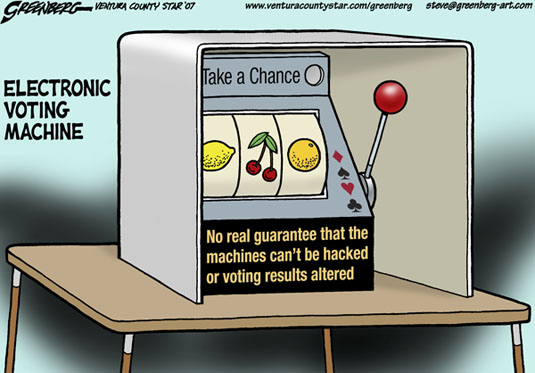
Federal voting machine case clears first hurdle
Wednesday, August 4th, 2010On July 28, Federal Judge Cameron Currie ruled that the SC Election Commission had until Aug. 20 to defend itself against a complaint that the voting machines in South Carolina do not meet federal requirements for record keeping. (For background on the case, see earlier post.)
SC Progressive Network Director Brett Bursey filed the complaint June 17, and the judge gave the parties a month to try and resolve the matter. On July 19, Bursey filed a report that concluded there could be no agreement between the parties regarding an independent audit of the entire voting system.
“I believe that the Election Commission doesn’t want a full system audit for fear that it would conclude — like a recent audit in Iowa did — that these machines should be scrapped.” Bursey said. “We warned the SCEC in 2004 not to buy these machines, and their continued defense of a voting system that cannot reliably tell us who won an election is regrettable.”
Only six states now use a statewide, paper-less system like we have in South Carolina. (Maryland outlawed the paper-less machines last year, but have not funded a replacement.) According to the Verified Voting Foundation, ballots in 38 states are cast on “voter verifiable paper records.”
Email network@scpronet.com to receive regular updates on the lawsuit.
Please consider making a secure donation now to help cover court costs. Indicate in the gift information “verified voting.” Or make a check to SC Progressive Network and mail to PO Box 8325, Columbia SC 29202. We appreciate your support.


Vile, vulgar and sexist
Thursday, August 26th, 2010“We’ve reached a point now where it’s like a milk cow with 310 million tits! Call when you get honest work!”
This quote:
1. comes from an appointee of President Obama
2. was written by a former Republican senator
3. is actually referring to seniors “milking” Social Security
4. is from a sexist, vulgar and insulting letter to a women’s rights leader
5. suggests that advocating for women and seniors is not “honest work”
6. all of the above
Yep, all of the above!
Outrageously, this vulgar former senator holds an important position, and I hope you will join me in urging President Obama to act immediately to remove former Senator Alan K. Simpson as co-chair of the National Commission on Fiscal Responsibility and Reform (aka the “deficit commission”) before his cynical attitudes influence policy that could be harmful to women, seniors, and social security.
Tell President Obama: “Send Simpson Back to Wyoming”
I’ll admit that I was worried when he was first appointed. I was concerned that he would put Social Security recipients at risk, instead of the real causes of the deficit. I also knew he could be condescending to women. Personally, I’ll never forget a confirmation hearing for a Supreme Court justice when Simpson, then a member of the Senate Judiciary committee, lectured a panel of women’s rights leaders, including myself, as though we were children.
You can hear some of that tone in Simpson’s email message to Ashley Carson, Executive Director of OWL, the Voice of Mid-Life and Older Women. The fact that Ashley has testified on behalf of OWL before the Commission in June did not deter him from disparaging her, the organization, their commitment and hard work. His so-called “smart cracks” reveal his own limited knowledge of women’s organizations. But most importantly, a man with this lack of respect for women and women’s organizations should not be in a powerful position to influence cuts to Social Security – the lifeline for millions of older women who are living below the poverty line even with their social security check – under the guise of deficit reduction.
Yesterday Simpson apologized for insulting Ashley personally – but not for his attack on advocates for women and his underlying conviction that seniors who need social security are milking the system.
Please join me in sending a message to President Obama – ask him to protect the social security safety net, and send the sexist senator back to Wyoming.
For Equality,
Ellie Smeal
NOW President
Posted in National News/Commentary | No Comments »