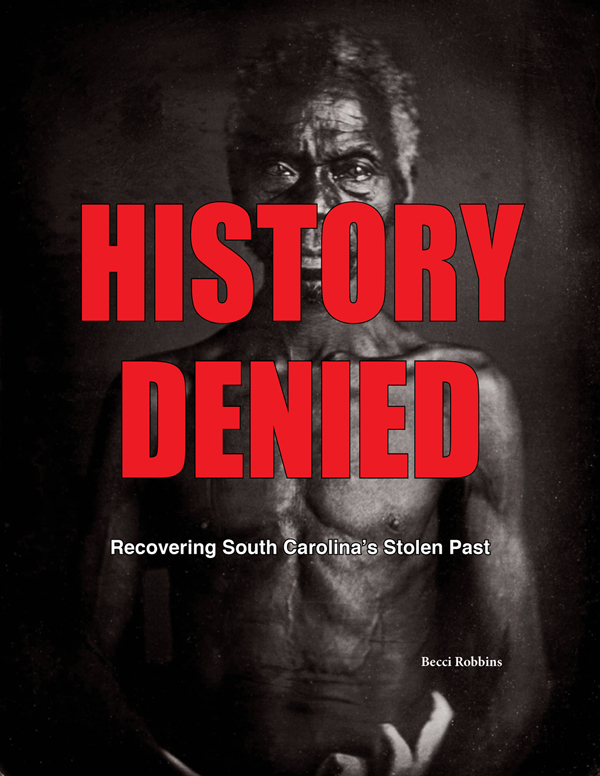
Public invited to July 23 launch of “History Denied: Recovering South Carolina’s Stolen Past”

Book Launch
Monday, July 23, 5:30-7pm
Seibels House and Garden
1601 Richland St., Columbia

Light eats  •  Cash bar
Booklets are FREE!

Join the SC Progressive Network in celebrating the recent publication of History Denied, Recovering South Carolina’s Stolen Past by Network Communications Director Becci Robbins.

“I learned so much on this project—not the least of which is how little I know,” Robbins said. “The more I dug and read, the angrier I got about my miseducation. It’s been unsettling to know how much history we’ve been denied, and calls into question everything we’ve been taught.”

History Denied is Robbins’ fourth booklet to be funded by the Richland County Conservation Commission. She previously published a trilogy to mark the achievements of three extraordinary South Carolina women: human rights activist Modjeska Monteith Simkins, gay rights advocate Harriet Hancock, and legal pioneer Sarah Leverette. Those booklets are available free at the Network’s office, and can be downloaded online. The History Denied booklet will be uploaded after the launch.
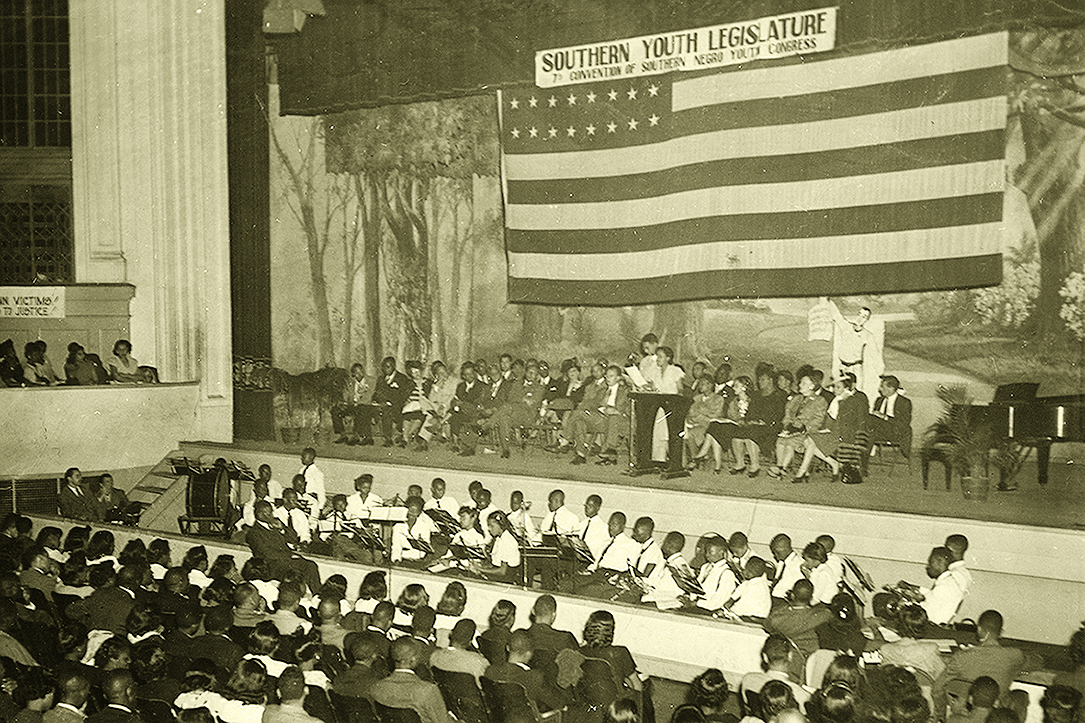
An unprecedented interracial crowd packs the Township Auditorium in Columbia for the Southern Negro Youth Congress’ 7th annual conference the weekend of Oct. 19, 1946.

“This is a cautionary tale. It centers on the Southern Negro Youth Congress (SNYC), a militant, interracial youth movement that thrived against all odds between 1937 and 1949 in the Jim Crow South. Its rise and fall—and the collective amnesia that followed—offers a timely warning about how history is made and unmade, and how that shapes our shared narrative.

While SNYC was based in Birmingham, AL, South Carolina activists played a key role in SNYC’s unlikely success. Early on, Columbia activist Modjeska Monteith Simkins served on its board, and was instrumental in bringing SNYC’s 7th annual conference to Columbia in October 1946.

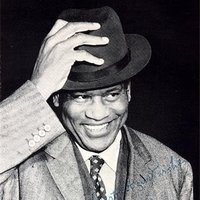
The three-day event promised a glittering line-up of distinguished speakers—including keynote W.E.B. DuBois and internationally acclaimed Paul Robeson—as well as invited guests from around the world. The ambitious schedule included daytime workshops to hone the organizing skills of the young delegates.

It was an unprecedented gathering, yet one that has largely been forgotten. Only recently has scholarship on the radical human rights movement in the 1930s and ’40s emerged, enriching our understanding of the people who drove it and the critical ground they laid for those who came later.

SNYC is far from the only chapter of history to be whitewashed, distorted, or erased altogether. This booklet offers a few South Carolina examples: the first Memorial Day, celebrated in war-ruined Charleston after Confederates evacuated the city in 1865; the radically democratic experiment that was Reconstruction; the widespread practice of lynchings after Reconstruction’s end; and the conspiracy of silence that followed the 1934 killings of seven striking textile workers in Honea Path.
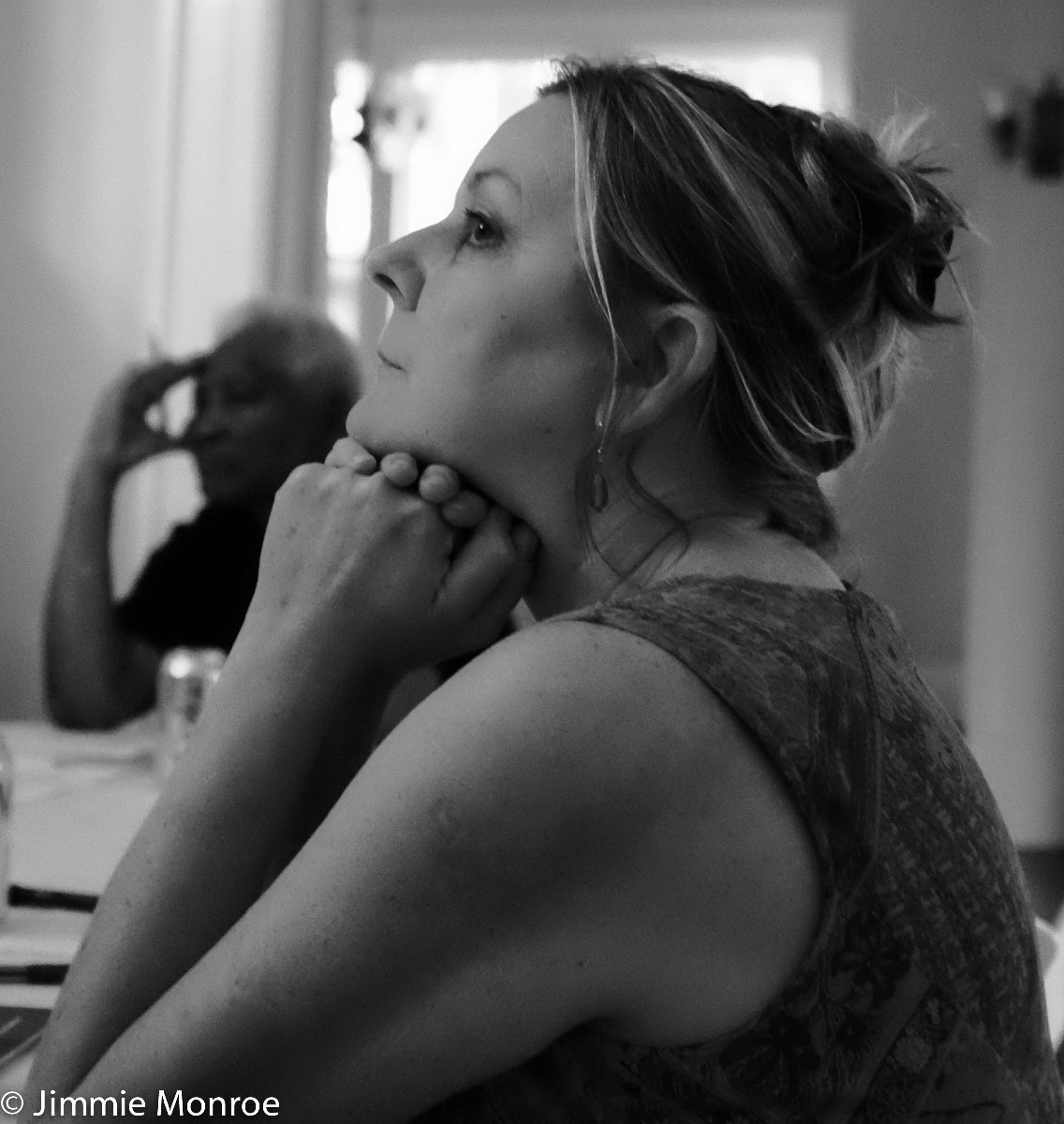
Becci Robbins

It is no accident that we don’t know our labor history or the darkest truths about the white supremacy built into South Carolina’s very constitution, and that denial carries lasting consequences. Ignorance comes with a heavy price.

This booklet is an attempt to broaden our view of the past, even if it hurts. These stories are painful, but they are also heroic. For every act of oppression, there have been acts of resistance by people willing to risk their very lives to stand for human decency and the promise upon which this country was built. Their struggles and triumphs deserve to be shared, their bravery celebrated, their work continued.

This volume is not a comprehensive telling of South Carolina’s forgotten resisters. The voices and contributions of women, workers, Native tribes, LGBTQ+ Americans, immigrants, and other marginalized communities also are missing or minimized in our textbooks and in the mainstream media. This is simply a reminder that what we’ve been taught has largely been dominated by money, war, and the experiences of white men of privilege. That cheats a whole lot of citizens from knowing that their ancestors played important roles in the making of this state and nation.

SNYC’s story lays bare the very best and worst of America. We’d be wise to know both.”
History Lost and Found: Lessons of the Southern Negro Youth Congress

To put our organizing work into context and better understand the legacy we’ve inherited, the SC Progressive Network will explore our ancestors’ radical roots at its 20th fall conference on Oct. 22 in Columbia.

Activists from across the state will meet at the Harbison campus of Midlands Tech for a Network membership meeting 10am – 2pm, to tend to internal business, hear updates from member groups about their projects, and look ahead to the upcoming legislative session.

In the afternoon, we invite the public to join us for a symposium with some of the state’s leading activists and historians. Led by University of South Carolina historian Dr. Bobby Donaldson and political scientist Dr. Sekou Franklin, the session will detail the vanguard role that Modjeska Monteith Simkins and South Carolina’s black activists played during the 1940s in the long struggle for civil rights.

After the Network’s meeting, we invite the public to join us for a symposium with some of the state’s leading activists and historians. All events will take place at the Harbison Campus of Midlands Tech.

The afternoon session – led by University of South Carolina historian Dr. Bobby Donaldson and political scientist Dr. Sekou Franklin – will detail the vanguard role that Modjeska Simkins and South Carolina’s black activists played during the 1940s in the long struggle for civil rights.

The meeting marks the 70th anniversary of the 1946 Southern Negro Youth Congress conference held at the Township in Columbia, a little-remembered but historic gathering. (See event program here.) Simkins did trainings at what was then Harbison Junior College for two dozen young blacks, mostly students, who spent 10 days studying black history, politics, civics, world affairs, and organizing techniques.

Simkins helped establish 11 chapters across the state that turned out over 400 members to the October 1946 weekend conference in Columbia. More than 2,500 people, from Birmingham to New York, filled the Township auditorium with the intention of striking a death blow to Jim Crow.

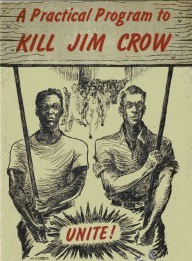
alkbpbhdhidgihgj1945 Socialist Workers Party Pamphlet

It was an impressive gathering. Julian Bond’s father came from Atlanta. Angela Davis’ mother came from Birmingham. The legendary Paul Robeson sang. Labor organizers and Communist Party members came from the north, and delegates came from as far away as Latin America and Africa. Our best notes on the conference come from FBI files that reported 170 participants were white, mostly union and peace activists.

paulrobesonPaul Robeson

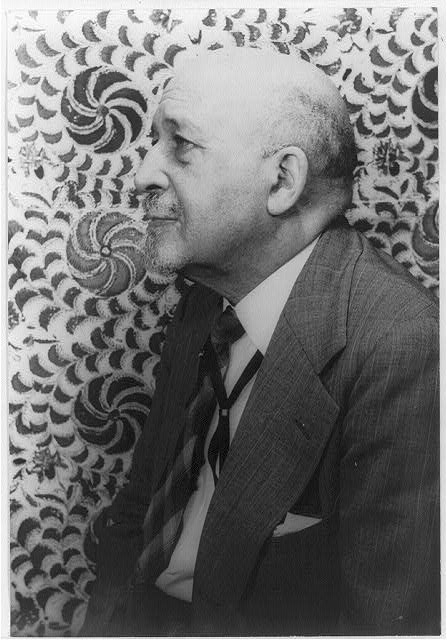
Dr. W.E.B. DuBois gave the keynote speech that Sunday at Benedict’s Antisdel Chapel.  The speech, Behold the Land, lifted up as among the nation’s best, rings true today. DuBois called on “young women and young men… to lift the banner of humanity… in the midst of people who have yelled about democracy and never practiced it.”

DuBois rose to national prominence in 1905 with the founding of the Niagara Movement that challenged Booker T. Washington’s accommodationist positions on segregation. He was instrumental in the founding of the NAACP in 1909, and the National Negro Congress and the Southern Negro Youth Congress in 1937.

web_du_bois_1946-1WEB DuBois

The Columbia SNYC conference was the largest human rights event the South had ever seen, with a class analysis of racism and a call for a mulitracial united front. By the time of the Columbia conference, black soldiers were returning from WWII to the hostile welcome of Jim Crow segregation. South Carolina was in the nation’s spotlight for having the last white-only primary, the South Carolina Progressive Democratic Party crashing the 1944 national Democratic convention (20 years before the Mississippi Democratic Freedom Party), and the blinding of Private Issac Woodard by police at the Batesburg bus station in February 1946.

Erik Gellman’s 2012 book Death Blow to Jim Crow claims that SNYC was more than a precursor to the modern civil rights movement; it was “the most militant interracial freedom movement since Reconstruction, one that sought to empower the American labor movement to make demands on industrialists, white supremacists and the state as never before.”

After WWII, white supremacists used anti-communism to beat back racial equality and labor organizing. We learned in our South Carolina high school history books that “carpet baggers and scalawags induced many of the ignorant and child-like Negroes to turn against the white people,” (Simms-Oliphant) and the Klan arose to beat back the 1870s Reconstruction and save the South.

Seventy years later, white supremacists like Gov. Jimmy Byrnes identified communists as the outsiders leading blacks astray. Simkins was “red-smeared up and down South Carolina,” and iced from the SC NAACP leadership in 1957 by black ministers who chaffed at her strong spirit and militant politics. The red scare effectively ended the militant era of civil rights, and domesticated the modern civil rights movement. That period is now recognized as one led by black ministers beginning in 1954.

DuBois called SNYC’s work the “second Reconstruction,” making the case that the gains of the first Reconstruction had been erased through the whitewashing of history. Now, ironically, 70 years after DuBois bemoaned the erasing of the first Reconstruction, we are studying the lost stories of the second Reconstruction of the 1940s – an astonishing period when the citizenry organized a serious challenge to the status quo – right here in South Carolina.

It is this under-valued people’s history that the Network is committed to lifting up, both at this conference and through its leadership institute the Modjeska Simkins School for Human Rights. While we’ve only recently discovered the importance of SNYC and Simkins’ deep involvement in that effort, the school is picking up where she left off, teaching similar solutions to sadly similar problems.

SC progressives map strategy for 2016

IMG_0160

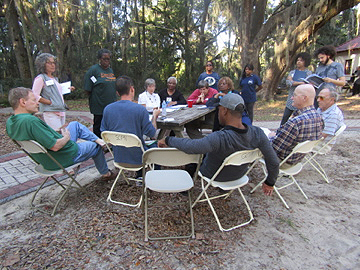
Grassroots activists from across the state met Oct. 23-25 at the SC Progressive Network‘s annual fall retreat at Penn Center in St. Helena, near Beaufort. It was a full weekend of networking, organizing, and mapping plans for the coming legislative session – and beyond.

Saturday morning was spent on Network business: reports from the 11 member groups present and updates from our chapters (Charleston, Columbia, Rock Hill and Spartanburg). The body also approved a bylaws change to establish caucuses within the Network so members can organize around issues and specific constituencies. At Penn, participants caucused on racial justice, women’s rights, and young people. They will identify and promote their own priorities, set their own meeting schedules and develop their own leadership.

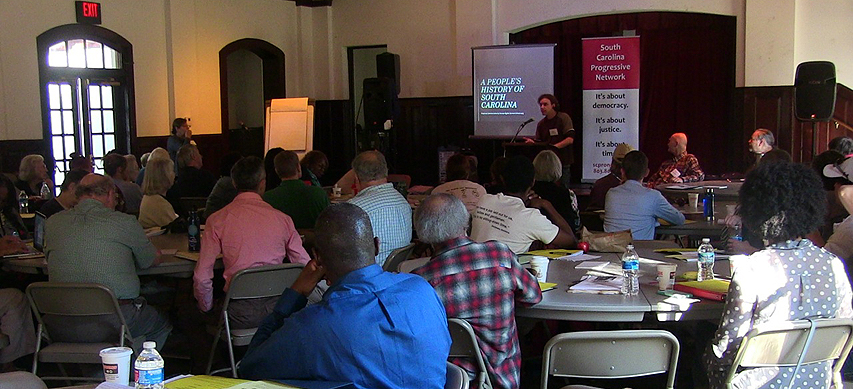
Graham Duncan and Meeghan Kane, who taught portions the summer session of the Network’s Modjeska Simkins School, led a short course on the people’s history of South Carolina. Brett Bursey talked about the history of Network, and its precursor GROW.

graham3

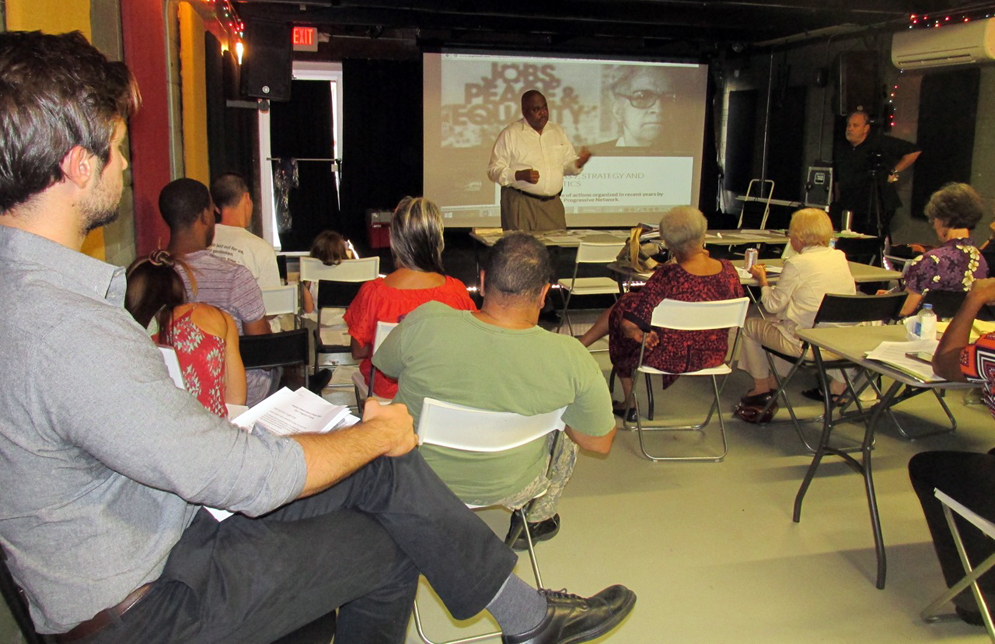
The afternoon was given over to a strategy discussion for 2016, centered on a four-pronged approach to: educate, agitate, legislate, and litigate. Reps. Gilda Cobb-Hunter (Orangeburg) and Joe Neal (Richland) – members of the newly formed SC Progressive Legislative Caucus – led a session on the state of voting rights. They were joined by George Eppsteiner, staff attorney for the Southern Coalition for Social Justice.

The main consideration for shaping our strategy about voting rights is recognizing that the system has been rigged by partisan gerrymandering. As the dominant Republican Party has been allowed by the US Justice Dept. to draw legislative districts that create majority-black and white districts, the winners will be chosen in primaries that fewer than 10% of the citizens decide. Accordingly, the Network’s strategy includes grassroots education and agitation around the nation’s least-competitive elections. This educational effort will reflect legislative proposals to restore democracy through creating competitive political districts and other voting methods. These efforts will be capped off by possible litigation challenging the rigged nature of elections.

That session segued into a facilitated discussion on this state’s most insidious problem – institutional racism – and practical ways the Network can address systemic oppression in South Carolina. The panel included Kevin Alexander Gray, Rep. David Mack, and Laura Cahue of Somos SC.

gilda

Participants then broke into work groups, joining issue caucuses or attending workshops on the Network’s Missing Voter Project (led by Kyle Criminger) and Racial Profiling Project (led by Kevin Gray). The Racial Justice caucus and the Immigrant Rights caucus joined the discussion around the Network’s Racial Profiling Project as a “shovel ready” tool to organize against racial injustice anywhere in the state. Laura Cahue reported that Latinos are being targeted by police in traffic stops that often result in jail and deportation. Rep. Neal wants the Network to help coordinate racial profiling complaints from Latino communities to the SC Progressive Legislative Caucus.

Network Caucus contacts:

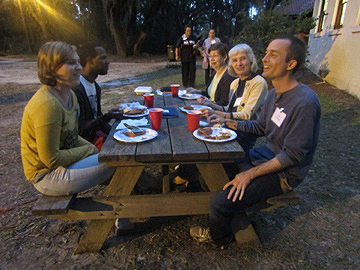
In the evening, everyone gathered at picnic tables under giant oaks to dine on Gullah Grub’s fried fish and fixin’s, then went inside Frissell Hall to sing along with the fabulous Dave Lippman.

IMG_0182

On Sunday morning, caucus representatives gave reports on their work and next steps. Among other Network business, it was decided to postpone elections for Network officers until our annual spring meeting.

Rep. Cobb-Hunter offered a legislative forecast for 2016, which was followed by discussion on bills we will introduce and promote.

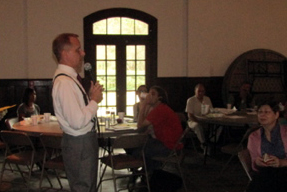
After lunch, the SC Progressive Voter Coalition (SC ProVote), the electoral arm of the Network, met to discuss GOTV priorities and involvement in upcoming state and local races. They were later joined by progressive activist and tax reform expert Mike Fanning, who is running for state Senate (Dist. 17: Chester, Fairfield and York). After a rousing presentation, he earned the group’s endorsement.

IMG_0241

Before adjourning, the body rejected a resolution to support a presidential candidate, as that would break with the Network’s state-based strategic model.

Our thanks to everyone who made time for a very long, but ultimately productive weekend. We will keep you posted about progress with the emerging caucuses and Network chapters.

For information on joining a caucus or creating a Network chapter in your area, or to schedule a Missing Voter Project or Racial Profiling Project training for you or your organization, call our office at 803-808-3384 or email network@scpronet.com.

IMG_0192

See more snapshots from the weekend at Penn Center in our photo album.

Inaugural class graduates from the Network’s Modjeska Simkins School

class2

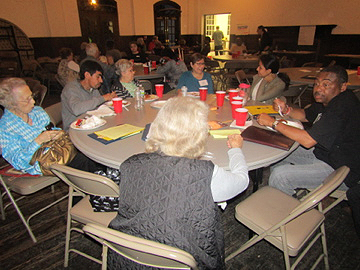
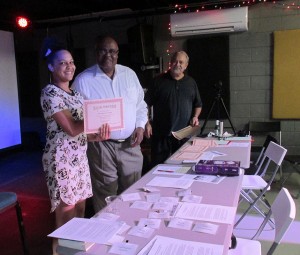
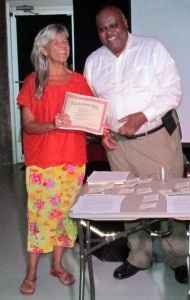
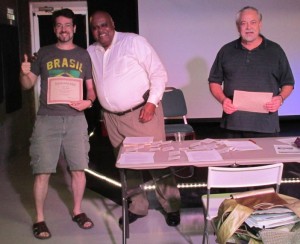
The students who graduated Aug. 24 from the Modjeska School’s summer session were a diverse mix: gay and straight, retired and collegiate, blue-collar, union and professional, black, Latino and white. The youngest was 2nd-grader Rose Duncan, daughter of guest lecturer Graham Duncan, and the eldest student was Eunice “Tootsie” Holland, who will turn 84 in December.

What they shared was an intense, three-month session that covered a South Carolina people’s history. The massacre at the Emanuel Church in Charleston took place just two days after we talked in class about Denmark Vesey’s 1822 slave rebellion. It was Vesey’s church that was again the chosen target of a violent racist attack. We added an extra class to talk about the tragedy, Sen. Clementa Pinckney – an ally of the SC Progressive Network – and the political maneuvering around the Confederate flag. Pressure from GOP candidates on the campaign trail forced Gov. Nikki Haley to call for the flag to come down. It was a stunning example to see how history is made, and remade.

The summer session covered South Carolina history as well as our own, teaching how the Network was created 19 years ago, and tracing its genealogy from the Grass Roots Organizing Workshop (GROW). Students also learned basic civics and organizing strategies. “You’re never too old to learn new things,” said Andy Sidden, pastor at Garden of Grace Church, “and, boy, did I!”

The school is a work in progress. “It was a privilege to have been a guinea pig for the noble experiment,” said Kyle Criminger. “We learned so much, so many stories that I had never heard. And it put the popular movement in historical context, and clarified our strategy and tactics.”

Course material will be revisited, repackaged, culled, expanded and posted to be accessible and user-friendly for students and the public. We are in the process of recording oral histories on key topics by South Carolina social justice movers and shakers, as well as uploading clips from the summer classes to share on the web site. Our goal is to see that the Modjeska School’s organizer training gets spread across the state by training up a corps of teachers and by also having on-line classes.

Students will carry what they’ve learned into the real world, starting immediately. They have signed up for at least one Network project, and will be working with other activists to expand and create Network initiatives. They are:

  • Medicaid expansion. South Caorlina is on track to privatize Medicaid funding, a really bad idea that’s driven by for-profit health care and anti-government ideologues. We will update our campaign for this new reality in 2016.
  • Racial profiling. Using the toolkit the Network created years ago, with a law we wrote to support it, we will teach community activists how to hold law enforcement accountable for its practices during traffic stops.
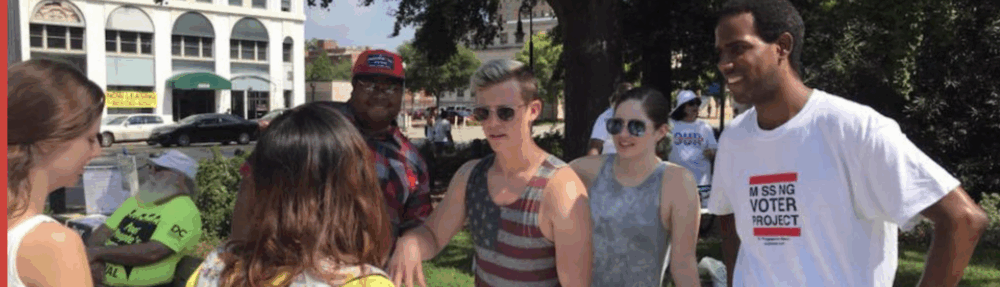
  • Missing Voter Project. The Network will continue its work on voting rights and targeting under-served communities to engage them and register them to vote.
  • Clean elections. Also called publicly financed, or voter-owned elections, this is the reform that can make all other reform possible. We will continue the work that Sen. Clementa Pinckney held dear, reducing the influence of money in politics.

Duncan said, “These last three months with the school have been incredible, and I feel fortunate and honored to have been included in helping develop a curriculum for the classes. Seeing a group of people come together to discuss how we can use lessons from South Carolina history to inform and influence our current efforts to organize in an attempt to enact more progressive policies gives me real hope for the future.”

Thank you to guest teachers Graham Duncan, Dr. Ed Madden, Dr. Hoyt Wheeler, Dr. Tom Terrill, Kevin Gray, Rep. Joseph Neal, and Meeghan Kane.

And congratulations to the graduates!

See more photos in our class album.

For more about the school, call 803-808-3384 or email network@scpronet.com.