SC deserves new voting machines

By Becci Robbins
SC Progressive Network Communications Director

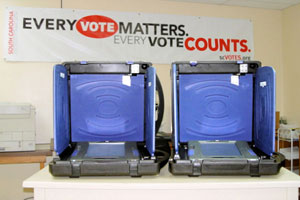
A SC Legislative Audit Council report released March 27 on the state’s voting machines found serious glitches. “Problems with iVotronic machines that have been reported in elections in other states include vote flipping, candidates missing from screens, lost votes or too many votes, freezing, and batteries,” the report found.

The report didn’t mention that many of those states have quit using the iVotronics, which are no longer being manufactured. While these same problems have been widely observed in South Carolina, every precinct still uses them.”63% of the counties that had problems with the machines have not reported the problems to the State Election Commission (SEC),” the study reported, and recommended the SEC establish a hotline to track problems with the machines.

The SC Progressive Network has helped run a statewide election day hotline, 866-OUR-VOTE, in every general election since 2004. Network Director Brett Bursey said, “In the last general election, while all the news was focused on long lines in Richland County, we had calls from five other counties about machine problems causing hours-long waits to vote.”

EP-sign“The SEC has not gathered information about the increasing unreliability of these machines, which are reaching the end of their projected 10-year-lifespan,” Bursey said, and we welcome the LAC report as the start of a serious discussion about what our new voting system should look like.”The Network opposed the purchase of the iVotronic machines in 2004, in part, due to their inability to produce a voter-verified paper ballot that could be used to call a close race. The LAC report concluded, “The audit process in South Carolina is limited by the absence of a voter-verified paper audit trail (VVPAT).” The LAC determined that a VVPAT could be added to the existing machines for $17.3 million.

The 2013 House budget includes $5 million that the SEC has requested to begin saving for a new system after 2016.

“Rather than consider patching up these machines, or buying more used ones as Richland County is planning, we need to be looking at better and cheaper ways to vote — well before 2016,” Bursey said.

elections001

The Network has long advocated a voter-verifiable voting system like the one Clemson has devised.

Dr. Juan Gilbert, Chair of the Clemson School of Computing, Human-Centered Computing Division, has been doing research and development on electronic voting systems since 2003. He got a $4 million grant from the federal Election Assistance Commission (EAC) several years ago to develop a better voting system. The EAC sets standards for voting machines, and has never approved the system currently used in South Carolina.

Gilbert’s “Prime III” meets federal requirements, and was used in a state election for the first time in January in Oregon. Prime III runs on open-source software, on machines available at any computer store. It’s simple, cheap, reliable, produces a voter-verified-paper ballot, and can be publicly owned. The privately owned system we now use costs $1million in annual licensing fees, more on tech support, and runs on secret codes.

“We see no legal impediments to using a system like Clemson has developed, and tremendous advantages,” Bursey said. “Clemson can provide the software, our technical schools can train technicians, and a whole new statewide system would cost little more than adding a paper trail to our old machines.”

SC health care advocates push Medicaid expansion

Medicaid Expansion Organizer’s Toolkit
nullify-obamacare-battaile-politics-1353314267

Overview

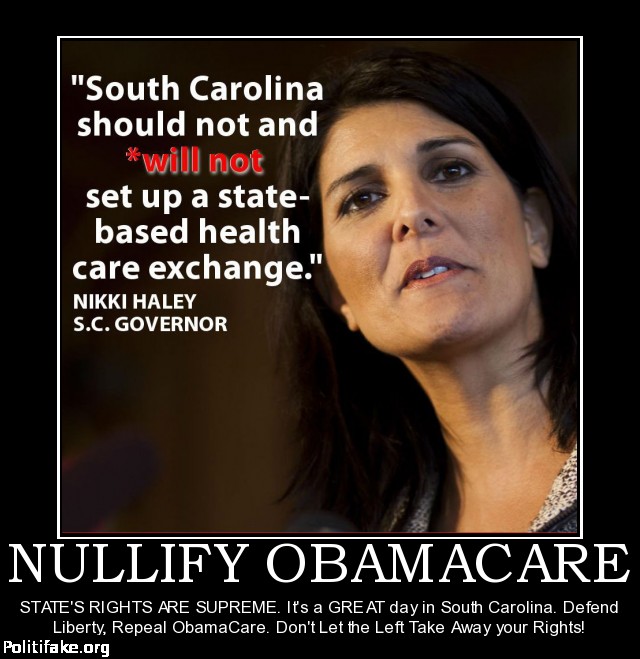
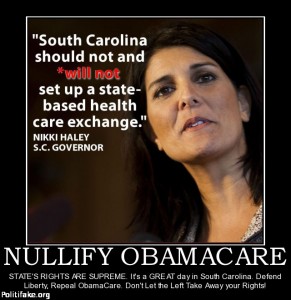
Gov. Nikki Haley’s refusal to accept Medicaid expansion for South Carolina must be challenged, whether we can win that battle or not. The numbers, common sense and decency are on our side.

In her refusal to accept the nine-to-one match in our tax money, Gov. Haley asks, “What good do the nine dollars do us when we can’t come up with the one?”

Truth is, South Carolina could raise the Medicaid match simply by eliminating the $300 sales tax cap on cars, boats and airplanes. It’s not the lack of revenue that may kill Medicaid expansion; it’s the rigid ideology that has promoted the idea that government is bad. That mindset threatens not just healthcare, but education, tax policy, environmental regulations, and so on.

If Medicaid is expanded, about 250,000 South Carolinians who make around $16,000 a year (138 percent of the federal poverty level) will be provided health coverage.

The Affordable Care Act cuts federal payments to SC hospitals by $2.6 billion. These cuts were supposed to be made up by the expansion of Medicaid to keep poor people out of emergency rooms by providing them with insurance. If South Carolina refuses to expand Medicaid, hospitals will lose this funding for the poor but still will be required to provide services to them.

Unless Medicaid is expanded, childless adults who are not disabled and make less than 100 percent of the federal poverty level – about 185,000 people – would be in health insurance limbo. They would not qualify for regular Medicaid nor the new federally subsidized insurance programs.

(Read more in a story in The State. See Health Care Fairness for SC for more information and links to your legislator.)

Democrats and hospital associations want the state to accept up to $11 billion in federal money over the next several years to expand South Carolina’s Medicaid program. Federal officials would pay 100% of the program’s billion-plus dollar annual cost for the first three years, gradually decreasing to 90% in 2020 . When our bill kicks in, it will be less than could be raised by lifting the 3% sales tax on cars, or by closing any of a number of other special interest tax loopholes.

House Republicans have an alternative plan that would pay hospitals up to $35 million to steer uninsured patients to community health centers, free health clinics and rural health clinics. Lawmakers also pledged to give those health centers and clinics an extra $10 million in state money to care for those uninsured patients.

This is part of a $83 million Republican plan created by Rep. Brian White (R-Anderson) to reduce costly emergency visits and to support rural hospitals and free clinics. His plan calls for only $8 million in new spending as part of next year’s budget. The remaining money would come from federal sources and cash the state Department of Health and Human Services has on hand.

While health care advocates welcome the proposal to increase support to community health centers, the Republican proposal is one-time-money, not a recurring budget item, and WAY short of the billions promised by Medicaid expansion.

Who Decides?

The House has refused to pass a bill that includes Medicaid expansion. Therefore, the focus of the debate on Medicaid expansion is on the Senate Finance Committee. Medicaid expansion has a better chance of passing in the Senate than the House, and we are focusing our immediate efforts on the Republican members of the Senate Finance Committee (see list below).

There are 23 members of the Senate Finance Committee – 14 Republicans and 9 Democrats. We need 3 Republicans to vote out a budget that includes Medicaid expansion.

The Senate Finance proposal will then go to the Senate floor for consideration, at which point all Republican senators should be lobbied.

If the House and Senate do not agree on their respective bills, the question then goes to a conference committee, which will try to reach a compromise.

Should a compromise that includes Medicaid expansion be reached and passed by both bodies, the next step is the Governor’s Office. Gov. Haley has pledged to veto any bill that includes Medicaid expansion. As a political face-saving move, she could let it become law without her signature.

If the governor vetoes the bill, the legislature can override her veto with a two-third’s vote of both bodies.

The state legislature decides whether to accept the expansion funds — and can do so only if it can muster the two-thirds majority to override the governor’s promised veto. Because all the Democratic legislators support the expansion, we must target Republicans.

Of the 124 House members, 83 must vote yes to override. With 48 Democrats and 76 Republicans in the 124 House seats, we must convince 35 Republicans to vote yes.

In the 46-seat Senate, 31 votes are needed for an override. With 27 Republicans and 19 Democrats, the override vote requires the support of 12 Republicans.

What can I do?

Arm yourself with the facts about Medicaid expansion. Health Care Fairness for SC, a coalition of hospitals and health care advocates that includes the SC Progressive Network, has a great web site with all the facts you need to understand the matter and lobby for it. There is also a link to send messages to your representatives here.

We are asking organizers to adopt a Republican legislator. Get outside your comfort zone.  If you don’t have a Republican in your district, find the closest one. Look in your county delegation. Recruit five of your friends who agree with you to do the same.

Find your legislator, or look them up by your district here.

Find your senator here, and

  1. Get that legislator to take a position on Medicaid expansion. Many Republicans are saying they are “looking at the options.” This is a way of saying they are waiting to see if a super-majority for the veto is possible before they decide how to vote.
  2. Go to your adopted legislator’s church and discuss the issue with congregants. Do the same with their fellow alumni and neighbors. A listing of Republican legislators, their churches and colleges is here.
  3. After a reasonable effort to solicit the legislator’s commitment to a yes vote, you may attempt to call him out on the question in public. Tactics ranging from letters to the editor, community forums, to pickets or leafleting may be considered. The Network can provide tactical and legal advice on such actions.
  4. Let us know who you’ve adopted, and their response, by calling 803-808-3384 or emailing network@scpronet.com.

If you have questions or need help, contact the SC Progressive Network at 803-808-3384.

To join an e-list for organizers working on Medicaid expansion, email network@scpronet.com.

See Health Care Fairness for SC for more information.

Goals

We want to get the Medicaid expansion passed.

Short of that, we want to:
•  Take the governor up on her position that community health care centers are a better alternative than “Obamacare,” and push for a recurring budget and increased funding for the centers and rural hospitals.
•  Use the opportunity to identify allies and broaden our base of support for movement for rational change in South Carolina.

See our web site for more about the SC Progressive Network. Join us on Facebook and Twitter.

Senate Finance Committee

List of Republicans on the finance committee. Click here for bio and local contact information.

Leatherman, Hugh K., Sr., Chairman (Florence, Darlington)
Peeler, Harvey S., Jr. (Spartanburg, Union, York)
Courson, John E. (Lexington, Richland)
O’Dell, William H. (Abbeville, Anderson, Greenwood)
Hayes, Robert W., Jr. (York)
Alexander, Thomas C. (Oconee, Pickens)
Grooms, Lawrence K. “Larry” (Berkeley, Charleston, Berkely, Colleton)
Fair, Michael L. (Greenville)
Verdin, Daniel B. “Danny”, III (Greenville, Laurens)
Cromer, Ronnie W. (Lexington, Saluda, Newberry)
Bryant, Kevin L. (Anderson)
Cleary, Raymond E., III (Charleston, Horry, Georgetown)
Campbell, Paul G., Jr. (Berkeley)
Davis, Tom (Beaufort)
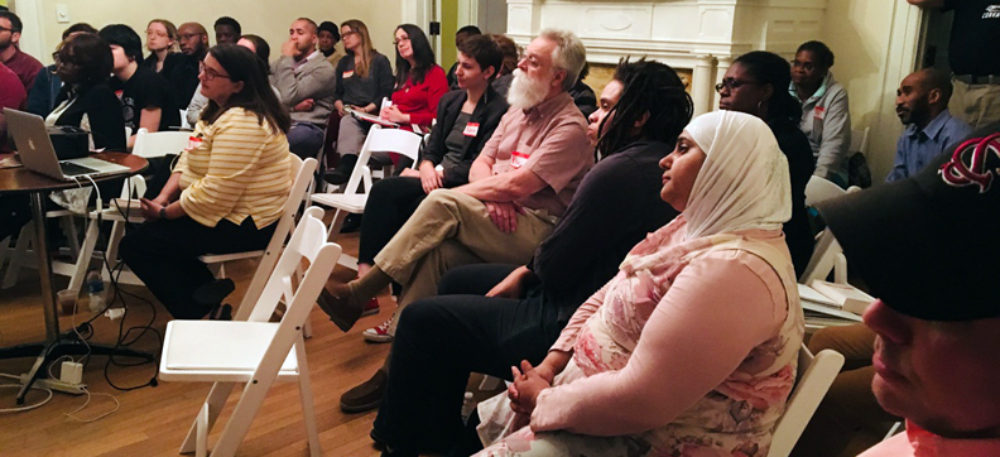
Activists from across SC to meet for Network’s organizing conference Feb. 23

Progressive Organizing Conference

Growing the grassroots in South Carolina

Feb. 23, 10am – 4:30pm
Brookland Baptist Conference Center
1066 Sunset Blvd., West Columbia

network_spring_2011

See photos from last year’s conference here.

The SC Progressive Network and the SC Legislative Black Caucus are offering a day-long activist training conference Feb. 23 in West Columbia. Participants will focus on significant policy issues being considered by the legislature, with an emphasis on building a progressive movement.

“We must do more than lift up just and rational social and economic policies,” said Rep. Harold Mitchell, chair of the Legislative Black Caucus. “We have to build a popular movement with the power to make the necessary changes.”

The conference will address the challenges and opportunities posed by the increasingly conservative leadership in South Carolina that believes government is the problem.

Member organizations will offer brief reports on recent victories and current projects. This is an opportunity to share and inspire fellow activists with the good work going on across the Palmetto State.

RSVP for lunch ($10) required by calling 803-808-3384 or emailing network@scpronet.com. You can also RSVP or share on Facebook.

Medicaid Organizing Packet with Power Point presentation: $10 (optional).

PROGRAM

10am – Registration

10:30 – Brief reports from member groups and discussion led by community activists:

Reproductive rights: Will Bigger, Planned Parenthood
Ethics reform: John Crangle, Director, Common Cause SC
Environment: Bob Guild, environmental lawyer and Sierra Club activist
Labor: George Hopkins, labor historian and SC Progressive Network’s Lowcountry representative
Immigration: Ivan Segura, Council of Mexicans in the Carolinas
Education: Roger Smith, Executive Director, SC Education Association
Voting reform: Brett Bursey, Director SC Progressive Network
LGBT rights: Ann Wilbrand, SC Equality

12:30 – Lunch catered by Tio’s (optional). $10 RSVP at 803-808-3384

1 – Keynote speaker Rep. Gilda Cobb-Hunter

1:30 – Health Care and Medicaid Expansion: Former Columbia Mayor and Medicaid lobbyist Bob Coble, SC AIDS Task Force Director Dr. Bambi Gaddist, and health care economist Lynn Bailey will facilitate the discussion. The governor’s refusal to accept our federal tax dollars back in the form of a 90 percent match for expanding health care coverage to over 300,000 low-income South Carolinians provides a great opportunity to illustrate the cost of free-market ideology as social policy. Participants will get an organizing packet that will help them organize educational forums on this issue in their communities.

2:30 – Medicaid expansion strategy discussion. Rep. Gilda Cobb-Hunter will facilitate.

3 – Politics and power in the Palmetto State. A discussion about how political parties, elections and grassroots activism figure in to building an effective progressive movement. Former State Superintendent of Education Dr. Jim Rex will join the discussion. He helped launch the new Free Citizens Party. Should be a spirited session.

4 – Network business meeting. Nonmembers welcome.

Jim DeMint, why should taxpayers fund special election?

Dear Mr. DeMint,

We are writing to ask you to help pay for the election to replace you in the Senate. The South Carolina Election Commission estimates that the special election required by your resignation will cost South Carolina taxpayers about $1 million.

According to the Federal Election Commission, your Senatorial political action committee has $800,409 “cash on hand” and no outstanding debts (Team DeMint FEC ID S4SC00083, most recent filing 9/30/2012).

In 2010, your PAC gave a total of $1,150,000 to Republican parties in eight states other than South Carolina. That year you made a total of $7,500 in contributions to 19 South Carolina county Republican parties.

In 2012, you generously donated $700,000 to the Club for Growth and $5,000 to the SC Republican Party.

Your new million-dollar-a-year job at the Heritage Foundation affords you the opportunity to donate the remaining $800,409 in your campaign account to the SC Election Commission, removing that burden from South Carolina taxpayers.

According to FEC staff, your check to the SC Election Commission to pay for an election you necessitated would qualify as a “public purpose” as required by statute.

Your resignation from the Senate, and Congressman Tim Scott’s resulting appointment to your seat, will cost South Carolina taxpayers $1 million to pay for a special election.

We hope that you agree that paying for this election with campaign money you no longer need would honor both your constituents and your conservative values.

Regards,

Brett Bursey
Director, SC Progressive Network

SC Election Day meltdown: a cautionary tale

By Brett Bursey
Director, SC Progressive Network

The Election Protection hotline started ringing shortly after the polls opened at 7. It didn’t stop all day. Ninety percent of the touch-screen voting machines in the county’s 118 precincts wouldn’t boot up. Some precincts didn’t have working machines until 5:30pm.

One campaign tried to get the court to extend voting hours, but failed. The SC Republican Party Chairman said, “There is always a backup in case there is an election machine malfunction.” But unfortunately for thousands of voters, there was no such backup.

This wasn’t Richland County on Nov. 6, 2012. It was in Horry County’s 2008 Republican presidential primary.

At the time, I thought this was the train wreck we needed to get out from under these unreliable voting machines and get our emergency ballot statute fixed. I was wrong.

Four years later, it was thousands of voters in Richland County standing in line for up to seven hours because there weren’t enough working machines and no emergency ballots.

These are the same machines that failed in Horry County in 2008. The same machines that gave the 2010 Democratic nomination for US Senate to the virtually unknown Alvin Green, a result deemed statistically impossible by the nation’s top computer voting experts. The same machines South Carolina bought between 2004 and 2006 – against our organization’s recommendation to the Election Commission. After studying the issue extensively and watching what was working in other states, we advocated simpler, paper-based voting devices.

This Election Day, machine failures didn’t happen in Richland County alone, but in at least seven other counties, according to reports to the Election Protection hotline. Callers from Spartanburg, Greenville, Charleston, Horry, Berkeley, Kershaw and Sumter counties all reported machine failures causing long lines.

In the 2008 Horry machine failure, State Election Commission spokesman Gary Baum said all precincts must have emergency paper ballots on hand, calling them “part of the election.”

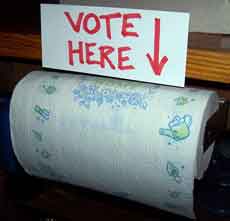
SEC spokesman Chris Whitmire said voters could use almost anything – “a napkin, a paper towel” – to vote.

That afternoon, Whitmire called and said, “Brett, let’s read that statute together, out loud.” He was referring to State Code 7-13-430 that used to require each precinct to have enough paper emergency ballots on hand “as are equal to ten percent of the registered qualified voters at such voting place.”

We discovered that, in 2000, the emergency ballot statute was amended to require “a number of ballots not to exceed ten percent of the registered qualified voters at the voting place.” The math we had learned in our minimally adequate schools allowed us to calculate that zero does not exceed 10 percent. So, while precincts are required to provide emergency ballots, they are not required to have any until after the emergency.

Sen. Phil Leventis requested an opinion from Attorney General Henry McMaster prior to the 2008 general election on the contradictory nature of the redrawn statute. McMaster agreed that while precincts were not required to have emergency ballots on hand, they are required to be available “without undue delay.”

In the 2008, deputy sheriffs waited for the county election office to print the various versions of ballots required by local races, and then drove paper ballots to the precincts. At 2pm, deputies were still delivering the first shipments of paper to some precincts.

Whether you consider it “undue delay” might depend on whether you were one of the thousands of Horry County voters who braved freezing rain only to be told to come back later.

In Richland County, with countywide reports of machine shortages and failures, only a few precincts considered offering emergency ballots. Our Election Protection Coalition provided emergency ballots for one precinct. Other precincts that requested them were told by county election officials they couldn’t use emergency ballots.

Richland County Election Board Chair Liz Crum said they were prohibited by law from using emergency ballots. It says “if no machine is available,” paper shall be provided. Most precincts had some machines working.

Clearly, the statute needs to be fixed to require an on-hand supply of paper ballots and specify the wait times at which point they may be used.

The requirement for emergency paper ballots to be on hand at precincts was written out of the law in 2000 at the insistence of the Association of Counties. At the time, counties were using lever machines, punch cards and mechanical devices that never failed county-wide. The counties argued that emergency paper ballots were an unnecessary expense.

In 2002, in the wake of the Florida “hanging chad” debacle, Congress passed the Help America Vote Act, which provided funding for states to update their voting systems. South Carolina was the first state to spend the money, and one of seven states not to seek an extension of the funding deadline pending the establishment of federal guidelines for the new generation of touch-screen voting computers.

The SC Progressive Network presented expert testimony to the state Election Commission about the devices’ shortcomings before the state spent $38 million to buy the iVotronic machines we still use. The “iVo’s” don’t produce a paper record that can be verified by the voter, or used to recount the vote, and have been de-certified in a number of states because they are unreliable.

Switching to a statewide, computer-based, paperless voting system should have caused the legislature to restore the requirement for emergency paper ballots at every precinct. The potential for county-wide machine failures is a proven liability of this kind of system.

While blame for the failure in Richland County is falling largely on election officials, ignoring the history of failed machines in this and other elections implies that only human ineptitude or malfeasance can cause such problems.

As these delicate and complicated devices reach the end of their lifespan, we should be concerned about future elections and our next generation of machines. Replacing the people that run the machines will not solve the core problem. We must learn from our past mistakes and acquire a more a reliable, rnon-proprietary, paper-based voting system.

Brett Bursey is SC Progressive Network Director and SC Election Protection Field Coordinator.

Network holds rally to support DART riders and urge voters to pass penny tax

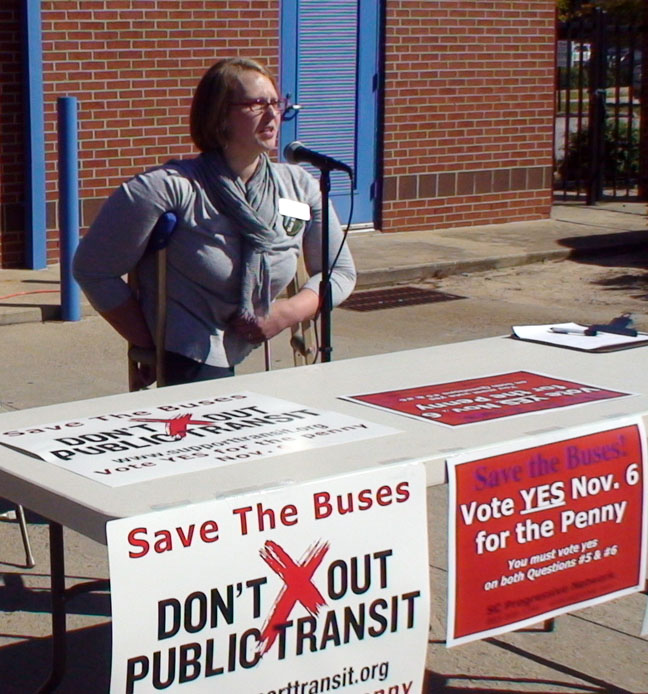
Those who stand to lose the most if the penny sales tax to fund public transit isn’t passed are the DART riders, who have already suffered 40% cuts to services. At a press conference Oct. 24 hosted by the SC Progressive Network, Dori Tempio from the Disability Action Center asked voters to weigh in on this critical issue Nov. 6. For more information, see scpronet.com or call 803-808-3384.

See more photos from the rally here.

Read about it in The State.

Court rules that SC voter ID law does not, in fact, require photo ID

By Becci Robbins
SC Progressive Network Communications Director

Following the federal court ruling that approved a substantially modified version of South Carolina’s voter ID law, SC Progressive Network Director Brett Bursey called the venture “very expensive theater.”

The ruling begins by noting “South Carolina’s new (photo ID) law…does not require a photo ID to vote.”

While Gov. Nikki Haley crowed, “This is not just a win for South Carolina, this is a win for our country,” and state Attorney General Alan Wilson hailed the ruling as a vindication of Republican state legislators, the law the court approved is not the one that went to Washington.

District Court Judge Bates said in his opinion, “Act 54 as now pre-cleared is not the Act 54 that was enacted in May 2011,” when signed by Gov. Haley.

While the Court acknowledged “an absence of recorded incidents of in-person voter fraud in South Carolina,” it found that “preventing voter fraud and increasing electoral confidence are legitimate” reasons for the law.

“After several years of divisive and racially charged debate on this unnecessary law,” Bursey said, “after $2 million in taxpayer money spent defending it, and several million more dollars to implement it, our photo ID law will not require voters to have a photo ID to vote.”

The original law allowed a voter to claim a “reasonable impediment” to not having a photo ID, and left it to the county board of elections to determine whether the reason was legitimate. Today’s ruling said that the reason for not having a photo ID “is to be determined by the individual voter, not the poll manager or county board. So long as the reason given by the voter is not a lie, an individual voter may express any one of of the many conceivable reasons why he or she has not obtained a photo ID…voters with the non-photo voter registration card…may still vote without a photo ID.”

Judge Baker wrote, “It is understandable that the [Dept. of Justice] and the intervenors [including the SC Progressive Network] in this case, would raise serious concerns about South Carolina’s voter photo ID law as it then stood.”

The governor’s victory dance notwithstanding, Judge Baker concluded, “One cannot doubt the vital function that Section 5 of the Voting Rights Act has played here. Without the review process under the voting Rights Act South Carolina’s voter photo ID law certainly would have been more restrictive.”

Calling it political theater, Bursey said, “The grandstanding on this issue by the governor and the Republican majority of the legislature comes at a very real cost to taxpayers, voters and election workers. It is partisan politics at its worst.”

The law will go into effect in 2013.

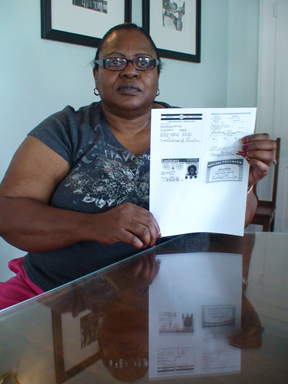
Delores Freelon has been jumping through hoops for more than a year trying to obtain a SC photo ID. In August, she testified in front of the three-judge panel in Washington, DC.

Network Director makes case for voter-owned elections

In wake of SC House Speaker Bobby Harrell’s spending of campaign cash, SC Progressive Network invited conservative groups to join in a press conference on Oct. 9, 2012, to ask for an independent investigation of the matter. SC Gov. Nikki Haley just days earlier returned $10,000 in improperly used campaign funds. With public frustration and disgust growing, the time is ripe for real reform in SC politics.

Penny tax would double funding for Midlands’ public transit

Richland County Council voted yesterday to place a referendum on the November ballot for voters in the county to consider adding a penny to the sales tax (taking it to 8 cents) to fund transportation.

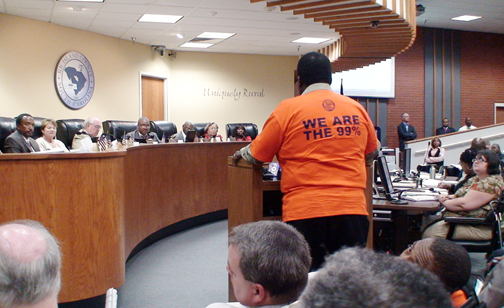
The SC Progressive Network and ATU turned out dozens of bus and DART riders to press for 33% of the penny to be allocated to public transit. Council gave second reading to a proposal that funds public transit at 25%, with 71% to roads and 4% to pathways.

The front-page story in today’s State newspaper reported that the public hearing was “packed with sign-toting, T-shirt wearing bus advocates.”

“While we didn’t get the council to fund a great public transit system, the 20-year penny tax will raise over a quarter-billion dollars for public transit, more than doubling what has ever been budgeted,” Network Director Brett Bursey said.

“This plan takes us from bad to good, and we will remain engaged to insure the initiative passes in November and that public transit better serves the needs of its users.”

Lucious Williams, Vice President of Amalgamated Transit Union Local 610, testifies June 19 before Richland County Council.

Piñata Politics Just Tempest in a Tea Party Pot

By Becci Robbins

Talk about falling down the rabbit hole. At this time last week I was making a gift for my friend Donna Dewitt to celebrate her retirement from the SC AFL-CIO. And what says party like a piñata?

Yes, the piñata was my idea. I made it. I filled it with candy and Bobby Bucks. I videotaped its predictable demise. I sent the clip to friends to amuse them in these most un-amusing times. Who knew it would go viral?

The breathless response has been over the top, a sad commentary on the echo chamber that is the Internet.

Was the piñata in poor taste? Yes. Was it malicious? No. Am I sorry it caused some people to lose their minds? That’s their problem.

My only regret is having put a dear friend in the position of having to defend a piñata she did not know about or ask for. Donna works harder at a thankless job than anyone I know. She doesn’t deserve the heat she’s taken, including death threats and a promise from Gov. Nikki Haley on national TV to “continue beating up on unions.”

To fixate on unions instead of dealing with the critical problems we’re facing is to use the tired politics of distraction. I should have expected it from the governor, whose favorite posture is that of victim – first of racism, then sexism, now union thugs.

While Haley has made an odd habit of union-bashing, for me she crossed the line when she used her last State of the State address to proclaim: “Unions are not needed, wanted or welcome in South Carolina.” Instead of a message to unite all of us who call the Palmetto State home, she served up a campaign speech of red meat. It was inappropriate. And insulting.

When the governor bashes unions, she’s bashing my colleagues. She’s bashing my friends. She’s bashing my family. She’s bashing me. So forgive me for taking it personally, but I’ve had enough.

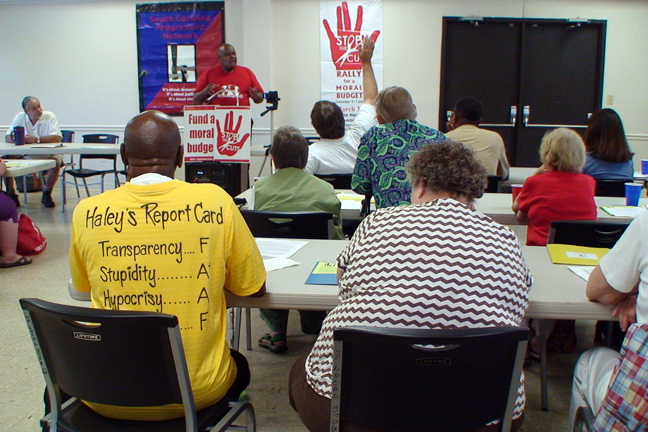
The piñata was intended as comic relief among friends after a long day of talking about the state budget, our election system and workers’ rights at the SC Progressive Network‘s annual spring conference. The party was a chance to unwind and honor Donna, our longtime co-chair. For the governor to use the incident for political gain is predictable but unfair, and more than a little ironic.

After all, Donna didn’t do anything as shameful as cut funding for education and mental health services. She didn’t gut environmental regulations or stack boards with corporate cronies. She didn’t show contempt to the Supreme Court. She didn’t campaign on a promise of transparency and then routinely sanitize her paper trail. She didn’t lobby for a corporation while being on their payroll. She didn’t use her power like a bludgeon.

Donna smacked a piñata. Which is, good people, what happens to piñatas. I made one of a Corporate Fat Cat for John Spratt’s retirement party, and it, too, got smashed. Why didn’t it go viral? Because nobody could make political hay out of it.

And that’s exactly what the governor is doing. Yesterday I got an email solicitation from her office inviting me to watch the video and contribute $250 to fight “Big Labor.” The email mentions President Obama twice. Talk about tasteless.

The governor will get no apology from me. But I offer one to Donna for putting her in an awful position. She could have risked hurting my feelings by refusing to play along at the party. Or she could have thrown me under the bus when she started catching heat. She did neither. As a labor leader, she knows something the governor doesn’t: solidarity matters most when it’s inconvenient.

Sorry if this flap has embarrassed any of our members. Please know that Donna and Network Director Brett Bursey have made the best of the rare media attention. (Watch Brett on Fox and Donna on CNN, for starters.)

It may not be pretty, but at least people are talking about organized labor in South Carolina. It’s a conversation that’s long overdue, and it’s up to us to keep it honest.

Becci Robbins is SC Progressive Network Communications Director. Reach her at becci@scpronet.com.