Citizens united win in South Carolina!

In case you missed it, here are video clips and photos of the SC Progressive Network‘s support of the Occupy Columbia movement. For the most current Network news and events, join us on Facebook.

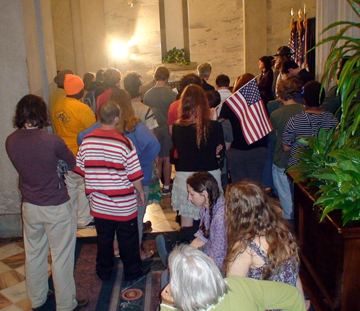
Occupy Columbia protesters defy Gov. Haley’s orders to leave State House grounds at 6pm.

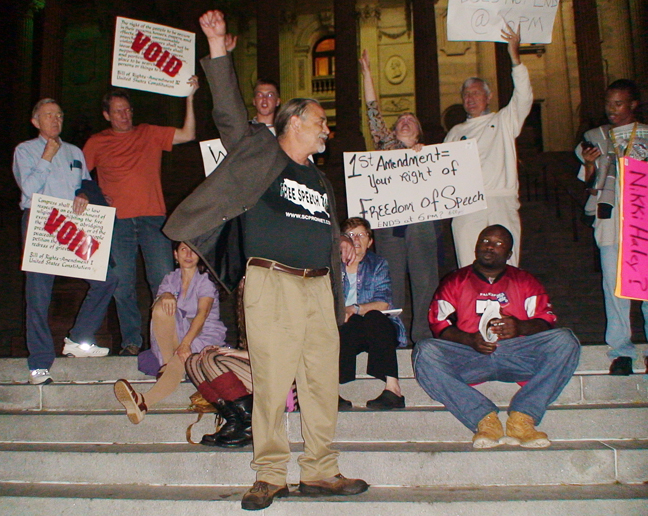
SC Progressive Network issues call for citizens to challenge Gov. Haley’s order. Some 300 people showed up for a spirited rally at the State House. Nobody was arrested. Big night for free speech in South Carolina.

SC Progressive Network Director declares victory with Rep. Gilda Cobb-Hunter, the only legislator to risk arrest in defense of the First Amendment.

Photos of Gov. Nikki Haley’s press conference Nov. 16 announcing the eviction of the Occupy Columbia protesters, and the arrest of 19 two hours later.

Photos of a rally organized by the SC Progressive Network Nov. 21 challenging Gov. Haley’s orders.

Citizens United to Challenge Gov. Haley’s Order

The SC Progressive Network is asking South Carolina citizens to gather at the State House on Monday, Nov. 21, to challenge Gov. Nikki Haley’s order against protesting on the grounds after 6pm.

“We are urging citizens who believe that our First Amendment right to petition our government doesn’t end at sunset to join us at the State House from 6 to 7pm on Monday,” said Network Director Brett Bursey. “We will peacefully protest on the grounds, and are inviting legislators to join us in taking a stand for free speech in South Carolina.”

Gov. Nikki Haley orders protesters off the State House grounds at a Nov. 16 press conference. Two hours later, 19 Occupy Columbia activists are arrested.

The Network is a 16-year-old statewide coalition of advocacy organizations and grassroots activists that promotes democratic reforms, including reducing the influence of money in politics. “We do not believe that money is free speech, that corporations are people, or that the Occupy Wall Street protests don’t have a clear message,” Bursey said.

Network Co-chair Virginia Sanders said the the prohibition against protesting after 6pm reminds her of Columbia’s old Jim Crow practice of running the last bus to the black communities before dark. “The governor is saying that if I work until 5pm, my opportunity to protest her decisions will last about 15 minutes,” Sanders said.

Sanders’ remembers 1961, when 187 black students were arrested for protesting racial segregation on the State House grounds. The US Supreme Court threw out the conviction, ordering that the state could not “make criminal the peaceful expression of unpopular views.”

Participants in Monday’s protest will not be arrested unless they refuse to leave after being ordered to do so by the Bureau of Protective Services.

Neither the Governor’s Office, the Dept. of Public Saftey or the Bureau responded to repeated requests Friday for clarification of the new limits on First Amendment expression on the State House grounds. “It’s my guess that they don’t have a clue how to enforce an illegal order,” Bursey said.

“If I can’t stand on the State House grounds with a sign that expresses my opinion about how our democracy has been hijacked by corporate interests, I’d rather be in jail,” he said.

Revolutionize your plate, and the planet

Progressive Network Movie Night

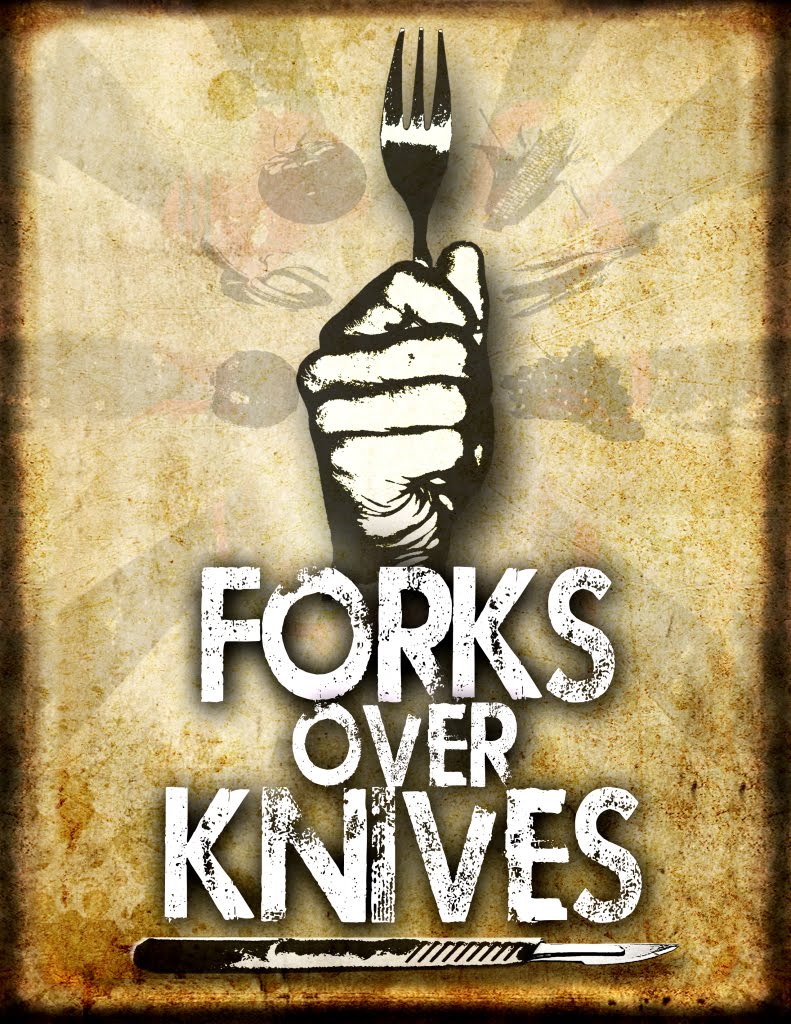
Forks Over Knives

Nov. 22, 6:30–9:30pm

Conundrum Music Hall, 626 Meeting St., West Columbia

Learn about the great health benefits of a whole foods, plant-based diet while sampling vegan dishes at our FREE screening of Forks Over Knives and potluck!

Don’t miss this film, full of crucial information but also easy and fun to watch. You will not be subjected to scenes of factory farm horror; instead you’ll see evidence of health hazards caused by meat and dairy in the human diet. Watch what happens when the narrator decides to try a whole foods, plant-based diet during filming. The results are extraordinary.

Beer and other beverages available for purchase. Bring a non-veg friend. The hope is to inspire people who haven’t tried a plant-based diet to move in that direction.

Film starts at 7pm. See movie trailer and more at www.forksoverknives.com. The SC Progressive Network shows free movies every 4th Tuesday.

Thanks to Rosewood Market for donated organic vittles.

Download a flyer to post at work, school or church.

New South battles old poverty as right-to-work promises fade

By Margaret Newkirk and Frank Bass

Oct. 11 (Bloomberg) — Nineteen years ago, when BMW announced a new factory off Interstate 85 in Spartanburg, South Carolina looked like the king of smokestack recruiting.

The world’s biggest manufacturer of luxury vehicles would make the city a “Mecca of foreign investment in the United States,” The Independent of London predicted. It would see a rush of industry chasing Munich-based Bayerische Motoren Werke AG. Downtown would spring to life. I-85 would be America’s Autobahn.

“Oh, they were going to solve all of our problems,” said Cynthia Lounds, director of community economic development at Piedmont Community Actions Inc., a social-service agency.

Today, South Carolina is one of the most impoverished states in the nation, becoming the seventh poorest in 2010 from 11th in 2007, according to recent U.S. Census data. Its percentage of residents living in poverty shot to 18.2 percent from 15 percent in that period. In downtown Spartanburg, near- empty Morgan Square features a used clothing store and two pawn shops.

South Carolina and other southern U.S. states topped the nation’s poverty rankings, a sign of trouble in the so-called New South known for its growth and ability to lure employers with laws restricting union organizing. The South was the country’s only region with an increase from 2009 to 2010 in both the number of poor and their proportion of the population, the census said.

‘Downward Pressure on Wages’

The numbers show that even as South Carolina trumpeted coups like BMW, the state’s stance toward organized labor has depressed living standards, said Chris Kromm, executive director of the Institute for Southern Studies in Durham, North Carolina.

“There’s been this kind of undertow of low-wage jobs all along,” Kromm said. “There have been successes in luring industries, there’s no question about that. But it brought an overall downward pressure on wages.”

Job creation is at the center of the 2012 presidential campaign. South Carolina on Jan. 21 will play a key role as host to the first Southern primary in the race to select President Barack Obama’s Republican challenger.

The effect of right-to-work laws on wages has been the subject of intense debate for years. The National Right to Work Committee, for instance, says that employee compensation rose faster in states with those laws, according to the organization’s website.

Boeing Battle

South Carolina’s rising poverty rate coincides with a dispute over expansion of a Boeing Co. plant in North Charleston. The National Labor Relations Board sued Boeing Co. over its decision to locate a 4,000-job factory there, saying the move was intended to punish union activity at its base in Washington State.

“It’s like the Obama administration can’t come up with anything else to stifle business growth in this state,” said Lewis Gossett, president of the South Carolina Manufacturers Alliance.

Hostility to organized labor was at the core of the region’s strategy for attracting jobs: South Carolina joined the ranks of right-to-work states in 1954, outlawing contracts that require union membership or dues, according to the U.S. Department of Labor.

‘Come on Down!’

The state marketed its non-union labor in the unionized North, said Brett Bursey, executive director of the SC Progressive Network, an activist group based in Columbia. One industry recruiting poster from the 1980s, he said, showed a man in a T-shirt and a swelling belly. “South Carolina has no labor pains,” it read. “Come on down!”

The fight over Chicago-based Boeing’s efforts to expand in North Charleston has revived the issue. With the state’s unemployment rate at 11.1 percent in August, compared with 9.1 percent nationwide, even some critics of the state’s labor stance want the Boeing plant to stay open.

“There’s not a lot of debate about that around here,” said Joseph Darby, a pastor of Morris Brown AME Church in Charleston who criticized what he said is the state’s emphasis on low-skill work over education. “The area is so starved for jobs.”

Like much of the Southeast, South Carolina lost construction employment during the recession. Its textile industry continued to bleed jobs as well: Union County, about 20 miles from Spartanburg, had the state’s fourth-highest unemployment rate after a sock factory and a mill closed in 2009 and 2010. The county also lost a 150-job Disney distribution warehouse it had lured from Memphis 12 years earlier with tax breaks. Disney moved the operation back to Tennessee in July.

Warehouse Work

“I’m just waiting to see what God has in store for me,” said Joan Bobo, 49, who worked at the facility since it opened. “I’m experienced in warehouse work. I haven’t found anything yet.”

South Carolina has seen good business news in the past year. Manufacturing employment in August was up 11,000 jobs from a year earlier, including 1,600 new jobs at BMW. The state beat out North Carolina for a Continental Tire company factory on Oct. 6. It’s getting an Amazon distribution center near Columbia.

BMW’s South Carolina plant directly and indirectly supported 23,050 jobs in 2007 and 2008, generating $1.2 billion in wages, according to a study by the Moore School of Business at the University of South Carolina in Columbia. The automaker’s direct employees at the plant accounted for 2.2 percent of the state’s manufacturing employment, the study said.

Expectations ‘Exceeded’

“Since announcing our BMW operations in South Carolina in 1992, and beginning production in 1994, our expectations have continually been exceeded,” Max Metcalf, a spokesman, said in an e-mail.

Some of the new jobs in the state, though, have carried a downside. Employers began hiring through staffing agencies, instead of directly. The jobs were temporary and lower paid than permanent positions. At BMW, the difference was $15 per hour compared with $15.50, Metcalf said. The company needs the flexibility to respond to demand, he said, and recently moved many temporary workers to permanent status.

While South Carolina’s private businesses have added employment, the state lost 15,700 government positions in the year ending in August.

Juanita Dixon, 33, lost her seven-year government job in February. A community-college graduate and mother of two, Dixon earned $10.25 an hour, paid vacation and insurance as a medical assistant at a county rehabilitation center. Budget cuts closed it, she said in a phone interview.

Five Applications Daily

Dixon put in five job applications daily, she said. When BMW’s staffing contractor held a job fair at a hotel, she applied and was told the wage was $13 an hour.

She passed a written test, but failed a physical one. “You have to put tires on a car, and you have to do so many in so much time,” Dixon said. “They said, ‘You can reapply in a year.’”

Dixon now works at Spartanburg’s new Adidas Distribution Center, earning $9 an hour doing factory warehouse work. She got the job through a staffing agency in September: “It’s a temporary job for three months,” she said.

When BMW arrived in the city, the look of the place was transformed, said Lounds, of Piedmont Community Actions. Factory workers tooled around town in cars bought with employee discounts.

“There were more BMWs around here than Fords,” she said.

Drawn by BMW

Out on I-85, BMW now employs 7,000, nearly twice the 4,000 promised in the 1990s, said Metcalf, the spokesman. The automaker attracted more than 40 suppliers to the state, spurred investment in the Port of Charleston and invested $750 million during the recession in Spartanburg, which now has 277,916 people, according to the census.

Yet the I-85 “autobahn” of industry didn’t materialize, said Holly Ulrich, senior scholar at the Strom Thurmond Institute of Government and Public Affairs at Clemson University.

“Those predictions were made during the boom years for South Carolina and the South, before a series of national economic catastrophes,” Ulrich said. “I haven’t seen evidence that it happened.”

On Sept. 27, five days after the census poverty numbers were released, the first-term Republican governor, Nikki Haley, tried to boost morale. She ordered state workers to change the way they answered the phone.

By the next morning, callers to an unemployment office in Spartanburg heard the new message: ‘It’s a great day in South Carolina.”

–Editors: Flynn McRoberts, Stephen Merelman

To contact the reporters on this story: Margaret Newkirk in Atlanta at mnewkirk@bloomberg.net; Frank Bass in Washington at fbass1@bloomberg.net. To contact the editor responsible for this story: Mark Tannenbaum at mtannen@bloomberg.net.
Town halls expand Network’s voter ID campaign

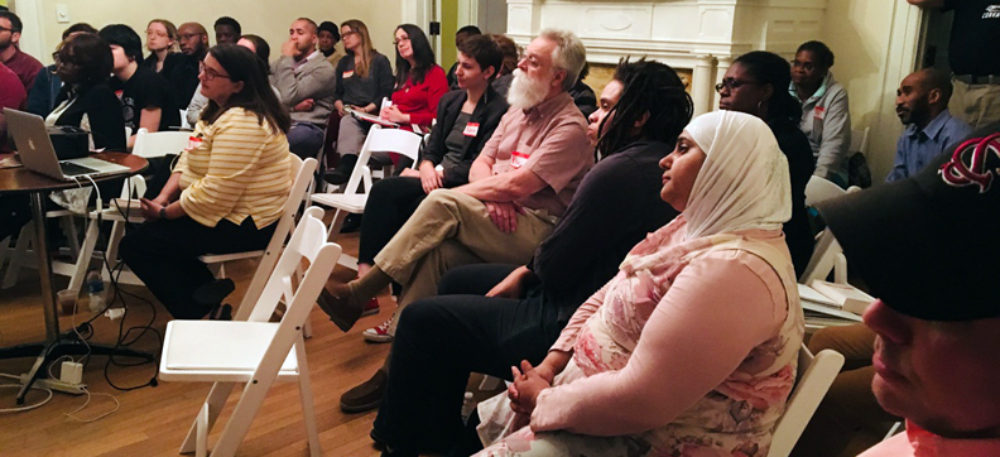
The SC Progressive Network is holding a series of community forums titled “Voter ID and the new Jim Crow.” Network Director Brett Bursey will moderate. Each event will include a Q&A session and instructions for activists to work the issue in their community.

The forums will address the moving target of DOJ pre-clearance, and where we should put our efforts to try and stop it. The meeting will recognize photo ID as a symptom of larger problems, and will focus discussion on sharpening a strategy to address The Big Picture.

The Network is planning a statewide summit on Oct. 29 in Columbia to sharpen our focus and efforts. Details and agenda to be posted as they become available.

Call  803-808-3384 or email network@scpronet.com for details or to schedule a meeting in your area.

•  •  •

Sept. 12, Florence: 7pm at Poyner Auditorium, 319 South Dargan St.

Sept. 15, Beaufort: 6:30pm at Golden Corral, 122 Robert Smalls Pkwy. or Hwy. 170. Come early if you want to have dinner.

Sept. 20, Charleston: 7pm at ILA Hall, 1142 Morrison Dr.

Sept. 22, Greenville: 7pm at Furman University, Younts Conference Center.

Feds find SC’s photo ID law inadequate


As state works to satisfy DOJ’s questions, SC Progressive Network will continue to educate and mobilize SC voters

By Becci Robbins
SC Progressive Network Communication Director

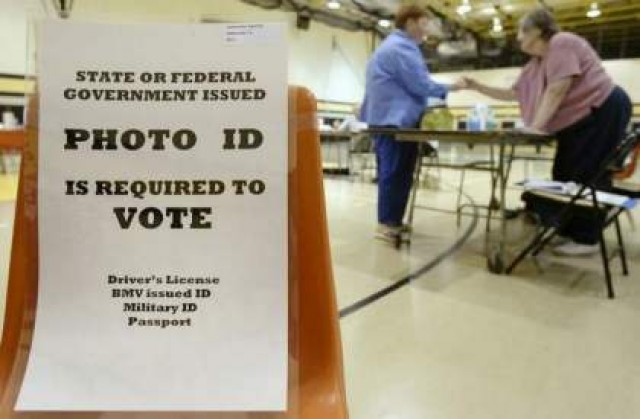
The US Dept. of Justice denied approval of South Carolina’s new voter ID law on Aug. 29, giving the state another 60 days to make its case. As required by the Civil Rights Act, DOJ has been reviewing the law to ensure that it does not abridge the rights of minority voters.

In its ruling, DOJ asked the state eight questions about procedures on obtaining photo voter registration cards, funding for voter education and poll worker training, and the process for casting provisional ballots when a voter has no photo ID.

The SC Progressive Network filed voter affidavits and comments with DOJ, highlighting the burdens posed on rural, poor and minority voters, and the likelihood of the law’s unequal enforcement.

DOJ raised many of the concerns the Network has about how the state will work around the burden posed by voters needing a birth certificate to get the required DMV ID card. The final version of the bill included a provision that a registered voter could obtain a photo voter registration card – pending funding – that would serve as acceptable ID without mandating a birth certificate. One camera for each county office has been funded for this purpose. The cards will be made in Columbia and mailed to voters.

In an Aug. 25 submission to DOJ, the state filed draft procedures for issuing photo voter registration cards. The plan entails issuing paper voter registration cards that a voter cannot vote with unless they have the DMV photo ID. If they don’t have the required photo ID, they must go to their county voter registration office and trade in their paper registration card for a “temporary voter registration card with a photo” that is good for 30 days. Permanent photo voter registration cards with photos will be printed by the state election office and mailed to voters.

Not only is the process burdensome to voters and election workers, it is inadequately funded. In June, $1.4 million was appropriated to cover everything from buying the cameras to mailing notices to the estimated 200,000 registered SC voters with no photo ID, to educating the public and poll workers on the new law.

As confusion and costs over the ID law mount, we should remember that no one has ever been caught impersonating another voter at the polls in SC, the sort of fraud this law was designed to prevent. Rather than protecting the sanctity of the vote, as proponents claim, the new requirement does nothing but make it harder to vote in South Carolina. For some voters, the burden will be too high.

While the state digs itself deeper into a hole of its own making, the Progressive Network will continue to educate voters and expand an organized coalition of citizens to fight this and other laws compromising voting rights in South Carolina.

Now’s your chance to weigh in with US Justice Dept. on SC’s new voter photo ID law

If you, or someone you know has a hard time getting a state issued photo ID, download a Dept. of Justice Comment Form. Fill it out online and print it out (this form can not be saved and must be printed). Sign it and follow the mailing instructions at the end of the form.

Anyone can comment directly to the Department of Justice through email to: vot1973c@usdoj.gov. Put in subject line: “2011-2495: Comment”. Or comments can be mailed to:
Chief, Voting Section, Civil Rights Division
Room 7254 – NWB, Department of Justice
950 Pennsylvania Ave., N.W., Washington, DC 20530
(Include the submission # 2011-2495 at the top of your letter.)
Or fax comments to the Dept. of Justice at 202-616-9514 with the same heading.

Got questions? Call the SC Progressive Network at 803-808-3384.

Latest news from Network’s photo ID campaign

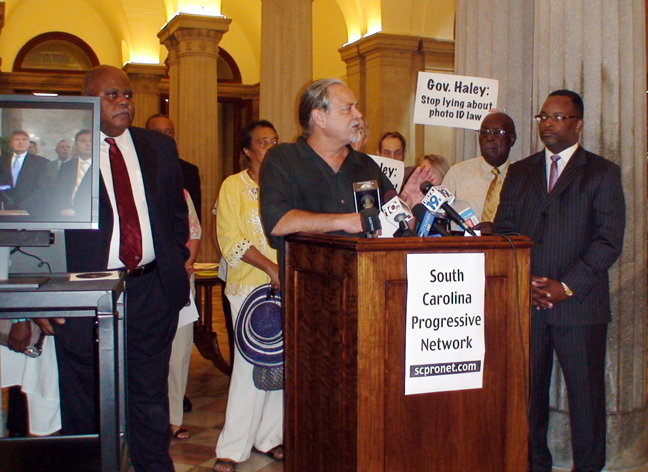
On July 8, the SC Progressive Network held a second press conference on the photo ID law to clear up misconceptions repeated by the governor and lawmakers, and to invite the public to submit comments to the US Dept. of Justice, which is reviewing the new law to consider whether it abridges the minority vote.

See more photos from the media event here.

Below is a sample of the media coverage the press conference generated.

Group seeks those impacted by new SC voter ID law

JIM DAVENPORT, Associated Press
July 8, 2011
South Carolina voting rights advocates said Friday they are looking for voters who might not be able to have their votes counted next year under one of the nation’s toughest voter identification laws. The South Carolina Progressive Network is trying to identify some of the nearly 180,000 people who are now registered to vote but who lack the state- or federal-issued photographic identification called for under the new law. Those people would be able to cast provisional ballots, but would have to show the required identification within three days to have their votes counted. Read more:

Critics challenge ‘Voter ID’ plan

By GINA SMITH
The State
When Delores Freelon was born in 1952, her mother could not decide on a name for her. So the space on the birth certificate for a first name was left blank. In the decades since, the incomplete birth certificate did not prevent Freelon from getting her driver’s license and voter registration card in the various states she has lived, including Texas and Louisiana.
But a measure — already passed by the General Assembly and signed by Gov. Nikki Haley — will create new hurdles for Freelon and others to vote. Read more:

Group aims to block voter ID law
Opponents push for rejection by U.S. Justice Dept.

BY YVONNE WENGER
The Post and Courier
COLUMBIA — The S.C. Progressive Network issued a warning Friday to the nearly 25,000 registered voters in the tri-county area without a state-issued photo ID: You could run into trouble the next time you go to the polls. The advocacy organization is urging the U.S. Department of Justice to reject a new South Carolina law that will require all voters to carry a picture ID to cast a ballot in future elections. The state’s Republican leadership pushed for the new law, citing a need to guard against voter fraud even though there has been no substantive proof of widespread voter fraud for years in the state. Read more:

Progressives Push to Stop Implementation of Voter ID Law

BY COREY HUTCHINS
Free Times
Five TV cameras, two reporters from The State, one from The Associated Press, a reporter from the Charleston Post & Courier and another from the South Carolina Radio Network, among others, swarmed around a podium in the lobby of the State House July 8, as South Carolina Progressive Network director Brett Bursey warned voters here that they might have trouble casting a ballot under a new state law. It comes during a time of a national pushback against such regulations.

Read more: