New photo ID law makes it harder to vote in South Carolina than anywhere in the country

By Becci Robbins
SC Progressive Network

You could forgive voters for being confused about South Carolina’s photo ID law. Debate on the bill went on so long their eyes glazed over years ago. It’s hard to be as charitable to Gov. Nikki Haley, who twists the truth every time she defends the law she helped push through.

The governor argues that if we need a photo ID to buy Sudafed or to board a plane, we should need one to vote. Sounds reasonable, but neither pharmacies nor airlines require a state-specific ID, as this law does. And to get a SC photo ID you need to produce a birth certificate. For some people, that’s a problem.

Finally, we are number one! Sadly, it’s in voter suppression.

These documents aren’t enough for Delores Freelon to vote.

The National Conference of State Legislatures has identified seven states as having the most restrictive photo ID requirements for voting: Georgia, Kansas, Texas, Indiana, Wisconsin, Tennessee and South Carolina. All require voters to show a photo ID, but states vary in what kind and how hard it is to get.

  • In Georgia, if voters are already registered, they automatically get a new photo ID voter registration card.
  • In Kansas, voters can use a driver’s license from out of state, any accredited college ID, or government-issued public assistance cards. Voters over 65 may show expired ID.
  • In Texas, you can get ID to vote with your concealed weapons permit, your boating license, insurance policy or beautician’s license. Or you can vote a provisional ballot if you will incur fees in order to vote. Voters over 70 are exempt.
  • In Indiana, those without a photo ID get their provisional vote counted by claiming the fees to get the required documents were a burden.
  • In Wisconsin, voters can use any state driver’s license, Social Security card or student ID.
  • In Tennessee, a driver’s license from any state allows you to vote.
  • In South Carolina, voters must produce a birth certificate to get the state-issued photo ID required to vote. No exceptions. (If you vote a provisional ballot, that won’t count unless you present your state-issued photo ID within three days.)

Numbers are hard to project, but it is clear that some of the nearly 200,000 registered South Carolina voters who don’t have their papers in order will not be able to vote in the next election.

Even though there are no cases of the kind of fraud this law is purported to prevent, our cash-strapped state will spend at least the $700,000 supporters say it will cost to implement. Opponents say it will cost two to three times that much to educate poll workers and the public about the new law. The governor has said you can’t put a price on the sanctity of the vote.

She should tell that to Delores Freelon, a Columbia resident and registered voter who won’t be able to vote in the next election because she has a Louisiana driver’s license and can’t get her birth certificate from California in time. What about the sanctity of her vote? What about Ms. Kennedy in Sumter, whose birth certificate lists her first name as Baby Girl, meaning she’ll have to go to court to get her papers straight in order to get a photo ID? Or Larrie Butler, who was born at home in Calhoun County in 1926 and is being told he needs records from an elementary school that no longer exists in order to establish a birth certificate?

Stories like these are coming in from around the state. The SC Progressive Network, which for 15 years has been advocating for voting rights, is fielding calls from people with questions about the new law or having problems meeting the ID requirements.

The lucky ones will still get to vote, but only after jumping through hoops and paying fees at various state agencies. Some will have to amend their birth certificates by going to court, at considerable cost. People without a car, a computer or short on money are simply out of luck. The disenfranchised will be primarily seniors and the poor. Many of them will be people of color who have voted all their lives.
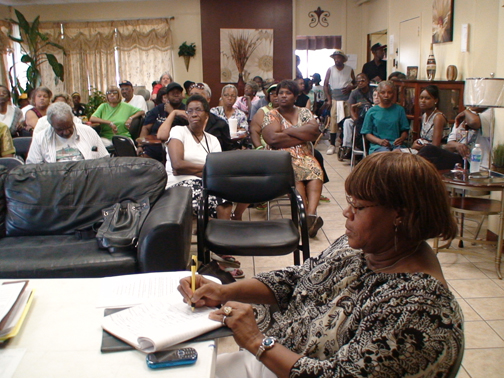
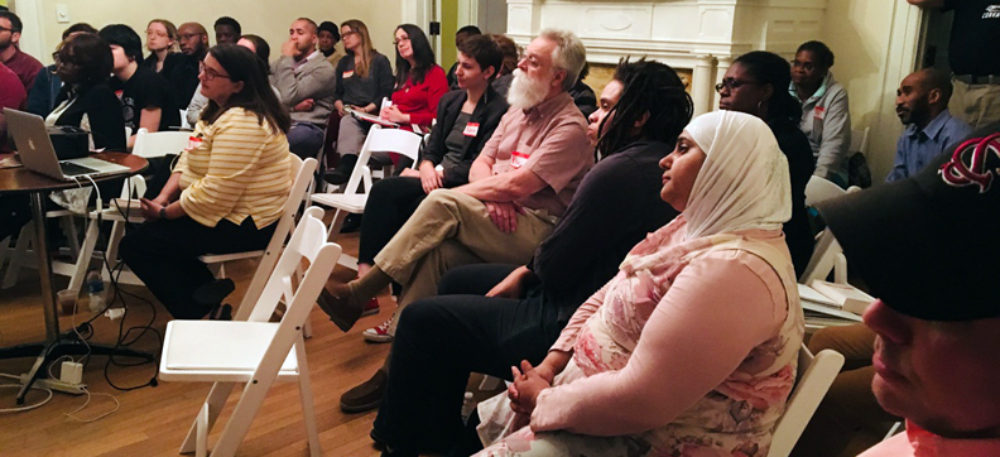
The Network is working to educate the public about the new law.

This quiet whittling away of the vote is no accident. It is, in fact, the point. It’s the pattern being repeated in GOP-controlled legislatures across the country.

In South Carolina, we have a brief chance to challenge this law. Because of our state’s history of disenfranchising people of color, ours is one of seven states that must get pre-clearance from the US Dept. of Justice (DOJ) before new voting laws can go into effect. Once the state attorney general files the case, DOJ has up to 60 days to consider whether the law suppresses the minority vote.

The SC Progressive Network is gathering statements to forward to DOJ documenting voters’ experiences. We need volunteers around the state to help find citizens who will have a hard time meeting the new voting requirements. If you want to help, call the Network at 803-808-3384 or see scpronet.com for details.

See video clips of Delores Freelon and Larrie Butler telling their stories.

As Senate takes up budget, town hall panel to debate role of special-interest tax breaks

Is South Carolina broke? That’s what the governor and a majority of the state legislature are saying. What if the state isn’t broke, but is leaving billions in revenue out of the budget because of special-interest tax breaks?

That’s the question to be debated at a town hall meeting April 27, 7pm, at the SC State Museum, 301 Gervais St. in Columbia. The forum is free and open to the public.

With the Senate set to begin debate on the budget April 26, it’s important that the public have a say in our funding priorities. The town hall was organized because the Senate is not allowing any opportunity for public comment during its deliberations.

The town hall will debate the argument that the state is broke, and will provide striking details about the $4 billion left out of the budget through special tax breaks.

Dr. Holley Ulbrich, Professor Emerita of Economics at Clemson University, will present the case that there is sufficient revenue to fund a moral budget that reflects our values as a society. “By any measure, our state and local tax system has failed to reflect our shared values of justice, of freedom, of compassion, and of opportunity,” Ulbrich said. “Instead, we have focused on tax cuts and failed to update our antiquated revenue system, standing idly by while our tax base continues to erode.”

Dr. Mike Fanning, who has been working with Chambers of Commerce across the state to promote comprehensive tax reform, will lay out the case to lower taxes and balance the budget. “How can a state claim to be broke?” Fanning asked. “Our legislators choose to collect taxes at twice the rate needed to run government while giving away billions in special interest exemptions.”

Network Director Brett Bursey said, “The Chambers of Commerce and the Progressive Network agree that tax breaks are leaving too much money on the table and that our political leadership refuses to acknowledge that the money exists. When the public understands we’re not broke and forces the politicians to reform the tax code, then we can have a productive fight over how to spend the money.”

The Chambers would use the revenue to reduce state taxes and balance the budget. The Network wants the money to enhance the budget and fund crumbling public services. The legislature and the governor are opposed to raising revenue, and see no alternative to cutting government programs.

After a panel discussion, the public will be invited to ask questions and make comments. This is a 90-minute opportunity for the public to understand that South Carolina is not broke, and that the real debate should be over what to do with the additional revenue.

A 2011 study by the Tax Foundation found that South Carolinians have the lowest state income tax burden in the nation and rank 43rd in combined state and local taxes.

The Organization of Economic Cooperation and Development, with 34 “first world” member nations, ranks the United States 33rd in collection of taxes, compared to the country’s wealth. Only Mexico ranked lower.

SC groups join forces to rally for a moral budget

By Becci Robbins
SC Progressive Network

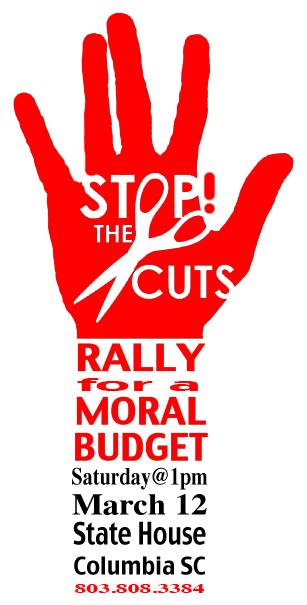
A growing number of churches, educators, health care providers, grassroots groups and professional organizations will rally in Columbia on Saturday, March 12, at 1pm at the State House to demand that lawmakers “Stop the cuts! Fund a moral budget.” The House begins debate on the budget March 15.

“Budgets are moral documents” said Rev. Brenda Kneece, Executive Minister of the SC Christian Action Council. “A civilized society chooses to do together what individuals or organizations cannot do alone: protect all and provide for the vulnerable.”

While the state’s political leadership says there is no alternative to further cuts to our bare-bones budget, they are ignoring the fact that more equitable cuts could be made through broad and fair reforms to our tax code.

According to the recent report by the Tax Realignment Commission (TRAC), created by the legislature to reform SC tax codes — a report that was quickly shelved — South Carolina imposes one of the country’s lowest individual income tax burdens. An estimated $3.7 billion was left out of the current budget due to sales and service tax exemptions alone.


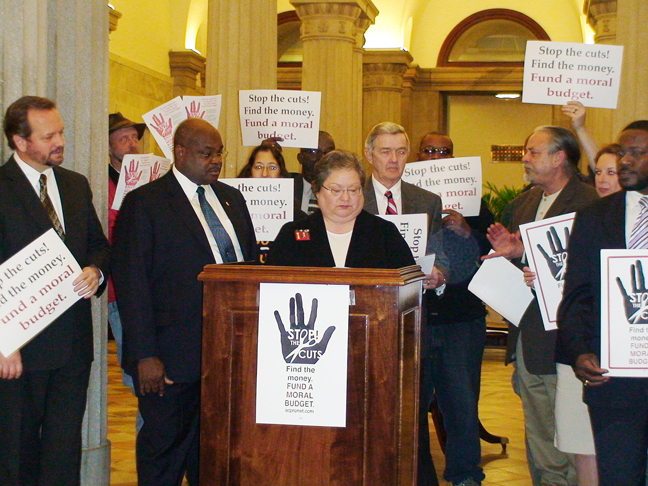
Rally sponsors hold press conference Feb. 24 in the SC State House.

“Taxes are low in South Carolina, and getting lower,” said Dr. Holley Ulbrich, Distinguished Professor Emerita of Economics at Clemson University and a Senior Scholar at the Strom Thurmond Institute. “South Carolina ranks 47th out of 51 states (including the District of Columbia) in taxes as a percent of income, and 51st in taxes per capita. The 2010 budget per person was at the 1984 level in constant dollars.”

“The problem isn’t money,” said Brett Bursey, Director of the SC Progressive Network. “The problem is a political ideology that’s both anti-government and anti-taxes. Exemptions, deductions and tax credits leave enough money out of the state budget to meet our needs, with some left over for improvements. We have to send a clear message to the legislature that the race to the bottom must end, and revenue must be raised to fund critical services.

“The money is there,” Bursey said. “The political will is not.”

“We are 1,000 percent behind this rally and are urging all state employees to be there,” said SC State Employee’s Association Interim Director Joe Benton. “Further budget cuts will result in more layoffs and furloughs that hurt not only state employees and their families, but the citizens they serve.”

Jackie Hicks, President of the South Carolina Education Association, South Carolina’s oldest and largest professional association of educators, is encouraging her members to rally to protect and defend public education. “For too long, we’ve allowed legislators to shirk their duty to provide adequate, equitable and stable funding for South Carolina’s public schools and the students they serve. Our current funding is totally inadequate for the educational services our students need.”

Rev. Kneece said, “As faithful citizens we are called to come together through budgets and the taxes that fund them to “Speak up for those who cannot speak for themselves, for the rights of all who are destitute. Speak up and judge fairly; defend the rights of the poor and needy (Proverbs 31:8-9, New International Version).”

Over the past two years, the state budget has been cut from $7.9 to $5 billion, making severe cuts to state services. Further cuts, being debated in the legislature, propose more reductions in health care services to nearly 900,000 Medicaid recipients, ending preventative care, AIDs drug programs, aid for needy children; more teacher’s jobs lost, larger classes, higher tuition; the end of SCETV and the Arts Commission – just to name a few of the casualties.

Life will be harder, with fewer opportunities, especially for the 25 percent of our children living in poverty.

Initial Sponsors: SC AFL-CIOSC Christian Action CouncilSC Education Association •  S.C. HIV/AIDS Care Crisis Task Force • SC NAACP •  SC Progressive NetworkSC State Employees AssociationTies That Bind

For more information, see scpronet.com, email network@scpronet.com or call 803-808-3384.

The budget is a moral document

Dr. Holley Ulbrich
Senior Scholar, Strom Thurmond Institute

A budget is a moral document. It expresses our values and our priorities as South Carolinians. It reminds us that each of us, four million plus South Carolinians, has needs to be met and gifts to offer the world.

One of our most deeply held American values is justice. We try to do that work of justice and compassion as individuals and through congregations and other private organizations. But the task is enormous. These scattered and individual efforts are not enough. Fifteen percent of South Carolinians lives in poverty—the 9th highest rate in the country.

Our underfunded schools are failing to develop our children’s talents and prepare them to become self-supporting, contributing members of society. We are not taking on those reciprocal responsibilities to one another as fellow citizens of South Carolina. The budget is an expression of our obligations to one another, and at present our budget demonstrates a lack of commitment, a failure to pay more than lip service to our shared values.

To treat everyone justly and fairly, we need to provide them with both freedom and opportunity. Freedom is not just freedom to, it is also freedom from. The four freedoms—freedom of speech and religion, freedom from want and fear—are all essential to human flourishing. Our children will not have that freedom and opportunity without providing them an adequate education for a demanding 21st century economy.

Those who cannot earn enough on their own—the disabled, the sick, the elderly, the children in single-parent homes where working mothers can’t earn enough to meet their needs—do not have freedom from want and fear, or opportunity to escape from poverty. Prisoners who are overcrowded and lack access to exercise and education have little or no opportunity to re-enter society as productive human beings leading meaningful lives.

The failure to maintain the state’s infrastructure, especially transportation infrastructure, will make it increasingly difficult to attract and retain business firms to provide employment opportunities for our workers, who still suffer from one of the highest unemployment rates in the nation.

Yet our state General Fund spending per person, adjusted for inflation, is lower than it was 10 years ago-$1,156,compared to $1,229 in the 1999-2000 budget. The 2010 budget per person was at the 1984 level in constant dollars. We are asking our teachers, our prisons, our colleges and universities, our health services and public safety officers to do more with less, and do it with 21st century technology.

Is there another way? Yes.

The budget is a moral document not only on the spending side, which displays our priorities for all to see, but also on the revenue side. How much are we able and willing to contribute to meeting the needs of our fellow citizens? By any measure, our state and local tax system has failed to reflect our shared values of justice, of freedom, of compassion, and of opportunity. Instead, we have focused on tax cuts and failed to update our antiquated revenue system, standing idly by while our tax base continues to erode.

Taxes are low in South Carolina, and getting lower. South Carolina ranks 47th out of 51 states (including the District of Columbia) in taxes as a percent of income and 51st in taxes per capita. Yet low taxes have not succeeded in the supposed goal of attracting and retaining industry, because business firms care about more than taxes. Business location studies show that firms care about an educated work force, an adequate transportation system, a consumer market that can afford to buy their products and services, and quality of life for the firm’s employees.

South Carolina’s sales tax system is eroding rapidly. One factor in that erosion is tax cuts over the last 10 years. Changes in the income tax that allow unincorporated business to file at the same 5% rate as corporations and eliminate the bottom bracket (which affects all taxpayers) on the individual income tax have cost the state more than $200 million a year. State-funded property tax relief has been a major drain on the state’s revenue.

The homestead exemption for the elderly and the original relief on the first $100,000 of owner-occupied property takes is one drain on state revenue. The shortfall in revenue from the extra penny of sales tax to fund additional relief to homeowners under Act 388 is a second source of drain on the General Fund- $124 million in the current fiscal year. Together, these three state-funded sources of property tax relief are reducing revenue available for public services by about $546 million a year. Added to the two income tax changes, these tax breaks just about cover the shortfall in the current budget.

In addition to the legislative changes above, there are some problems with the revenue system that slow the growth of revenue so that it cannot keep pace with growth of population and inflation. Growth of sales tax revenue lags behind growth of personal income, in part because South Carolina has failed to follow the lead of other states in responding to the change in how households spend their money. In 1970, 45% of consumer spending was for tangible goods, which is the base of our sales tax. Today that share has fallen to 30%.

The average state taxes 57 kinds of services; South Carolina taxes only 36. The sales tax base needs to be updated to reflect the change in how we spend our money, as the Tax Realignment Commission has recommended.

We also need to address updating our excise taxes and revenue losses from such tax breaks as the sales tax cap on cars, boats, motorcycles and airplanes.

The income tax also has some structural problems. Only about 40% of South Carolinians pay any income tax. Some of us are too poor to pay income tax, but some are too old. South Carolina has the most senior-citizen-friendly income tax in the nation, according to a Georgia State study a few years ago. A family of two adults over age 65 that can take advantage of pension provisions, Social Security and the age-related deduction could have an income of more than $60,000 a year before having to pay any income tax. There are also some 53 credits available to reduce one’s income tax liability.

Unlike spending, tax breaks never come up for a scheduled annual review. They just continue from year to year, eroding the revenue base that needs to be shored up in order to continue to fund essential public services. The covenant that South Carolinians have with each other includes not only the services that we wish to ensure for all citizens but also the commitment to pay for them. Our legislators need to look closely every year at tax provisions that may have made sense 10 or 20 years ago but are never subject to review and reconsideration.

This document prepared in collaboration with Dr. Holley Ulbrich, Senior Scholar, Strom Thurmond Institute; Alumni Distinguished Professor Emerita of Economics, Clemson University

Help us now to protect your vote in November!

SC Progressive Network Director Brett Bursey filed a complaint in federal court on June 17 to require the state to preserve voting records in federal elections. Since then, the Network has worked to arrange an audit of the entire June 8 South Carolina primary vote.

As you know, the results of two federal elections — US Senate and Congressional District 1 — were, in the words of numerous well-credentialed experts, “anomalous.”

The Verified Voting Foundation released a statement on the South Carolina primary results that concluded, “Whether specific reports of irregularities in this election are confirmed, the most important fact about South Carolina’s voting system is that most ballots cannot be effectively audited or recounted. Serious concerns about the integrity of the primary (and of other elections conducted using the same technology) are inevitable, and legitimate.” For the full statement go to Verified Voting.org.

Since a “recount” of the voting machine tallies we use in South Carolina can only produce the same number, over and over, an audit of the internal memories on the machines is the only way to discover anomalies — and even this won’t reveal the intent of the voter beyond what is recorded by the software.

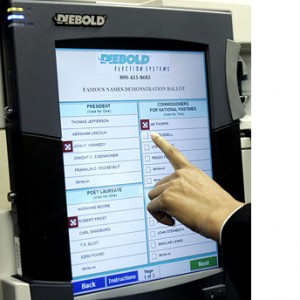
South Carolina is one of only eight states that uses paper-less, touch-screen devices that are not routinely audited. Thirty-four states now require a “voter verified paper ballot” that can be referred to in the event of a recount or audit.

“We are not questioning the results of the June 8 primary,” said Bursey. “We are questioning whether the machines we use can be audited to insure that the results reflect the voters’ true choices, and if the preserved records satisfy federal requirements.”

Yesterday, we gave up on trying to get the SC Election Commission to agree to a third-party audit of the entire system. The executive director of the SCEC, as well as the board chair, both had roles in the purchase of these machines in 2004. They maintain that the system works fine and no audit is necessary.

We are now focusing on the federal complaint we have filed that questions whether the intent of the federal records preservation statute can be met using the counties’ current systems and software. Our lawsuit is the only thing standing between us and another election in November with unverifiable results.

We have filed a request for all the compact discs that each county was supposed to have used to record the flash memory of each voting machine.

The state Election Commission does not know if all counties followed this procedure, or whether this procedure adequately preserved the records, or whether what is preserved is sufficient to reliably determine the voters’ intent. The state Election Commission is arguing that it is not its job to keep these records, nor to gather them for us.

We need immediate financial help to make our case. We need to raise $3,000 to cover filing fees and expert assistance. If you can help, please do.

We hope that this case, and the growing public awareness of the inherent shortcomings of our voting system, will lead to a voter-verifiable, recountable, paper record of the most critical part of our democracy — our vote.

Please make a secure donation now and indicate in the gift information “verified voting.”

Thank you for your support.

SC Progressive Network scrambles to preserve voting machine records

If the 46 county election offices are not stopped, within days they will erase the most critical data from the memories of all the voting machines, warns SC Progressive Network Director Brett Bursey. With controversy over the reliability of the touch-screen computers heating up, the Network is working to ensure that valuable information is not lost as counties prepare the machines for the upcoming run-off elections.

Bursey explained that the state Election Commission only keeps a summary of the information from the counties, and that only by preserving or copying the flash cards (memory chips) inside the computer will there be enough information to perform an audit.

“There is no way the machines you have in South Carolina can be audited without all the information on the computer flash card in each machine,” Dr. Douglas Jones said. Jones has taught at the University of Iowa Department of Computer Science since 1980, served on the Iowa Board of Examiners for Voting Machines and Electronic Voting Systems from 1994 to 2004, and chaired the board for three terms.

Jones, who serves on the Federal Election Assistance Commission’s Technical Guidelines Development Committee, has performed numerous audits on voting machines like those used in South Carolina. He provided the Network with an affidavit outlining the necessary steps to preserve data for an audit.

“We have been in communication with the US Justice Department’s Voting Rights Section,” Bursey said. “We are arguing that erasing the data violates the federal statute (USC 42-1974) that requires all records in a federal election to be preserved for 22 months.”

Bursey said that if the Justice Department doesn’t intervene, they will try to get a federal judge to order a halt to erasing the records. “We are not questioning candidates, motives or conspiracy theories,” Bursey said. “We simply want a trustworthy audit to assure that all votes are counted accurately.”

“It’s not difficult or expensive to copy the flash card,” Dr. Jones said. “You can hook up a flash card reader that you use to download pictures on your computer from a digital camera and save the data to a CD.” Replacing the flash card would cost a few dollars for each machine.

The flash card records all actions taken on the machine, the time of the vote or any errors in an “events log.” The “ballot image log” records the actual ballot cast. The detailed information on the flash cards is not saved by the state or counties and is routinely erased to prepare the machines for the next election.

Even as the calls increase for investigations into several races, counties will erase the data and install the ballot program for the June 22 runoff. “In a matter of days, there won’t be any way to determine whether the machines played a role in the unusual vote counts,” Bursey said. “We simply want a trustworthy audit to assure that all votes are counted accurately.”

Sen. Phil Leventis (D-Sumter) has sponsored legislation to require voting machines to produce a voter-verifiable paper record that can be used to recount or audit an election.

“With these machines not only is there no paper trail to examine, if the records are erased it’s like cremating the body before the autopsy is performed,” he said.

The Network presented expert testimony at a SC Election Commission Board meeting in  2004, urging the agency not to buy the iVotronic computers that do not have a voter verified paper record. SC is one of four states that has neither a paper record nor a regular audit of its machines.

SC Progressive Network’s racial profiling study reveals SC traffic cops breaking the law

The SC Progressive Network has released a study — based on a review of racial disparities in arrest rates and a new law requiring cops to report the race of those stopped for traffic warnings — that reveals most police agencies in the state are breaking the law by not reporting. The most recent report on the Department of Public Safety’s web site reveals that 189 of the state’s police agencies are not in compliance.

The Network is circulating this study to stimulate public dialogue about racial profiling and to encourage police agencies to advocate for a database that records all stops and allows for increased transparency.

Download the study here.

Does SC have a racial profiling problem?

Legislature urged to make law agencies process data to see how prevalent it is

By John Monk

The State

The General Assembly needs to order all law enforcement agencies to process the racial data they collect on their traffic tickets to provide a snapshot of whether there is evidence of racial profiling.

That’s the conclusion of a 26-page report on racial profiling in state traffic stops just released by the S.C. Progressive Network. (You can download the study here.)

The state Highway Patrol analyzes the race of drivers given warning tickets by troopers because of a 2005 law. But it doesn’t analyze the race of those given actual citations for such offenses as driving under the influence of alcohol, speeding or breaking the state’s seat belt laws.

Other law enforcement agencies collect similar racial data on tickets of their own volition, but also don’t analyze it.

All of that needs to change, according to Brett Bursey, director of the S.C. Progressive Network.

“After all, the race of over 2 million drivers a year is already recorded on all traffic tickets, but that data is not put in a form so it may be examined for patterns,” Bursey said.

Racial profiling is a term that refers to the improper targeting of a motorist because of his or her race, not because of a driving issue.

Bursey said that since the General Assembly is required this session to review a 2005 state law that mandated that warning ticket data be analyzed, now is the time for that issue to be studied anew.

The 2005 law requires the Senate Transportation Committee and the House Education and Public Works Committee to make recommendations on how that law can be improved – if any are deemed necessary.

Rep. Joe Neal, D-Richland, a longtime supporter of better racial traffic stop data, agreed with Bursey.

“This goes to public confidence in laws and justice. To ensure our system is truly color blind, we need to understand what actually is happening when tickets are given,” Neal said.

Analyzing existing racial traffic stop data apparently would not be difficult or cost much money, law enforcement officials indicated.

Neal and Bursey say the state already collects and analyzes racial data in two law enforcement areas: prison populations and suspects arrested for serious crimes like murder.

And one major agency – the Richland County Sheriff’s Department – has been collecting and analyzing racial data on its 20,000-plus annual traffic stops for 10 years.

“It’s fast and it doesn’t cost anything,” said Sheriff Leon Lott.

Lott’s data gives an overall picture of how the race and ethnicity of stopped motorists compares with county racial demographics. The individual traffic stop records of each of Lott’s 500 deputies can be easily examined for possible profiling, he said.

Three years ago, Lott said, his data helped prove a deputy was targeting blacks and Hispanics. The officer was arrested and fired.

Statistics alone aren’t proof of racial profiling, Lott said. Further investigation is needed to establish the complete situation, he said.

“The statistic is the baseline to start looking,” he said.

A spokeswoman for the S.C. Department of Motor Vehicles, which handled 1.9 million adjudicated traffic tickets last fiscal year, said it wouldn’t be difficult to write a software program to extract an overall racial picture of citations in which people have been found guilty of violations.

DMV official Beth Parks estimated it would take about two hours and cost at least $200 to arrive at a computer-generated racial profile of last year’s citations to which people were found guilty. She did not have an estimate of what percentage of the 1.9 million citations itwould be.

Last year, as the 2005 law required, the DPS analyzed – and made public – overall race data on 377,676 warning tickets the Highway Patrol issued.

But those warning tickets are only 41 percent of 904,348 tickets it issued last year for seat belt, DUI and other violations.

Last week, DPS director Mark Keel, at The State’s request, examined how his agency handles racial data in the 59 percent of actual citations.

“We have learned we do have the ability to do things with this data that we have not fully explored and fully utilized,” Keel said.

For example, said Keel, DPS can access each trooper’s record of the race of the people who get citations. Racial breakdowns of all citations in individual counties also are available, Keel said.

In the past, such matters as reducing the highway death rate and dealing with budget concerns, have taken much of his attention, Keel said.

But DPS already is having conversations about how to make better use of the data, including possibly making some of the overall patterns publicly available, Keel said.

Keel also said troopers’ supervisors already monitor their officers’ performance, and any racial profiling should be detected now, from an examination of troopers’ tickets issued as well as video made at traffic stops. Before Keel assumed his job in 2008, a few of those videos made the news because they showed troopers mistreating motorists, some of them black.

An official at the Denver-based National Conference of State Legislatures, which tracks state laws, said a “fair number” of states track and process racial profiling data for traffic stops. She did not have specific numbers.

Lott said he has had good results gathering such data.

“It’s another tool,” Lott said. “You do it because it’s the right thing to do.”

Bursey said he hopes law enforcement will take the lead on creating a transparent database. “Good cops don’t mind sharing this data with the public.”

(The Progressive Network’s report can be viewed at www.scpronet.com.)

LGBT groups spearhead Charleston anti-discrimination victory

Because of the collaborative effort among LGBT groups — including SC Progressive Network member organizations AFFA and SC Equality — the city of Charleston now has proactive legislation protecting LGBT people in both housing and public accommodations.

Last week, the Charleston City Council passed ordinances expanding the city’s existing policy prohibiting discrimination in housing to include age, sexual orientation and gender identity The council also passed a public accommodations ordinance prohibiting discrimination on the basis of race, color, religion, sex, age, disability, familial status, national origin, sexual orientation or gender identity.

The ordinances were presented to the mayor’s office in August by AFFA, SC Stonewall Democrats, SC Log Cabin Republicans, American Civil Liberties Union and South Carolina Equality–who paved the way by successfully introducing similar ordinaces in Columbia, SC, last year.

Charleston is the second municipality in the state to pass comprehensive human rights ordinances in housing and public accommodations that include sexual orientation and gender identity. Council Member Gary White said, “It’s a step forward in the right direction in making sure that we are not discriminating against anyone.”

Read the ordinances here.